



CNC EDM vs ECM vs Laser for Medical-Device Precision Holes
Direct answer: For medical-device precision holes, a CNC EDM drilling machine suits deep holes in conductive materials but requires control of recast and electrode wear. ECM avoids a conventional heat-affected zone and favors stable production, but passivation, stray corrosion, and electrolyte residues must be validated. Laser drilling favors thin, multi-hole parts and short cycles; pulse width, focus, and heat accumulation determine hole quality. Compare material, aspect ratio, surface integrity, and annual cost per finally accepted hole.
Why is minimum hole diameter not enough for medical-device machining?
Minimum hole diameter alone is not a valid selection criterion. It is normally a machine limit under one material and single-hole test condition, not proof of repeatable hole geometry, surface integrity, or final-release capability.
Medical-device manufacturers face three linked problems. First, the “minimum hole” in a brochure is usually a single-hole limit. It does not establish process capability for a specified alloy, wall thickness, or continuous batch; diameter drift, taper, and exit morphology can change flow or fixation performance. Second, EDM and longer-pulse lasers can create recast, microcracks, or a heat-affected zone, while ECM can avoid thermal damage but introduce stray corrosion and electrolyte-control burdens. Third, a machine quotation excludes electrodes, optics, electrolyte, waste treatment, inspection, cleaning, validation, and scrap. The fastest gross cycle is therefore not necessarily the lowest cost per accepted hole.
FDA's public biocompatibility information states that risk assessment should consider material-processing methods and manufacturing-aid residues. Manufacturers of finished medical devices for the US market must also establish applicable process, record, and change controls under the Quality Management System Regulation, which became effective on 2026-02-02.
How do CNC EDM, ECM, and laser drilling differ in accuracy and heat effects?
The table deliberately avoids a false, universal “hole-diameter range.” Laboratory limits, experimental machines, commercial platforms, and different process architectures are not equivalent datasets. Every production claim must be tied to the actual material, wall thickness, hole depth, incidence angle, measurement method, and post-cleaning condition.
| Comparison | CNC EDM drilling | Electrochemical machining (ECM) | Laser drilling |
| Removal mechanism | Pulsed electrical-discharge thermal erosion across an electrode gap | Anodic dissolution of the workpiece | Melting, vaporization, or ultrafast ablation by optical energy |
| Material boundary | Conductive materials only; hardness is usually not the primary limit | Conductive materials only; alloy passivation affects removal | Metals, polymers, and ceramics, subject to absorption and thermal response |
| Published capability examples, not a universal range | Machine specifications often state electrode diameter, not finished-hole diameter. Finished size also includes discharge gap, overcut, and electrode runout. | One Ti-6Al-4V study produced φ2.52–2.57 mm holes under a defined electrolyte and pulse window; the result is not a universal ECM range. | A published study drilled φ0.8 mm holes through 1 mm Ti-6Al-4V. Other sizes require validation against wavelength, pulse duration, spot size, thickness, and toolpath. |
| Aspect-ratio behavior | Strong for deep microholes; limited by electrode stiffness, flushing, and wear | Limited by electrolyte renewal, gap control, and stray dissolution | Fast in thin material; deep holes can develop taper, shielding, and redeposition unless trepanned or processed with multi-axis paths |
| Thermal effects | Recast, microcracks, and electrode-material transfer are possible | No conventional HAZ or recast layer | Nanosecond and millisecond lasers can create HAZ, recast, and spatter; picosecond and femtosecond pulses reduce but do not automatically eliminate them |
| Tool degradation | Electrode length and radius wear require compensation | No conventional contact-tool wear, but insulation and gap tooling remain critical | No cutting-tool wear; focus optics, protective windows, and beam delivery require maintenance |
| Burr and edge condition | No mechanical burr, but resolidified droplets or exit damage can occur | Normally burr-free; overcut and stray corrosion can occur | Spatter, melt deposits, and recast projections can appear at the exit |
| Principal control variables | Current A, open voltage V, pulse duration μs, spindle speed rpm, dielectric pressure MPa | Voltage V, current density A/cm², frequency Hz, duty factor %, electrolyte concentration wt% | Average power W, pulse energy μJ/mJ, pulse duration fs/ps/ns, frequency kHz/MHz, focus position mm |
| Automation priorities | Electrode and guide change, breakthrough detection, wear compensation, dielectric condition | Electrolyte temperature/conductivity, gap servo, fixture sealing, waste and ion control | Vision alignment, focus tracking, scan path, assist gas, optical-contamination monitoring |
| Critical inspection | Diameter, taper, roundness, recast, microcracks, EDS, residues | Diameter, overcut, roundness, stray corrosion, surface chemistry, electrolyte residues | Diameter, taper, HAZ, recast, spatter, microcracks, surface-chemistry changes |
| Cost structure | Medium-to-high capital plus electrodes, dielectric, filtration, and longer deep-hole cycles | Dedicated equipment/fixtures plus electrolyte and treatment; tool cost can be low at stable volume | Nanosecond platforms can deliver high throughput; ultrashort-pulse capital and optical-maintenance costs are higher |
Which medical-device precision holes favor CNC EDM?
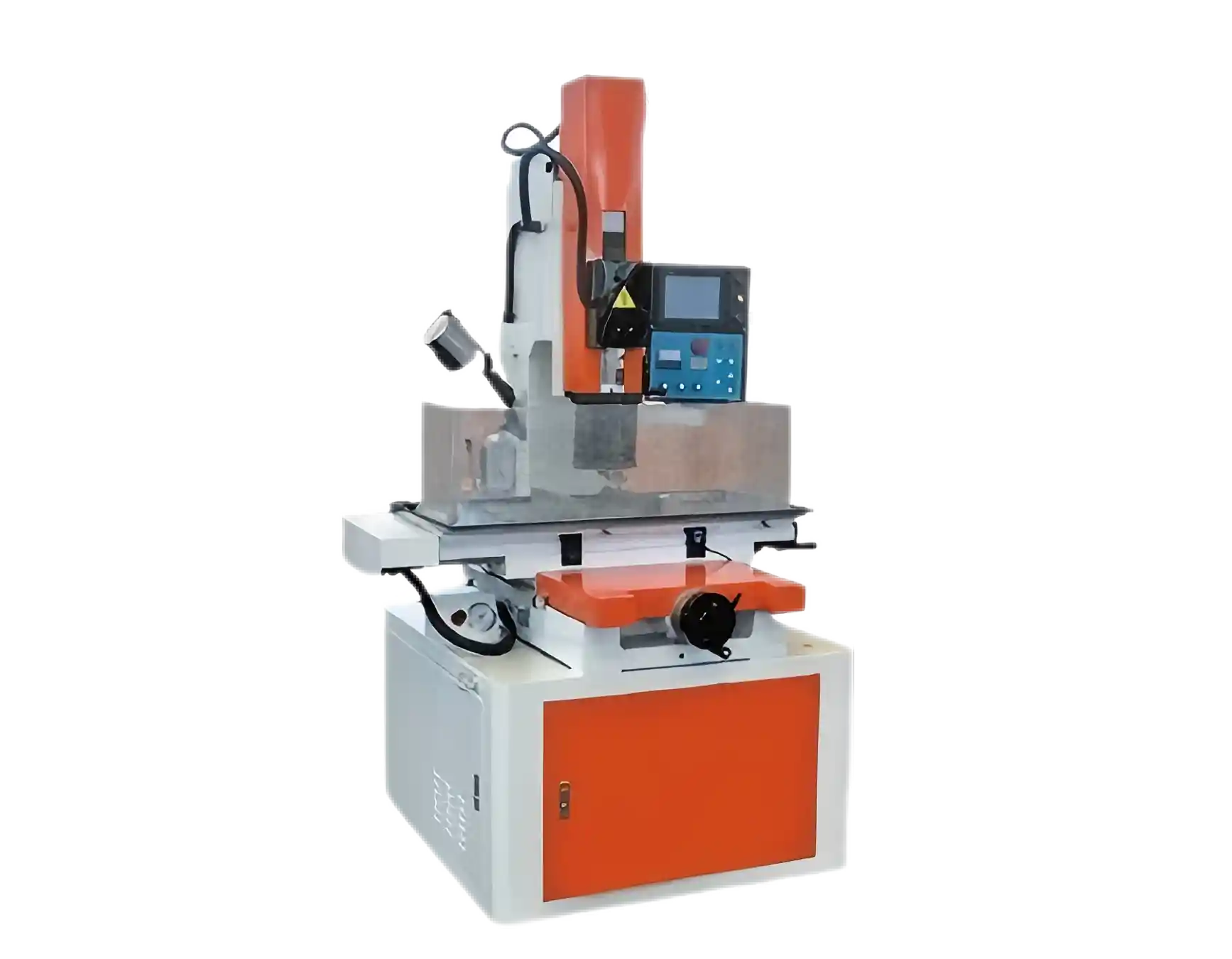
CNC EDM can machine Ti-6Al-4V, 316L, cobalt-chromium, and other conductive difficult-to-cut materials without mechanical hardness being the main constraint. Rotating tube electrodes provide internal flushing for deep holes, and multi-axis platforms can position inclined holes on curved surfaces. General small-hole EDM and dedicated micro-EDM must be evaluated separately. A finished-hole claim should always state electrode diameter, discharge gap, entrance and exit diameters, overcut, and measurement method.
The tradeoff is electrode wear and thermally eroded surfaces. A Ti-6Al-4V microhole study used 3.33–4.65 A, 550–1000 μs pulse duration, 100 V open voltage, and 300 rpm tool speed while treating radial overcut, cylindricity, and recast thickness as response variables. Procurement testing should therefore include metallographic or SEM inspection and, where electrode transfer is a risk, suitable surface-composition analysis.
Which medical-device precision holes favor ECM?
ECM removes metal through anodic dissolution. It does not create a conventional HAZ, recast layer, or mechanical burr, and it has no conventional contact-tool wear. It suits geometrically stable, high-volume hole arrays where the project can amortize dedicated tooling, sealed fixtures, and electrolyte-control development.
ECM is not a damage-free universal process. Titanium forms a passive oxide film, so electrolyte chemistry, transpassive potential, and pulse parameters matter. In one Ti-6Al-4V TMECM experiment, 10 wt% NaNO₃, 35 V, 400 Hz, and 20% duty factor produced φ2.52–2.57 mm holes with maximum roundness of 9 μm. That result is specific to the study and is not a general ECM guarantee.
Which medical-device precision holes favor laser drilling?
Laser drilling uses no electrode or electrolyte and integrates readily with scan heads, vision, and multi-axis stages. It is often favored for thin, high-hole-count parts, frequent product changeover, and cycle-time priority. Nanosecond or millisecond systems can cover conventional microholes economically, but melt-dominated removal can create HAZ, recast, and spatter. Picosecond or femtosecond pulses reduce thermal diffusion and support tighter edge requirements, with higher capital cost and potentially longer scan paths.
A 316L orthopedic-implant laser-microdrilling study treated HAZ, recast thickness, circularity, and taper as simultaneous responses and reported improved surface quality with argon assist gas. An ultrashort-pulse study drilled φ0.8 mm holes in 1 mm Ti-6Al-4V and compared three-dimensional paths, showing that contour, raster, and other strategies can be as important as the laser source.
Which published data verify precision-hole quality?
What dimensional and surface risks do EDM studies verify?
A Ti-6Al-4V microhole experiment measured material-removal rate, linear tool wear, radial overcut, cylindricity, and recast thickness rather than reporting diameter alone. Procurement acceptance should follow the same logic: record maximum recast by SEM/metallographic cross-section, measure entrance and exit geometry, and validate compensation across cumulative hole count.
How do ECM studies demonstrate the importance of electrolyte parameters?
A Ti-6Al-4V TMECM experiment used 10 wt% NaNO₃, 35 V, 400 Hz, and 20% duty factor to produce φ2.52–2.57 mm hole arrays with maximum roundness of 9 μm.The result demonstrates why material, electrolyte, pulse window, and gap design must be validated together rather than transferred between applications.
Why must ultrashort-pulse laser drilling still be checked for heat accumulation?
Ultrashort-pulse processing can reduce heat diffusion, but repetition rate, pulse overlap, focus, assist gas, and scan path still affect surface integrity.An acceptance specification must therefore state pulse duration, repetition rate, focus position, scan strategy, and assist-gas condition rather than merely saying “femtosecond laser.”
How should annual cost per accepted EDM, ECM, or laser-drilled hole be calculated?
No verified customer case was provided, so this article does not invent an “X% efficiency gain” or “Y% 12-month saving.” Compare the three processes inside one financial boundary:
Annual cost per finally accepted hole = (annualized equipment + process development and validation + labor + electrodes/optics/electrolyte + utilities + EHS infrastructure + maintenance + inspection + cleaning + scrap/rework) ÷ annual finally accepted holes
Annualized equipment cost should include purchase, installation, financing or cost of capital, expected life, and residual value. Do not use brochure cycle time directly:
Annual finally accepted holes = planned hours × theoretical holes/hour × availability × performance × machining first-pass yield × downstream release yield
Downstream release yield should include only cleaning, surface-treatment, residue, and final-function losses that are not already counted in machining first-pass yield. If the company uses standard OEE, remember that OEE = availability × performance × quality; do not multiply by the same first-pass yield a second time.
| Annual cost element | CNC EDM | ECM | Laser |
| Annualized equipment | Medium-high; five-axis stages and micro-energy supplies increase investment | Dedicated machines and fixtures dominate | Nanosecond systems are medium-high; picosecond/femtosecond systems are normally higher |
| Process development and validation | Electrode, dielectric, compensation, IQ/OQ/PQ, and cross-section inspection | Electrolyte, gap, insulation, fixture development, and IQ/OQ/PQ | Source, focus, path, gas window, laser safety, and IQ/OQ/PQ |
| Main consumables | Tube/rod electrodes, guides, dielectric, filters | Electrolyte, filtration/ion control, fixture seals, waste treatment | Protective windows, focus optics, assist gas, fume filters |
| Utilities and EHS | Temperature control, filtration, fire protection, medium handling | Waste liquid, ventilation, corrosion protection, chemical management | Laser guarding, fume extraction, assist gas, cooling, optical cleanliness |
| Main cycle losses | Electrode change, short-circuit recovery, deep-hole flushing | Gap instability, electrolyte service, fixture cleaning | Scan path, focus finding, optical contamination |
| Main scrap drivers | Diameter drift, taper, recast, microcracks | Overcut, stray corrosion, residues, surface-chemistry change | HAZ, spatter, recast, taper, exit quality |
| Scenarios with likely cost advantage | Deep holes, hard conductive materials, medium-volume changeover | Stable high volume, surface-integrity priority, amortizable tooling | Thin, high-hole-count parts, high throughput, broader material set |
For a 12-month comparison, run at least four sensitivities: availability down 10%; machining first-pass yield down 5%; downstream release yield down 2%; and consumable/inspection cost up 20%. A process that is cheapest only when it never stops and produces zero rejects is not a credible procurement choice.
Which process fits each medical-device precision-hole application?
| Workpiece application | First process to evaluate | Why | Boundary that must be validated |
| 316L minimally invasive thin-wall tube side ports | Ultrashort-pulse laser or micro-EDM | Laser offers cycle rate; EDM is less sensitive to hardness and depth | HAZ/recast, internal spatter, exit condition, cleaning residue |
| Ti-6Al-4V implant deep microholes | Micro-EDM or developed ECM | EDM supports depth; ECM avoids thermal effects | EDM recast/material transfer; ECM passivation, stray corrosion, electrolyte residue |
| Surgical-instrument irrigation or flow holes | CNC EDM | Broad tube-electrode coverage and flexible changeover | Internal debris, flow continuity, recast, dielectric cleaning |
| Metal metering or spray orifices | ECM or picosecond/femtosecond laser | ECM is burr-free; ultrashort-pulse laser controls geometry | Flow consistency, overcut/heat accumulation, surface chemistry |
| High-volume metal filter-plate arrays | Laser or dedicated ECM | Laser scanning is fast; ECM has no conventional tool wear | Hole-to-hole consistency, optical drift/electrolyte state, final cleanliness |
| Nonconductive ceramic or polymer microholes | Laser | EDM and ECM require conductivity | Carbonization, melted edge, particles, biocompatibility change |
The conclusion must remain application-specific. Evaluate CNC EDM first when high aspect ratio and conductive difficult-to-cut materials dominate. Evaluate ECM when no conventional thermal layer and stable high volume dominate. Evaluate laser when thin multi-hole parts, broader materials, and throughput dominate. For implant or patient-contact functional surfaces, every process still requires final-surface, cleanliness, and biocompatibility risk assessment under ISO 14971. Metallic surgical-implant surface preparation may also reference applicable ASTM F86-21(2026) and product-specific requirements.
Medical-device precision-hole FAQ
Q: Which is more accurate, CNC EDM or laser drilling?
A: Accuracy cannot be ranked without material, diameter, aspect ratio, and laser pulse duration. EDM geometry depends on discharge gap, electrode runout, and wear; laser geometry depends on spot size, focus, scan path, and heat accumulation. Require both suppliers to process a continuous batch from the same material and compare entrance/exit diameter, roundness, taper, position, and process capability.
Q: Does ECM really produce no heat-affected zone?
A: ECM removes material primarily by anodic dissolution, so it does not create the HAZ or recast layer associated with EDM or thermal laser processing. It can still cause overcut, stray corrosion, pitting, surface-chemistry change, and electrolyte residues. Titanium passivation can also make dissolution nonuniform. Acceptance must shift from “thermal damage” to electrochemical surface condition and cleanliness.
Q: Does femtosecond laser drilling still require post-processing?
A: Sometimes. Femtosecond pulses normally reduce thermal diffusion, but high repetition rate, pulse overlap, focus error, and poor debris evacuation can still create heat accumulation, redeposition, or edge defects. Cleaning, spatter removal, passivation, or other surface treatment must be decided from final-product inspection.
Q: How should EDM, ECM, and laser samples be tested on one basis?
A: Use the same material lot, hole pattern, and measurement method. Cover the smallest and largest diameters, maximum aspect ratio, and worst incidence angle. Record cycle time, consumables, and alarms. After final cleaning, measure diameter, roundness, taper, Ra, recast or stray corrosion, particle/chemical residues, and functional flow. Critical gauges require MSA or gauge R&R.
Q: What should a buyer ask a medical precision-hole equipment supplier?
A: Ask for continuous-batch data on the specified material and geometry; methods for surface-integrity and residue testing; consumable, maintenance, waste-liquid, and fume-control costs; recipe access, audit trail, and change control; and responsibility for IQ/OQ/PQ, calibration, and the final sample report. An unsupported “medical grade” claim should not receive procurement credit.

 Email
 sales1: +86 15312799623