



Purchasing Guide: Key Points to Consider When Buying a Vertical Milling Machine
Vertical milling machines are core equipment in machining shops, subcontracting workshops, prototyping facilities, and manufacturing enterprises. Regardless of scale, their versatility supports various operations such as face milling, end milling, drilling, and tapping, making them critical for producing high-quality metal and plastic parts in industries including automotive, aerospace, medical, and electronics. However, the market offers a wide range of vertical milling machine models and configurations, with significant differences from entry-level manual types to high-end CNC models. Poor selection may lead to reduced accuracy, increased costs, and unmet production targets. This guide breaks down key evaluation factors based on actual purchasing scenarios and provides practical recommendations to help buyers select suitable equipment that balances efficiency, precision, and cost-effectiveness.
This guide applies to all types of buyers, whether small business owners upgrading their first milling machine, managers purchasing for medium-sized workshops, or shop operators recommending equipment. It provides targeted advice to select the most suitable machine based on material type, part size, tolerance requirements, and production volume, avoiding blind investment.
Select the Appropriate Type and Configuration of Vertical Milling Machine
The core of choosing a vertical milling machine is matching the workflow. Different machine types correspond to various operations, production volumes, and skill requirements. Common types and applicable scenarios are as follows:
- Bed-type Vertical Milling Machine: Extremely rigid, featuring a fixed bed and moving column design. Ideal for heavy cutting and large workpieces (≥1000 lbs), it is the first choice for mass production of hard materials such as steel and titanium alloys, e.g., subcontracting workshops for automotive and aerospace parts. It offers better stability than knee-type models but less flexibility. New equipment costs $50,000–$150,000, depending on size and power.
- Knee-type Vertical Milling Machine: Flexible and adjustable with a movable knee table. Suitable for general machining, small-batch production, and prototyping, it is the mainstream choice for small and medium-sized workshops. For example, prototyping shops with 10–50 pieces per order and small machining workshops undertaking custom business can adapt to diverse needs through its reconfigurability. New manual models cost $10,000–$30,000, and CNC models cost $40,000–$80,000.
- CNC Vertical Milling Machine: Highly automated and repeatable, designed for complex parts, mass production, and strict tolerances. It reduces human error and improves efficiency, suitable for high-precision scenarios such as medical devices and electronic enclosures. Requires professional operators and can run unattended. 3-axis models meet basic needs, while 4–5-axis models adapt to complex geometries. New equipment starts at $50,000, with high-end models exceeding $200,000.
- Manual Vertical Milling Machine: Economical and easy to use, suitable for simple operations, personnel training, and low-volume production. It is an entry-level choice for startup machining enterprises. Operation requires skilled techniques, with simple maintenance and low upfront costs. New equipment costs $8,000–$25,000, suitable for small workshops with limited budgets.
For machining bevels, multi-sided parts, or reducing clamping time, a 4th-axis rotary table can be added to complete multi-sided machining in one setup and minimize errors. It costs $5,000–$20,000, depending on size and compatibility.
Prioritize Bed Rigidity and Structural Quality
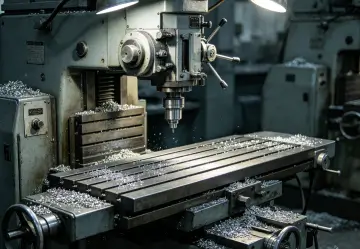
Rigidity is the core performance of a vertical milling machine, directly affecting vibration control, operational stability, and service life. Focus on the following elements during purchase:
- Material: Prioritize cast iron beds and columns. Cast iron has excellent vibration damping, ensuring precision during heavy cutting and avoiding poor surface finish and shortened tool life caused by vibration in lightweight materials such as aluminum and thin steel plates.
- Weight: Weight is positively correlated with stability. Small manual models should weigh at least 1000 lbs, and large CNC or bed-type models at least 5000 lbs. For example, a 1500-lb manual knee-type milling machine is more stable than an 800-lb model and suitable for large-diameter tool operations.
- Ways: Prioritize hardened, ground, or Turcite-coated ways for low wear and smooth operation, maintaining long-term precision. Avoid uncoated or poorly surface-treated ways, which wear easily and require frequent maintenance.
- Structure: Cast-in-one structure reduces deformation and enhances stability, suitable for strict tolerance machining. Avoid bolted or welded structures, which deform easily, generate high vibration, and affect machining accuracy.
Evaluate Spindle Performance (The Core of the Machine)
The spindle directly determines cutting power, precision, and tool life, making it a key consideration during purchase. Key evaluation factors are as follows:
- Spindle Power: Higher power handles hard materials and heavy cutting better. Soft materials (e.g., aluminum) require 2–5 HP, and hard materials (e.g., stainless steel, titanium alloy) require 5–15 HP or more. For example, cutting 1-inch thick steel plate needs a spindle above 10 HP.
- Speed Range: Stepless speed adjustment flexibly adapts to rough machining (low speed, high torque) and finishing (high speed, low torque). 50–3000 RPM is suitable for general machining, and high-speed spindles (up to 10,000 RPM) are ideal for soft material finishing.
- Taper Type: R8 taper fits small manual milling machines; ISO40, BT40, and CAT40 fit large CNC and bed-type milling machines. Prioritize models matching existing tool holders to avoid extra costs. BT40 is an industry-standard choice.
- Runout: Ideal runout < 0.001 mm ensures high precision and surface finish. Excessive runout causes inconsistent part dimensions. Confirm specifications with the manufacturer before purchase.
- Torque: High torque at low speed improves performance with large-diameter tools and heavy cutting, ensuring stable spindle operation during hard material machining without stalling or slowing down.
Ensure Table Size and Axis Travel Meet Requirements
Table size and axis travel determine the maximum machinable part size. Sufficient margin must be reserved to avoid unmet needs later. Key points are as follows:
- Table Size: Must accommodate the largest workpiece and leave clamping space. Usually add 6–12 inches to the length and width of the largest part. For example, a 12×18-inch part fits an 18×24-inch table.
- T-slot Configuration: 3–5 T-slots (2–3 inches apart) flexibly fix fixtures and workpieces. 4 or more T-slots better adapt to large, irregular workpiece clamping.
- Table Load Capacity: Must meet the total weight of the workpiece + fixture. A safety margin is recommended. For example, for a workpiece and fixture totaling 700 lbs, select a table with a load capacity ≥ 800 lbs to avoid overload deformation.
- X/Y/Z Axis Travel: Add a 20% margin to the maximum part size to ensure all machining operations are completed. For example, a 10×8×6-inch part requires a machine with X ≥ 12 inches, Y ≥ 10 inches, and Z ≥ 8 inches.
- Positioning Accuracy: Parts with strict tolerances (±0.001 inches) require accuracy ≥ 0.01 mm; general machining (±0.005 inches) requires accuracy ≥ 0.02 mm. Match with your own part specifications.
Focus on Accuracy and Tolerance Capability
Accuracy directly affects scrap rate, part consistency, and customer satisfaction, making it a key differentiator of machine grades. Focus on the following functions:
- Positioning Accuracy: Accuracy ≥ 0.01 mm meets high-precision needs; 0.005 mm-class machines stably process strict tolerance parts and avoid defective products.
- Repeatability: Repeatability of ±0.005 mm or higher ensures consistency in multi-batch production, reducing scrap and rework costs, suitable for mass production.
- Digital Readout (DRO): Recommended for manual milling machines. It displays axis positions in real time (accuracy 0.001 mm), reducing human error and improving clamping and adjustment efficiency.
- Backlash Control: Excessive backlash causes positioning deviations. Prioritize machines with backlash compensation (CNC models) or adjustable lead screws to ensure cutting consistency.
Evaluate Control and Automation Functions (For CNC Models)
The control system of a CNC milling machine determines usability and production efficiency. Focus on the following practical functions:
- Controller Brand: Prioritize reliable brands such as Fanuc, Mitsubishi, Siemens, and Syntec. Fanuc suits entry-level CNC workshops; Siemens fits complex parts and mass production, with comprehensive support and abundant training resources.
- Programming Convenience: Choose a controller with intuitive programming tools and built-in operation templates. Some support conversational programming without G-code knowledge, reducing training costs.
- Automatic Tool Changer (ATC): Automatically changes tools to reduce downtime. A tool capacity of 10–40 tools adapts to operations of varying complexity, the first choice for complex part machining.
- Tool Magazine Capacity: Mass production recommends a tool magazine of 20 or more tools; 10–15 tools suffice for small workshops, reducing tool reloading between operations.
- Spindle Through-Coolant Function: Delivers coolant directly to the cutting area, improving chip removal, extending tool life, and enhancing surface finish. Suitable for deep-hole drilling and hard material machining.
Consider Feed, Speed, and Operational Functions
Practical operational functions improve efficiency, reduce operator fatigue, and ensure safety. Focus on the following points:
- Automatic Feed: X/Y/Z axis automatic feed ensures consistent feed rates, reducing fatigue and errors. Operators can focus on cutting monitoring, improving precision and efficiency.
- Speed Adjustment: Stepless speed adjustment quickly switches between rough and finishing without stopping the spindle, saving time and avoiding process interruptions from stepped speed adjustment.
- Cooling System: Large-capacity tank (≥20 gallons) + adjustable flow adapts to different machining scenarios. Some are equipped with spray cooling, suitable for finishing and low coolant demand.
- Chip Management: Chip conveyors (mass production) or chip trays (small workshops) reduce downtime for chip cleaning, keep the work area tidy, and prevent chips from damaging the machine.
- Safety Guards: Fully enclosed guards + safety interlocks prevent flying chips and injuries, comply with safety standards, and reduce noise and coolant splashing.
Match Equipment to Materials and Application Scenarios
Equipment selection must align with machining materials and application scenarios to avoid redundant or insufficient functions. Specific matching recommendations are as follows:
- Aluminum/Soft Materials: 2–5 HP spindle + speed within 5000 RPM. Manual or entry-level CNC milling machines suffice. Focus on speed control and rigidity to avoid vibration.
- Steel/Stainless Steel: 5–15 HP spindle + high torque + cast iron bed. Bed-type or heavy-duty knee-type milling machines. CNC models are recommended with spindle through-coolant to extend tool life.
- Titanium Alloy/Superalloys: High-torque spindle above 10 HP + spindle through-coolant + rigid bed. High-end CNC bed-type milling machines ensure stable low-speed cutting and avoid tool breakage.
- Mold Machining: High-precision (≥0.005 mm) CNC milling machines. 4–5-axis models adapt to complex cavities. Focus on spindle stability and surface finish.
- Prototyping: Flexible knee-type milling machines (with DRO) or entry-level CNC milling machines, adjustable quickly to adapt to small-batch, multi-iteration prototyping needs.
Calculate Budget and Total Cost of Ownership
Purchasing must balance upfront costs and long-term value. Total Cost of Ownership (TCO) includes upfront investment, maintenance, energy, training, etc. Key points are as follows:
- Upfront Cost: Manual models $8,000–$25,000; CNC models $50,000–$200,000+. Bed-type models are more expensive than knee-type models. Set a budget based on needs and avoid blindly pursuing high-end functions.
- Maintenance Cost: Prioritize machines with easily accessible spare parts and simple maintenance. Well-known brands have sufficient spare parts supply, reducing downtime losses and avoiding spare parts procurement difficulties for unknown brands.
- Energy Efficiency: Machines with Variable Frequency Drives (VFD) adjust power according to load, reducing long-term electricity costs, suitable for mass production.
- Brand Support: Choose brands with local service networks for fast on-site repair and training, reducing downtime.
- Residual Value: Well-known brand machines have good value retention. Used CNC milling machines such as Fanuc and Haas can sell for 50–70% of the original price, while general models only 20–30%, facilitating later upgrades and resale.
Verify Brand Reliability, Support, and Warranty
Reliable brands and after-sales service guarantee long-term stable operation of the machine. Confirm the following during purchase:
- Well-known Manufacturers: Prioritize brands such as Haas, Fanuc, Okuma, Bridgeport, and Jet, with reliable quality, good industry reputation, and high durability.
- On-site Installation and Training: Suppliers must provide on-site installation (including machine leveling) and operator training to ensure quick commissioning and reduce operational errors.
- Warranty: Prioritize 1–3 years parts + labor warranty. High-end CNC models may consider extended warranty. Avoid machines with no warranty or short warranty (<1 year).
- Local Service Network: Confirm the location and response time of the supplier’s local service center to ensure fast repair in case of machine failure and reduce downtime losses.
- Genuine Spare Parts: Suppliers must provide genuine spare parts to avoid machine damage from generic parts and extend service life.
Final Inspection Checklist for Vertical Milling Machine Purchase
Check the following list before purchase to ensure all key needs are covered:
- Maximum part size and required axis travel (with 20% margin added);
- Machining materials and hardness (matching spindle power and machine rigidity);
- Tolerance and accuracy requirements (matching machine accuracy grade);
- Manual/CNC selection (based on production volume and operator skills);
- Budget and total cost of ownership (including maintenance, training, energy);
- Supplier after-sales service and warranty (prioritize local support and genuine spare parts);
- Required operational functions (automatic feed, cooling, chip removal, etc.).
Conclusion
Selecting a vertical milling machine is a critical investment affecting production quality and profitability. It must combine factors such as machine type, rigidity, spindle performance, and operational functions to match material, operation, and budget needs. There is no need to pursue the most expensive equipment; the key is to adapt to the workflow and ensure accuracy, efficiency, and long-term stability. It is recommended to fully evaluate needs and test the machine before purchase.
 Email
Email sales1: +86 15312799623