



The "Heart" and "Brain" of Gantry Machining Centers: How High-End CNC Systems and Spindle Technology Boost Machining Efficiency
In the realm of high-precision manufacturing, gantry machining centers stand as the backbone of complex and large-scale part processing. Behind their exceptional performance lies the synergy of two core components: the CNC system (the "brain") that issues precise commands, and the gantry machining center spindle (the "heart") that executes cutting operations. For manufacturers striving to enhance productivity and product quality, understanding how these two components work independently and collaboratively is crucial. This article delves into the advanced functions of high-end CNC systems such as Siemens 840D and Heidenhain TNC, analyzes the performance of different spindle types in various machining scenarios, and reveals the secret of maximizing machining efficiency through hardware-software synergy.
The "Brain": High-End CNC Systems Drive Precision and Efficiency with Advanced Functions
The CNC system is the command center of gantry machining centers, responsible for translating design blueprints into precise machining actions. High-end CNC systems represented by Siemens 840D and Heidenhain TNC have transcended basic control functions, integrating a series of advanced technologies that lay the foundation for high-efficiency and high-precision machining.
1. High-Precision Contour Control: The Foundation of Complex Machining
Complex parts such as aerospace components and precision molds require ultra-high contour accuracy. High-end CNC systems like Siemens 840D feature advanced contour control algorithms that optimize tool path planning. By reducing interpolation errors and ensuring smooth transition between different machining segments, they enable the gantry machining center to achieve micron-level contour accuracy even during high-speed machining. Heidenhain TNC, on the other hand, excels in 5-axis simultaneous (5-axis simultaneous machining) contour control, accurately coordinating the movement of multiple axes to handle complex curved surfaces that traditional systems struggle with. This precision not only improves product quality but also reduces rework rates, directly boosting overall machining efficiency.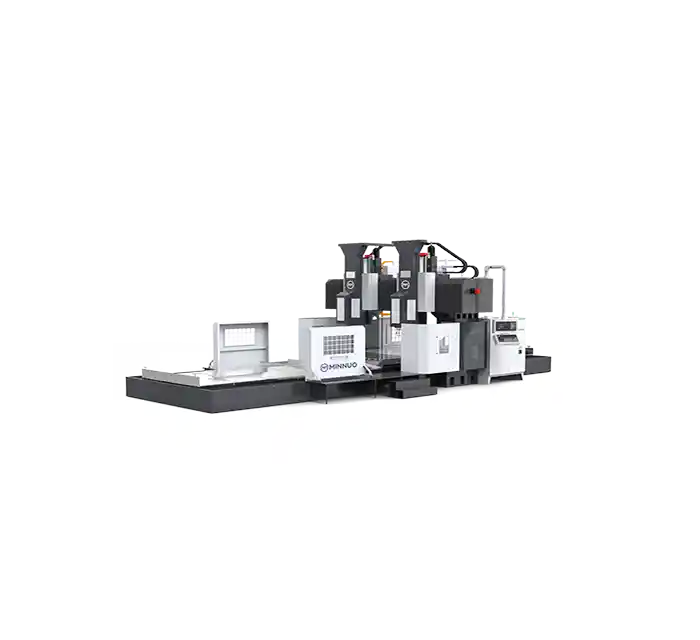
2. Vibration Suppression: Stabilizing Machining Processes
Vibration during machining is a major enemy of efficiency and precision, often leading to poor surface finish, tool wear, and even machine damage. High-end CNC systems address this issue through built-in vibration suppression technologies. For example, Siemens 840D uses real-time monitoring of spindle speed and cutting force to adjust feed rates dynamically, minimizing resonant vibrations. Heidenhain TNC integrates adaptive control algorithms that detect subtle vibrations and modify machining parameters instantly, ensuring stable cutting even when processing high-hardness materials. By reducing vibration-related downtime and tool replacement frequency, these systems significantly enhance machining stability and efficiency.
3. Intelligent Thermal Compensation: Overcoming Thermal Deformation Limitations
Thermal deformation caused by friction and cutting heat during long-term operation is a key factor affecting machining accuracy. High-end CNC systems solve this problem with intelligent thermal compensation functions. They use built-in sensors to collect real-time temperature data from the spindle, guide rails, and other critical components. Based on pre-established thermal deformation models, the systems automatically adjust machining parameters such as axis positions and spindle speed to offset the impact of thermal expansion and contraction. Both Siemens 840D and Heidenhain TNC are equipped with high-precision thermal compensation modules, which ensure consistent machining accuracy even during long hours of continuous operation, eliminating the need for frequent manual adjustments and improving production efficiency.
The "Heart": Spindle Technology Adapts to Diverse Machining Needs
The spindle of a gantry machining center is the core component that drives the tool to perform cutting operations, and its performance directly determines machining efficiency and quality. There are two main types of spindles used in modern gantry machining centers: electric spindles and gear-driven spindles. Each has unique characteristics and is suitable for different machining scenarios, especially in heavy cutting and high-speed precision machining.
1. Electric Spindles: The Ideal Choice for High-Speed Precision Machining
Electric spindles adopt an integrated design where the motor and spindle are combined into one, eliminating the need for belt or gear transmission. This design minimizes energy loss and improves dynamic response speed. Electric spindles typically have a high rotational speed, ranging from 10,000 to 60,000 rpm, and even higher for ultra-precision models. Their advantages are particularly evident in high-speed precision machining scenarios such as 3C product parts and aerospace precision components.
In high-speed precision machining, electric spindles offer excellent precision with radial runout controlled within 0.001 mm, ensuring a smooth surface finish (mirror-like effect) on workpieces. Their fast acceleration and deceleration capabilities reduce non-cutting time, improving overall machining efficiency. However, electric spindles have limitations: they have relatively weak low-speed torque, making them unsuitable for heavy cutting. Additionally, their cost is 2-5 times that of gear-driven spindles, and maintenance is more complex, often requiring complete replacement in case of damage.
2. Gear-Driven Spindles: Reliable Performers in Heavy Cutting
Gear-driven spindles use belts or gears to transmit power from the motor to the spindle, featuring a mature and robust structure. They are characterized by high torque output at low speeds, making them ideal for heavy cutting scenarios such as machining mold steel, cast iron, and large-scale heavy workpieces. In heavy cutting, gear-driven spindles can withstand large cutting forces, ensuring stable machining performance and high material removal rates.
Compared to electric spindles, gear-driven spindles have lower rotational speeds (usually 1,000 to 8,000 rpm) and lower precision (radial runout ≥ 0.005 mm) due to cumulative errors in the transmission chain. However, they have significant advantages in cost and maintenance: their purchase and maintenance costs are only 1/3 to 1/2 of electric spindles, and damaged components such as bearings and gears can be replaced individually, reducing downtime. For manufacturers engaged in large-scale heavy-duty processing, gear-driven spindles are a cost-effective and reliable choice.
Hardware-Software Synergy: The Key to Maximizing Machining Efficiency
The high efficiency of gantry machining centers is not achieved by the CNC system (brain) or spindle (heart) alone, but by the seamless synergy between the two. This synergy covers the entire machining process from path planning to cutting execution, ensuring that every link operates at optimal efficiency.
In the pre-machining stage, the high-end CNC system (such as Siemens 840D or Heidenhain TNC) performs intelligent path optimization based on the characteristics of the spindle. For example, when matching with an electric spindle for high-speed precision machining, the system optimizes the tool path to minimize sharp turns and sudden speed changes, leveraging the spindle's fast response capability. When paired with a gear-driven spindle for heavy cutting, the system adjusts the cutting parameters to maximize the spindle's high-torque advantage, increasing material removal efficiency.
During machining, the CNC system and spindle maintain real-time communication. The system's vibration suppression function monitors the spindle's operating status in real time; if abnormal vibration is detected, the system immediately reduces the feed rate or adjusts the spindle speed to stabilize the cutting process. At the same time, the intelligent thermal compensation function uses temperature data from the spindle to adjust machining parameters, ensuring that the spindle's thermal deformation does not affect machining accuracy. This real-time feedback and adjustment mechanism forms a closed-loop control system, eliminating process fluctuations and improving machining stability and efficiency.
In addition, high-end CNC systems support advanced functions such as automatic tool change (ATC) and multi-process integration, which are coordinated with the spindle's operation. For example, after the spindle completes a cutting process, the CNC system automatically issues a tool change command, and the ATC replaces the tool while the spindle adjusts its speed and torque for the next process. This seamless coordination reduces non-cutting time between processes, realizing "one-time clamping, multiple processes completed" and significantly improving production efficiency.
Conclusion: Investing in Core Components to Enhance Competitiveness
The "brain" (high-end CNC system) and "heart" (spindle) are the core drivers of gantry machining center efficiency. High-end CNC systems like Siemens 840D and Heidenhain TNC provide precise command and intelligent control through advanced functions such as high-precision contour control, vibration suppression, and intelligent thermal compensation. Electric spindles and gear-driven spindles, each with their own advantages, adapt to different machining needs from high-speed precision machining to heavy cutting. The seamless synergy between these hardware and software components maximizes machining efficiency, improves product quality, and reduces production costs.
For manufacturers looking to gain an edge in the competitive manufacturing landscape, understanding and investing in these core technologies is essential. Whether upgrading to a high-end CNC system or selecting the right spindle type for specific applications, optimizing the "heart" and "brain" of gantry machining centers will be the key to improving productivity and maintaining a competitive advantage.
 Email
Email sales1: +86 15312799623