



5-Axis CNC Milling for Beginners: When Should You Upgrade to 5-Axis Machining? 3-Axis vs 5-Axis Guide
As competition in the precision machining industry continues to intensify, 5-axis CNC milling machines are no longer exclusive equipment for large high-end manufacturing enterprises. An increasing number of small and medium-sized processing factories, mold manufacturers, and precision component suppliers are considering technical upgrades. A common dilemma faced by technical managers is: with stable mass production on existing 3-axis machines, is upgrading to 5-axis machining necessary, and when delivers the best return on investment?
This guide covers core differences between 3-axis and 5-axis machining, ideal workpiece types for 5-axis, and the investment costs and ROI. It provides clear 5-axis entry-level insights for manufacturing companies, helping you determine whether a technical upgrade is suitable, avoid blind investment risks, and maximize 5-axis machining advantages.
1. 3-Axis vs 5-Axis Machining: More Than Just Two Extra Axes
Many manufacturers assume that 5-axis CNC milling machines merely add two extra axes to standard 3-axis equipment. In reality, the two technologies differ fundamentally in machining logic, precision limits, production efficiency, and application scenarios — the critical factors for your upgrade decision.
1.1 3-Axis Machining: Standard Solution for Mass Production
3-axis machining operates with three linear axes (X, Y, Z). The workpiece remains fixed during processing, and cutting tools only perform vertical and planar linear cuts. It remains the mainstream setup for small and medium machining workshops thanks to its low equipment cost, simple programming, low operator requirements, and easy maintenance. It is ideal for mass production of standardized, simple-structured workpieces.
However, 3-axis machining has notable limitations. For multi-angle, complex curved, and irregular workpieces, the process requires split procedures and repeated re-clamping. This significantly extends machining cycles, introduces cumulative positioning errors that reduce precision, increases scrap rates, and even makes certain complex parts unmanufacturable.
1.2 5-Axis Machining: Efficient Solution for Complex Precision Parts
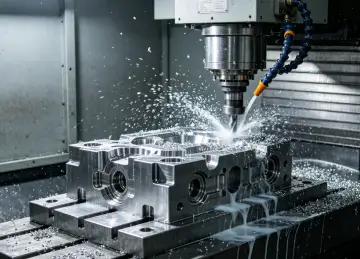
Built on the foundation of 3-axis systems, 5-axis CNC milling machines incorporate two additional rotary axes, enabling multi-angle free movement of tools or workpieces. This delivers true one-setup, five-sided machining — the core of all 5-axis machining advantages. Compared with 3-axis machining, the key upgrades include:
- Superior Precision: Eliminates repeated clamping and positioning errors. 5-axis machining maintains tight tolerances of ±0.003mm, far outperforming the ±0.01–0.02mm range of 3-axis machining, perfectly meeting ultra-precision component requirements.
- Higher Productivity: Eliminates repetitive clamping, setup, and alignment steps. Machining time for complex parts can be reduced by up to 65%, minimizing manual intervention and maximizing capacity utilization.
- Full Machining Coverage: Supports multi-angle, curved surface, cavity, and irregular contour machining, solving complex process challenges impossible for 3-axis equipment.
2. Ideal Workpieces for 5-Axis Machining: Signs You Need an Upgrade
For beginners adopting 5-axis machining, upgrades should never be blind. You gain the highest ROI and value from a 5-axis CNC milling machine when your orders and workpieces match the following scenarios.
2.1 Complex Curved & Irregular Structural Parts
Workpieces with free-form surfaces, spatial curves, intricate cavities, angled holes, and irregular protrusions/indentations are the best fit for 5-axis machining. Typical examples include aerospace turbine blades, impellers, new energy vehicle structural components, and precision instrument housings. These parts require dozens of split procedures on 3-axis machines with inconsistent precision, while 5-axis equipment enables one-time forming with near 100% yield rates.
2.2 Multi-Sided & Multi-Angle Feature Parts
Parts requiring drilling, grooving, chamfering, and cutting on various inclined planes demand frequent flipping and repositioning in 3-axis machining, leading to lengthy lead times and alignment errors. 5-axis machining adjusts processing angles freely via rotary axes, completing all procedures in a single setup and greatly reducing machining defects.
2.3 High-Precision Mold Components
Molds for phone casings, automotive interiors, precision die-casting, and medical devices feature complex cavities, curved textures, and multi-angle fitting structures with strict surface finish and tolerance requirements. 3-axis machining leaves visible tool marks and joint lines that are hard to eliminate, whereas 5-axis one-pass cutting delivers ultra-smooth surfaces, improves mold quality and service life, and supports high-end custom mold orders.
2.4 High-Value Precision Components
Medical prosthetic joints, orthopedic implants, and high-end instrument accessories feature complex ergonomic curves and strict tolerance standards as high-value-added products. Upgrading to 5-axis machining helps manufacturers meet industrial precision specifications, secure premium orders, and escape low-end homogeneous price competition.
Industry data indicates that if a workpiece requires 3 or more clamping operations on 3-axis machines, switching to 5-axis machining delivers lower overall costs and higher efficiency — the critical threshold for upgrading.
3. 5-Axis CNC Milling Investment & ROI: Essential Financial Analysis
Most manufacturers delay 5-axis upgrades due to concerns over high investment and technical barriers. Clarifying the true costs and returns is essential for 5-axis beginners planning a strategic upgrade.
3.1 Investment Barriers: Higher Initial Cost with Improving Affordability
5-axis CNC milling machines require higher upfront investment than 3-axis alternatives, with cost differences concentrated in three areas:
- Equipment Cost: Standard 5-axis machines cost 2–3 times more than equivalent 3-axis models. Entry-level 5-axis machines tailored for small and mid-sized factories fully support basic precision machining, eliminating the need for high-end premium models.
- Labor & Technical Cost: 5-axis machining requires professional CAM programmers and trained operators. While technical thresholds are slightly higher than 3-axis operations, mature talent pools and systematic entry-level training programs keep labor costs manageable.
- Maintenance Cost: 5-axis equipment adopts high-precision components with stricter daily maintenance standards. However, it features stable failure rates and controllable long-term operational costs.
3.2 ROI Advantages: Long-Term Cost Reduction & Capacity Growth
Despite higher upfront spending, 5-axis machining delivers far superior long-term benefits compared to 3-axis processing, with core returns reflected in four aspects:
- Lower Labor & Time Costs: Cuts over 80% of clamping and setup work. A single operator can manage multiple machines, drastically shortening machining cycles, expanding production capacity, and enabling more order fulfillment.
- Reduced Scrap & Rework Costs: One-setup forming eliminates cumulative positioning errors, significantly improving yield rates and reducing material waste and rework losses.
- Access to High-End Orders: Breaks the limitations of 3-axis machining, allowing manufacturers to undertake high-value orders in aerospace, medical, new energy, and premium mold industries, boosting profit margins and avoiding low-price market saturation.
- Enhanced Core Competitiveness: 5-axis machining capability is a key entry threshold for high-end manufacturing supply chains. Upgrading optimizes your processing system, expands customer resources, and strengthens market competitiveness.
In terms of payback period: factories focusing on complex precision parts can recover upgrade costs within 1–3 years. Workshops balancing mass production and premium customization achieve sustainable long-term profitability.
4. Best Time to Upgrade to 5-Axis Machining
A blind 5-axis upgrade is not suitable for every machining enterprise. 3-axis machining fits standardized, simple, high-volume mass production, while 5-axis machining targets precision, complex, curved, and high-value customized parts.
Your business is ready for a 5-axis upgrade if you face any of the following situations:
- 3-axis machines cannot handle complex curved, irregular, and multi-angle precision parts, resulting in lost high-end clients;
- Frequent re-clamping, rework, high scrap rates, and insufficient capacity lead to soaring comprehensive production costs;
- Your business aims to enter high-end precision manufacturing fields including new energy, medical devices, aerospace, and premium molds;
- Your order structure is shifting toward high-value customized precision parts, with shrinking profit margins in low-end homogeneous competition.
Conclusion
Upgrading to 5-axis CNC milling machines is not a blind trend, but a strategic move for manufacturers to adapt to market upgrades, improve quality and efficiency, and break profit bottlenecks. For 5-axis beginners, premium top-tier equipment is unnecessary. Select entry-level 5-axis machines matching your order structure and processing needs to achieve phased technical upgrades, fully leverage 5-axis machining advantages, and complete the transformation from low-end mass production to high-end precision manufacturing.

 Email
Email sales1: +86 15312799623