



Unlock the Machining Code: The Ultimate Guide to Choosing Between 5-Axis and 3-Axis Mill-Turn Centers
In today's increasingly competitive manufacturing landscape, selecting the right machining equipment is crucial for determining a company's efficiency, cost-effectiveness, and competitiveness. How do you choose between 5-axis and 3-axis mill-turn centers? This comprehensive guide will unlock the decision-making code, helping you make the smartest investment.
Basic Understanding of Machining Centers
Mill-turn centers integrate turning and milling functionalities, allowing most or even all operations to be completed on a single machine. This realizes the manufacturing philosophy of "Complete in One Setup," significantly improving machining accuracy and production efficiency.
- 3-Axis Mill-Turn: Refers to the milling part of the machine having movement along three linear coordinate axes: X, Y, and Z. It is the most widely used, mature, and foundational equipment in manufacturing.
- 5-Axis Mill-Turn: Builds upon the three linear axes by adding two rotational axes (typically two from the A, B, and C axes), enabling the tool or workpiece to move in five directions simultaneously in space. It is the essential tool for machining complex parts.
3-Axis Machining Centers: The Cornerstone of Simplicity and Efficiency
Structure and Movement of 3-Axis Machining Centers
The structure of a 3-axis machining center is relatively simple, using three linear servo motors to drive the table or spindle along the X (left-right), Y (front-back), and Z (up-down) directions. This structure dictates that its machining capabilities are primarily limited to the top and sides of a workpiece. For complex parts requiring multi-angle machining, multiple setups are often necessary.
Suitable Applications for 3-Axis Machining Centers
3-axis machining centers are ideal for machining simple parts. Their advantageous scenarios include:
- Box-type and plate-type parts: Such as frames, cover plates, and mounting plates.
- Planar and Cavity Machining: Face milling, slot milling, and cavity roughing.
- Hole Pattern Machining: Drilling, tapping, and reaming.
- Rotational parts that only require milling or drilling at specific angles (e.g., 90°).
Advantages of 3-Axis Machining Centers
- High Cost-Effectiveness: Relatively lower equipment acquisition and maintenance costs.
- Simpler Programming: CAM programming strategies are mature, requiring less expertise from programmers.
- Ease of Operation: Familiar to skilled workers, easy to get started, lower training costs.
- Stable Efficiency: Highly competitive in terms of unit time cost for simple, high-volume tasks.
Limitations of 3-Axis Machining Centers
The primary limitation is the inability to machine complex 3D contours in a single setup. For parts with angled holes or surfaces, multiple setups are required. This not only reduces efficiency but also introduces repeated positioning errors, affecting the part's overall accuracy.
5-Axis Machining Centers: The Powerful Tool for Complex Machining
Structure and Movement of 5-Axis Machining Centers
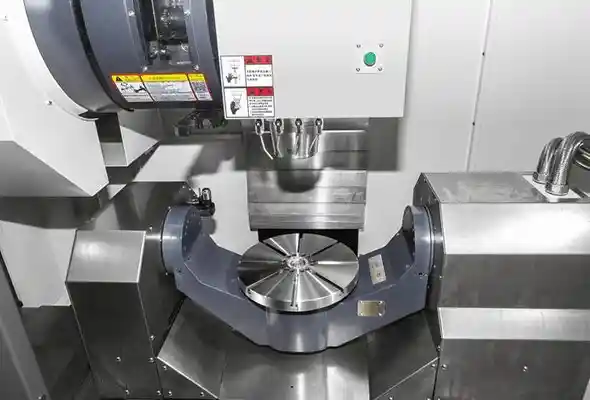
5-axis machines add two rotational axes to the three linear axes. Common configurations include:
- Dual Rotary Table Type: The table rotates and tilts the workpiece (e.g., AC axes, BC axes), suitable for small to medium-sized parts.
- Head-Tilting Type: The spindle head itself performs the angular tilt, suitable for large, heavy parts.
- Mixed Type (Table-Head): A combination of the above two.
These rotational axes allow the tool to approach the workpiece from any angle, enabling true 5-axis simultaneous machining.
Suitable Applications for 5-Axis Machining Centers
5-axis is the essential choice for manufacturing complex parts, widely used in:
- Aerospace Industry: Engine blades, impellers, wing ribs.
- Medical Devices: Artificial bones, joints, surgical instruments.
- Precision Molds: Automotive panel molds, injection molds.
- High-Precision Complex Parts: Any workpiece with complex spatial surfaces.
Advantages of 5-Axis Machining Centers
- Complete Machining in One Setup: Eliminates repeated positioning errors, achieving extremely high geometric tolerances.
- Machine Complex Surfaces: Capable of machining spatial contours unattainable by 3-axis machines.
- Avoid Interference, Improve Quality: By tilting the tool, shorter tools can be used, increasing system rigidity, reducing vibration, achieving better surface finish, and extending tool life.
- Leap in Efficiency: By optimizing the tool axis angle, larger cutting depths and faster feed rates can be achieved.
Challenges of 5-Axis Machining Centers
- High Cost: Significantly higher equipment purchase and maintenance costs compared to 3-axis.
- Complex Programming: Requires specialized 5-axis CAM software and experienced programming engineers.
- High Skill Requirements: Places high demands on the skills and understanding of operators.
- Tooling Costs: Stricter requirements for the accuracy and performance of tool holders and cutting tools.
Making the Decision Based on Machining Complexity
Factors for Assessing Machining Complexity
Assess complexity primarily based on:
- Geometric Shape: Are they simple planes and holes, or complex free-form surfaces?
- Accuracy Requirements: Are geometric tolerances (e.g., parallelism, perpendicularity) in the micron range?
- Multi-Sided Features: Does the part need machining from more than two directions?
Low Complexity Machining: The Stage for 3-Axis
When parts have simple structures, regular features, and are produced in large batches, 3-axis machining centers are the undisputed king of cost-effectiveness. For example, mass-producing aluminum alloy electrical mounting plates using a 3-axis machine for face milling, drilling, and tapping offers the highest efficiency and lowest cost.
High Complexity Machining: The Domain of 5-Axis
When parts involve complex contours like impellers or medical implants, or require accuracies within 0.01 mm guaranteed by a single setup, a 5-axis machining center is the only and necessary choice. The gains in precision and efficiency often justify the high initial investment.
Weighing the Middle Ground
For parts with both simple features and a few angled holes or surfaces, a trade-off is needed:
- Use 3-Axis + Indexing Fixture: Complete via a second setup, sacrificing some efficiency to save costs.
- Directly Use 5-Axis: Complete in one setup, improving efficiency and accuracy, but at a higher cost.The key is to calculate whether the precision risks and time costs associated with multiple setups outweigh the investment in a 5-axis machine. If future work tends towards complexity, moderately investing ahead in 5-axis might be wise.
Comprehensive Consideration of Cost, Efficiency, and Quality
Consideration Dimension | 3-Axis Machining Center | 5-Axis Machining Center |
Acquisition & Operating Cost | Low (Equipment, maintenance, programming, labor costs are all lower) | High (Massive initial investment, higher subsequent operating costs) |
Machining Efficiency | High efficiency for simple parts | Extremely High for complex parts; comparable to 3-axis for simple parts |
Machining Quality | High, but multiple setups accumulate errors | Extremely High, one setup ensures perfect geometric accuracy |
Practical Case Studies
Case 1: Simple Part Machining – A Victory for 3-Axis
Part: Servo Motor Flange
Reason for Choice: The part primarily consisted of planes, stepped holes, and standard bolt circles. All features could be machined from the axial and radial directions. Using a 3-axis mill-turn center, turning the outer diameter and face, plus drilling and tapping the back side, could be done in one setup. Programming was simple, and the cycle time was fast, perfectly meeting the high-volume demand of thousands of pieces per month, maximizing profitability.
Case 2: Complex Part Machining – The Power of 5-Axis
Part: Drone Propeller
Reason for Choice: The propeller blades are typical complex spatial surfaces with extremely high requirements for dynamic balance. Using a 5-axis machining center, a raw blank was set up once, and all blades were finish-machined via 5-axis simultaneous milling. This not only guaranteed the geometric consistency and excellent surface finish of each blade but also ensured the absolute positional accuracy of all blades relative to the hub, achieving a very high standard of dynamic balance – something impossible with a 3-axis machine.
Selection Advice and Future Outlook
Summary of Selection Advice
- Define Requirements: Start by thoroughly analyzing the machining complexity, precision, and batch size of your core products.
- Cost Calculation: Consider not only the machine price but also long-term operating costs, efficiency gains, and the value of precision.
- Assess Talent: Evaluate your team's existing programming and operational capabilities, or include training costs in the budget.
- Decision Process:
- Simple Parts, High Volume → Confidently choose 3-Axis.
- Complex Surfaces, High Precision, Low Volume/High Mix → Must invest in 5-Axis.
- Middle Ground → Quantify precision risks vs. time costs. If trending towards complexity, consider proactive investment in 5-Axis.
Technology Trends
Looking ahead, both technologies will continue to evolve:
- Intelligence and Automation: Both types of machines will be more deeply integrated into smart manufacturing cells, equipped with robotics for automated loading/unloading and in-process measurement systems.
- Software Empowerment: 5-axis programming software will become more intelligent and user-friendly, lowering the technical barrier.
- Higher Precision and Speed: The adoption of technologies like linear motors and torque motors will drive both towards higher precision and speed.
The conclusion is: There is no absolute "better," only the absolute "more suitable." Accurately assessing your machining needs is the ultimate code to unlocking the choice between 5-axis and 3-axis. We hope this guide provides you with clear direction.
 Email
Email sales1: +86 15312799623