



What Is an Automatic Tool Changer (ATC)? 4 Common Types Explained
An Automatic Tool Changer (ATC) is an important component of modern CNC machines. It allows machines to switch between different cutting tools automatically, reducing manual intervention and non-cutting time during machining operations.
The four commonly discussed ATC designs are carousel (rotary), linear, arm-type, and chain-type systems. Each has different structural characteristics, tool storage arrangements, and application requirements.
Choosing the right automatic tool changer depends on the CNC machine configuration, tool magazine capacity, tool change time, available space, and production needs.
This article explains how automatic tool changers work, compares four common designs, and provides practical guidance for selecting a suitable ATC system.
1. What Is an Automatic Tool Changer (ATC)?
An Automatic Tool Changer (ATC) is a system that automatically replaces cutting tools in a CNC machine during a programmed machining cycle.
ATCs are commonly used in CNC machining centers, milling machines, and CNC routers. They enable machines to perform multiple operations, such as drilling, milling, boring, and tapping, without requiring operators to change tools manually between operations.
An ATC system generally consists of:
- Tool Magazine: Stores cutting tools in designated positions.
- Tool Changing Mechanism: Transfers or exchanges tools between the magazine and spindle.
- Drive System: Controls the movement of the magazine or changing mechanism.
- Sensors and Control System: Monitor tool positions, confirm tool clamping, and coordinate the changing sequence.
How Does an Automatic Tool Changer Work?
Although the exact mechanism varies by machine, a typical automatic tool-changing process includes the following steps:
- Tool Change Command: The CNC controller initiates a tool change according to the machining program.
- Tool Selection: The tool magazine positions the required cutting tool for retrieval.
- Tool Exchange: The current tool is returned to the magazine, and the selected tool is transferred into the spindle.
- Tool Confirmation: The system verifies that the new tool is correctly positioned and clamped before machining resumes.
Depending on the design, the tool exchange may be performed by a mechanical arm or by direct interaction between the spindle and tool magazine.
The main benefit of an ATC is reduced manual tool-changing time, which can improve machining efficiency and support automated production.
However, machining accuracy still depends on the machine's spindle, tool holders, positioning system, and overall mechanical condition.
2. Four Common Types of Automatic Tool Changers
Automatic tool changers use different designs for tool storage and exchange.
Four commonly discussed arrangements are carousel, linear, arm-type, and chain-type systems.
It is important to distinguish between tool magazine designs and tool-changing mechanisms. Carousel, linear, and chain types primarily describe tool storage arrangements, while arm-type refers to the mechanism used to exchange tools.
These designs are not always mutually exclusive. For example, a rotary or chain magazine can operate together with a double-arm tool changer.
2.1 Carousel (Rotary) Automatic Tool Changer
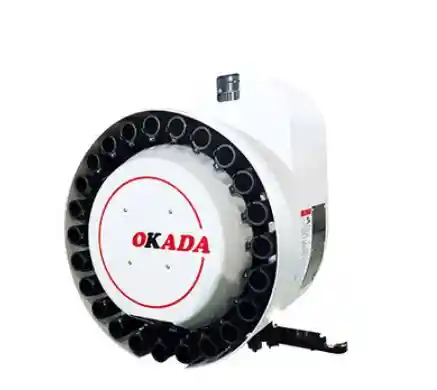
A Carousel ATC, also called a rotary tool changer, uses a circular magazine to store multiple cutting tools.
The magazine rotates to position the required tool at the tool-changing station. Depending on the machine design, the tool may be transferred directly into the spindle or exchanged using a separate mechanism.
Carousel systems are widely used in CNC machining centers.
Advantages:
- Compact Arrangement: The circular magazine can provide efficient tool storage within a relatively compact structure.
- Flexible Tool Capacity: Different rotary magazine designs support various numbers of cutting tools.
- Established Design: Rotary magazines are widely used and available in multiple machine configurations.
Limitations:
- Indexing Time: The time needed to position the selected tool depends on magazine design and tool location.
- Tool Size Restrictions: Oversized tools may require adjacent magazine positions to remain empty.
- Maintenance Requirements: The rotating mechanism, tool pockets, and sensors require periodic inspection.
Best Applications:
Carousel systems are suitable for CNC machines requiring a compact, integrated tool magazine with a capacity appropriate for their machining operations.
2.2 Linear Type Automatic Tool Changer

A Linear Type ATC typically stores cutting tools in a straight-line arrangement, often called a linear tool magazine or tool rack.
In some systems, the spindle moves to the required tool position and performs a direct pick-up or return operation. Other designs may use a dedicated transfer mechanism.
Linear tool magazines are commonly found in certain CNC routers and other machines designed around a straightforward tool storage layout.
Advantages:
- Simple Storage Layout: Tools are arranged in clearly defined linear positions.
- Easy Tool Access: Tool positions can be convenient for loading, inspection, and replacement.
- Flexible Integration: The design can be suitable for machines with space available along one axis.
Limitations:
- Space Requirements: A longer magazine may require more installation space as the number of tools increases.
- Tool Change Movement: Direct pick-up systems may require additional spindle or axis travel during tool changes.
- Capacity Constraints: Practical tool capacity depends on the available rack length and machine layout.
Best Applications:
Linear ATCs are suitable for CNC routers and other machines where a straight tool rack provides a practical balance between storage capacity, accessibility, and system complexity.
2.3 Arm Type Automatic Tool Changer
An Arm-Type ATC uses a mechanical transfer arm to move tools between the tool magazine and the machine spindle.
One common design is the double-arm tool changer, which can hold the current tool and the next tool at the same time.
During the exchange sequence, the arm removes the current tool from the spindle, transfers the replacement tool into position, and returns the previous tool to the magazine.
Arm-type mechanisms are commonly used in CNC machining centers requiring efficient tool exchange.
Advantages:
- Efficient Tool Exchange: Double-arm mechanisms can exchange two tools during a coordinated sequence.
- Flexible Magazine Compatibility: Arm-type changers can operate with various compatible magazine arrangements.
- Suitable for Repeated Tool Changes: Properly designed systems support frequent automatic tool-changing operations.
Limitations:
- Mechanical Complexity: Transfer arms involve moving components, gripping mechanisms, and position sensors.
- Installation Clearance: The arm requires sufficient space to complete its movement.
- Maintenance Requirements: Grippers, alignment, clamping mechanisms, and sensors must be maintained.
Best Applications:
Arm-type ATCs are commonly used in CNC machining centers requiring frequent tool changes and efficient automated machining cycles.
Important: Arm-type describes the tool-exchange mechanism. It can be combined with carousel or chain-type tool magazines.
2.4 Chain Type Automatic Tool Changer
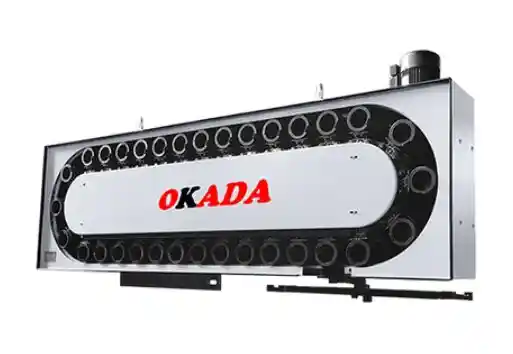
A Chain-Type ATC stores cutting tools in holders or pockets mounted along a moving chain.
The chain advances to bring the selected tool into the changing position, where a compatible transfer mechanism exchanges it with the tool in the spindle.
Chain-type magazines are commonly used when a CNC machine requires a relatively large number of tool positions.
Advantages:
- Large Tool Storage Capacity: Chain arrangements can accommodate substantial tool inventories.
- Flexible Magazine Layout: The chain path can be designed to fit different machine configurations.
- Suitable for Complex Machining: Larger magazines can support jobs requiring numerous cutting tools or spare tools.
Limitations:
- Larger Installation Space: High-capacity magazines may increase the machine's overall footprint.
- More Mechanical Components: Chains, guides, drives, and tool pockets require maintenance.
- Variable Tool Selection Time: Magazine indexing time depends on the system layout and selected tool position.
Best Applications:
Chain-type ATCs are suitable for machining centers requiring larger tool inventories, including complex machining operations and production environments with multiple tool requirements.
3. Comparison of Four Automatic Tool Changer Designs
The following table summarizes the main differences between the four commonly discussed ATC designs.
| ATC Design | Main Characteristic | Key Advantage | Main Consideration |
|---|---|---|---|
| Carousel (Rotary) | Circular tool magazine | Compact, widely used storage arrangement | Tool capacity and indexing time vary |
| Linear Type | Straight-line tool magazine | Simple layout and accessible tool positions | Rack length and axis movement |
| Arm Type | Mechanical tool-exchange arm | Efficient tool transfer | Mechanical complexity and clearance |
| Chain Type | Chain-driven tool magazine | Supports larger tool inventories | Space, indexing, and maintenance |
Which ATC Type Is Faster?
Tool change speed depends on the complete ATC system rather than the magazine type alone.
A double-arm mechanism may provide rapid tool exchange, but overall cycle time also depends on spindle positioning, magazine indexing, tool selection, and machine movement.
When comparing equipment, distinguish between:
Tool-to-Tool Time: The time required for the tool-changing operation, according to the manufacturer's stated measurement conditions.
Chip-to-Chip Time: The time from the end of machining with one tool to the start of machining with the next tool, including the relevant machine movements.
For production planning, chip-to-chip time often provides a more useful indication of the total interruption between cutting operations.
Actual values should be compared under equivalent test conditions.
4. How to Choose the Right Automatic Tool Changer
Selecting a suitable ATC requires evaluating the machine's cutting tools, machining operations, and production requirements.
Production Volume and Tool Capacity
For high-volume production, consistent tool-changing performance and reliability are important.
However, production volume alone does not determine the ideal ATC design.
A machine producing large quantities of a simple part may require relatively few tools, while a machine handling complex or frequently changing jobs may need a larger magazine.
Recommendation: Determine the maximum number of cutting tools required for your machining operations, including any spare or sister tools.
Tool Size and Complexity
Tool dimensions are important when selecting an ATC system.
Check the following specifications:
- Maximum tool diameter
- Maximum tool length
- Maximum tool weight
- Tool holder interface, such as BT, CAT, or HSK
- Magazine capacity when oversized tools are installed
Some magazines require empty adjacent positions when storing large-diameter tools, reducing their effective capacity.
For applications involving heavy or specialized tools, verify the maximum supported tool weight and changing mechanism capability.
Machine Space and Configuration
The available installation space also influences ATC selection.
A compact carousel may suit machines with limited space, while a linear tool rack may be convenient where sufficient straight-line space is available.
Larger chain magazines can provide additional storage capacity but may require more machine space.
Arm-type mechanisms need adequate movement clearance and must be compatible with the magazine and spindle arrangement.
Tool Change Time
For machining operations requiring frequent tool changes, evaluate the complete change cycle.
Important factors include:
- Tool-to-tool time
- Chip-to-chip time
- Magazine indexing time
- Tool selection method
- Spindle and axis movement during tool exchange
A fast mechanical exchange does not always mean the complete machine achieves the shortest tool-changing cycle.
Budget and Maintenance
The initial cost and maintenance requirements of an ATC depend on its capacity, drive system, mechanical configuration, and control features.
Before selecting a system, consider:
- Equipment purchase and integration costs
- Routine maintenance requirements
- Replacement parts availability
- Tool pocket and gripper wear
- Sensor and clamping system reliability
- Ease of troubleshooting and repair
A simpler magazine arrangement may be suitable for machines with limited tool requirements, while a higher-capacity system may justify its cost when it reduces repeated tool loading or production interruptions.
Selection Recommendation: Choose an ATC based on actual tool requirements, tool change performance, machine compatibility, and long-term operating needs rather than assuming one design is universally faster or more accurate.
Conclusion
An Automatic Tool Changer (ATC) enables CNC machines to change cutting tools automatically, reducing manual intervention and supporting efficient machining operations.
The four commonly discussed ATC designs include carousel, linear, arm-type, and chain-type systems.
Each design has different characteristics:
- Carousel ATC: Provides a compact rotary tool storage arrangement.
- Linear ATC: Uses a straight-line tool magazine for accessible tool storage.
- Arm-Type ATC: Uses a mechanical arm for automated tool exchange.
- Chain-Type ATC: Supports larger tool inventories through a chain-driven magazine.
Because tool magazines and changing mechanisms can be combined, the final selection should consider the complete ATC configuration.
For the best results, evaluate tool capacity, tool dimensions, tool change time, available machine space, and maintenance requirements.
If you are looking for CNC equipment with a suitable automatic tool changer, contact MINNUO to discuss your machining requirements and available equipment configurations.
Frequently Asked Questions (FAQ)
Q1. What is the main function of an automatic tool changer?
A:An automatic tool changer automatically replaces cutting tools in a CNC machine according to the machining program. It reduces manual tool changes and helps improve machining efficiency.
Q2. What are the four common types of automatic tool changers?
A:Four commonly discussed designs are carousel (rotary), linear, arm-type, and chain-type ATCs. Carousel, linear, and chain types mainly describe tool magazine layouts, while arm-type refers to the tool-exchange mechanism.
Q3. Which automatic tool changer is best for a CNC machining center?
A:The best ATC depends on the number and size of tools, required tool change time, available space, and machine configuration. Arm-type systems are often combined with rotary or chain magazines for automated tool exchange.
Q4. What is the difference between a carousel ATC and a chain-type ATC?
A:A carousel ATC stores tools in a circular magazine, while a chain-type ATC uses a moving chain of tool pockets. Chain magazines are often selected for larger tool inventories, but actual capacity depends on the machine design.
Q5. Does an automatic tool changer improve CNC machining accuracy?
A:An ATC primarily improves tool-changing efficiency and process automation. It does not inherently increase machining accuracy. Accuracy depends on tool holder positioning, spindle condition, machine geometry, and the overall machining process.

 Email
 sales1: +86 15312799623