



China vs. Taiwan vs. Japan Slant Bed CNC Lathes: Specifications, Acceptance Tests, and 5-Year TCO
Executive answer: There is no universal winner among Chinese, Taiwanese, and Japanese slant bed CNC lathes. A precision machine shop should first screen machines by part diameter, length, material, cycle time, and required operations. The final decision should then be based on thermal drift, test-part results, local service SLAs, and five-year total cost of ownership. This article compares three representative platforms; it does not treat one machine as representative of an entire country or region.
1. Why Country of Origin and Catalog Specifications Can Lead to the Wrong CNC Lathe
The most common purchasing risks are not insufficient spindle speed or motor power. They are inconsistent comparison criteria, overstated machining envelopes, omitted options, and unaccounted downtime costs.
Why do identical rpm and kW ratings produce different machining results?
Two machines rated at 4,500 rpm do not necessarily deliver the same continuous torque, vibration level, bearing temperature, dimensional stability, or surface finish at that speed.
Purchasers must distinguish between:
- Maximum spindle speed and sustainable production speed
- Peak, short-duration, and continuous motor power
- Low-speed torque and the constant-power range
- Vibration and spindle growth at the required speed
- Effective chuck gripping force under rotation
A machine with a higher maximum speed may still be the weaker choice for large-diameter alloy-steel parts if its continuous low-speed torque is insufficient.
Why is the maximum turning diameter often unusable in production?
Maximum turning diameter is usually a theoretical envelope under a specific turret and toolholder configuration. The chuck, jaws, tailstock, live tooling, guards, and adjacent tools may reduce the usable diameter.
Require the supplier to provide a work-envelope drawing that identifies:
- Swing over bed
- Maximum turning diameter
- Diameter available with the specified turret
- Clearance with the specified chuck jaws and toolholders
- Effective turning length at different workpiece diameters
Which production costs are commonly missing from a low quotation?
A base quotation may exclude the chip conveyor, mist collector, tool setter, spindle chiller, high-pressure coolant, transformer, bar feeder, parts catcher, toolholders, networking licenses, and on-site training.
Compare production-ready configurations that meet the same cycle-time and quality targets, not bare machine prices.
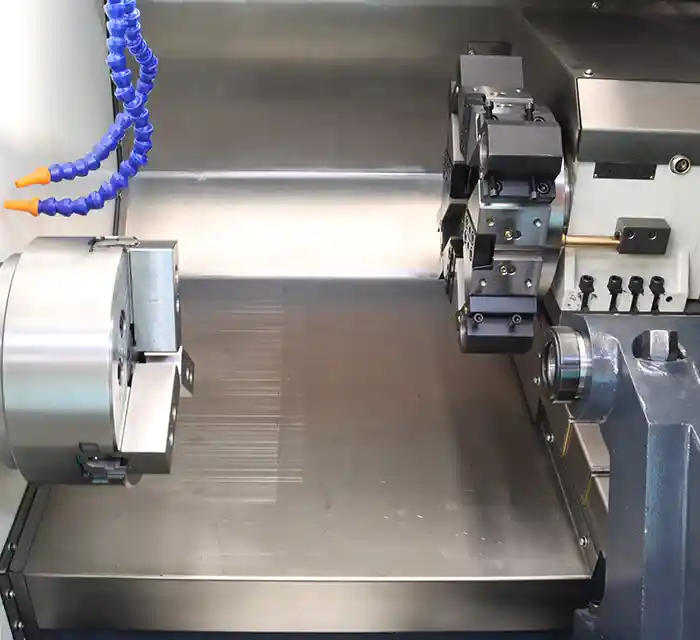
2. Comparing Three Representative CNC Lathes: Specifications, Accuracy, Controls, and TCO
How do the three representative machines differ?
These models illustrate a procurement method. They are not a brand ranking or a statistical comparison of national machine-tool industries.
| Origin and reference model | Bed and guideway information | Chuck | Published capacity | Spindle | Published power | Configuration boundary |
|---|---|---|---|---|---|---|
| China: Dalian CT40 | Explicitly identified as a slant bed machine; linear guideways | 8/10 in | Φ500 mm swing; 450/430 mm turning length | 45–4,500 or 35–3,500 rpm | 11/15 kW | The two chuck and spindle packages must not be combined as one specification |
| Taiwan: Goodway GLS-2000 | 30° slant bed; linear guideways on X and Z | 8 in | Φ390 mm maximum turning diameter; 330/630 mm length | 4,500 rpm | 11 kW continuous; 15 kW for 30 min | Y-axis, live tooling, and sub-spindle are optional |
| Japan: Takisawa TCN-2100 | Box slideways on all axes; exact bed angle must be confirmed in the order | 8 in | Φ410 mm with T8 turret; Φ340 mm with T12 turret; 300/600 mm length | 3,200 rpm; optional 5,000 rpm | Official page lists 11/9 kW | Diameter changes with turret and bed-length configuration |
Sources: Dalian CT40 specifications, Goodway GLS-2000 specifications, and Takisawa TCN-2100 specifications.
This table can eliminate machines with insufficient capacity, but it cannot establish an accuracy ranking. The three platforms use different guideways, turrets, bed lengths, and optional functions. No independent source provides an equal-condition test of all three machines.
The current Takisawa product page does not state the bed angle. A buyer specifically requiring a slant bed must obtain written confirmation of the bed architecture before treating the TCN-2100 as a compliant candidate.
Are linear guideways or box slideways better for precision turning?
Neither design is universally superior.
Linear guideways typically provide low motion friction and high rapid-traverse capability. Box slideways generally emphasize load capacity and damping. Guideway type alone cannot predict finished-part accuracy.
Run two controlled tests on each candidate machine:
- A heavy-cut test at low spindle speed to evaluate vibration, turret clamping, and low-speed torque
- A finish-turning test after thermal stabilization to evaluate roundness, cylindricity, surface roughness, and dimensional variation
Use the same material grade, tool geometry, insert grade, coolant condition, and inspection method.
What should be compared in the CNC control specification?
Do not write only “FANUC control,” “Siemens control,” or “OEM control” in the purchase contract.
| Control item | Contract requirement |
|---|---|
| CNC hardware | Complete model, display specification, memory, and interfaces |
| Software | Version, turning cycles, macros, and licensed options |
| Drives | Servo amplifiers, spindle drive, and motor models |
| Connectivity | Ethernet, OPC UA, MTConnect, and available data points |
| Backup | PLC, parameters, compensation tables, tool data, and system image |
| Support | Remote response, on-site response, and critical-parts lead time |
| Training | Operator, programming, maintenance, and diagnostics hours |
SINUMERIK 828D is designed for compact and mid-range machine tools and is supported by offline training and service resources. Actual capability still depends on the licenses, PLC implementation, and drives supplied by the machine builder. Siemens SINUMERIK 828D
Which ISO standards should be used for CNC lathe acceptance?
| Acceptance category | Key measurements | Units | Applicable basis |
|---|---|---|---|
| Geometric accuracy | Spindle, guideway, tailstock, and axis relationships | μm | ISO 13041-1:2020 |
| Positioning | X/Z positioning, reversal error, and repeatability | μm | ISO 13041-4 and ISO 230-2:2014 |
| Contouring | Clockwise/counterclockwise circular error and servo mismatch | μm | ISO 13041-7 and ISO 230-4:2022 |
| Thermal behavior | Environmental, spindle, and axis-motion drift | μm, μm/h | ISO 13041-8 and ISO 230-3:2020 |
| Cutting test | Size, roundness, cylindricity, and surface finish | μm, Ra μm | ISO 13041-6:2009 |
ISO 13041-1:2020 remains current following its 2025 review. Its scope is geometric accuracy; it does not replace checks for vibration, abnormal noise, stick-slip motion, thermal drift, or cutting performance.
How should factory and site acceptance tests be performed?
- Measure X- and Z-axis positioning with a laser interferometer. Retain the raw data, environmental readings, and compensation status.
- Test X-Z contouring with a ballbar or equivalent method. Record the test radius, feed rate, direction, and warm-up condition.
- Machine representative parts using the buyer’s normal material, chuck, tools, and coolant method.
- Starting from a cold machine, machine or measure at fixed intervals until the dimensional trend stabilizes.
- Inspect the test parts with a roundness tester, surface-roughness tester, and validated dimensional instruments.
- Run a production batch covering the beginning, middle, and end of the planned tool-life window.
- Confirm statistical stability with control charts before calculating Cpk or Ppk. A 30-part study is only preliminary evidence.
- Include the program, material batch, tools, gauges, compensation status, and acceptance limits in the signed FAT and SAT documents.
Which chuck, coolant, and energy measurements belong in the RFQ?
| System | Required production data |
|---|---|
| Hydraulic chuck | Static pressure in MPa and effective gripping force in kN at the specified speed |
| Coolant | Nozzle flow in L/min, pressure in MPa, and filtration rating in μm |
| Spindle | Vibration in mm/s and bearing-temperature rise in °C |
| Compressed air | Supply pressure in MPa and average consumption in Nm³/h |
| Energy | Idle, non-cutting, cutting, and kWh per 100 accepted parts |
| Chip removal | Material, chip form, and uninterrupted operating duration |
Hydraulic pressure is not a substitute for dynamic gripping-force verification. Centrifugal effects can reduce effective gripping force as spindle speed rises. Safe limits must consider the chuck manufacturer’s curve, jaw mass, jaw extension, and workpiece risk.
Which machine origin fits each production scenario?
| Production scenario | Selection priorities |
|---|---|
| High-mix, low-volume precision parts | Changeover time, first-part inspection, program compatibility, and tooling standards |
| Repetitive shaft production | Thermal drift, bar capacity, chip control, automation, and OEE |
| Stainless steel or alloy-steel roughing | Continuous torque, guideway behavior, turret clamping, and dynamic gripping force |
| Turn-mill parts | Y travel, C-axis accuracy, continuous live-tool power, and interference envelope |
| Unattended night production | Tool-breakage detection, in-process gauging, fire monitoring, and remote alarms |
| High downtime cost | Local parts inventory, response SLA, remote diagnostics, and escalation policy |
A shop with strong in-house process and maintenance capability can evaluate a wider range of Chinese machines. Shops expecting future Y-axis or sub-spindle expansion should compare Taiwanese platforms with equivalent configurations from other origins. Where downtime is expensive and the machine will remain in service for many years, local support, thermal performance, and residual value matter more than the country label.
These are candidate-screening principles, not a national quality ranking.
How should five-year CNC lathe TCO be calculated?
Use a discounted cash-flow model:
5-year TCO = Initial net investment + Σ[Year-t operating cost ÷ (1+r)^t] − Year-5 residual value ÷ (1+r)^5
Operating cost should include:
- Electricity, compressed air, coolant, and lubrication
- Inserts, toolholders, jaws, and filtration consumables
- Preventive maintenance, repairs, and spare parts
- Software licenses, training, and service agreements
- Contribution margin lost on production that cannot be recovered
- Outsourcing premium, expedited logistics, and late-delivery penalties
- Floor space, environmental treatment, and insurance
For a financed purchase, use the actual down payment and debt-service cash flows. Do not count the full purchase price and loan principal twice.
Use the following downtime formula:
Downtime loss = Lost margin on unrecovered production + Outsourcing premium + Expedited logistics + Penalties + Repair cost
If outsourcing restores the full delivery quantity, do not also count the full contribution margin on those same parts as lost.
What must every supplier include in a comparable quotation?
Require every bidder to respond to the same RFQ with:
- Delivered and installed price, including taxes and production-required options
- Separate warranties for the machine, spindle, and CNC control
- Remote response, on-site response, and spare-part dispatch times
- Cycle time and energy consumption under a defined part condition
- One-, three-, and five-year maintenance costs
- Test cuts using the same material, drawing, tool class, and inspection method
- Payment milestones, financing costs, and warranty retention
Without these inputs, no credible analysis can conclude that a Chinese, Taiwanese, or Japanese machine has the lowest five-year TCO.
3. Which Claims Are Verified, and Which Require On-Site Evidence?
Claims supported by manufacturer or standards-body sources
- The CT40 source identifies it as a slant bed CNC lathe with 8/10-inch chuck options and linear guideways.
- The GLS-2000 source specifies a 30° slant bed, Φ390 mm maximum turning diameter, 4,500 rpm spindle, and optional Y-axis, live tooling, and sub-spindle.
- The TCN-2100 source specifies an 8-inch chuck, box slideways, T8/T12 turret differences, and 3,200/5,000 rpm spindle configurations.
- ISO 13041-1 states that its geometric tests do not cover vibration, abnormal noise, or stick-slip behavior.
Claims that public specifications cannot establish
- An accuracy ranking under an identical test part
- An eight-hour thermal-drift ranking
- Average failure rates by country of origin
- Actual service response in the buyer’s location
- Five-year TCO under an identical configuration and tax basis
- An unconditional guarantee that any candidate will hold a specific μm tolerance
No buyer-owned laser report, thermal record, inspection report, or verifiable shop-floor video was supplied. This article therefore does not invent measurement results or claim that any candidate has passed a specific precision threshold.
4. Verified Turning Case: What Does a Cycle-Time Reduction from 103 to 34 Seconds Mean?
In an Okuma-published process test, the customer’s original single-turret cycle took 1 minute 43 seconds, or 103 seconds. Tooling and process changes reportedly produced approximately 33% time and cost savings. Adding simultaneous two-turret machining reduced the cycle to 34 seconds. Okuma application case
The arithmetic is:
- Cycle-time reduction:
(103 − 34) ÷ 103 = 66.99% - Theoretical throughput multiplier:
103 ÷ 34 = 3.03×
The source also estimates annual savings of approximately USD 4 million. It does not provide an independently audited 12-month operating result, so that estimate must not be rewritten as realized customer savings.
The case demonstrates the combined value of tooling, CAM strategy, machine architecture, and simultaneous machining. It does not establish that Japanese single-turret lathes are generally better than Chinese or Taiwanese machines.
After 12 months, calculate actual benefit as:
Actual annual benefit = Incremental margin from accepted parts + Labor savings + Outsourcing savings − Additional tooling, maintenance, energy, software, and financing costs
Also report OEE, first-pass yield, mean time between failures, mean time to repair, tool life, and energy per 100 accepted parts.
5. Slant Bed CNC Lathe Purchasing FAQ
Q: Can catalog positioning accuracy answer this question?
A: No. Axis positioning is only one contributor to finished-part size. Spindle growth, chuck deformation, tool wear, material behavior, coolant, and the measurement system also affect the result. Run representative parts through a thermal cycle and evaluate Cpk or Ppk only after confirming process stability.
Q: Are box slideways automatically better for roughing and finishing?
A: No. Box slideways generally emphasize load capacity and damping, while linear guideways generally provide low friction and fast motion. Compare vibration, thermal drift, cycle time, and finished test parts under identical conditions.
Q: Should a precision shop automatically select the higher speed?
A: No. Small-diameter parts may require higher speed, while large-diameter steel parts often depend more on continuous low-speed torque. Dynamic chuck force and the complete torque curve must also be evaluated.
Q: Which control presents the lowest overall risk?
A: Prefer the platform your team can support, with strong local parts availability, mature CAD/CAM post-processors, complete backup capability, and compatibility with existing production systems. A control brand cannot compensate for weak machine geometry or thermal behavior.
Q: Does the brand premium automatically produce a return?
A: No. Five-year TCO is lower only if improvements in availability, repair time, scrap, throughput, or residual value exceed the initial price difference.

 Email
 sales1: +86 15312799623