



CNC EDM Drilling Machine Guide: Medical Applications, Microholes, and Process Selection
A CNC EDM drilling machine is primarily used to produce microholes, deep holes, angled holes, and radial cross-holes in conductive materials such as titanium, medical-grade stainless steel, cobalt-chromium, and Nitinol. Typical applications include flushing holes in medical housings, sensor-lead passages, functional holes in surgical instruments, fine holes in implant components, cannula side ports, mold vents, and wire EDM start holes. Machine selection should focus on actual hole diameter, position, taper, recast layer, and production stability rather than the minimum advertised electrode diameter.
Which Medical Components and Microholes Are Best Suited to CNC EDM?
CNC EDM drilling removes material through controlled electrical discharges between a tubular electrode and a conductive workpiece. Because the electrode does not cut into the material like a conventional drill, the process is particularly useful for hard materials, thin-wall components, difficult entry angles, and holes where mechanical microdrills may deflect or break.
| Medical application | Typical hole features | Why EDM is used | Primary purchasing concern |
|---|---|---|---|
| Miniature medical housings | Radial cross-holes, flushing holes, sensor-lead passages | Connects accurately with a central bore while limiting thin-wall distortion | Hole position, internal edge condition, sealing surfaces, and flow |
| Surgical instruments | Straight holes, angled holes, irrigation ports, locating holes | Suitable for hardened stainless steel and difficult entry angles | Diameter, taper, particles, and cleanliness |
| Implant components | Fine holes in titanium or cobalt-chromium | Reduces mechanical tool wear in difficult materials | Recast layer, microcracks, and corrosion risk |
| Minimally invasive shafts and cannulas | Side ports, intersecting holes, fluid outlets | Reduces drill deflection and tube deformation | Internal blockage, pin-gauge passage, and flow |
| Metal IVD fluid components | Probe-holder ports, reagent channels, intersecting passages | Suitable for narrow bores and cross-flow passages | Intersection position, residue, and sealing |
| Medical production tooling | Extrusion-die holes, mold vents, wire EDM start holes | Machines deep small holes in tool steel and carbide | Tool life, maintenance, and dimensional drift |
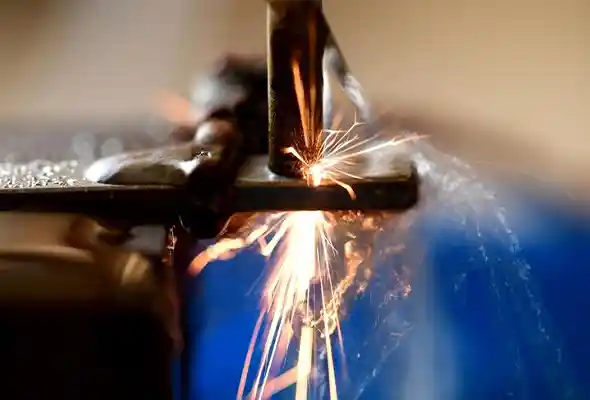
How Are Radial Cross-Holes Used in Miniature Medical Housings?
Miniature medical housings may use radial holes for fluid flushing, component crimping, or sensor-lead routing. Each hole must enter the central bore accurately without damaging the thin outer wall, sealing shoulder, or internal flow path.
A published medical application uses multi-axis EDM to machine titanium, stainless steel, cobalt-chromium, and Nitinol housings. Rotary positioning, workpiece probing, and dynamic coordinate correction are used to produce 90-degree radial cross-holes. The application also specifies a 32-microinch surface requirement before passivation. Multi-axis EDM medical housing case study
This application typically benefits from:
- Four- or five-axis rotary positioning;
- Automatic workpiece datum probing;
- Radial-hole coordinate compensation;
- Automatic electrode changing;
- Breakthrough detection and back-strike prevention;
- Exportable process, alarm, and rework records.
A length of 32 microinches equals approximately 0.813 µm. The drawing should still identify whether the requirement is Ra, Rz, RMS, or another surface parameter so every supplier uses the same measurement method.
Which Fine Holes Can Be Machined in Surgical Instruments and Implant Components?
Surgical tools and implant components commonly use 17-4PH, 13-8, 316L, Ti-6Al-4V, cobalt-chromium, or Nitinol. As material strength and hardness increase, mechanical microdrills become more susceptible to wear, breakage, and entry-point deflection.
Suitable EDM features include:
- Small through-holes in hardened stainless steel;
- Holes entering curved or angled surfaces;
- High-aspect-ratio holes in titanium and cobalt-chromium;
- Irrigation holes distributed at multiple angles;
- Start holes for enclosed wire EDM profiles;
- Holes in delicate structures that cannot tolerate cutting forces.
Fine-hole requirements in medical manufacturing can reach diameters of 0.010 mm with tolerances around ±0.005 mm. This scale requires a dedicated micro-EDM platform, a stable machining environment, and a measurement system capable of resolving the specified tolerance. It should not be assigned automatically to a conventional high-speed EDM hole drill. EDM hole-drilling technology and selection guide
Larger, easily accessible features such as standard bone-plate screw holes are usually more economical to drill or mill mechanically. EDM provides the most value when the hole is smaller, the material is harder, the entry angle is more complex, or cutting force must be minimized.
When Should EDM Be Used for Cannula and Minimally Invasive Device Side Ports?
Cannulas, instrument shafts, and metallic delivery components often require side ports, irrigation openings, or intersecting holes. EDM is a strong candidate when:
- The hole enters a cylindrical or angled surface;
- The side port must intersect a narrow central lumen;
- The component has already been heat-treated;
- Mechanical drilling may distort the tube;
- Internal mechanical burrs are difficult to remove;
- Several holes require precise rotary positioning;
- Production volume supports automatic electrode feeding and multi-station fixtures.
Laser drilling should also be evaluated for high-volume, thin-wall tubing. Laser processing usually offers a faster per-hole cycle, while EDM performs well with conductive hard materials, complex entry angles, and low-force machining.
How Is EDM Applied to IVD Fluid Components?
Metal probe holders, valve bodies, and fluid connectors used in blood analyzers and other IVD systems may combine an axial bore, lateral ports, sealing shoulders, and cleaning interfaces.
EDM is useful when a lateral hole must intersect an axial bore accurately or when a conventional drill cannot evacuate chips effectively. Acceptance should address:
- The intersection point between the lateral hole and axial bore;
- Internal lips or resolidified deposits;
- Pin-gauge and flow-test results;
- Particles and residues after cleaning;
- Integrity of sealing shoulders and mating surfaces;
- Positional repeatability between multiple ports.
If mechanical drilling already meets position, burr, and cycle-time requirements consistently, retaining the established process may be more economical than adding electrodes, dielectric fluid, and filtration.
Where Is CNC EDM Used in Medical Molds and Tooling?
A CNC EDM drilling machine can also produce tooling used to manufacture medical products:
- Fine openings in catheter and microtube extrusion dies;
- Vent holes in medical injection molds;
- Small holes in carbide stamping and forming dies;
- Start holes for enclosed wire EDM profiles;
- Hard-material holes in medical fixtures and locating plates.
Although this tooling does not contact the patient, dimensional drift and tool wear can affect final product dimensions, burr formation, and lot-to-lot consistency. Tool drawings, service life, replacement, repair, and change records should therefore remain under production control.
How Do Hole Drilling EDM, Micro-EDM, and Wire EDM Differ?
| EDM process | Tool and operating principle | Suitable features | Medical manufacturing use |
|---|---|---|---|
| High-speed hole drilling EDM | Rotating tubular electrode with internal high-pressure flushing | Through-holes, deep holes, angled holes, radial holes | Housing cross-holes, irrigation ports, start holes |
| Micro-EDM | Fine rod or tubular electrode with low-energy pulses | Extremely small holes, fine blind holes, microfeatures | Miniature instruments and fine implant components |
| Wire EDM | Continuously moving wire cuts through the workpiece | Slots, notches, and complex through-profiles | Surgical tool profiles, fixtures, and implant outlines |
| Sinker EDM | Formed electrode reproduces a cavity | Blind cavities, complex recesses, non-round features | Medical molds and specialized precision cavities |
Wire EDM normally requires a predrilled start hole when cutting an enclosed internal profile. In that workflow, the hole-drilling EDM creates the start hole, while the wire EDM determines the final profile accuracy.
How Should the Three EDM Hole-Machining Levels Be Selected?
| Machining level | Reference capability range | Typical application | Selection priority |
|---|---|---|---|
| Standard high-speed hole drilling | Electrodes around Ø0.10–3.00 mm; depths up to 200 mm on some machines; flushing up to about 7 MPa | Wire start holes, mold holes, general functional holes | Cycle time, breakthrough detection, and electrode consumption |
| Precision small-hole drilling | Electrodes around Ø0.20–3.00 mm; spindle speeds up to about 1,000 rpm on some platforms | Straight, angled, and radial instrument holes | Diameter, taper, position, and production Cpk |
| Dedicated micro-EDM | Micron-scale electrodes, low-energy pulses, and precision thermal control | Miniature instruments, fine implant components, and development parts | Thermal stability, measurement capability, and recast layer |
The minimum advertised electrode diameter is not the minimum finished-hole diameter. Spark gap, radial overcut, electrode runout, wear, and measurement uncertainty all affect the final result.
When Should EDM Be Chosen Instead of Laser or Mechanical Drilling?
| Selection factor | EDM drilling | Laser drilling | Mechanical microdrilling |
|---|---|---|---|
| Conductive hard materials | Well suited | Well suited | Higher tool wear |
| Nonconductive materials | Not suitable for conventional EDM | Processes many material types | Depends on the material |
| Cutting force on thin walls | Very low | No mechanical cutting force | May cause deformation |
| Curved or angled entry | Strong capability | Strong capability | Susceptible to drill walking |
| Per-hole cycle time | Usually slower | Usually fastest | Depends on diameter and material |
| High aspect ratio | Depends on flushing and electrode wear | Deep-hole debris evacuation can be difficult | Depends on tool stiffness and chip evacuation |
| Main surface risks | Recast layer, microcracks, material transfer | Spatter, heat-affected zone, taper | Burrs, work hardening, tool marks |
| Consumables | Electrodes, dielectric, filters | Shielding gas, optical components | Drills, cutting fluid |
| Production suitability | Medium-volume and automated production | High-speed, high-volume production | High-volume production of regular holes |
EDM is most valuable when difficult materials, small diameters, complex entry angles, and sensitivity to cutting force occur in the same component.
What Should Be Verified When Purchasing a CNC EDM Drilling Machine?
Machine travel, electrode range, and maximum pressure are not enough to approve a production process. Factory acceptance testing should use the intended material, representative wall thickness, production fixture, and worst-case electrode condition.
| Verification item | Data to record | Purchasing purpose |
|---|---|---|
| Diameter and roundness | Mean, standard deviation, minimum, maximum, and Cpk | Demonstrates production dimensional capability |
| Position and angle | Datum system, measurement program, and positional deviation | Confirms that radial holes enter the intended lumen |
| Entry-to-exit taper | CT, contour, or section measurements | Evaluates flushing and electrode wear |
| Breakthrough detection | Detection signal, stopping position, and back-wall condition | Prevents damage after hole breakthrough |
| Electrode life | Holes per electrode, length loss, and replacement rule | Calculates consumable cost and dimensional drift |
| Continuous operation | Longest cycle, alarms, downtime, and temperature change | Evaluates automation stability |
| Data export | Program version, operator, settings, alarms, and timestamps | Supports lot traceability |
| Energy use | Measured average kW and kWh per part | Supports five-year total cost calculations |
A kVA rating is apparent power. It should not be converted directly into input kW or annual energy consumption without the machine’s power factor and actual load profile.
Which Quality Characteristics Must Be Inspected on Medical EDM Holes?
EDM does not normally create the rolled mechanical burr associated with conventional drilling. However, the discharge process may produce resolidified deposits, a recast layer, microcracks, hole taper, and electrode-material transfer.
| Quality characteristic | Recommended method | Primary risk |
|---|---|---|
| Diameter, roundness, and position | Optical measurement, CMM, or CT | Spark gap and electrode runout change final geometry |
| Entry-to-exit taper | CT, contour measurement, or sectioning | Flushing and electrode wear vary with depth |
| Internal edge condition and blockage | Borescope, CT, pin gauge, or flow test | Intersecting holes are difficult to inspect visually |
| Recast layer | Metallographic section or SEM at the entrance, wall, and exit | Melted material resolidifies on the hole wall |
| Microcracks | SEM at a defined magnification | May affect fatigue strength and localized corrosion |
| Electrode-material transfer | EDS elemental analysis | Electrode or dielectric constituents may remain on the wall |
| Cleanliness and particles | Validated cleaning and particle testing | Loose particles may enter a fluid path or patient-contact area |
| Corrosion and surface treatment | Product-specific corrosion testing | Implant surfaces may be susceptible to localized corrosion |
Final medical products should be managed under ISO 14971 risk-management principles. Depending on the product and intended use, the validation plan may also reference ISO 13485, ISO 10993-1:2025, ISO 10993-18, ASTM F86-21(2026), and ASTM F2129-25.
Conclusion
CNC EDM drilling is particularly valuable for conductive hard materials, thin-wall components, angled entry points, and microholes that are difficult to produce with mechanical tools. A successful process depends on matching the machine, electrode, flushing system, automation, and inspection method to the actual part requirements.
For manufacturers evaluating a suitable configuration, MINNUO offers CNC EDM drilling machines and application-based equipment selection. Buyers can submit the material, hole size, depth, drawing, and production volume for a configuration review before FAT requirements are finalized.
CNC EDM Medical Application FAQ
Q: Which applications benefit most from EDM?
A: Radial cross-holes, flushing ports, and sensor-lead passages in thin-wall medical housings, plus straight, angled, and high-aspect-ratio holes in hardened surgical instruments.
Q: Does material hardness limit EDM?
A: Conventional cutting hardness is generally not the main limitation as long as the material is electrically conductive. Discharge energy, flushing, electrode selection, and wear compensation must be adjusted for each material.
Q: Can cleaning and post-processing be eliminated?
A: EDM normally avoids rolled mechanical burrs, but resolidified deposits, a recast layer, microcracks, and loose particles may remain. Cleaning and surface verification are still required.
Q: Which process is better for production?
A: Laser drilling usually offers a faster cycle. EDM is stronger for conductive hard materials, complex entry angles, and low-force machining. The decision should be based on trials using the same drawing, material, and inspection method.
Q: Can a 0.10 mm electrode reliably produce a 0.10 mm finished hole?
A: Not directly. Spark gap, radial overcut, electrode runout, wear, and measurement uncertainty all influence the finished diameter.
 Email
 sales1: +86 15312799623