



CNC EDM Drilling Machines for High-Aspect-Ratio Holes: 6 Critical Requirements
High-aspect-ratio EDM drilling demands more than accurate CNC positioning. As holes become deeper and narrower, poor debris removal, electrode deflection, unstable discharge, and tool wear can quickly compromise hole accuracy and machining efficiency.
For precision machining manufacturers, the real challenge is maintaining consistent hole diameter, straightness, and surface quality throughout the drilling process.
A high-performance CNC EDM drilling machine must combine six essential capabilities: precise pulse control, effective dielectric flushing, accurate electrode guidance, responsive servo feeding, electrode wear management, and stable mechanical positioning.
Understanding these requirements helps manufacturers select equipment that can handle demanding deep-hole applications without sacrificing productivity or dimensional accuracy.
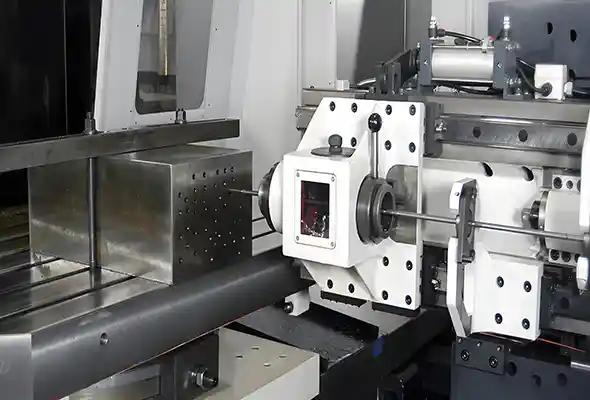
1. What Is High-Aspect-Ratio EDM Drilling?
High-aspect-ratio EDM drilling is used to produce deep, narrow holes in electrically conductive materials through controlled electrical discharges.
Unlike mechanical drilling, EDM removes material through electrical erosion rather than direct cutting contact. This makes it particularly useful for hardened tool steels, titanium alloys, nickel-based superalloys, and conductive tungsten carbide grades.
The hole aspect ratio describes the relationship between depth and diameter:
Aspect Ratio=Hole Depth÷Hole Diameter
For example, a hole measuring 0.5 mm in diameter and 15 mm in depth has an aspect ratio of 30:1.
| Hole diameter | Hole depth | Aspect ratio |
|---|---|---|
| 0.3 mm | 3 mm | 10:1 |
| 0.3 mm | 9 mm | 30:1 |
| 0.5 mm | 15 mm | 30:1 |
| 0.5 mm | 20 mm | 40:1 |
| 1.0 mm | 30 mm | 30:1 |
The values above illustrate geometric relationships rather than specific machine performance.
As the aspect ratio increases, debris removal and electrode stability become more challenging. However, hole diameter also matters. A 0.3 mm hole at 30:1 typically presents different difficulties from a 2 mm hole at the same aspect ratio.
High-Speed EDM Drilling vs. Micro-EDM
Industrial high-speed EDM drilling and specialized micro-EDM share the same electrical erosion principle but serve somewhat different machining needs.
High-speed EDM drilling machines commonly use hollow tubular electrodes for small-hole and deep-hole applications, including wire-EDM starter holes, mold components, and precision metal parts.
Micro-EDM systems focus on extremely small features, often requiring miniature electrodes and very low discharge energy.
For most industrial deep-hole applications, the key considerations are electrode diameter, achievable depth, flushing performance, and finished-hole quality.
2. Why Are High-Aspect-Ratio Holes Difficult to Machine?
As drilling depth increases, the conditions inside the machining gap become increasingly complex.
Three problems account for many of the quality and productivity challenges encountered during deep-hole EDM drilling.
Debris Accumulation and Unstable Discharge
During EDM drilling, electrical discharges remove small amounts of material from the workpiece.
These particles must be carried away by the dielectric fluid.
In shallow holes, debris can escape relatively easily. In deep, narrow holes, the restricted gap makes flushing more difficult.
When debris accumulates, secondary discharges may occur along the electrode sidewall instead of the intended machining front.
This can lead to excessive hole enlargement, increased taper, unstable machining, and higher electrode wear.
Research on electrical discharge drilling identifies poor debris evacuation as a major limitation in high-aspect-ratio machining.
Electrode Deflection and Hole Straightness
Deep micro-holes often require long, slender electrodes.
Although EDM does not generate conventional mechanical cutting forces, electrodes can still experience deflection caused by dielectric flow, spindle runout, vibration, and guide misalignment.
Smaller electrodes have lower bending stiffness, making precise guidance particularly important.
As drilling progresses, even slight electrode misalignment can affect the final hole axis.
This explains why a machine with accurate CNC positioning can still produce holes with unacceptable straightness or taper.
Electrode Wear and Dimensional Errors
Electrode wear is another major challenge.
As machining continues, the electrode gradually loses material. Axial wear affects effective electrode length, while radial and corner wear can change the hole profile.
These effects become more important during deep blind-hole machining and repeated production.
Without effective wear management, the finished hole may be shallower than expected or show greater dimensional variation.
A stable process must therefore control electrode consumption while maintaining efficient material removal.
3. Six Critical CNC EDM Drilling Machine Requirements for Deep Holes
3.1 Precision Pulse Generator for Stable Discharge Control
The pulse power supply plays a central role in EDM drilling accuracy and efficiency.
It controls the electrical energy delivered to the machining gap, influencing material removal rate, electrode wear, and surface condition.
Higher discharge energy can improve removal efficiency, but excessive energy may increase overcut and thermal damage.
Lower-energy settings may improve surface quality, although they often reduce machining speed.
A capable EDM drilling machine should provide suitable control over:
- Discharge voltage and current.
- Pulse duration and interval.
- Discharge-gap conditions.
- Short-circuit detection and recovery.
- Machining stability during deep-hole penetration.
For high-aspect-ratio holes, the priority is maintaining consistent discharge behavior as machining depth increases.
A well-designed pulse generator helps reduce abnormal discharges, minimize unnecessary electrode wear, and improve hole consistency.
3.2 Effective Dielectric Flushing for Deep-Hole Debris Removal
Flushing performance becomes increasingly important as the machining gap grows deeper.
Many industrial EDM drilling machines use hollow tubular electrodes to deliver dielectric fluid toward the machining zone.
This helps remove eroded particles and maintain stable discharge conditions.
However, deep holes restrict the escape path for debris, making flushing efficiency more difficult to maintain.
An effective flushing system should provide consistent fluid delivery, appropriate pressure and flow, reliable filtration, and stable performance during extended drilling operations.
Electrode rotation can also assist debris movement in suitable applications.
For extremely small holes, specialized methods such as periodic electrode retraction or modified electrode geometry may improve flushing.
Effective debris removal is often one of the main differences between successful deep-hole drilling and a process that becomes unstable before reaching the required depth.
3.3 Precision Spindle and Electrode Guidance for Hole Straightness
Hole straightness depends heavily on how accurately the electrode is supported and guided.
A high-precision CNC controller cannot fully compensate for electrode runout, guide misalignment, or excessive unsupported electrode length.
For small-diameter electrodes, these factors become especially important.
A suitable spindle and guidance system should provide:
- Low spindle runout.
- Accurate electrode clamping.
- Consistent guide alignment.
- Minimal unsupported electrode length.
- Stable rotation when required.
Precision guides help keep the electrode aligned with the intended drilling axis and reduce unwanted lateral movement.
Research reviewed in 2022 described specialized electrode-guidance arrangements that achieved experimental aspect ratios as high as 44:1.
This demonstrates how improved electrode support can extend deep-hole machining capability.
For manufacturers producing narrow holes with strict geometric tolerances, guide accuracy is often as important as the machine's positioning performance.
3.4 Responsive Servo Feed for Stable Machining
The servo feed system controls electrode movement while maintaining the electrical discharge gap.
If the electrode advances too aggressively, frequent short circuits may occur.
If the servo retracts too often or responds slowly, machining efficiency decreases.
Deep-hole EDM drilling requires the servo to handle changing conditions as debris accumulates and flushing becomes more difficult.
A responsive feed system can maintain more stable discharge conditions and reduce unnecessary interruptions.
Important characteristics include fine-feed stability, reliable gap feedback, fast short-circuit recovery, and controlled movement during hole breakthrough.
These capabilities contribute directly to machining consistency and productivity.
3.5 Electrode Wear Management for Consistent Hole Depth
Electrode wear affects both hole geometry and operating cost.
As the electrode becomes shorter, the relationship between programmed movement and actual hole depth changes.
Corner and radial wear may also influence the hole diameter and taper.
Depending on the machine configuration, wear management can involve programmed compensation, periodic measurement, controlled feeding, or electrode replacement.
For repeated production, automatic or standardized electrode handling can reduce manual intervention and improve consistency.
Effective wear management is particularly important when machining deep blind holes, where even a small depth error may cause the finished part to fall outside tolerance.
3.6 CNC Positioning Accuracy and Long-Term Machine Stability
High-aspect-ratio drilling often involves long machining cycles and repeated electrode changes.
During these operations, mechanical alignment, thermal behavior, and fixture stability influence dimensional consistency.
A well-designed machine should combine accurate axis movement with a rigid mechanical structure, stable spindle mounting, reliable workpiece clamping, and consistent positioning.
For components containing multiple holes, CNC control also simplifies hole-pattern programming and repeated positioning.
However, machine quality is not determined by structure or axis resolution alone.
The most useful performance measure is the ability to maintain consistent finished-hole quality during actual production.
4. How to Control Hole Taper, Overcut, and Straightness in EDM Drilling
High-aspect-ratio hole quality involves several dimensional characteristics.
A hole may have the correct entrance diameter while still showing unacceptable taper, axis deviation, or depth error.
Understanding these differences helps engineers identify the actual causes of machining problems.
How Does Discharge Overcut Affect Hole Diameter?
Discharge overcut describes the difference between the physical electrode size and the finished-hole dimension.
Electrical discharges remove material across a small gap, so the resulting hole is generally larger than the electrode.
For an approximately circular hole, the effective radial overcut can be estimated as:
g=(Dh-De)÷2
Where Dh is the measured hole diameter and De is the relevant electrode outer diameter.
Overcut is influenced by discharge energy, electrode condition, material, and flushing.
Controlling it requires selecting suitable electrodes and establishing stable machining parameters.
What Causes Hole Taper in Deep EDM Drilling?
Hole taper occurs when the diameter changes along the drilling depth.
One simple way to evaluate it is to compare entrance and exit diameters:
△ D=Dentrance-Dexit
Secondary side discharges, electrode wear, and changing flushing conditions can contribute to taper.
A larger entrance diameter does not always mean the electrode is incorrectly sized. It may indicate that discharge conditions changed as the hole became deeper.
Improving flushing, electrode guidance, and wear management can help reduce these variations.
How Does Electrode Deflection Affect Hole Straightness?
Hole straightness describes how closely the actual hole axis follows the intended drilling direction.
Electrode deflection can cause the hole axis to deviate even when the CNC feed system follows its programmed path.
Accurate guides, stable clamping, and controlled electrode length help minimize this problem.
For demanding components, measuring both entrance and exit geometry provides more useful information than inspecting the entrance alone.
Why Does Hole Breakthrough Affect Accuracy?
When the electrode breaks through the opposite surface of a workpiece, dielectric flow changes.
Fluid and debris can escape through the new opening, affecting discharge behavior near the exit.
This may create local dimensional variation or exit defects.
For precision through-holes, controlled breakthrough and suitable exit inspection help maintain consistent results.
5. What Does Research Reveal About High-Aspect-Ratio EDM Drilling?
Research on deep-hole EDM drilling highlights the importance of electrode design, flushing performance, and machining stability.
In a 2020 study published in Procedia CIRP, researchers investigated specially shaped micro-electrodes for drilling tungsten carbide.
Their experiments demonstrated high-aspect-ratio holes of approximately 10:1 using modified electrode geometry to improve debris evacuation.
A 2022 review of electrical discharge drilling also discussed specialized electrode guidance systems achieving aspect ratios up to 44:1 in experimental conditions.
These studies used different equipment and machining methods, but they point toward the same conclusion.
Improving electrode guidance and debris removal can substantially extend the practical capability of EDM drilling.
The machine's maximum travel range is only one part of the problem. The ability to maintain stable discharge and electrode alignment throughout the drilling process is equally important.
For industrial manufacturers, these findings reinforce the value of well-designed flushing systems, precision guides, and reliable process control.
6. How to Evaluate CNC EDM Drilling Machine Specifications
Machine specifications provide a useful starting point, but engineers should focus on how those specifications affect actual machining performance.
The following table summarizes the most important selection criteria.
| Machine capability | What to examine | Why it matters |
|---|---|---|
| Pulse generator | Discharge control and stability | Influences overcut, material removal, and surface quality |
| Electrode system | Supported sizes, spindle, and guides | Affects hole diameter and straightness |
| Flushing system | Pressure, flow, and filtration | Controls debris evacuation |
| Servo feed | Gap feedback and response | Influences machining stability |
| Wear management | Compensation and electrode handling | Supports consistent depth |
| CNC positioning | Accuracy and repeatability | Controls hole location |
| Machine structure | Rigidity and alignment | Supports consistent operation |
When selecting equipment for deep-hole applications, the most useful comparison is not simply which machine has the highest advertised drilling speed.
Instead, engineers should consider whether the equipment can maintain acceptable hole geometry while achieving practical production efficiency.
For example, two machines may produce the same nominal hole diameter, but one may require frequent interruptions or electrode replacement.
A more stable machine can therefore offer better production value even if its maximum advertised drilling speed is lower.
7. How to Select a CNC EDM Drilling Machine for Deep-Hole Applications
Equipment selection should begin with the most demanding feature of the intended workpiece.
Consider a hardened steel component requiring a 0.5 mm diameter through-hole with a depth of 20 mm.
Its nominal aspect ratio is 40:1.
In this application, electrode guidance, debris removal, and wear management are likely to be important factors.
The manufacturer should evaluate the machine using the actual hole dimensions, material, and required tolerances.
Define the Machining Requirements
Prepare a specification covering:
- Workpiece material.
- Hole diameter and depth.
- Dimensional tolerances.
- Hole type and orientation.
- Required production volume.
- Surface-quality requirements.
This information helps narrow the selection to equipment with suitable working capacity, electrode options, and process controls.
Conduct a Representative Drilling Trial
A practical machining trial provides a clearer understanding of equipment performance than nominal specifications alone.
The trial should assess entrance and exit dimensions, hole depth, taper, and overall consistency.
Where required, additional inspection may include hole straightness, surface roughness, or recast-layer condition.
Compare Production Efficiency
Production efficiency involves more than the time needed to drill one hole.
Electrode replacement, machine interruptions, inspection, and rejected parts all contribute to manufacturing cost.
A useful comparison is the cost per accepted hole:
Cost per Accepted Hole=Total Production Cost÷Number of Accepted Holes
This provides a more practical basis for comparing equipment intended for continuous production.
8. Where Are High-Aspect-Ratio EDM Holes Used?
High-aspect-ratio EDM drilling supports a range of precision manufacturing applications.
Aerospace Components
Turbine blades and other high-temperature alloy components may contain narrow cooling holes with demanding geometric and surface-integrity requirements.
EDM can process electrically conductive high-temperature alloys without relying on conventional mechanical cutting forces.
Mold and Die Manufacturing
Hardened molds and dies may require deep starter holes, precision openings, and small passages.
EDM drilling is particularly useful where material hardness makes conventional drilling difficult.
Fuel Injection and Precision Nozzles
Selected nozzle components require accurately controlled small openings to achieve intended flow characteristics.
Hole diameter, geometry, and consistency are important manufacturing considerations.
Hard-Metal Precision Tooling
Conductive tungsten carbide grades and hardened tool steels can be machined using EDM.
For deep, narrow features, stable discharge and electrode wear control help maintain consistent results.
9. Five Common Mistakes When Selecting an EDM Drilling Machine
1. Choosing Equipment Based Only on Electrode Diameter
The supported electrode diameter does not determine the finished-hole diameter or achievable machining depth.
2. Assuming Higher Flushing Pressure Always Improves Performance
Effective debris removal depends on flow conditions, electrode geometry, and machining-gap clearance.
3. Confusing CNC Resolution With Hole Accuracy
Small programmed movement increments do not guarantee equivalent finished-hole accuracy.
4. Comparing Maximum Aspect Ratios Without Considering Machining Conditions
Material, electrode design, hole diameter, and dimensional requirements all influence achievable depth.
5. Prioritizing Drilling Speed Over Consistent Hole Quality
A faster machining cycle provides limited value if holes require excessive rework or inspection failures increase.
For precision manufacturers, stable production and consistent dimensional quality are more valuable than impressive isolated specifications.
10. FAQs About CNC EDM Drilling for High-Aspect-Ratio Holes
Q:What Is the Maximum Aspect Ratio for EDM Drilling?
A:There is no single maximum applicable to every EDM drilling machine. Achievable aspect ratio depends on hole diameter, material, electrode design, flushing, and dimensional requirements. Specialized research systems have demonstrated very high aspect ratios using advanced guidance and process-control methods.
Q:Can CNC EDM Machines Drill Holes Smaller Than 0.3 mm?
A:Yes, specialized micro-EDM equipment can produce holes smaller than 0.3 mm. Standard industrial EDM drilling machines may have different minimum supported electrode sizes and machining capabilities.
Q:Why Does EDM Drilling Speed Decrease With Hole Depth?
A:Deeper holes restrict debris evacuation, increasing the likelihood of secondary discharges, short circuits, and servo retractions. These conditions reduce effective material removal efficiency.
Q:How Can Hole Taper Be Reduced in EDM Drilling?
A:Improving flushing, optimizing discharge parameters, maintaining electrode alignment, and controlling electrode wear can help reduce taper.
Q:Can EDM Drill Hardened Steel and Tungsten Carbide?
A:Yes. EDM can machine hardened steel and electrically conductive tungsten carbide grades. Process performance depends on material composition, electrode selection, and machining conditions.
Q:How Can Buyers Verify Deep-Hole Drilling Accuracy?
A:Representative machining trials can be used to evaluate actual hole diameter, depth, taper, straightness, machining time, and repeatability.
11. Conclusion: Choose CNC EDM Drilling Machines Based on Hole Quality
High-aspect-ratio EDM drilling places demanding requirements on machine design and process control.
As holes become deeper and narrower, debris evacuation, electrode stability, discharge behavior, and wear management become increasingly important.
A suitable CNC EDM drilling machine should combine precise pulse control, effective flushing, accurate electrode guidance, responsive servo feeding, and reliable positioning.
For precision machining manufacturers, consistent hole quality and stable production performance are more valuable than maximum drilling speed or depth claims alone.
The right machine is one that can reliably produce the required hole geometry while maintaining practical machining efficiency.
For manufacturers exploring deep-hole EDM solutions, MINNUO offers a range of CNC and high-speed EDM drilling equipment for conductive materials. The MINNUO EDM Drilling Machine Series provides an overview of available configurations for different machining requirements.

 Email
 sales1: +86 15312799623