



CNC Milling Machine Automation Transformation Plan: Upgrade Path from Standalone Machine to Flexible Manufacturing Cell
In the era of intelligent manufacturing, the automation transformation of CNC milling machines is no longer an option but a necessary path for enterprises to improve production efficiency, reduce labor costs, and enhance market competitiveness. For production directors and automation planning engineers, how to smoothly upgrade from a standalone CNC milling machine to a flexible manufacturing cell (FMC) has become a core issue. This article focuses on the key links of CNC milling automation transformation, including robot loading and unloading, automatic tool change systems, online measurement integration, and multi-machine connection, to provide a practical and feasible upgrade path for enterprises, helping you realize the leap from traditional processing to intelligent manufacturing.
Why Transform CNC Milling Machine Automation? Core Demands of Production Directors & Automation Engineers
Traditional standalone CNC milling machines rely heavily on manual operations, which have many pain points: low production efficiency (long idle time of machines due to manual loading and unloading), high labor costs (difficulty in recruiting and retaining skilled operators), unstable product quality (human errors in loading, unloading and tool change), and limited production capacity (difficult to achieve 24-hour continuous operation).
The machine tool automation transformation and the upgrade to a flexible manufacturing cell can perfectly solve these pain points: it can reduce labor input by 60%-80%, improve machine utilization rate from 50% to more than 85%, ensure consistent product precision, and realize unattended operation, laying a foundation for the enterprise’s subsequent intelligent factory construction.
Upgrade Path: From Standalone Machine to Flexible Manufacturing Cell (4 Key Stages)
The automation transformation of CNC milling machines is not an overnight project. It needs to be promoted step by step according to the enterprise’s production scale, product type, and budget. The following is a phased upgrade path suitable for most manufacturing enterprises, covering the core links of transformation.
Stage 1: Basic Automation - Robot Loading and Unloading (Entry-Level Transformation)
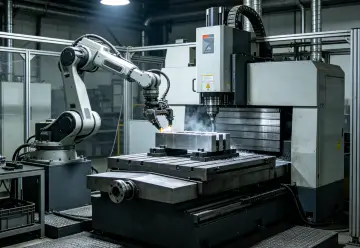
Robot loading and unloading is the first step of CNC milling machine automation transformation, with low investment, quick effect, and suitable for enterprises that have just started automation. Its core is to replace manual loading and unloading with industrial robots, reduce human intervention, and improve the continuity of machine processing.
Key implementation points:
- Robot selection: According to the weight of the workpiece (usually 1-50kg for CNC milling), select a 6-axis industrial robot with high rigidity and high repeat positioning accuracy (±0.02mm). For small workpieces, collaborative robots can be selected to save space; for heavy workpieces, gantry robots are recommended to ensure stability.
- Integration with CNC machine tools: Realize signal communication between the robot and the CNC system (such as Fanuc, Siemens), ensure that the robot and the machine tool are linked in steps (the robot loads materials after the machine tool completes processing, and the machine tool starts processing after the robot unloads materials), and avoid collision between the robot and the machine tool.
- Feeding and blanking mechanism: Configure a simple feeding rack (such as a vibrating plate, material box) according to the shape of the workpiece, realize automatic feeding of blanks and automatic collection of finished products, and reduce manual handling links.
Transformation effect: Machine idle time is reduced by 40%+, labor input is reduced by 1-2 people per machine, and the processing efficiency is increased by 30% on average. It is suitable for small and medium-sized enterprises with single product, large batch, and simple processing technology.
Stage 2: Efficiency Upgrade - Automatic Tool Change System Integration
After realizing robot loading and unloading, the next step is to solve the problem of manual tool change, which is the key to improving processing efficiency and reducing human errors. The automatic tool change system (ATC) is integrated with the CNC milling machine to realize automatic tool selection, tool change, and tool management, which is especially suitable for workpieces that require multiple tool processing (such as complex parts with drilling, milling, boring, and tapping).
Key implementation points:
- Selection of automatic tool change system: According to the number of tools required for processing (usually 16-60 tools), select a turret tool changer (suitable for small and medium-sized milling machines) or a chain tool changer (suitable for large-scale, complex processing). Ensure that the tool change time is less than 5 seconds to avoid affecting processing efficiency.
- Tool management function: Integrate tool length measurement and tool wear detection modules in the CAM system, realize real-time monitoring of tool status, automatically alarm when tool wear exceeds the limit, and avoid product defects caused by tool failure.
- System debugging: Cooperate with the robot loading and unloading system to realize the linkage of tool change and workpiece loading and unloading, ensure that the tool change is completed before the workpiece is loaded, and the next tool is prepared in advance during processing to shorten the auxiliary time.
Stage 3: Quality Control - Online Measurement Integration
For enterprises with high requirements for product precision (such as auto parts, aerospace parts), online measurement integration is an indispensable link in automation transformation. It can realize real-time measurement of workpieces during processing, automatically adjust processing parameters, avoid over-processing or under-processing, and reduce the scrap rate.
Key implementation points:
- Selection of online measurement equipment: Install a contact probe or non-contact laser probe on the CNC milling machine, which can measure the size, position, and shape of the workpiece in real time without disassembling the workpiece.
- Data integration and feedback: Connect the online measurement equipment with the CNC system and MES system, transmit the measurement data to the system in real time, and automatically adjust the cutting parameters (such as cutting depth, feed rate) if the deviation exceeds the standard, or stop processing and alarm to remind the operator.
- Process optimization: Use the accumulated measurement data to analyze the causes of dimensional deviations (such as tool wear, machine tool deformation), optimize the processing process, and continuously improve product precision and stability.
Stage 4: Flexible Upgrade - Multi-Machine Connection to Build Flexible Manufacturing Cell
The ultimate goal of CNC milling automation transformation is to build a flexible manufacturing cell (FMC), which connects multiple CNC milling machines, robots, automatic tool change systems, and online measurement equipment through a conveyor line or AGV, realizing flexible production of multiple products and small batches.
Key implementation points:
- Layout design: According to the production process, reasonably arrange the position of each equipment (milling machine, robot, conveyor line), minimize the movement distance of the robot and AGV, and improve production efficiency. For example, arrange multiple milling machines in a circle, and one robot is responsible for loading and unloading multiple machines.
- Control system integration: Use a unified PLC control system to realize the linkage of all equipment in the cell, realize automatic scheduling of workpieces (AGV transports workpieces between different machines), automatic allocation of tools, and real-time monitoring of production status.
- Flexible production realization: Configure a flexible fixture system, which can quickly switch fixtures according to different product types, realize quick changeover of production lines (changeover time is less than 30 minutes), and meet the production needs of multiple products and small batches.
Transformation effect: The production capacity of the cell is increased by 50%+ compared with standalone machines, the labor cost is reduced by 70%+, the scrap rate is reduced to less than 1%, and it can quickly respond to market changes and customer personalized needs.
Key Notes for CNC Milling Automation Transformation (For Production Directors & Automation Engineers)
- Combined with enterprise actual needs: Do not blindly pursue high automation, select the appropriate transformation stage and equipment according to the enterprise’s product type, production scale, and budget. For example, small-batch and multi-variety enterprises can give priority to flexible fixture and online measurement transformation.
- Pay attention to system compatibility: When selecting robots, automatic tool change systems, and online measurement equipment, ensure that they are compatible with the original CNC system (such as Fanuc, Siemens, Mitsubishi) to avoid problems such as signal mismatch and difficult debugging.
- Strengthen personnel training: After the transformation, train operators and maintenance personnel to master the operation and maintenance skills of automation equipment, and establish a regular maintenance system to ensure the stable operation of the equipment.
Conclusion
The automation transformation of CNC milling machines from standalone machines to flexible manufacturing cells is a phased, systematic project. By gradually implementing robot loading and unloading, automatic tool change system, online measurement integration, and multi-machine connection, enterprises can effectively solve the pain points of traditional processing, improve production efficiency, product quality, and market competitiveness. For production directors and automation planning engineers, grasping the core links and upgrade paths of machine tool automation transformation is the key to realizing the intelligent upgrading of the enterprise’s production line.
If you are facing the confusion of CNC milling automation transformation, or need to customize a transformation plan according to the enterprise’s actual situation, you can contact us for professional technical support and solutions.
 Email
Email sales1: +86 15312799623