



Function and Classification of Machine Tool Grating Scales – Analysis of Core Components for Precision Positioning
1 High-Precision Displacement Detection and Positioning: The Core of Ensuring Machining Accuracy
The core requirement of part machining is dimensional accuracy, which fundamentally depends on precise control of the relative position between the cutting tool and the workpiece. During machine tool operation, positional deviations of moving parts such as worktables and spindles directly cause dimensional errors of parts, which may lead to defective products. Machine tool grating scales enable real-time, high-precision measurement of the displacement of moving components, achieving detection accuracy at the micron (0.001 mm) or even nanometer (0.000001 mm) level – far exceeding traditional measuring components.
The grating scale transmits the detected displacement signal to the CNC system in real time. The system compares the actual displacement with the preset machining parameters (theoretical displacement). If a deviation is detected, it immediately sends an adjustment command to drive the servo motor and correct the trajectory of moving parts, keeping displacement errors within the allowable range.
In addition, the high-precision positioning capability of grating scales significantly improves part consistency. In mass production, traditional machine tools often produce inconsistent dimensions due to positioning errors. In contrast, machine tools equipped with grating scales ensure uniform machining dimensions for every part, reducing reject rates and improving production efficiency.
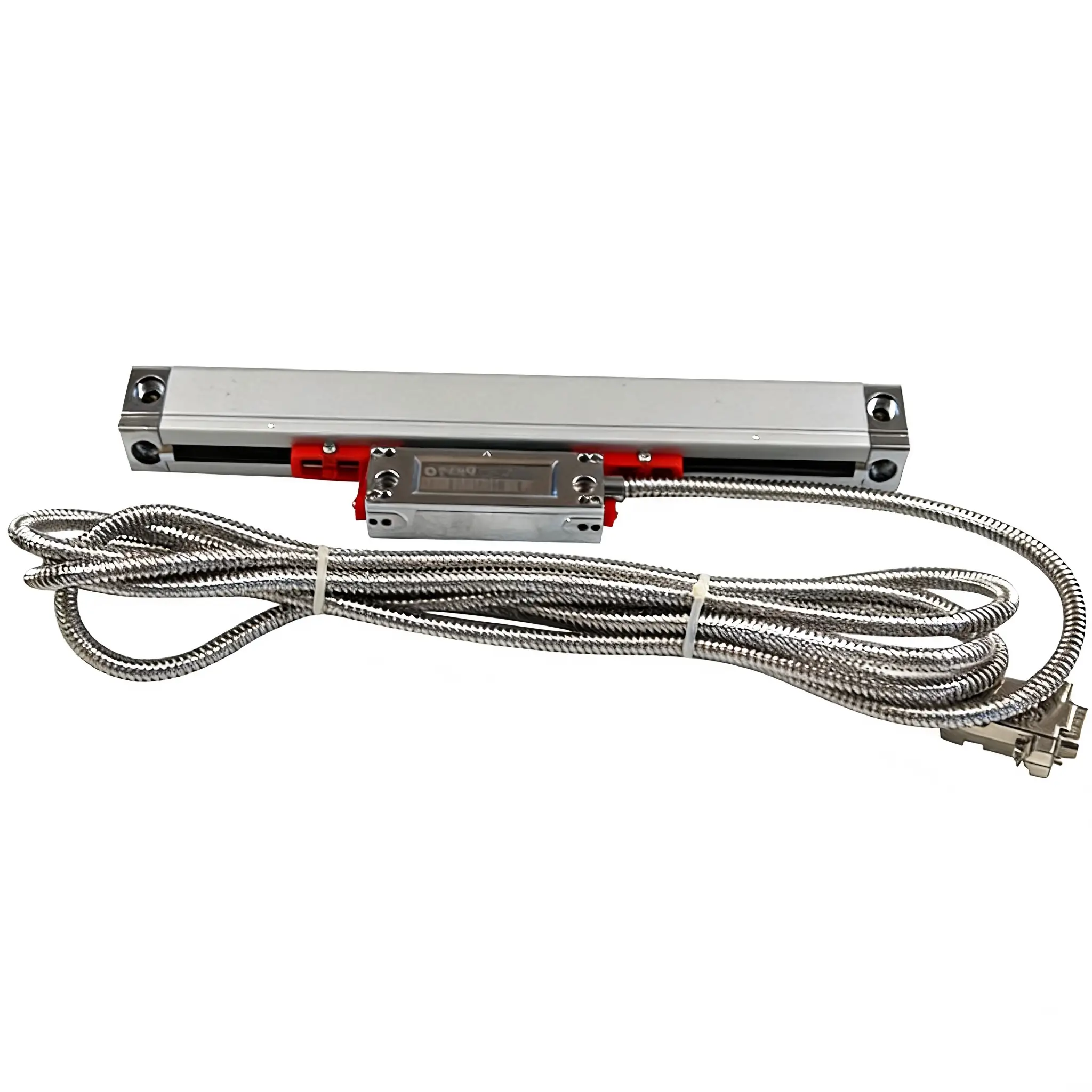
2 Real-Time Feedback and Closed-Loop Control: Enhancing Machine Tool Motion Stability
Machine tool control systems include open-loop and closed-loop modes, whose key difference lies in displacement feedback capability. Traditional open-loop systems control the displacement of moving parts only by motor pulse signals, without real-time deviation detection. They are easily affected by mechanical wear, load changes and temperature fluctuations, resulting in increased positioning errors.
In contrast, closed-loop systems integrate displacement sensors such as grating scales to form a self-regulating cycle of detection – feedback – adjustment, which greatly improves motion stability and control accuracy.
At present, high-end precision machine tools (such as five-axis CNC machine tools and ultra-precision grinding machines) generally adopt closed-loop control systems. As the core feedback component of these systems, the performance of grating scales directly determines the effect of closed-loop control. Industry research shows that closed-loop control systems equipped with grating scales achieve 3–5 times higher positioning accuracy than open-loop systems, with significantly improved motion stability.
3 Precision Speed Detection and Optimization: Improving Machining Efficiency and Surface Quality
In addition to displacement detection, machine tool grating scales also realize precise speed measurement. The system calculates the operating speed of moving parts by counting the number of Moiré fringe pulses captured by the photoelectric sensor per unit time. Based on the speed data from the grating scale, the CNC system dynamically adjusts the rotation speed of the drive motor to optimize the acceleration and deceleration process, achieving a motion state of smooth start, stable operation and accurate stop.
This speed optimization mechanism brings two core benefits:
- Improves machining efficiency
- Improves part surface quality
Furthermore, the speed detection function of the grating scale provides data support for machine tool overload protection. When the operating speed of moving parts exceeds the preset threshold, the system can stop the machine in time according to the feedback signal of the grating scale to prevent equipment damage or safety accidents.
4 Error Compensation and Precision Calibration: Extending the Precision Service Life of Equipment
During long-term operation, machine tools inevitably produce positioning errors due to mechanical wear, temperature changes and vibrations. Grating scales not only detect these errors, but also cooperate with the CNC system to compensate for them, thus extending the precision service life of the equipment.
In addition, grating scales can be used as precision calibration tools for machine tools. During equipment maintenance, technicians can analyze the detection data of the grating scale to accurately evaluate the accuracy loss and formulate targeted solutions (such as lead screw lubrication or guide rail alignment), so as to prevent quality degradation caused by accuracy problems.
5 Detailed Classification of Machine Tool Grating Scales
Machine tool grating scales can be classified by multiple criteria, with obvious differences in structural design, performance parameters and application scenarios. The industry mainly classifies them into four categories: working principle, grating pitch, installation method and material.
5.1 Classification by Working Principle
5.1.1 Transmission Grating Scale
The transmission grating scale uses transparent materials (such as glass) for both the main scale and the readhead grating, with evenly distributed light-transmitting and light-blocking stripes on the surface.
Core advantages:
- Ultra-high precision
- Stable performance
- Fast response
Disadvantages: Limited anti-pollution capability.
Application scenarios: High-precision machine tools, measuring instruments, and electronic chip processing equipment.
5.1.2 Reflection Grating Scale
The reflection grating scale is made of metal materials (such as stainless steel), with reflective and non-reflective grooves etched on the surface; the readhead grating is still transparent glass.
Core advantages:
- Excellent anti-fouling performance
- Compact structure
- Cost-effective
Disadvantages: Slightly lower accuracy than transmission grating scales.
Application scenarios: General machine tools, heavy-duty processing equipment, and harsh machining environments.
5.2 Classification by Grating Pitch
5.2.1 Coarse Grating Scale
Coarse grating scales have a large grating pitch, usually more than 0.05 mm (50 μm), with common specifications of 0.1 mm, 0.2 mm, 0.5 mm.
Core advantages:
- Cost-effective
- Strong anti-interference
- Long service life
Application scenarios: Ordinary machine tools, conveying equipment, and rough positioning stations with low precision requirements.
5.2.2 Fine Grating Scale
Fine grating scales have an extremely small grating pitch, usually less than 0.05 mm (50 μm), with common specifications of 0.01 mm, 0.02 mm, 0.005 mm.
Core advantages:
- High detection accuracy
- High measurement resolution
Disadvantages:
- High cost
- Strict environmental requirements
Application scenarios: Precision machinery, aerospace component manufacturing equipment, electronic chip manufacturing equipment, and high-precision measuring instruments.

 Email
Email sales1: +86 15312799623