



CNC Milling Process Breakthroughs for Difficult-to-Machine Materials (Titanium Alloys & Superalloys)
1. Introduction: Core Challenges of Titanium Alloy & Superalloy Milling
Titanium alloys and high-temperature superalloys are indispensable core materials in modern high-end manufacturing, widely applied in aerospace components, medical implant devices, and energy power equipment. Featuring high specific strength, excellent high-temperature resistance, and superior corrosion resistance, these difficult-to-machine materials deliver unmatched mechanical performance, yet bring severe challenges to traditional CNC milling processes.
Due to low thermal conductivity, high chemical activity, and strong cutting resistance, titanium alloy machining and superalloy milling often suffer from excessive cutting force, rapid tool wear, concentrated cutting heat, poor surface finish, and low processing efficiency. For a long time, manufacturers have been plagued by short tool service life, high production costs, and unstable product precision, which restrict the mass production and high-precision processing of key industrial parts. Therefore, targeted process breakthroughs for difficult-to-machine materials are the key to improving manufacturing competitiveness.
2. Precision Cutting Force Control Technology for Difficult-to-Machine Materials
Unstable and excessive cutting force is the primary cause of workpiece deformation, machining chatter, and precision failure in titanium alloy and superalloy CNC milling. Different from ordinary metal processing, difficult-to-machine materials generate strong instantaneous cutting resistance during intermittent milling, leading to tool vibration, edge chipping, and dimensional deviation of finished parts.
The optimized cutting force control process solves this pain point fundamentally through systematic path planning and rigid matching. First, segmented variable feed rate and variable cutting depth strategies are adopted to avoid peak cutting force generated by full-contact milling, effectively smoothing instantaneous cutting load and reducing milling impact force by 30%-50%. Second, high-rigidity fixture and tool holder matching technology is used to enhance the overall rigidity of the processing system, suppress low-frequency chatter in superalloy milling, and keep cutting force fluctuation within the precision control range.
In addition, trochoidal milling technology is introduced for deep cavity and complex structure processing of titanium alloys. This technology reduces radial cutting force significantly, avoids continuous friction and extrusion between the tool and the workpiece, and effectively improves the processing stability of thin-walled titanium alloy parts, meeting the high-precision requirements of aerospace and medical structural components.
3. Efficient Tool Wear Mitigation Solutions for Titanium & Superalloy Milling
Rapid tool wear is one of the most prominent problems in difficult-to-machine material processing. Titanium alloys have strong chemical affinity with cemented carbide tools, prone to adhesive wear and built-up edge; high-temperature superalloys contain a large number of hard metal phases, causing serious abrasive wear and thermal crater wear on tool cutting edges. Uncontrolled tool wear will directly lead to reduced workpiece surface quality and frequent tool replacement, greatly increasing production costs.
Through a large number of processing tests and parameter verification, we have formed a complete set of tool wear countermeasures suitable for titanium alloy processing and superalloy milling. In terms of tool selection, ultra-fine grain cemented carbide tools, SiAlON ceramic tools, and PCBN tools are selected in a targeted manner according to material characteristics, matched with high-temperature resistant AlCrN and TiAlN multilayer composite coatings. The coating can effectively isolate the chemical bonding between the tool and the workpiece, resist high-temperature oxidation, and greatly improve the tool’s wear resistance.
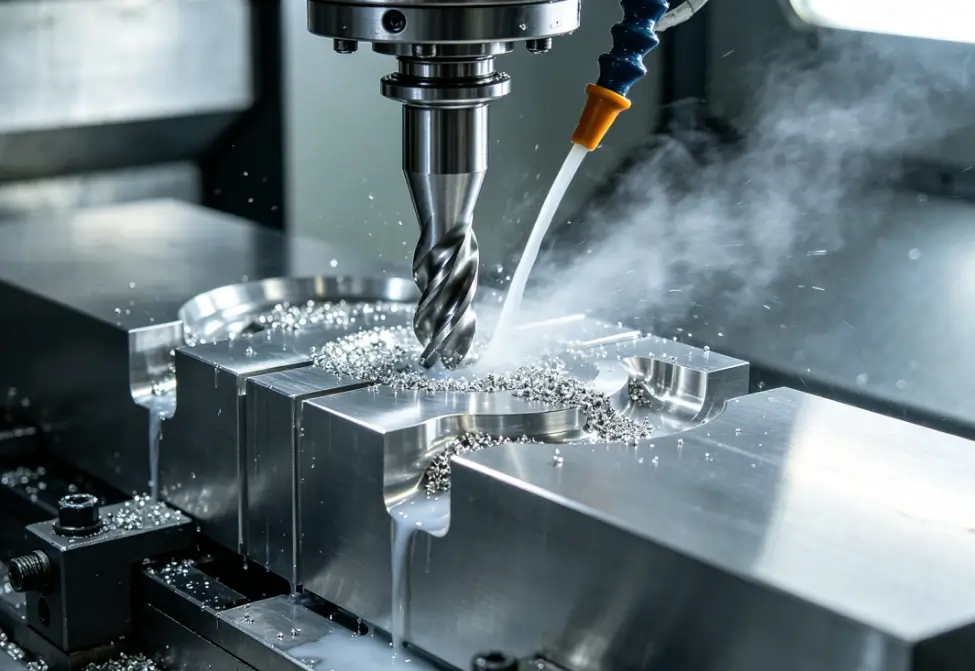
In terms of tool structure optimization, a reasonable large-rake-angle sharp cutting edge design is adopted to reduce cutting friction, and a professional chip breaker structure is configured to accelerate chip discharge and avoid chip adhesion and secondary cutting. At the same time, optimizing the tool path to eliminate long-term dwell cutting and repeated friction cutting can effectively slow down local thermal wear of the tool, extend the tool life by more than 40%, and reduce the downtime loss caused by tool replacement.
4. Advanced Cooling Schemes to Solve High-Temperature Cutting Problems
Poor heat dissipation is the core bottleneck of difficult-to-machine material CNC milling. Titanium alloys and superalloys have extremely low thermal conductivity, and more than 80% of the cutting heat cannot be discharged through the workpiece and chips, resulting in heat concentration in the cutting area. Excessively high cutting temperature is the main inducement of tool thermal wear, workpiece thermal deformation, and surface oxidation defects.
Traditional flood cooling cannot penetrate the high-pressure narrow cutting area, resulting in poor cooling and lubrication effect. We have optimized and promoted three efficient cooling schemes for high-precision processing scenarios:
Minimum Quantity Lubrication (MQL) Cooling: This eco-friendly cooling technology sprays micron-level oil mist to the cutting contact point at high speed, realizing precise fixed-point lubrication and heat dissipation. It solves the problem of tool adhesion in titanium alloy medical part processing, improves surface integrity, and reduces coolant consumption.
Cryogenic Cooling Technology: Using liquid nitrogen or CO₂ cryogenic medium for ultra-low temperature cooling, it instantly takes away massive cutting heat generated in superalloy heavy-duty milling, suppresses material thermal softening and adhesion, and fundamentally improves thermal crater wear of the tool tip.
High-Pressure Internal Coolant System: Equipped with internal cooling tools, the high-pressure cutting fluid directly acts on the cutting zone from the inside of the tool, breaking through the air barrier of high-speed milling, realizing efficient heat dissipation and chip flushing, and suitable for continuous mass production of aerospace high-strength alloy parts.
5. Scientific Process Parameter Optimization for Stable High-Efficiency Milling
Unreasonable process parameters are the key factor leading to unstable processing quality and low efficiency of difficult-to-machine materials. Blindly increasing the feed rate and cutting depth will cause tool overload and severe wear; overly conservative parameters will lead to low production efficiency and high time cost.
Based on finite element simulation and actual processing data accumulation, we have established a mature parameter optimization system for titanium alloy and superalloy milling. By optimizing the matching of spindle speed, feed rate, cutting depth, and cutting width, the processing state is always kept in the optimal load range. For thin-walled titanium alloy structures, low-speed and low-vibration parameter matching is adopted to avoid deformation; for thick superalloy parts, graded cutting parameter settings are used to balance processing efficiency and tool loss.
Scientific parameter optimization not only ensures the dimensional accuracy and surface roughness of difficult-to-machine material parts but also effectively balances processing efficiency and production cost, helping enterprises realize high-quality and high-volume production of key parts in aerospace, medical, and energy fields.
6. Conclusion
The CNC milling processing of difficult-to-machine materials represented by titanium alloys and high-temperature superalloys has long been a technical difficulty in the high-end manufacturing industry. Through systematic breakthroughs in cutting force control, tool wear response, advanced cooling schemes, and process parameter optimization, the common pain points of difficult processing, low precision, high loss, and low efficiency have been effectively solved.
These optimized milling processes are highly adaptable to the processing requirements of aerospace structural parts, medical implant devices, and energy power equipment, providing reliable technical support for the precision manufacturing and cost reduction upgrading of high-end difficult-to-machine material parts.
 Email
Email sales1: +86 15312799623