



Desktop Drilling and Milling Machine vs Vertical Drilling and Milling Machine: Selection Comparison and Cost-Performance Analysis
In industries such as mechanical processing, mold manufacturing, and hardware fabrication, drilling and milling machines serve as critical equipment integrating drilling, milling, and boring functions. Their selection directly impacts production efficiency, machining accuracy, and overall costs. Currently, bench-type and vertical drilling and milling machines dominate mid-range applications due to their structural advantages and performance benefits. However, many buyers face a dilemma: How to balance the compact flexibility of bench-type machines with the stable efficiency of vertical models? How to quantify their cost-effectiveness for different processing needs? This article provides a comprehensive comparative analysis from multiple dimensions—including structural principles, core performance, application scenarios, and cost investment—to offer scientific selection guidance for enterprises and individual users.
1. Core Definitions and Structural Differences: The Essential Distinctions Between the Two Types of Devices
1.1 Basic Characteristics of the Table Drilling and Milling Machine
The bench-type drilling and milling machine (also known as "table-top drilling and milling machine" or "compact drilling and milling machine") is a compact, lightweight (typically 50-500kg) compound machining equipment designed for direct placement on workbenches. Its core structure consists of a base, column, spindle housing, worktable, and feed mechanism. The spindle enables switching between drilling and milling modes, with some models supporting manual or semi-automatic feed.
The design philosophy of bench-type drilling and milling machines centers on "portability" and "multi-functional integration". These machines feature a wide spindle speed range (typically 500-20,000 rpm) and allow manual adjustment of the worktable along X/Y/Z axes. Some high-end models are equipped with digital displays or basic CNC systems. Their compact size minimizes workshop space requirements, while easy mobility and installation—without specialized foundations—make them ideal for small-to-medium processing scenarios or temporary operations.
1.2 Basic Characteristics of Vertical Drilling and Milling Machine
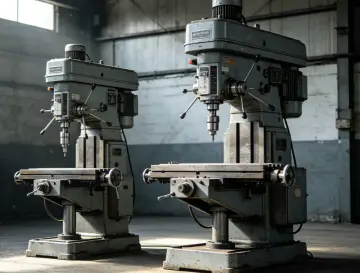
A vertical drilling and milling machine (also known as a floor-standing or heavy-duty drilling and milling machine) is a precision machining equipment with a vertical layout and substantial weight (typically over 500kg, with heavy-duty models reaching several tons), fixed on the ground. Its structure includes the bed, columns, spindle housing, worktable, feed system, and cooling system. The spindle is vertically arranged and achieves high torque output through gear transmission or variable frequency speed control.
The vertical drilling and milling machine is designed with a focus on stability and high precision. Its worktable enables three-axis (X/Y/Z) motion feed, and some models feature CNC systems for multi-process automatic machining. The heavy-duty frame ensures low operational vibration, achieving IT7-IT8 machining accuracy. This makes it ideal for mass production, large workpiece processing, or high-precision applications.
2. Comparison of Core Performance Parameters: Key Indicators for Selection
2.1 Processing Scope and Capability
| parameter | table drilling and milling machine | vertical drilling and milling machine |
| maximum drilling diameter | Typically ≤16mm (steel) and ≤25mm (aluminum) | Usually ≥20mm (steel), ≤50mm (aluminum) |
| maximum milling width | Usually ≤80mm | Usually ≥120mm |
| Workbench size (length × width) | Usually ≤500×200mm | Usually ≥800×300mm |
| travel of spindle | Usually ≤150mm | Usually ≥200mm |
| Maximum weight of the workpiece to be processed | Usually ≤50kg | Usually ≥100kg (heavy models can reach several tons) |
The processing range of the bench drilling and milling machine is concentrated on small and light workpiece, which is suitable for simple processing with small hole diameter and less milling amount. The vertical drilling and milling machine can cover medium and large workpiece, and support complex processing such as large hole drilling and deep cavity milling, with more comprehensive processing ability.
2.2 Processing Accuracy
Processing accuracy is the core requirement of mechanical processing. The difference of precision between the two types of equipment is mainly reflected in the following aspects:
- Table drill and milling machine: Due to its lightweight frame, it is prone to vibration during operation, resulting in relatively low processing accuracy. The radial runout of the spindle is usually 0.02-0.05mm, the milling flatness is ≤0.03mm/m, and the drilling perpendicularity is ≤0.05mm/100mm. It is suitable for rough machining or semi-finishing with lower precision requirements, such as the rough machining of hardware accessories and small molds.
- Vertical drilling and milling machine: The machine body is heavy, the base is stable, the vibration is small, and the machining accuracy is higher. The radial runout of the spindle is usually 0.01-0.02mm, the milling flatness is ≤0.015mm/m, and the drilling perpendicularity is ≤0.02mm/100mm. The positioning accuracy of some CNC vertical drilling and milling machines can reach ±0.005mm, and the repeat positioning accuracy is ±0.003mm, suitable for precision machining and ultra-precision machining, such as precision parts and mold cavities.
2.3 Operational Efficiency
The running efficiency directly affects the production cycle and cost, which is mainly reflected in the spindle speed, feed speed and automation degree.
- Spindle speed: The table-type drilling and milling machine features a wide spindle speed range (500-20000 rpm), ideal for high-speed machining of non-ferrous metals or small workpieces. In contrast, the vertical drilling and milling machine has a narrower speed range (300-10000 rpm) but delivers greater torque, making it suitable for low-speed, heavy-load machining of hard materials like steel.
- Feeding speed: The table drilling and milling machine is mainly manual feeding, the motorized feeding speed is usually less than 500mm/min, the efficiency is low; the vertical drilling and milling machine supports motorized feeding, the feeding speed can reach more than 1000mm/min, some CNC models support high speed feeding, the processing efficiency is 2-3 times of the table.
- Automation level: Desktop drilling and milling machines are typically manual or semi-automatic, requiring frequent manual operation, making them suitable for small-batch production. Vertical drilling and milling machines, however, can be equipped with CNC systems, enabling automatic tool changes and continuous multi-process machining, thus achieving high automation and suitability for mass production.
2.4 Ease of Use and Flexibility
- Desktop drilling and milling machine: Compact and lightweight, it's easy to move and requires no special installation. Simply plug it in to use. The user-friendly interface makes it easy to operate, perfect for solo use—ideal for small workshops, individual businesses, or laboratories with limited space. However, manual feed operation is labor-intensive and can lead to fatigue with prolonged use.
- Vertical drilling and milling machines are bulky and heavy, requiring fixed foundations for installation and posing challenges for relocation. Their operation is relatively complex, necessitating skilled technicians, with some CNC models requiring programming expertise. However, features like motorized feed and automation reduce labor intensity and enhance operational stability, making them ideal for large-scale manufacturing enterprises.
3. In-depth Analysis of Applicable Scenarios: Core Logic of On-demand Selection
3.1 Applicable Scenarios of the Table Drilling and Milling Machine
The desktop drilling and milling machine excels in compactness, agility, and cost-effectiveness, making it ideal for the following applications:
- Small-scale manufacturing enterprises or workshops: These operations feature limited production capacity, primarily producing small and simple components such as metal stamping parts, electronic components, and small mechanical parts. They require minimal precision (below IT10 grade) and operate within a budget of up to 50,000 yuan.
- Individual businesses and repair shops: These operations require handling diverse machining needs including drilling, milling, and grinding. They typically handle small batches (≤100 units per job) and operate in compact spaces (≤20㎡ workshop area), such as agricultural machinery repair shops, auto parts repair shops, and hardware processing stores.
- Laboratory/Teaching Institution: Designed for scientific research experiments and teaching demonstrations, these facilities require compact equipment, safe operation, and comprehensive functionality, such as mechanical engineering labs in universities and vocational training centers.
- Temporary processing needs: Mobile processing scenarios such as construction sites and field operations. The bench drill-milling machine can be transported by truck and installed on-site for applications like construction machinery maintenance and pipeline processing.
3.2 Applicable Scenarios of Vertical Drilling and Milling Machine
The vertical drilling and milling machine excels in "stability, efficiency, and precision", making it ideal for the following applications:
- Medium-sized manufacturing enterprises: These companies operate at moderate production scales, specializing in processing medium-to-large and complex components such as mold cavities, mechanical housings, and drive shafts. They require high precision (IT8 grade or above), mass production (≥500 units per batch), and sufficient budgets (≥80,000 yuan).
- Precision machining industry: Aerospace components, medical devices, and electronic precision parts require high-precision machining (IT7 grade or higher) with stringent demands for processing stability and consistency. The high rigidity and precision of vertical drilling and milling machines can fully meet these requirements.
- In mass production scenarios such as standard parts processing plants and automotive component manufacturing facilities requiring efficient continuous processing, the vertical drilling and milling machine's motorized feed and automation features can enhance production efficiency while reducing labor costs.
- Processing of heavy workpieces: Such as machine tool beds, large molds, and heavy machinery components, with weights ≥100kg and dimensions ≥1m, which cannot be handled by bench-type drilling and milling machines. The stable frame and large worktable of vertical drilling and milling machines can meet the processing requirements.
4. Comprehensive Analysis of Cost-Effectiveness: Balance of Cost and Benefit
Cost-effectiveness is the core criterion for equipment selection, requiring a comprehensive evaluation of factors such as procurement costs, operational expenses, maintenance costs, service life, and return on investment, rather than a simplistic price comparison.
4.1 Comparison of procurement costs
- Desktop drilling and milling machines typically range in price from 10,000 to 50,000 yuan. Entry-level manual models (e.g., ZXT-M32) cost around 10,000-20,000 yuan, mid-range semi-automatic models (with digital display and motorized feed) range from 30,000 to 50,000 yuan, while high-end compact CNC models (e.g., XK7124) are priced at 50,000-80,000 yuan. With low entry barriers, these machines are ideal for users with limited budgets.
- Vertical drilling and milling machines typically range in price from 80,000 to 500,000 yuan. Entry-level manual models (e.g., Z5140A) cost around 80,000-150,000 yuan, mid-range motorized models (with digital display and three-axis feed) range from 150,000 to 300,000 yuan, while high-end CNC models (e.g., XK7136) are priced at 300,000-500,000 yuan. Given their high procurement costs, these machines are best suited for enterprises with substantial financial resources.
Conclusion: If the budget is less than 50,000 yuan, the bench drilling and milling machine is the only choice; if the budget is more than 80,000 yuan, the vertical drilling and milling machine is the choice for mass production or high precision processing.
4.2 Comparison of Operating Costs
Operating costs include electricity, consumables, and labor, which affect the overall cost-effectiveness in the long run.
- Electricity costs: Desktop drilling and milling machines typically operate at 1.5-3kW, consuming 1.5-3 kWh per hour, while vertical models range from 5-15kW with 5-15 kWh hourly. At the industrial rate of 1 yuan/kWh, daily electricity costs are approximately 12-24 yuan for desktop units (8-hour operation) and 40-120 yuan for vertical models. Desktop machines demonstrate lower operational electricity expenses.
- Material costs: Both types primarily use consumables like drill bits, milling cutters, and lubricants. While material expenses depend on production volume, vertical drilling and milling machines deliver higher efficiency, resulting in lower per-unit material costs (e.g., 50 yuan per 100 workpieces for bench-type machines versus 30 yuan for vertical models).
- Labor cost: The bench-type drilling and milling machine is mainly operated manually, and one worker can process about 100-200 pieces per day. The vertical drilling and milling machine has a high degree of automation, and one worker can process about 500-1000 pieces per day. The unit labor cost is lower (about 0.5-1 yuan per piece for the bench-type machine, and about 0.1-0.3 yuan per piece for the vertical type).
Conclusion: The running cost of bench drilling and milling machine is lower in small batch production (less than 200 pieces per day), while the running cost of vertical drilling and milling machine is more advantageous in large batch production (more than 500 pieces per day).
4.3 Maintenance Cost and Service Life
- Maintenance costs: Desktop drilling and milling machines feature a simple structure with fewer wear-prone components (primarily spindle bearings and gears), resulting in lower maintenance costs of approximately 500-1000 yuan annually. Vertical drilling and milling machines, however, involve complex structures with hydraulic systems and CNC systems, requiring more wear-prone parts (such as guides, lead screws, and motors), leading to higher maintenance costs of 2000-5000 yuan per year. CNC models incur even higher maintenance costs, ranging from 5000 to 10000 yuan annually.
- Service life: Desktop drilling and milling machines, with their thin-body construction (typically cast iron), are prone to deformation and increased vibration after prolonged use, with a service life of approximately 5-8 years. Vertical drilling and milling machines, featuring robust bodies (mostly high-quality cast iron or welded steel plates), offer stable structures and a service life of 10-15 years, while heavy-duty models can exceed 20 years.
Conclusion: The maintenance cost of bench drilling and milling machine is obviously superior to that of vertical drilling and milling machine in short-term use (≤5 years) or low frequency processing, but the long life of vertical drilling and milling machine is more cost-effective in long-term use (≥10 years) or high frequency processing.
4.4 Return on Investment Analysis
The essence of cost-effectiveness lies in the input-output ratio. Under different processing requirements, the payback periods of these two types of equipment show significant differences.
- Case 1: A small metalworking workshop with daily processing capacity of 100 small parts (diameter ≤10mm, requiring minimal milling)
- The equipment investment is about 20,000 yuan for the bench drilling and milling machine and 100,000 yuan for the vertical drilling and milling machine.
- The daily operating cost is 270 yuan for the desktop unit (20 yuan for electricity, 200 yuan for labor, and 50 yuan for consumables) and 310 yuan for the vertical unit (80 yuan for electricity, 200 yuan for labor, and 30 yuan for consumables).
- Payback period: Assuming a profit of 5 yuan per unit, the daily average profit for a bench-type machine is 500-270=230 yuan, with a payback period of approximately 20000 ÷ 230 ≈ 87 days. For a vertical-type machine, the daily average profit is 500-310=190 yuan, yielding a payback period of about 100000 ÷ 190 ≈ 526 days. In this case, the bench-type drilling and milling machine offers better cost-effectiveness.
- Case 2: A medium-sized manufacturing enterprise processes 500 medium-sized parts daily (with hole diameters ≤20mm requiring high-precision milling).
- Equipment investment: The high-end model of bench drilling and milling machine costs about 50,000 yuan, while the mid-range mobile model of vertical drilling and milling machine costs about 200,000 yuan.
- Operating costs: For the desktop model, daily expenses include 30 yuan for electricity, 500 yuan for labor (requiring 2 workers), and 250 yuan for consumables, totaling 780 yuan. For the vertical model, daily expenses are 100 yuan for electricity, 200 yuan for labor (1 worker), and 150 yuan for consumables, amounting to 450 yuan.
- Return Period: Assuming a profit of 5 yuan per unit, the daily average profit for a bench-type machine is 2500-780=1720 yuan, yielding a return period of approximately 50000 ÷ 1720 ≈ 29 days. However, the processing accuracy of bench-type drilling and milling machines is insufficient, with a qualification rate of about 80%. The actual profit is 2500 × 80% -780=1220 yuan, resulting in a return period of about 41 days. For vertical drilling and milling machines, the qualification rate is approximately 98%, yielding an actual profit of 2500 × 98% -450=1900 yuan, with a return period of about 200000 ÷ 1900 ≈ 105 days. Although the vertical machine has a longer return period, in the long run, the improved qualification rate and efficiency advantages brought by high precision lead to higher overall returns.
5. Selection Decision Process: Four Steps to Select High Cost-Performance Equipment
5.1 Clarify processing requirements
First, establish the core machining parameters: workpiece dimensions (length × width × height), weight, maximum drilling diameter, milling range, machining accuracy requirements (IT grade), daily processing capacity, and material type (steel/aluminum/plastic, etc.). For workpieces ≤500mm in size, ≤50kg in weight, requiring IT10 or lower precision, and processing ≤200 pieces daily, a bench-type drilling and milling machine is recommended. For workpieces ≥800mm in size, ≥100kg in weight, requiring IT8 or higher precision, and processing ≥500 pieces daily, a vertical drilling and milling machine is preferred.
5.2 Budget Assessment and Site Requirements
For projects with a budget of ≤50,000 yuan and a workspace of ≤20㎡, a bench-type drilling and milling machine is the only option. When the budget exceeds 80,000 yuan and the workspace is ≥50㎡, a vertical drilling and milling machine becomes a viable choice. For budgets between 50,000 and 80,000 yuan, the decision hinges on processing requirements: high-end bench-type machines are recommended for low-precision applications, while entry-level vertical models are better suited for batch processing needs.
5.3 Calculating long-term costs
The operation cost and return period are calculated by combining the processing batch: for small batch processing (daily average ≤200 pieces), the long-term cost of bench drilling and milling machine is lower; for large batch processing (daily average ≥500 pieces), the efficiency advantage of vertical drilling and milling machine can cover the high purchase cost, and the long-term cost performance is higher.
5.4 Consider future expansion
If the production scale is to be expanded, the size of the workpiece is to be increased or the precision is to be improved, it is recommended to choose the vertical drilling and milling machine directly to avoid the secondary investment. If the business is relatively stable and there is no expansion plan, the bench drilling and milling machine can be chosen according to the current demand to reduce the initial investment.

 Email
Email sales1: +86 15312799623