



High-Precision Milling for Automotive Parts: Top CNC Machines in 2026
The automotive industry is undergoing a profound transformation driven by electrification and intelligence, raising unprecedented requirements for the precision, consistency, and efficiency of auto parts. High-precision milling, as a core process for manufacturing key components such as engine blocks, transmission housings, and EV battery enclosures, directly determines the performance and safety of vehicles. In 2026, with the integration of AI, automation, and green manufacturing technologies, CNC milling machines are evolving toward higher precision, smarter operation, and more stable performance. This article will explore the core demands of high-precision milling for automotive parts and recommend the top CNC machines in 2026, providing a valuable reference for manufacturers.
1 Core Demands of High-Precision Milling for Automotive Parts
Automotive parts, especially core components like powertrain parts and new energy vehicle (NEV) components, have strict tolerances, usually requiring control within ±0.002mm. Meanwhile, mass production needs to balance efficiency and consistency, avoiding high scrap rates caused by precision deviations. The main demands include three aspects:
- Ultra-high precision and stability: Key parts such as engine cylinder bores and transmission gears require micron-level machining accuracy, and the machine tool must maintain stable performance during long-term continuous operation to ensure batch consistency. Data shows that the scrap rate of auto parts due to precision issues is still as high as 8% in 35% of manufacturers, far exceeding the industry ideal standard of less than 0.05%.
- Efficiency matching mass production: With the expansion of NEV production capacity, manufacturers need CNC machines with high spindle speed, fast tool change, and automated integration capabilities to shorten the processing cycle. The industry average delivery cycle for auto parts is 20 days, but leading enterprises can compress it to 7–12 days through advanced equipment.
- Adaptability to diverse materials: From traditional steel and aluminum alloys to lightweight materials such as titanium alloys and carbon fiber composites for NEVs, CNC machines need to adapt to different cutting characteristics and achieve high-precision milling with minimal tool wear.
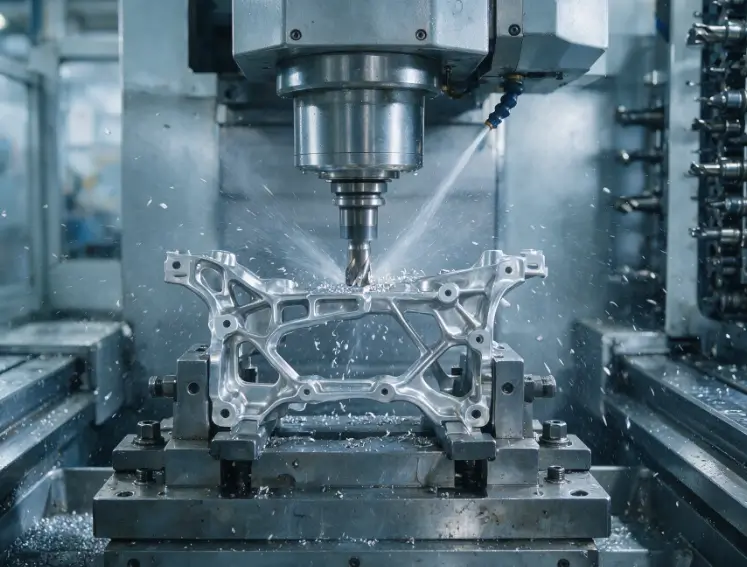
2 Top CNC Machines for High-Precision Milling of Automotive Parts in 2026
Combining market popularity, technical performance, and automotive industry application cases, the following top CNC machines stand out in 2026, covering imported and domestic high-quality models to meet different production needs.
2.1 Haas VF-2SSYT-V Vertical Machining Center
As a cost-effective model tailored for the Chinese market by Haas Automation, the VF-2SSYT-V has become a preferred choice for medium and small auto parts manufacturers with its excellent performance and high cost ratio. It is particularly suitable for mass production of engine accessories and chassis parts.
Core advantages: Equipped with a 12,000-rpm spindle and a 30+1 high-speed side-mounted tool magazine, the tool change time is significantly shortened, and the maximum travel of 762mm×508mm×508mm meets the processing needs of most auto parts. The optional 18,000-rpm built-in spindle and HSK-A63 interface further enhance precision and cutting efficiency for high-hardness materials. In terms of automation, it supports Haas 15kg collaborative robot kits and 3-station pallet changing systems, enabling 24-hour unattended operation and matching the demand for lights-out manufacturing.
The machine is also equipped with Haas Connect remote monitoring and energy-saving eco-mode, which can reduce energy consumption while realizing real-time monitoring of processing status, aligning with the trend of sustainable machining.
2.2 DMG MORI 5-Axis Machining Center
DMG MORI's five-axis machines are well-known in the field of high-precision machining of complex auto parts, and are widely used by leading auto part manufacturers such as Weimait. They excel in processing complex curved parts such as NEV battery housings and aerospace-grade auto components.
Core advantages: The five-axis linkage technology realizes one-time clamping and multi-surface processing, avoiding precision errors caused by multiple clampings, and the tolerance can be stably controlled within ±0.002mm. It is equipped with advanced dynamic error compensation technology and high-precision CMM inspection integration, forming a "processing-inspection-calibration" closed-loop system to ensure batch processing consistency. The spindle with center cooling function (up to 1000 psi) effectively reduces tool wear when processing high-temperature alloy materials.
In practical applications, Weimait used DMG MORI five-axis machines to process engine blocks for a well-known auto parts enterprise, reducing the scrap rate from 6% to 0.02% and completing the delivery of 5,000 pieces 3 days in advance, reducing the customer's losses by over three hundred thousand dollars.
2.3 JONYDA High-Precision Vertical Machining Center (TZM Series)
As a representative of domestic high-end CNC machines, JONYDA from Shenzhen Tuozhizhe Technology Co., Ltd. has won the trust of BYD, Gree and other leading auto and home appliance enterprises with its import-substituting technology. The TZM series is specially optimized for auto parts processing, balancing precision and cost-effectiveness.
Core advantages: Adopting independently developed CNC temperature rise compensation technology and five-axis RTCP measurement technology, it solves the problem of precision drift caused by long-term operation. The rigid bed structure and high-precision linear guideway ensure stable cutting performance under heavy load. The machine supports customized tool magazine configurations (30–70 tools) and can be equipped with automatic loading and unloading systems to adapt to small-batch and multi-variety auto parts processing needs.
With a complete after-sales service network covering nearly 40 major cities in China, JONYDA provides on-site technical support and programming guidance, lowering the application threshold for small and medium-sized manufacturers.
2.4 Beijing Jingdiao High-Speed Milling Center (JDGR Series)
Beijing Jingdiao is a leader in domestic precision CNC technology, and its JDGR series high-speed milling centers have unique advantages in processing precision auto parts such as automotive electronic components and micro-molds. The integration of self-developed software and hardware forms a unique competitive barrier.
Core advantages: The self-developed JDSoft CAD/CAM software is deeply integrated with the machine tool, realizing precise control of complex curved surfaces and micron-level precision engraving. The high-speed spindle with a maximum speed of 18,000 rpm and high feed acceleration ensure efficient processing of small and precision parts. The built-in tool damage detection system can timely alarm for tool wear, avoiding batch quality problems.
Its software-hardware integration solution is particularly suitable for processing precision electronic components of new energy vehicles, such as battery management system (BMS) shells and sensor parts.
3 Key Technologies for High-Precision Milling of Automotive Parts
In addition to selecting high-quality CNC machines, mastering core supporting technologies is crucial to improving processing precision and efficiency:
3.1 AI-assisted precision control
Adopting predictive maintenance technology to monitor spindle operation status and tool wear in real time, predict potential failures in advance, and reduce downtime by 50%. Machine learning algorithms can automatically optimize cutting parameters according to different materials, improving processing consistency.
3.2 Green cutting technology
Applying MQL (Minimum Quantity Lubrication) technology to reduce cutting fluid waste while avoiding environmental pollution caused by waste liquid. Haas VF-2SSYT-V also provides optional coolant purification systems and chip recycling devices to meet the requirements of sustainable machining.
3.3 Full-process quality inspection
Equipping CMM coordinate measuring instruments and implementing the "first article inspection (FAI) + in-process inspection (IPQC) + final inspection (FQC)" three-level quality control system to ensure that each batch of products meets the design requirements. Weimait has 15 CMM measuring instruments, achieving 100% batch consistency.
4 Selection Guide and Future Trends
4.1 Core Selection Criteria
When selecting CNC machines for high-precision milling of automotive parts, manufacturers should focus on three core points:
- Whether the precision and stability meet the tolerance requirements of parts;
- Whether the automation level and efficiency match the production scale;
- Whether the manufacturer has perfect after-sales service and automotive industry certification.
4.2 Industry Development Trends (2026 and beyond)
Looking ahead to 2026 and beyond, high-precision milling for automotive parts will show three trends:
- Deep integration of AI and digital twins to realize full-process intelligent control;
- Popularization of five-axis machining technology to reduce the threshold for complex part processing;
- Combination of green manufacturing and energy-saving design to become a rigid requirement of the industry.
Choosing the right CNC machine and keeping up with technological trends will be the key for auto parts manufacturers to gain a competitive advantage.
Whether it is imported high-end equipment or cost-effective domestic models, matching their own production needs and technical capabilities is the core of selection. With the continuous upgrading of CNC technology, high-precision milling will inject stronger power into the high-quality development of the automotive industry.
 Email
Email sales1: +86 15312799623