



The Difference between Drill Center and Machining Center
In modern CNC machining, drilling centers and machining centers are two widely used core equipment types. Many manufacturers often struggle with their similar appearances and partially overlapping functions during procurement, making it difficult to choose based on specific needs. This article will analyze the differences between drilling centers and machining centers from six key dimensions: essential definitions, structural designs, performance parameters, and application scenarios. Practical selection recommendations will also be provided to help enterprises accurately match production requirements.
Defining Essence: Specialization vs. All-Round
The fundamental difference between the two lies in their distinct design philosophies, which in turn shape their functional priorities.
The Drilling and Tapping Center (DTC), as the name implies, is a CNC machine tool specifically designed for high-speed drilling and tapping, while also capable of performing light milling operations. Its design philosophy emphasizes "specialization, precision, and efficiency," with the core objective of enhancing the speed and accuracy of hole and thread machining. It is particularly suited for mass production tasks requiring concentrated single operations. With technological advancements, some high-end DTCs can now process slightly harder materials like stainless steel, though light cutting remains their primary focus.
A Machining Center (MC) is a multifunctional automated machine tool equipped with capabilities such as milling, drilling, boring, tapping, and planing. Designed as a 'versatile all-in-one' solution, it enables continuous multi-process machining through an automatic tool changer, allowing for comprehensive processing of complex parts in a single operation. Its core advantage lies in handling complex machining requirements involving multiple processes and diverse product types. In terms of configuration, Machining Centers are available in various models including vertical, horizontal, gantry, and five-axis types, catering to different application scenarios.
Structural Design: Compact and Flexible vs. Steady and Massive
To accommodate different design orientations, the two exhibit significant differences in structural dimensions and core component configurations.
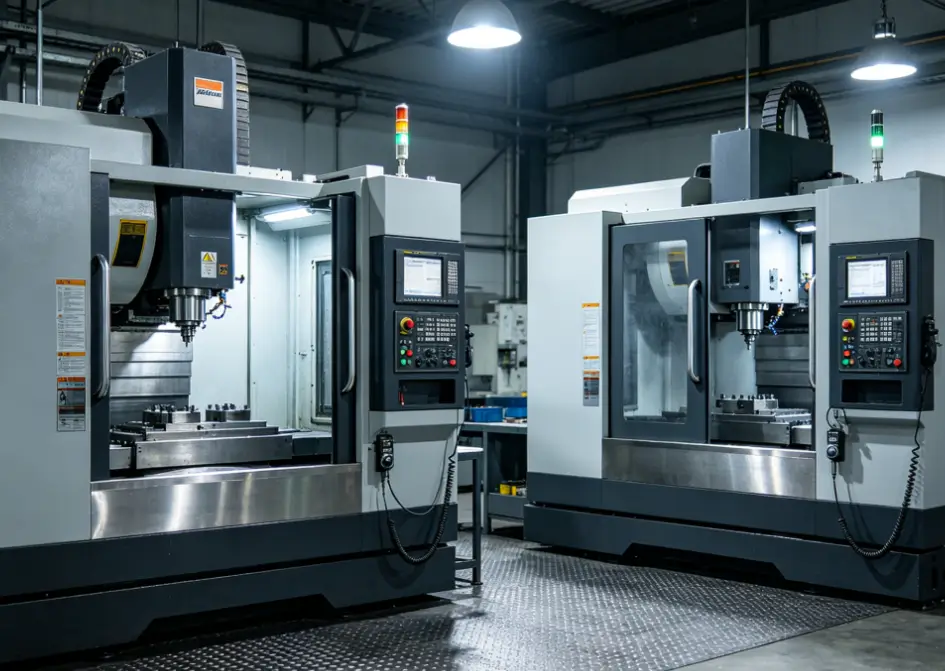
1. Volume and Travel: The drilling center prioritizes high-speed operational flexibility, featuring a streamlined design with reduced axial weight and a more compact profile. Typical models measure approximately 2m × 2m × 2.6m, equipped with a limited worktable travel, making them ideal for small part machining. In contrast, the machining center is designed to ensure machining rigidity and load-bearing capacity, resulting in a larger footprint. For instance, the standard 850-type vertical machining center measures around 2.8m × 2.8m × 3m, offering extended worktable travel to accommodate large workpieces.
2. Tool Magazine and Tool Change System: Drilling and tapping centers typically employ solar-type tool magazines mounted on the spindle's upper end, with limited capacity (usually 16 tools). Even high-end servo tool magazines do not exceed 21 tools. The key advantage is rapid tool change, with some models achieving under 1 second per cycle. In contrast, machining centers predominantly use arm-type tool magazines installed on the column side, offering greater capacity (typically 24+ tools), and some complex models can accommodate over 40 tools. This design supports diverse tool types and meets multi-process machining requirements.
3. Spindle Design: The drilling center spindle prioritizes high-speed operation, typically exceeding 20,000 rpm, with high-end models reaching 30,000 rpm to enhance drilling and tapping efficiency. In contrast, the machining center spindle emphasizes high rigidity and torque, operating at relatively lower speeds (8,000-15,000 rpm) but with greater power (10-30 kW), enabling heavy cutting operations.
Performance Parameters: High Speed & Efficiency vs High Precision & Heavy Load
The differences in performance parameters directly determine the processing capability boundaries between the two, with key parameter comparisons clearly visible:
1. Spindle speed: The drilling center operates at 20,000-30,000 rpm, while the machining center runs at 8,000-15,000 rpm. The drilling center's speed is 2-3 times higher than that of the machining center.
2. Feeding speed: The drilling center features high-speed feed, typically 10-30 meters per minute, with some high-end models achieving 60-100 meters per minute. In contrast, the machining center has a relatively slower feed speed, usually 5-15 meters per minute.
3. Cutting power: The drilling center has limited structural rigidity and weak cutting force, making it suitable only for light cutting, primarily for soft materials like aluminum and copper alloys. In contrast, the machining center boasts robust rigidity and high cutting force, effortlessly handling heavy cutting loads on hard materials such as steel and cast iron. It serves as the core equipment for heavy cutting applications like mold processing.
4. Positioning accuracy: Both systems meet high-precision machining requirements. The machining center typically achieves μm-level positioning accuracy, with some high-end models reaching ±0.002mm or less, making it ideal for complex parts requiring extreme precision. While the drilling center's positioning accuracy is slightly lower, it remains sufficient for routine machining needs in industries like 3C electronics.
Application Scenarios: Batch Small Items vs Complex Large Items
Given these differences, their application domains show distinct divergence, precisely aligning with the production needs of various industries.
The drilling center is primarily designed for mass production of standardized small components, particularly in scenarios requiring extensive drilling and tapping operations. Key applications span multiple industries: 3C electronics (e.g., smartphone frames, circuit board mounting holes), home appliance manufacturing (e.g., small aluminum alloy parts), hardware production (e.g., fastener holes), and new energy vehicles (e.g., small structural components). As the "efficiency champion" in 3C part manufacturing, it delivers over 30% higher processing efficiency compared to conventional machining centers.
The primary application of machining centers lies in processing multi-step, complex-shaped components, catering to small-batch and multi-variety production needs. Key industries include aerospace (engine blades, complex structural components), automotive manufacturing (automotive molds, engine blocks), mold manufacturing (plastic molds, metal molds), and high-end equipment manufacturing. For instance, five-axis machining centers excel in high-precision processing of complex curved surfaces, while gantry machining centers handle comprehensive processing of large workpieces.
Cost Budget: The Choice Between Cost-Effectiveness and High-end Investment
The price difference between the two is significant, which directly affects the procurement budget planning of the enterprise.
Drill center systems offer superior cost-effectiveness. Domestic entry-level models typically range from 180,000 to 220,000 yuan, while high-end models cost 450,000 to 650,000 yuan, with customized units potentially exceeding 800,000 yuan. Imported brands like FANUC's Robodrill series are priced between 238,000 and 278,000 yuan. For small-batch machining enterprises, drill center systems provide better return on investment.
The price range of machining centers is more extensive. Basic vertical models like the VMC650 cost approximately 150,000-300,000 yuan, while mid-to-high-end four-axis or five-axis models range from 500,000 to 1,500,000 yuan. Large gantry machining centers or high-speed, high-precision models can reach unit prices of 1.5 to 5 million yuan. Imported brands are 30%-50% more expensive than domestic ones, primarily due to their complex structural designs and comprehensive functional configurations.
Selection Recommendations: Need-based Matching as the Core
Having identified the differences between the two, how should enterprises choose the right solution? The key principle is to 'match their specific processing needs,' which can be assessed through the following three criteria:
1. Process requirements: For applications primarily involving drilling and tapping on soft materials like aluminum alloy with high-volume production needs, a drilling and tapping center is the preferred choice. When multiple operations such as milling, boring, and tapping are required on hard materials like steel or cast iron, or for parts with complex geometries, a machining center is the optimal option.
2. Check part specifications: For small-sized parts (worktable stroke ≤500×400mm), use a drilling and tapping center; for larger parts requiring extended stroke machining, select a machining center.
3. Budget vs. Capacity: For limited budgets prioritizing mass production efficiency, select a drilling center; for ample budgets requiring complex machining capabilities, choose a machining center.
sum up
Drilling and machining centers are not a zero-sum game but complementary strengths. The former excels as a "batch processing specialist for small components," delivering high-speed, efficient, and cost-effective solutions. The latter serves as a "versatile machine for complex large parts," featuring multifunctionality, precision, and powerful cutting capabilities. To maximize production efficiency and quality, companies should carefully select models based on their specific needs, part specifications, and budget. For model selection uncertainties, consulting professional CNC equipment manufacturers for customized solutions is recommended.
 Email
Email sales1: +86 15312799623