



Inverted Machining vs. Vertical and Horizontal Lathes: Precision, Automation & Applications
Inverted machining, conventional vertical turning, and horizontal CNC turning offer different advantages for precision and automated manufacturing. Inverted pick-up turning can integrate workpiece loading with machining and support efficient chip evacuation. Conventional vertical lathes are often suitable for large, heavy components, while horizontal CNC lathes offer flexibility for shafts, bar-fed parts, and mixed production. This guide compares their working principles, accuracy, automation, applications, productivity, and manufacturing costs to help machine shops choose the right equipment.
Which CNC lathe is best for precision and automated manufacturing? Inverted pick-up turning is often a strong option for high-volume production of compact rotational components. Conventional vertical lathes are generally better suited to large, heavy workpieces, while horizontal CNC lathes offer flexibility for shaft machining and varied production. The best choice depends on workpiece geometry, required accuracy, production volume, automation needs, and total manufacturing cost.
1. What Is Inverted Machining and How Does It Work?
Inverted machining refers to a machining arrangement in which the workholding spindle faces downward and suspends the workpiece above the cutting area. In CNC turning applications, this arrangement is commonly known as inverted spindle turning.
One important type is vertical pick-up turning, which combines machining and workpiece handling in a single spindle system.
Unlike a conventional vertical lathe, where the workpiece generally rests on a rotating table or chuck, an inverted turning machine holds the workpiece from above.
In a pick-up spindle configuration, the spindle can move between the loading station and the machining area. It collects the raw workpiece, clamps it, performs the programmed machining operations, and returns the finished part.
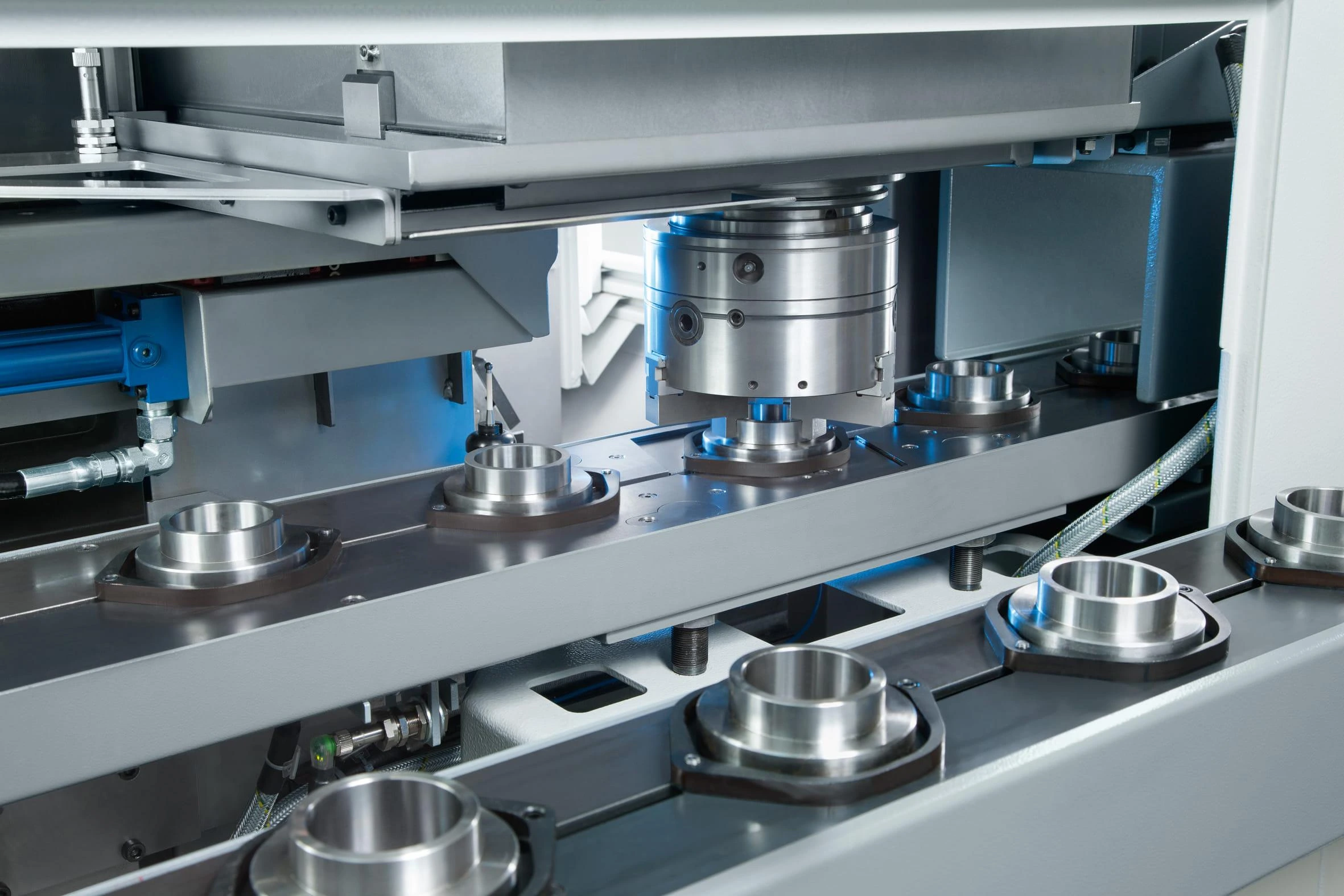
A typical vertical pick-up turning process follows six steps:
- A raw workpiece arrives at the loading station.
- The spindle moves into the loading position.
- The chuck grips and lifts the workpiece.
- The spindle transfers it into the machining area.
- The machine performs the programmed turning operations.
- The spindle returns the finished component to the unloading station.
This integrated handling arrangement can simplify automated production for suitable rotational components.
However, not every inverted spindle machine includes automatic pick-up loading. The distinction between inverted spindle turning and vertical pick-up turning is important when comparing machine specifications.
2. Inverted Machining vs. Vertical and Horizontal Lathes: Key Differences
The three machine configurations differ primarily in spindle orientation, workpiece support, chip flow, and automation architecture.
| Comparison factor | Inverted spindle turning | Conventional vertical turning | Horizontal CNC turning |
|---|---|---|---|
| Spindle orientation | Vertical, downward-facing | Vertical, workpiece supported below | Horizontal |
| Workpiece holding | Suspended from chuck or spindle | Supported on table or chuck | Held by chuck, collet, or centers |
| Typical components | Compact rotational parts | Large, short, or heavy components | Shafts, bars, cylindrical parts |
| Chip evacuation | Gravity-assisted flow away from suspended workpiece | Depends on cutting zone and chip handling | Depends on tooling and chip management |
| Automation | Integrated pick-up loading on suitable models | Robots, gantries, conveyors | Bar feeders, robots, gantries |
| Production volume | Attractive for repeatable high-volume work | Depends on machine and application | Suitable for low- to high-volume production |
| Heavy workpieces | Limited by machine-specific capacity | Often advantageous | Depends on machine design |
| Changeover flexibility | Depends on fixtures and loading system | Depends on machine and workpiece | Often flexible for varied turning work |
The comparison shows that each machine type addresses different production requirements.
Inverted machining is particularly interesting when manufacturers need automated handling of compact rotational components. Conventional vertical turning offers a practical arrangement for supporting large, heavy parts. Horizontal turning remains widely applicable to shafts, bar-stock machining, and general precision manufacturing.
3. Which CNC Turning Machine Offers Better Precision and Accuracy?
No spindle orientation guarantees higher machining accuracy.
Precision depends on machine rigidity, spindle performance, thermal stability, workholding, tooling, and the cutting process.
An inverted turning machine may offer advantages in repeatable handling and compact machine construction, but these features do not automatically produce tighter tolerances than conventional CNC turning.
3.1 Machine Rigidity and Cutting Stability
Machine rigidity determines how effectively the structure resists deformation under cutting forces.
Insufficient rigidity can contribute to chatter, dimensional variation, poor surface finish, and unstable tool wear.
Some inverted turning machines use compact structural layouts and relatively short tool arrangements. These features may support stable cutting when the machine is properly designed.
However, heavy-duty conventional vertical lathes can offer substantial structural rigidity and cutting torque for large workpieces.
Horizontal CNC lathes may also provide excellent cutting stability through rigid beds, spindle assemblies, tailstocks, and steady rests.
The appropriate comparison should consider actual machine specifications and machining tests.
3.2 Thermal Stability in Continuous CNC Turning
Temperature changes can influence machining accuracy during extended production runs.
Heat generated by spindle bearings, motors, feed drives, and cutting operations may cause dimensional drift.
All three machine configurations require effective thermal management.
Manufacturers should evaluate spindle cooling, thermal compensation, machine warm-up requirements, and dimensional consistency over time.
A machine that achieves a tight tolerance during a short demonstration may not maintain the same performance throughout an extended production shift.
Therefore, long-run production stability is particularly important for precision manufacturing.
3.3 Workholding Accuracy and Machining Repeatability
Workholding affects the relationship between the workpiece, spindle, and cutting tool.
In vertical pick-up turning, the spindle can collect and clamp each workpiece through a repeatable automated sequence.
This can reduce separate handling operations, but it does not eliminate clamping errors.
Potential sources of variation include contaminated locating surfaces, inconsistent clamping force, workpiece deformation, and differences in raw material dimensions.
Manufacturers should evaluate the following quality indicators.
| Quality indicator | Purpose |
|---|---|
| Roundness | Evaluates circular form accuracy |
| Cylindricity | Evaluates cylindrical surface form |
| Radial runout | Measures radial variation relative to a datum |
| Face runout | Measures axial face variation relative to a datum |
| Dimensional repeatability | Evaluates variation across repeated machining cycles |
| Thermal displacement | Evaluates temperature-related movement |
| Process capability (Cpk) | Evaluates stable process performance relative to specifications |
For machine acceptance, buyers should request representative workpiece test results and applicable inspection documentation.
Which machine is more accurate? The answer depends on the specific machine model, workpiece, and machining process—not simply whether the spindle is inverted, vertical, or horizontal.
4. How Does Inverted Machining Improve CNC Automation and Chip Evacuation?
Automation and chip management are two important reasons manufacturers consider inverted spindle turning.
Vertical pick-up turning can integrate workpiece handling into the machine structure, while the suspended workpiece arrangement supports gravity-assisted chip flow.
These features may improve production efficiency in suitable applications.
4.1 Integrated Workpiece Loading and Unloading
Conventional CNC turning cells often use operators, robots, gantries, or bar feeders to load workpieces.
In a vertical pick-up turning system, the spindle itself can perform the loading and unloading movements.
This may reduce the need for a separate robot dedicated to machine loading.
It can also simplify the arrangement of conveyors and handling equipment.
However, complete production lines may still require workpiece orientation, transfer systems, measurement stations, and other automation devices.
The benefits depend on the full manufacturing-cell design.
4.2 Gravity-Assisted Chip Evacuation
Chip accumulation can affect machining reliability, surface quality, and machine availability.
In inverted turning, cutting tools are generally positioned below the suspended workpiece.
This arrangement allows many chips to fall away from the workholding area under gravity.
This can be useful when machining steel, cast iron, and other materials that generate substantial chip volumes.
However, chip behavior also depends on material properties, cutting speed, feed rate, tool geometry, coolant delivery, and enclosure design.
Long stringy chips may still wrap around tools or workpiece features. Internal machining operations may require additional chip-control measures.
Therefore, inverted machining offers a potentially favorable chip-flow arrangement rather than a universal solution to chip evacuation problems.
4.3 Unattended Machining and Production Automation
Unattended manufacturing requires more than automatic loading.
A reliable automated cell may need tool monitoring, measurement systems, part identification, coolant management, chip monitoring, and fault handling.
Inverted pick-up turning can support these functions when equipped appropriately.
However, horizontal CNC lathes with bar feeders, robots, and sub-spindles can also provide advanced automation.
Manufacturers should compare complete production cells operating under equivalent conditions.
5. Inverted Machining Applications Across Manufacturing Industries
Inverted machining is particularly relevant to manufacturers producing rotational components with repeatable machining requirements.
Its suitability depends on workpiece dimensions, machining operations, batch size, and automation needs.
5.1 Automotive Manufacturing: Gears, Hubs and Transmission Parts
Automotive manufacturing frequently requires high-volume production of components with consistent dimensions and short production cycles.
Potential applications for inverted turning include gear blanks, hubs, bearing-related components, and selected transmission parts.
Vertical pick-up turning can be attractive when integrated loading reduces handling complexity and supports repeatable production.
However, not every automotive component is suitable for this arrangement.
Long shafts, irregular components, and parts requiring extensive milling may benefit from other machine configurations.
5.2 Industrial Machinery: Housings, Sleeves and Flanges
Industrial machinery manufacturers produce a broad range of rotational components.
Inverted machining may be suitable for repeatable turning of selected sleeves, flanges, housings, and transmission-related parts.
The technology can be useful when component dimensions are compatible with suspended workholding and production volumes justify automated handling.
For larger or heavier components, conventional vertical turning may provide a more practical solution.
5.3 Energy Equipment: Valves, Rings and Rotational Components
Energy equipment manufacturing includes a wide variety of component sizes, materials, and machining requirements.
Smaller rotational parts may be suitable for inverted turning.
Large flanges, heavy rings, and substantial valve components may require conventional vertical lathes with greater workpiece capacity.
Manufacturers should evaluate workpiece weight, material properties, required cutting forces, and production volume.
Inverted machining should not be considered a universal replacement for heavy-duty vertical turning in energy applications.
5.4 Precision Engineering and General Metalworking
Precision engineering workshops often manufacture components for several industries.
Horizontal CNC lathes are frequently practical because they support a wide variety of shafts, bar-stock parts, and cylindrical components.
Inverted machining becomes more attractive when production involves repeated families of rotational parts and manufacturers want to automate loading and unloading.
For high-mix, low-volume production, a flexible conventional CNC turning center may be more economical.
5.5 Aerospace Manufacturing: Specialized Precision Components
Aerospace manufacturing requires strict process control, traceability, and dimensional verification.
Inverted turning can be suitable for selected rotational components, depending on geometry, material, and production requirements.
However, complex geometries, difficult-to-machine materials, and relatively small production batches may favor other machining arrangements.
Aerospace applications should therefore be evaluated individually rather than treated as a general advantage of inverted machining.
6. Inverted Machining vs. Conventional Turning: Cycle Time and Productivity
Production efficiency depends on cutting time, non-cutting time, equipment availability, and process reliability.
Inverted pick-up turning may reduce certain loading and unloading operations.
However, the total cycle time must be compared with an equivalent conventional manufacturing cell.
A simplified cycle-time relationship is:

Consider the following hypothetical example.
| Parameter | Inverted turning | Conventional turning |
|---|---|---|
| Cutting time | 60 seconds | 60 seconds |
| Non-cutting time | 8 seconds | 20 seconds |
| Total cycle time | 68 seconds | 80 seconds |
| Theoretical production | 52.94 parts/hour | 45 parts/hour |
Under these assumptions, inverted turning provides approximately 17.65% higher theoretical hourly output.
Illustrative Theoretical Production Output
Hypothetical cycle-time comparison, not verified machine performance
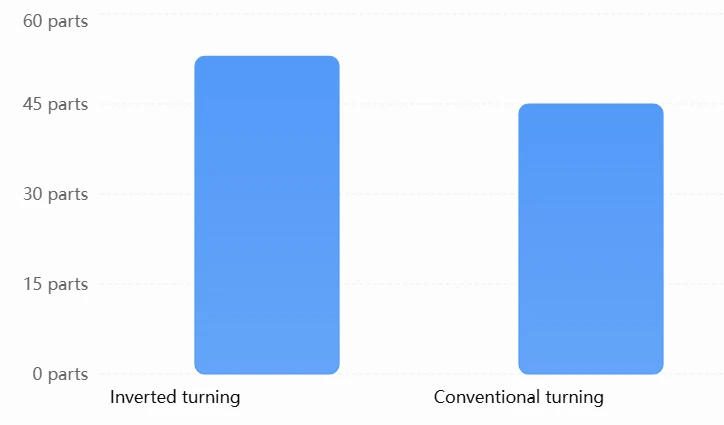
These figures are illustrative and are not manufacturer test results.
Actual production may differ because cutting strategies, loading operations, tool changes, and inspection requirements vary between machines.
Manufacturers should also consider Overall Equipment Effectiveness (OEE).
A simplified effective-output relationship is:

For example, if the ideal output is 52.94 parts per hour and OEE is 80%, the estimated effective output is approximately 42.35 good parts per scheduled hour.
This model assumes that OEE is calculated consistently and includes availability, performance, and quality losses.
The most reliable productivity comparison comes from representative production trials.
7. Inverted Machining vs. Traditional CNC Lathes: Total Manufacturing Cost Comparison
The purchase price of a CNC machine does not fully represent its manufacturing cost.
A lower-priced machine may require additional labor, handling equipment, or floor space.
A more expensive automated machine may reduce certain operating costs but still deliver poor financial results if production volume is insufficient.
Manufacturers should evaluate the total cost per acceptable finished component.
| Cost factor | Evaluation considerations |
|---|---|
| Machine acquisition | Initial equipment investment |
| Automation | Feeders, robots, conveyors, and integration |
| Tooling | Toolholders, cutting tools, and fixtures |
| Labor | Loading, inspection, supervision, maintenance |
| Energy | Machine electricity and supporting utilities |
| Maintenance | Preventive maintenance and unexpected repairs |
| Changeovers | Setup time and lost production capacity |
| Scrap and rework | Material losses and additional machining |
| Floor space | Production-cell footprint |
| Annual output | Number of acceptable components produced |
A simplified cost-per-part formula is:
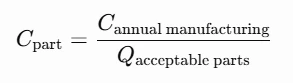
Annual manufacturing costs should include relevant fixed and variable expenses, with capital costs allocated consistently across the compared alternatives.
Inverted machining may reduce manufacturing costs when integrated loading improves utilization and reduces handling requirements.
However, horizontal CNC turning with bar feeding can be highly economical for suitable components.
For low-volume or frequently changing production, a flexible conventional machine may offer a better overall result.
The correct investment decision should be based on total manufacturing cost rather than machine purchase price alone.
8. What Are the Limitations of Inverted Spindle Turning?
Inverted machining offers advantages in selected applications, but its machine structure also creates practical limitations.
8.1 Workpiece Size and Weight Restrictions
Inverted turning machines suspend the workpiece from the spindle.
The machine must therefore safely support the workpiece weight, clamping forces, and cutting loads.
Buyers should verify maximum workpiece diameter, height, weight, chuck capacity, and spindle performance.
Large, heavy components may be more suitable for conventional vertical turning.
8.2 Long-Shaft and Heavy-Cutting Applications
Long shafts often require additional support through tailstocks, steady rests, or specialized workholding.
Horizontal CNC lathes are frequently more practical for these applications.
Heavy cutting also requires adequate spindle torque, machine rigidity, and secure clamping.
For large-diameter, heavy-duty machining, conventional vertical lathes may provide a more suitable structural arrangement.
8.3 Changeover Flexibility and Maintenance Requirements
Integrated pick-up loading systems must coordinate workpiece positioning, clamping, spindle movement, and machining.
Changing between different workpiece families may require adjustments to fixtures, loading stations, and programs.
For manufacturers producing many unrelated parts in small quantities, these changes can reduce the economic benefits of automation.
Maintenance planning should also account for spindle movement, clamping mechanisms, sensors, and material-handling systems.
9. How to Choose the Right CNC Lathe for Your Manufacturing Needs
Selecting the right CNC turning machine requires a structured evaluation of workpiece requirements, production volume, automation, and total cost.
9.1 Evaluate Workpiece Size, Material and Tolerances
Start by defining the maximum workpiece diameter, length, weight, material, and required machining operations.
Also establish dimensional tolerances, surface finish requirements, and inspection methods.
These factors determine whether a machine can safely and consistently perform the required operations.
9.2 Match Production Volume with Automation Requirements
High-volume production may justify dedicated automated loading systems.
Inverted pick-up turning can be attractive for repeatable rotational components.
For bar-stock production, horizontal turning with automatic bar feeding may be more efficient.
For large or heavy components, conventional vertical turning may offer better workpiece support.
9.3 Compare Machine Specifications and Total Manufacturing Cost
Machine buyers should request detailed specifications and representative machining results.
Important parameters include spindle power, torque, speed range, workpiece capacity, tooling configuration, and automation options.
Manufacturers should also compare total production-cell costs under equivalent operating assumptions.
| Manufacturing requirement | Machine configuration worth evaluating |
|---|---|
| High-volume rotational components | Inverted pick-up turning |
| Large, heavy components | Conventional vertical turning |
| Long shafts | Horizontal CNC turning |
| Continuous bar-stock production | Horizontal turning with bar feeder |
| Compact automated production cells | Inverted pick-up turning |
| High-mix general machining | Flexible horizontal CNC turning |
| Large-diameter heavy-duty cutting | Heavy-duty vertical turning |
| Selected precision rotational components | Compare suitable configurations individually |
The final decision should rely on machine-specific evidence, representative workpiece trials, and realistic production-cost calculations.
10. Frequently Asked Questions About Inverted Machining
Q:Is inverted machining more accurate than horizontal CNC turning?
A:Not inherently. Both configurations can achieve high accuracy. Actual performance depends on machine rigidity, thermal stability, workholding, tooling, and process control.
Q:Is inverted machining suitable for mass production?
A:Yes. Inverted pick-up turning is particularly attractive for repeated production of suitable rotational components because it can integrate workpiece handling and machining.
Q:Can inverted machining replace conventional vertical turning?
A:It can replace conventional vertical turning in selected applications. However, large or heavy workpieces may still require conventional heavy-duty vertical lathes.
Q:Is inverted machining better for chip evacuation?
A:Its suspended workpiece arrangement can support gravity-assisted chip evacuation. Actual chip control still depends on material, cutting parameters, tooling, coolant, and machine design.
Q:Which CNC turning machine is best for automated manufacturing?
A:There is no universal winner. Inverted pick-up turning may simplify handling for suitable components, while horizontal turning with bar feeders or robots can also provide highly efficient automation.
Q:Is inverted machining suitable for small machine shops?
A:It can be suitable when a workshop produces repeatable part families in sufficient quantities. For highly varied, low-volume production, a flexible conventional CNC lathe may be more economical.
Conclusion: Which CNC Turning Machine Is Right for Your Factory?
Inverted machining, conventional vertical turning, and horizontal CNC turning each serve different manufacturing requirements.
Inverted spindle turning, particularly vertical pick-up turning, can be an effective solution for automated production of suitable rotational components. Its integrated handling capabilities and favorable chip-flow arrangement make it attractive for selected high-volume manufacturing applications.
Conventional vertical lathes remain important for large, heavy, and wide workpieces. Horizontal CNC lathes offer flexibility for shafts, bar-stock machining, and general precision manufacturing.
For manufacturers planning new production capacity, the best solution depends on workpiece geometry, machining accuracy, automation requirements, production volume, and total manufacturing cost.
The right CNC machine is the one that consistently produces acceptable components at the required rate and cost—not simply the one with the most advanced configuration.
 Email
 sales1: +86 15312799623