



Key Technology Analysis & Machining Efficiency Revolution of 4-Axis and 5-Axis Gantry Machining Centers
Introduction
In the high-end manufacturing industry, gantry machining centers act as core processing equipment. Their technological progress directly determines manufacturers’ production capacity and product quality standards. The adoption of 4-axis and 5-axis technologies has pushed the performance of gantry machining centers to new heights. Equipped with additional rotary axes, these machines not only expand basic processing capabilities, but also achieve substantial improvements in machining precision, production efficiency and the ability to fabricate complex workpieces. As a professional manufacturer of machining centers, we fully recognize the core value of multi-axis technology in practical production. This article elaborates on the technical features of the 4th and 5th axes applied to gantry machining centers, as well as their transformative impact on modern manufacturing.
Overview of Gantry Machining Centers
1.1 Basic Structure and Features
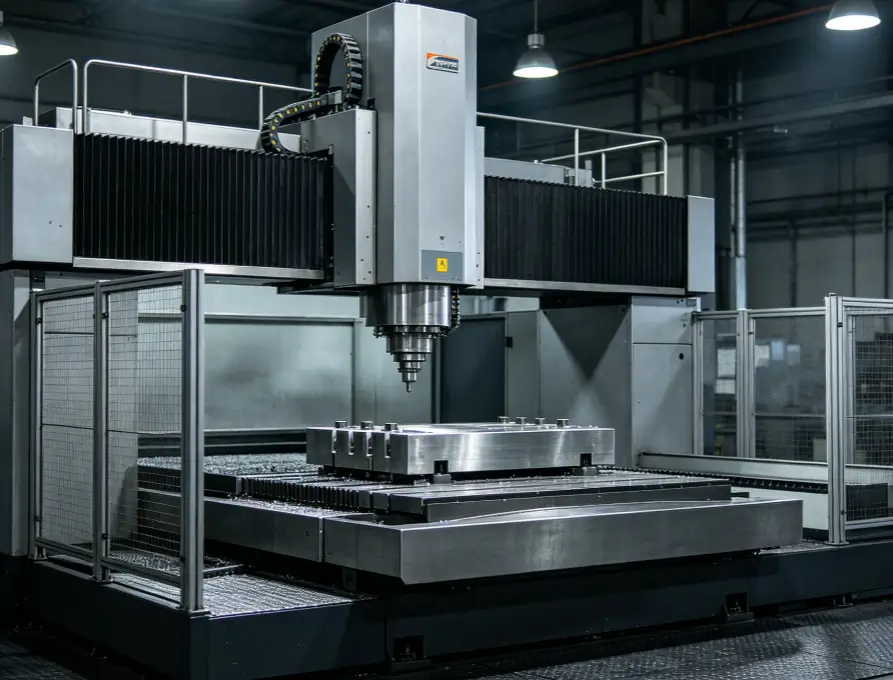
A gantry machining center is named after its distinctive gantry frame, which consists of two vertical columns and a crossbeam to form a portal structure. The worktable is either fixed on the foundation or designed for longitudinal movement. This structural design delivers exceptional rigidity and stability, making the machine well-suited for processing large and heavy workpieces.
Compared with vertical and horizontal machining centers, the gantry frame can better withstand cutting forces and suppress vibration, so as to guarantee stable machining accuracy. Gantry machining centers are generally classified by travel stroke, with mainstream models including 2-meter, 4-meter and 8-meter specifications. The 4-meter gantry machining center features a balanced processing range and robust performance, making it a preferred option for medium-sized workpieces such as mechanical components and molds, and it can deliver high-precision and high-efficiency machining.
1.2 Evolution from 3-Axis to Multi-Axis Machining
Traditional 3-axis machining centers equipped with X, Y and Z linear axes can complete most milling, drilling and tapping operations. However, they are only capable of machining the top and partial side surfaces of workpieces. Operators have to re-clamp workpieces repeatedly for multi-sided processing, which increases auxiliary operation time and introduces cumulative positioning errors caused by datum repositioning.
To solve this problem, multi-axis machining technology has been developed. A 4-axis machining center adds one rotary axis to the standard 3-axis configuration, while a 5-axis machining center is fitted with two extra rotary axes. This upgrade enables multi-sided machining in a single clamping setup, bringing remarkable improvements to both precision and efficiency.
| Number of Axes | Basic Configuration | Core Processing Capacity | Applicable Workpieces |
| 3-Axis | X, Y, Z linear axes | Planar machining, simple 3D surface machining | Plate parts, disc parts |
| 4-Axis | 3 linear axes + 1 rotary axis | Four-sided machining, cylindrical surface machining | Box-type parts, cam parts |
| 5-Axis | 3 linear axes + 2 rotary axes | Five-sided machining, complex spatial surface machining | Impellers, molds, aerospace components |
In-Depth Analysis of 4-Axis Technology
2.1 Definition and Working Principle of the 4th Axis
The 4th axis refers to the first rotary axis added to a standard 3-axis machine tool, which is marked as the A-axis (rotating around X-axis), B-axis (rotating around Y-axis) or C-axis (rotating around Z-axis) in the machine tool coordinate system. In practical applications, the rotary axis can be installed as a rotary worktable on the machine bed or as a swing head on the spindle unit.
The core function of the 4th axis is to rotate the workpiece around a designated axis, so that different surfaces can be presented to the cutting tool. Controlled precisely by the CNC system and driven by servo motors, it realizes high-accuracy indexing positioning via transmission components such as worm gear sets and gear trains.
For example, the 2000mm × 2000mm high-precision CNC rotary table (B-axis) installed on a horizontal machine tool can work in tandem with linear axes to process complex workpieces efficiently.
2.2 Technical Types and Design Characteristics of the 4th Axis
Based on structure and working principles, the 4th axis is divided into three mainstream types:
CNC Indexing Head Type
This type is essentially a high-precision CNC indexing head adopting worm gear transmission, which provides large torque output and reliable precision. Some gantry machining centers use this structure to achieve a Y-axis swing range of ±110°, enabling three-sided machining in one clamping cycle.
Continuous Rotary Worktable Type
This design supports continuous rotation over 360°. It is equipped with slip ring assemblies to ensure uninterrupted supply of power, lubricant and coolant during rotation. For applications requiring a rotation range within ±360°, coiled pipeline layouts can be adopted to cut costs.
Direct Drive Type
In recent years, torque motor direct drive technology has been widely applied to the 4th axis. It eliminates errors generated by intermediate transmission links, and improves overall structural rigidity and dynamic response performance.
Rotational accuracy is a key performance indicator of the 4th axis. High-end models are fitted with circular grating scales for position feedback, achieving arcsecond-level angular positioning accuracy; some premium products even reach sub-arcsecond resolution to meet stringent high-precision machining requirements.
2.3 Practical Machining Advantages of the 4th Axis
The 4th axis creates prominent value in actual production, which is reflected in the following aspects:
- Reduce clamping times: The rotary function allows operators to machine multiple surfaces in sequence without re-clamping. For box-type workpieces, traditional 3-axis machining requires at least three clamping operations, while 4-axis machining finishes all processes in a single setup, cutting auxiliary time by around 70%.
- Improve overall machining accuracy: Fewer clamping operations mean less cumulative errors caused by datum conversion. The relative positional accuracy between all workpiece features is guaranteed by the machine tool’s inherent precision, rather than the accuracy of fixtures.
- Simplify process flow: Multiple processing procedures that once required several separate machine tools can now be completed on one 4-axis machining center.
- Support special machining processes: The linkage of linear and rotary axes enables the fabrication of spiral grooves, inclined planes and complex cylindrical contours.
Technical Analysis of 5-Axis Technology
3.1 Definition and Technical Connotation of the 5th Axis
The 5th axis is a second rotary axis added to the 4-axis configuration. A full 5-axis machining center is controlled by five axes (X, Y, Z, B and C), with two independent rotary axes working collaboratively. This configuration allows the machine to adjust the orientation of workpiece surfaces freely, so that all machining tasks can be completed in one single clamping cycle.
According to the installation layout of the two rotary axes, 5-axis machining centers are categorized into three major structural types:
Dual Rotary Table Structure: Both the 4th and 5th axes are mounted on the worktable. The workpiece rotates and swings to complete spatial contour machining. This structure is mainly applied to machine tools for small and lightweight workpieces.
Rotary Table & Swing Head Combined Structure: One rotary axis is installed on the spindle head to adjust the cutting angle of tools, and the other is mounted on the worktable to change the workpiece placement angle. The worktable section can adopt a full rotary design or an auxiliary rotary fixture on a fixed base.
Dual Swing Head Structure: Both rotary axes are integrated on the spindle unit to adjust the tool angle. This layout is the most widely used on large gantry machining centers.
3.2 Core Technical Features of the 5th Axis
High-precision operation of the 5th axis relies on a set of key supporting technologies:
- High-rigidity structural design: The rotary unit must have sufficient rigidity to withstand strong cutting forces during machining.
- High-precision feedback system: Premium rotary axes are equipped with circular grating scales for position feedback, achieving arcsecond-level indexing accuracy, though such high-performance systems come with higher manufacturing costs.
- Diversified transmission technologies: Driving modes include torque motor direct drive, worm gear transmission and gear transmission. Some designs adopt dual independent torque motor drive, while others combine torque motors with worm gear sets.
- Interference avoidance technology: In 5-axis linkage machining, the risk of collision between tools, spindle, workpiece and fixtures increases. Therefore, the supporting CAM and CNC systems must be equipped with real-time interference detection and avoidance functions.
3.3 Transformative Impact of the 5th Axis on Machining
5-axis technology has revolutionized modern manufacturing:
Superior capability for complex surface machining: 5-axis linkage can process all kinds of intricate 3D spatial surfaces, which is irreplaceable for components in aerospace and mold manufacturing industries.
Optimized tool posture: When machining curved surfaces with ball end mills, the tool tip has zero linear speed if the spindle is perpendicular to the workpiece surface, resulting in poor surface finish. The 5-axis system can adjust the spindle angle to avoid tip cutting, ensure sufficient cutting linear speed and greatly improve surface quality.
Higher machining accuracy: Single-clamp processing eliminates repositioning errors. Optimized tool posture shortens tool overhang, enhances cutting rigidity and reduces deformation errors of cutting tools.
Remarkably improved efficiency: One-clamp full-process machining drastically cuts clamping and auxiliary time. Meanwhile, optimized tool paths and cutting parameters further shorten actual cutting cycles.
High-end 5-axis machine tools can achieve workpiece precision within 0.001mm, fully demonstrating the outstanding precision performance of 5-axis technology.
Comprehensive Influence of 4-Axis & 5-Axis Technology on Practical Machining
4.1 Improved Machining Accuracy and Product Quality
Multi-axis technology boosts accuracy and quality through multiple mechanisms:
- Eliminate cumulative errors: Traditional processing requires repeated re-clamping, and each repositioning introduces new errors. 4-axis and 5-axis machines complete all processes in one setup, avoiding errors caused by datum changes.
- Enhance positional accuracy: The positioning precision of machine tools is far higher than that of ordinary fixtures. Multi-axis machining relies on the precise movement of machine axes to guarantee the relative position of workpiece features.
- Optimize cutting conditions: The adjustable tool posture of 5-axis machines ensures uniform participation of cutting edges when machining inclined planes.
- Reduce tool deformation: Adjusting the tool angle shortens tool overhang length, improves rigidity and minimizes errors caused by tool deflection.
Many gantry 5-axis machining centers adopt real-time interpolation technology to finish complex mold cavities and surfaces in one clamping. Equipped with high-strength gantry frames and constant temperature control systems, they restrain cutting vibration and temperature fluctuation, and maintain consistent surface quality of molds.
4.2 Significant Improvement in Production Efficiency
Multi-axis technology lifts efficiency in various aspects:
- Cut down clamping time: In traditional 3-axis machining, clamping work accounts for 20% to 30% of the total production time, while multi-axis machining drastically reduces this proportion.
- Support high-speed cutting: Most multi-axis machining centers are fitted with high-performance spindles and feed systems, with spindle speeds reaching 12,000 rpm or even 24,000 rpm for high-speed cutting.
- Centralize processing procedures: One multi-axis machine can replace multiple ordinary machine tools, reducing workpiece handling and waiting time between different processes.
- Easy integration with automation: Multi-axis equipment can be connected with automated production lines to realize long-term unattended machining.
4.3 Breakthrough in Machining Complex Workpieces
4-axis and especially 5-axis technology have broken the limitations of traditional equipment for complex workpiece processing:
- Spatial surface machining: 5-axis linkage can fabricate any complex spatial surfaces, which is essential for manufacturing impellers, blades, marine propellers and similar parts.
- Machining for aerospace components: A large number of irregular structural parts and thin-walled parts in the aerospace field can only be processed stably on 5-axis machining centers.
- Micro and intricate feature machining: 5-axis machines excel at processing tiny complex profiles, such as precision dental molds and watch component molds.
Aerospace parts are mostly made of difficult-to-cut materials including titanium alloys and superalloys, and feature irregular cavities and thin-walled structures. Gantry 5-axis machining centers equipped with high-torque spindles and adaptive cutting systems can efficiently remove excess material and prevent thin-wall deformation via precise 5-axis control.
4.4 Comprehensive Cost Optimization
Although 4-axis and 5-axis machining centers require higher upfront investment, they deliver obvious cost advantages over the entire service life:
- Higher return on investment: One multi-axis machine can replace multiple 3-axis devices, reducing overall equipment procurement costs.
- Lower fixture costs: Multi-axis machining reduces dependence on custom fixtures and tooling.
- Shorter production cycles: Process integration and efficiency improvement speed up capital turnover.
- Save workshop space: A single multi-axis machine takes up far less floor space than a group of ordinary machine tools.
- Optimize labor allocation: High automation reduces the number of on-site operators, though higher professional skills are required for technical personnel.
Selection Guidelines for 4-Axis and 5-Axis Machining Centers
5.1 Select Axis Configuration According to Machining Requirements
It is unnecessary to choose 5-axis equipment for all production tasks. Users shall select the axis configuration based on actual processing demands:
- 3-axis machining center: Suitable for planar parts and workpieces with simple 3D surfaces, such as plate and disc components.
- 4-axis machining center: Ideal for parts requiring multi-sided machining without ultra-high requirements for spatial surfaces, such as box-type and cam parts. It reduces clamping frequency, improves accuracy and streamlines production procedures.
- 5-axis machining center: The best choice for workpieces with complex spatial surfaces and special angular features, including impellers, blades, high-precision molds and aerospace components.
5.2 Key Technical Specifications for Selection
When purchasing 4-axis or 5-axis gantry machining centers, focus on the following core parameters:
Rotation range: Select a proper swing or rotation range matching your processing needs.
Positioning repeatability: The repeat positioning accuracy of rotary axes directly affects finished product quality; high-precision applications require arcsecond-level accuracy.
Load capacity: Ensure the rotary table or swing head can bear the maximum weight of workpieces.
Linkage performance: Confirm the number of synchronous linkage axes to meet machining requirements.
CNC system performance: 5-axis machining requires high-performance CNC systems equipped with RTCP (Rotating Tool Center Point) function and collision avoidance modules.
Maintenance and Operational Guidelines
6.1 Precision Maintenance for Multi-Axis Machine Tools
As high-precision equipment, 4-axis and 5-axis machining centers need standardized daily maintenance:
- Regular inspection: Check all components periodically, and replace severely worn parts in a timely manner after long-term heavy-load operation.
- Precision detection and compensation: Test the positioning and repeat accuracy of all axes regularly, and adjust compensation parameters to restore standard precision.
- Lubrication system maintenance: Keep rotary axis bearings and transmission mechanisms well lubricated, and replace lubricant on schedule.
- Dustproof and sealing protection: The special structure of rotary axes requires reliable sealing to prevent cutting chips and dust from entering internal components.
Mechanical faults such as broken gearbox screws and worn gears will cause severe jitter of rotary axes, which fully proves the importance of regular inspection and maintenance.
6.2 Operational Skills and Notes
To maximize the performance of multi-axis machining centers, follow the below operational rules:
- Reasonable programming: 5-axis programming is more complex than 3-axis programming. Use professional CAM software and conduct full simulation verification of tool paths to avoid errors.
- Optimize cutting parameters: Cutting conditions change dynamically during multi-axis machining. Optimize parameters to prevent vibration and equipment overload.
- Proper tool selection: Choose cutting tools with suitable geometric shapes and lengths according to the characteristics of multi-axis processing.
- Reliable workpiece clamping: Ensure firm clamping of workpieces, while avoiding interference between fixtures and the spindle or tools during movement.
High-speed collision will cause axial and radial offset of rotary axes, so operators must operate the machine with extreme caution.
Future Development Trends
Multi-axis machining technology is still evolving, and the mainstream development trends are summarized as follows:
Higher precision: Supported by advanced feedback and control technologies, the positioning accuracy of multi-axis machines will be further improved.
Higher efficiency: Direct drive technology and high-rigidity structural design will continuously boost processing efficiency.
Intelligent operation: Equipped with adaptive control, real-time status monitoring and intelligent fault diagnosis functions.
Modular and flexible design: Modular structure enables flexible configuration to adapt to multi-variety and variable-batch production.
Process integration: Integrate measurement, machining and inspection functions into one machine to realize full-process one-stop production.
Modern high-end 5-axis gantry machining centers feature high precision, excellent stability and outstanding efficiency, which perfectly meet the production demands of high-precision mold manufacturing and aerospace industries.
Conclusion
4-axis and 5-axis technologies mark major milestones in the development of gantry machining centers. These technological upgrades not only expand the functional boundaries of machine tools, but also bring revolutionary changes to the manufacturing industry. From precision improvement and efficiency growth to the capability of processing complex workpieces, multi-axis technology is driving the whole manufacturing sector toward higher standards.
As a professional machining center manufacturer, we keep exploring and applying multi-axis technology to deliver advanced and efficient processing solutions for customers. With the growing demand for high precision, high efficiency and complex part manufacturing, 4-axis and 5-axis gantry machining centers will play an increasingly vital role in the industry. For manufacturing enterprises, mastering the technical characteristics and application rules of multi-axis equipment is of great practical significance for long-term development.
 Email
Email sales1: +86 15312799623