



Robots Revolutionize Machining Centers: Boosting Production, Capacity and Optimization
In the era of Industry 4.0, the integration of industrial robots and machining centers has become a core driving force for the transformation and upgrading of the machine tool industry. As a leading Chinese machine tool manufacturer, we have witnessed firsthand how robotic automation reshapes the production model of machining centers, breaking through traditional bottlenecks in efficiency, capacity and precision. For manufacturers seeking to enhance competitiveness in the global market, understanding how robots optimize machining center operations is no longer an option but a necessity. This article delves into the profound impact of robots on the production, capacity and optimization of machining centers, combining industry data, practical cases and technical insights to provide actionable guidance for enterprises embarking on intelligent transformation.
The Current Dilemma of Machining Center Production and the Rise of Robotic Integration
Machining centers, as the "backbone" of modern manufacturing, are widely used in automotive, aerospace, 3C electronics, mold manufacturing and other fields. However, traditional machining center production models are facing increasingly prominent challenges, especially in the context of the global industrial robot industry's explosive growth. According to the latest data from the China Machine Tool & Tool Builders Association, the global industrial robot market size will exceed 200 billion US dollars in 2026, with China accounting for more than 45% of the market share, and the proportion of high-end industrial robots with six or more axes has risen to 60%. Against this backdrop, the limitations of manual operation in machining centers have become more obvious.
Firstly, manual operation is prone to errors and inconsistent precision. Machining centers require high-precision operations, and human factors such as fatigue, operational proficiency and subjective judgment often lead to deviations in processing accuracy. For example, in the processing of robot core components such as reducers, the positioning error needs to be ≤0.005mm and the repeat positioning error ≤0.003mm, which is difficult to stably achieve through manual operation. Secondly, production efficiency is constrained by human labor limits. Workers need rest, and the operation rhythm is difficult to maintain consistency, resulting in low utilization rates of machining centers. A typical machining center with manual operation runs only 10 hours a day, with a utilization rate of only 42%. Thirdly, labor costs are rising continuously, and the shortage of technical workers has become a bottleneck for enterprise development. The machine tool industry is facing a serious shortage of skilled workers, and even if the equipment process is optimized, it is difficult to meet the growing order demand. Finally, the flexibility of traditional production lines is poor, making it difficult to adapt to the trend of multi-variety and small-batch production, which is increasingly common in the modern manufacturing industry.
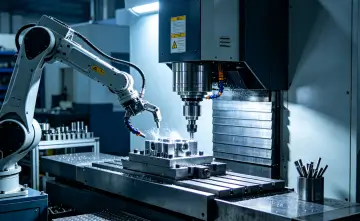
In response to these pain points, industrial robots have emerged as the optimal solution for upgrading machining center production. With their high precision, high efficiency, 24/7 continuous operation capabilities and strong flexibility, robots have become an indispensable part of intelligent machining centers. The integration of robots and machining centers is not a simple superposition of equipment, but a comprehensive transformation of the production model, which fundamentally solves the bottlenecks of traditional production and injects new vitality into the development of the machine tool industry.
How Robots Optimize Machining Center Production: From Precision to Efficiency
The integration of robots and machining centers has brought a comprehensive upgrade to production operations, covering every link from workpiece loading and unloading to process monitoring, quality inspection and tool management. This integration not only improves processing precision and efficiency but also reduces operational risks and labor intensity, realizing a leap from "manual operation" to "intelligent operation".
Precision Improvement: Eliminating Human Errors and Ensuring Consistency
Precision is the core competitiveness of machining centers, and robots have inherent advantages in ensuring processing precision. Industrial robots have high repeat positioning accuracy, generally reaching ±0.01mm, and even up to ±0.005mm in high-precision models, which can completely avoid errors caused by human fatigue, misoperation and other factors. In the processing of robot core components such as planetary roller screws, the transmission error needs to be controlled at 8-18μm, and the surface roughness requires 0.1-0.4μm. Robots can cooperate with high-precision machining centers to stably achieve this level of precision, ensuring the consistency of each workpiece.
In practical applications, robots can complete workpiece clamping, positioning and transfer with high precision, avoiding the deviation caused by manual clamping. For example, in the processing of aluminum alloy structural parts of collaborative robots, high-speed precision five-axis machining centers equipped with robots can achieve efficient processing while ensuring that the processing precision reaches 0.002mm, which is difficult to achieve by manual operation. At the same time, robots can cooperate with visual inspection systems to conduct real-time detection of workpieces during the processing process. The robot is equipped with a high-precision camera, which can detect the dimensional tolerance of the processed parts in real time with a detection accuracy of ±0.01mm, and link with the machining center data to correct the tool compensation, further ensuring the processing precision.
Efficiency Enhancement: Realizing 24/7 Continuous Production
One of the most significant impacts of robots on machining center production is the substantial improvement of production efficiency. Unlike manual operation, robots do not need rest, can work continuously 24 hours a day, 7 days a week, and maintain a stable operation rhythm, which greatly improves the utilization rate of machining centers. Taking an Italian precision parts supplier as an example, after introducing a robotic automation system, the utilization rate of its machining centers increased from 42% to more than 95%, and the monthly output of parts increased by 60% compared with before the automation transformation.
Robots can significantly shorten the auxiliary time of processing. In traditional manual operation, the time for workpiece loading and unloading, tool replacement and other auxiliary links accounts for 30%-50% of the total processing time. Robots can complete these auxiliary operations quickly and accurately, reducing the auxiliary time by more than 70%. For example, a turning center adopting a circular loading and unloading robot has increased the processing efficiency of a single equipment by 3 times and reduced manual intervention by 80%. In addition, robots can realize seamless connection between multiple processes, avoiding the time waste caused by manual transfer of workpieces between different equipment. For example, robots equipped with quick-change fixtures can automatically transfer workpieces between machining centers and lathes, realizing integrated processing of multiple processes, which greatly shortens the production cycle.
Labor Cost Reduction: Alleviating the Shortage of Technical Workers
The rising labor cost and the shortage of technical workers have become important challenges restricting the development of manufacturing enterprises. The integration of robots and machining centers can effectively solve this problem. A single robot can replace 2-3 skilled workers, and even more in some complex scenarios, which greatly reduces the labor cost of enterprises. At the same time, robots do not require social security, training and other additional costs, and the one-time investment can be recovered within 1-2 years, bringing long-term economic benefits to enterprises.
In addition, the operation threshold of robotic automation systems is low, and new employees can operate independently after one week of basic training, which alleviates the pressure of enterprise recruitment and training. For example, a family-run precision parts enterprise in Italy had only 3 employees and 10 machining centers, which could not meet the order demand due to the shortage of technical workers. After introducing a robotic automation system, the enterprise not only solved the labor shortage problem but also doubled the number of orders it could undertake during the production peak period without rejecting orders due to insufficient capacity.
Safety Improvement: Reducing Operational Risks
Machining centers involve high-speed rotation, cutting and other operations, which have certain safety risks. Manual operation is prone to safety accidents due to misoperation, fatigue and other factors. Robots can replace humans to complete dangerous operations in harsh environments, such as high-temperature, high-pressure, high-noise and other scenarios, reducing the risk of safety accidents. For example, collaborative robots can form a safety unit with machining centers, which does not require protective fences, while reducing energy consumption by 30% and ensuring the safety of the production process.
At the same time, robots are equipped with multiple safety protection mechanisms, such as emergency stop buttons, collision detection sensors, etc., which can immediately stop operation when an abnormality occurs, ensuring the safety of equipment and personnel. This not only protects the personal safety of workers but also reduces the economic losses caused by safety accidents to enterprises.
Robots Drive Capacity Expansion of Machining Centers: Breaking Through Quantity and Quality Bottlenecks
Capacity is the core indicator of the production capacity of machining centers, and robots play a key role in expanding the capacity of machining centers. By optimizing the production process, improving equipment utilization and reducing production waste, robots help machining centers break through the traditional capacity bottleneck, realizing the dual improvement of capacity quantity and quality.
Improving Equipment Utilization to Expand Effective Production Capacity
The utilization rate of machining centers is the key factor affecting production capacity. In traditional manual operation, due to factors such as worker rest, shift change and operational proficiency, the utilization rate of machining centers is generally low, usually only 40%-60%. After the integration of robots, the machining center can achieve 24-hour continuous operation, and the utilization rate can be increased to more than 90%, which directly expands the effective production capacity of the machining center. According to the 2025 Annual Economic Operation Report of the Machine Tool Industry released by the China Machine Tool & Tool Builders' Association, the rapid development of emerging fields such as humanoid robots and industrial robots has driven the demand for high-precision, automated and composite machine tools, and the utilization rate of machining centers equipped with robotic automation systems has increased by more than 50% compared with traditional manual operation models.
In addition, robots can realize the sharing of multiple machines, further improving the utilization rate of equipment. The "robot + seventh axis" integrated solution has become a popular trend in the automation transformation of machining centers. A single track can arrange 2-10 machining centers, and the robot can move along the track to realize multi-machine sharing, which greatly improves the utilization rate of robots and machining centers. For example, a machining workshop equipped with 5 machining centers and 1 robot with a seventh axis can realize the continuous operation of all 5 machining centers, and the production capacity is increased by 3-4 times compared with the traditional manual operation mode.
Reducing Production Waste to Improve Effective Output
Production waste is an important factor affecting the effective output of machining centers. In traditional manual operation, due to errors in operation, inconsistent precision and other factors, the scrap rate of workpieces is relatively high, generally 5%-10%, which seriously affects the effective output of the machining center. After the integration of robots, the processing precision and consistency are greatly improved, and the scrap rate can be reduced to less than 1%, which significantly improves the effective output of the machining center.
For example, in the automotive manufacturing industry, the engine block processing adopts a flexible production line composed of six-axis robots and vertical machining centers, which not only increases the production capacity by 40% but also reduces the scrap rate by 60%. In the 3C electronics industry, the high-speed drilling and tapping of mobile phone metal casings adopts a combination of high-speed drilling and tapping centers and SCARA robots for loading and unloading, and the yield rate is increased to 99.8%. This shows that robots can effectively reduce production waste and improve the effective output of machining centers by ensuring processing precision and consistency.
Realizing Flexible Production to Adapt to Diversified Demand
With the continuous upgrading of market demand, the production model of machining centers is gradually shifting from mass production to multi-variety and small-batch production. Traditional manual operation production lines have poor flexibility and are difficult to adapt to the rapid switching of different products, which restricts the expansion of production capacity. Robots have strong flexibility and can quickly switch production tasks by modifying programs, adapting to the processing needs of different types and specifications of workpieces.
Robots can be equipped with modular fixture libraries, and can automatically switch between suction cups, electromagnetic and mechanical grippers to adapt to the processing of different types of workpieces, which perfectly meets the needs of multi-variety and small-batch production. At the same time, the integration of robots and digital twin technology can realize virtual debugging of the production line, which shortens the development cycle of the integrated system by more than 50% and further improves the flexibility and responsiveness of the production line. For example, in the mold manufacturing industry, the five-sided precision machining of large injection molds adopts a combination of five-axis machining centers and orbital handling robots, which not only reduces labor costs by 70% but also can quickly switch between different mold processing tasks, improving the adaptability of the production line to diversified demands.
Expanding Processing Scope to Tap Capacity Potential
Traditional machining centers have certain limitations in processing scope, especially for complex workpieces and special-shaped parts, which are difficult to process manually. Robots can expand the processing scope of machining centers by virtue of their flexible movement capabilities. For example, in five-axis machining centers, robots can assist in adjusting the posture of workpieces, expanding the processing scope of the equipment, such as the processing of the inner wall of deep cavity parts. In addition, robots can complete the processing of large workpieces by cooperating with gantry machining centers. Track-type mobile robots with a travel axis stroke of ≥10m can cooperate with gantry machining centers to support the continuous processing of ultra-long workpieces, tapping the potential of machining center capacity.
In-depth Optimization of Machining Centers by Robots: From Single Link to Full Process
The optimization effect of robots on machining centers is not limited to production efficiency and capacity expansion, but also involves the full process of machining center operation, including process optimization, energy consumption optimization, maintenance optimization and other aspects, realizing the comprehensive improvement of the overall performance of machining centers.
Process Optimization: Realizing Intelligent Collaboration of Multiple Processes
Robots can realize the intelligent collaboration of multiple processes of machining centers, optimizing the production process and reducing unnecessary links. For example, robots can integrate workpiece loading and unloading, processing, quality inspection, tool replacement and other processes into a whole, realizing the seamless connection of the production process and avoiding the time waste caused by manual transfer and operation. In the processing of robot reducers, the gear processing needs to adapt to high-precision five-axis hobbing machines and turning-milling composite machine tools, and the meshing gap of spline teeth needs to be controlled within 2-5μm. Robots can cooperate with machining centers to complete the integrated processing of multiple processes such as hobbing, turning and grinding, ensuring the processing precision and efficiency of the reducer.
At the same time, robots can realize the optimization of processing parameters through the integration with artificial intelligence technology. The AI algorithm can dynamically adjust the spindle speed and feed rate according to the vibration data fed back by the robot, optimizing the processing process and improving the processing efficiency and quality. For example, Qinchuan Machine Tool has realized the coverage of P1/P0 level top precision of ball screws through its Hanjiang Machine Tool, and its precision grinding machine equipment investment accounts for 46% of the screw production line cost. With the cooperation of robots, it has successfully entered the Tesla Optimus supply chain, and the relevant machine tool orders increased by 45% in 2025.
Energy Consumption Optimization: Achieving Green and Efficient Production
Green manufacturing has become an important trend in the development of the manufacturing industry, and energy consumption optimization is an important part of green manufacturing. Robots can help machining centers reduce energy consumption and achieve green and efficient production. Compared with traditional manual operation, robots have stable operation rhythm and can avoid energy waste caused by unstable manual operation. For example, collaborative robots can form a safety unit with machining centers, reducing energy consumption by 30% compared with traditional manual operation models.
In addition, robots can realize the intelligent management of energy consumption. Through the integration with the Internet of Things (IoT) technology, robots can monitor the energy consumption of machining centers in real time, find out the energy consumption bottlenecks and optimize them. For example, robots can automatically adjust the operation state of the machining center according to the production task, avoiding idle operation of the equipment and reducing energy consumption. At the same time, robots can automatically sort aluminum and iron chips, with a recycling rate of more than 95%, realizing the recycling of resources and further reducing the production cost of enterprises.
Maintenance Optimization: Reducing Equipment Failure Rate and Extending Service Life
The stable operation of machining centers is the basis for ensuring production capacity, and maintenance optimization is an important means to improve the stability of machining centers. Robots can assist in the maintenance of machining centers, reducing the failure rate of equipment and extending the service life of equipment. For example, robots can cooperate with RFID systems to realize automatic identification, replacement and wear monitoring of tools, shortening the tool change time to less than 15 seconds, and avoiding equipment failures caused by tool wear and damage.
At the same time, robots can monitor the operation state of machining centers in real time, collect operation data such as temperature, vibration and noise of the equipment, and predict potential failures through data analysis. This allows enterprises to carry out predictive maintenance, avoid sudden equipment failures, reduce maintenance costs and downtime. For example, Heidenhain launched a high-precision grating ruler for robot precision machining, which is matched with domestic high-end machine tool enterprises to help improve processing precision. In 2025, its sales of precision measurement and control components in China increased by 35% with the help of robotic monitoring and maintenance systems.
Practical Cases of Robot Integration in Machining Centers: From Theory to Practice
To better illustrate the role of robots in optimizing machining centers, we will combine practical cases from domestic and foreign enterprises to show the specific effects of robot integration, providing reference for enterprises that are preparing to carry out intelligent transformation.
Italian Torneria Novoletto Enterprise - Solving Capacity Bottlenecks with Robotic Automation
Torneria Novoletto is an Italian precision parts supplier in the chemical, pharmaceutical and medical fields, focusing on processing aluminum, steel, titanium and cobalt-chromium alloys into high-precision parts with a weight of ≤2 kg. The enterprise has long been restricted by two major dilemmas: a single part takes 2-3 hours to process, the workshop has only 3 employees, 10 CNC machining centers run only 10 hours a day, and are largely idle at night and on weekends; the shortage of technical workers in the industry makes it difficult to meet order demand and production peaks even if the equipment process is optimized.
After in-depth cooperation with SCHUNK, the enterprise selected the R-C2 hybrid automation system, which integrates "workpiece automation" and "pallet automation", and uses a single equipment to open up the whole process of workpiece grabbing, positioning and clamping. The system is equipped with a turning station, which can automatically complete the secondary clamping of workpieces, realizing the all-round six-sided processing of parts without manual intervention; as a robot wrist clamping module, it integrally completes the picking of blanks, the positioning and clamping of machine tools and the delivery of finished products, completely eliminating the manual adjustment link and greatly shortening the production change time. At the same time, the system can switch between circular parts and prismatic parts processing by replacing the vice jaw, which is suitable for multi-variety and small-batch production.
After the introduction of the R-C2 system, the production efficiency of the enterprise has achieved a qualitative breakthrough: the utilization rate of machining centers has doubled, realizing 24-hour unmanned operation, and the utilization rate has increased from 42% to more than 95%; the monthly output of parts has increased by 60% compared with before the automation transformation, and the number of orders that can be undertaken during the production peak period has doubled, without rejecting orders due to insufficient capacity; the operation threshold of the system is low, and new employees can operate independently after one week of basic training, alleviating the pressure of labor shortage.
Domestic Huizhuan Technology - Customizing Robotic Solutions for Robot Structural Parts Processing
As a domestic high-end machine tool manufacturer, Huizhuan Technology focuses on the R&D and production of precision machining equipment. With the rapid development of the robot industry, the enterprise has launched an ultrasonic green five-axis machining center specially designed for robot aluminum alloy structural parts, and matched it with industrial robots to form a complete automated processing solution. The machining precision of the equipment reaches 0.002mm, and the processing efficiency is increased by 30% compared with the traditional manual operation mode.
At the CIMT2025 exhibition, the enterprise's robotic automated processing solution attracted wide attention, and signed more than 200 million yuan of robot industry orders on site. The solution adopts the integration mode of robots and five-axis machining centers, which can automatically complete the loading and unloading, processing, quality inspection and other processes of robot aluminum alloy structural parts, realizing 24-hour continuous operation. At the same time, the solution uses ultrasonic green processing technology, which reduces energy consumption by 25% compared with traditional processing technology, and realizes green and efficient production. This case fully shows that the integration of robots and machining centers can not only improve processing efficiency and precision but also help enterprises open up new market spaces and enhance core competitiveness.
Future Trends: The Deep Integration of Robots and Machining Centers Towards Intelligence and Flexibility
With the continuous development of artificial intelligence, Internet of Things, digital twin and other technologies, the integration of robots and machining centers will move towards a deeper and more intelligent direction, bringing more profound changes to the machine tool industry. The future development trends mainly include the following aspects:
Firstly, the intelligent level of integration will be further improved. The future robot-machining center integration system will integrate artificial intelligence, big data and other technologies to realize self-learning, self-optimization and self-diagnosis. For example, the system can automatically adjust processing parameters according to the processing effect and equipment operation state, optimize the production process, and realize intelligent decision-making and control. At the same time, the integration of robots and machining centers will realize the sharing and interconnection of data, forming an intelligent production network, which improves the overall efficiency and flexibility of the production line.
Secondly, the flexibility of the production line will be further enhanced. With the increasing diversification of market demand, the future production line will be more flexible and adaptable. Robots will be able to realize faster production task switching and more flexible workpiece handling, adapting to the processing needs of multi-variety, small-batch and personalized products. The "robot + seventh axis" integrated solution will be more widely used, realizing the flexible scheduling of multiple machining centers and further improving the utilization rate of equipment.
Thirdly, the integration will develop towards a full-process solution. In the future, the integration of robots and machining centers will no longer be limited to the production link, but will cover the whole process of product design, production, maintenance and service. Enterprises will provide customers with integrated solutions from equipment supply to technical support and after-sales service, realizing the transformation from "providing equipment" to "providing complete value chain".
Fourthly, green and low-carbon integration will become a new trend. With the increasing emphasis on environmental protection, the future integration of robots and machining centers will pay more attention to energy conservation and emission reduction. Through the optimization of processing technology, energy consumption management and resource recycling, the production process will be more green and environmentally friendly, helping enterprises achieve sustainable development.
Conclusion: Seize the Robotic Automation Opportunity to Upgrade Machining Center Competitiveness
In the context of the global industrial robot industry's explosive growth, the integration of robots and machining centers has become an inevitable trend in the transformation and upgrading of the machine tool industry. Robots not only optimize the production process of machining centers, improve processing precision and efficiency, reduce labor costs and safety risks but also drive the expansion of machining center capacity, realize the dual improvement of capacity quantity and quality, and carry out in-depth optimization of the full process of machining centers, bringing comprehensive improvement to the overall performance of machining centers.
As a leading Chinese machine tool manufacturer, we have rich experience and strong technical strength in the integration of robots and machining centers. We can provide customers with customized robotic automation solutions according to their production needs, helping customers break through traditional production bottlenecks, improve core competitiveness and achieve high-quality development. In the future, we will continue to focus on the research and development and application of intelligent manufacturing technologies, promote the deep integration of robots and machining centers, and make greater contributions to the development of the global machine tool industry.
For manufacturing enterprises that are preparing to carry out intelligent transformation, seizing the opportunity of robotic automation is the key to achieving leapfrog development. By introducing robotic automation systems, optimizing the production model of machining centers and improving production efficiency and capacity, enterprises can better adapt to the changes of the global market and gain an advantage in the fierce market competition.
 Email
Email sales1: +86 15312799623