



Siemens CNC Repair, Upgrade, or Replacement: How to Preserve Machine Performance
If an existing Siemens CNC meets machining requirements, the fault is identifiable, and the original configuration can be restored, targeted repair may help preserve established machining performance. However, repair does not automatically guarantee better accuracy than an upgrade or replacement. Factory equipment managers should compare positioning accuracy, program compatibility, test-cut results, and continuous operating stability before making a decision.
Choosing between CNC repair, modernization, and complete control replacement requires more than evaluating controller specifications. The most appropriate solution depends on the machine's mechanical condition, available technical support, and ability to meet current production requirements.
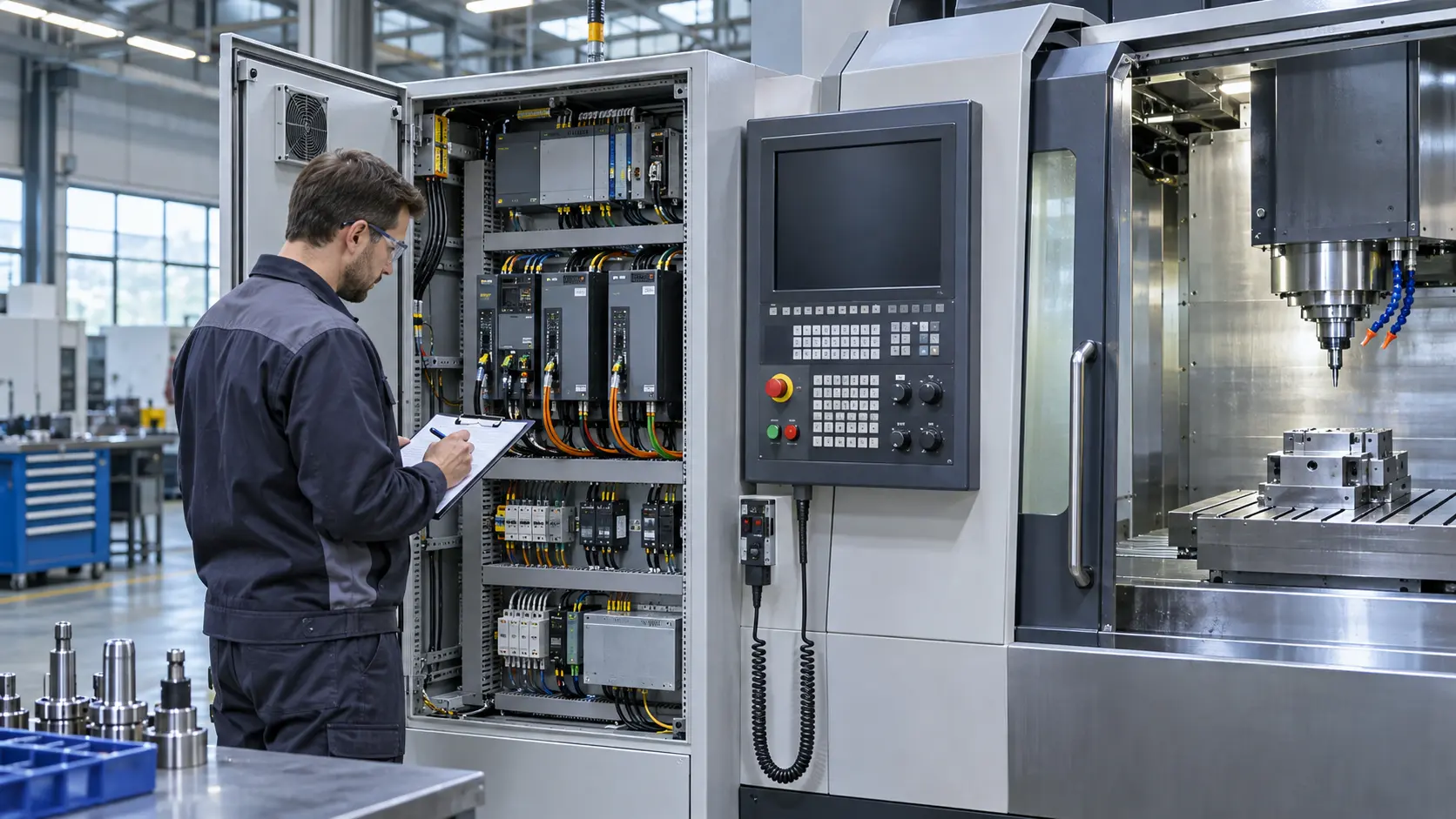
Why Diagnose a Siemens CNC Fault Before Replacing the Control?
A CNC machine's performance depends on more than its controller. Servo drives, feedback systems, mechanical components, compensation settings, machining programs, and operating conditions all influence the quality of finished parts.
When a Siemens CNC machine develops problems, three factors deserve particular attention.
1. Incorrect fault identification
Changes in machining accuracy or surface finish may result from spindle wear, ball screw backlash, guideway deterioration, thermal deformation, or tooling problems rather than the CNC controller.
Replacing the control system without identifying the underlying problem may leave the original machining defects unresolved.
2. Compatibility with existing production processes
Established machining programs, macros, fixed cycles, PLC logic, probing functions, and compensation settings may depend on the original machine configuration.
Replacing the controller can require additional programming, integration, and process validation.
3. Restoring the original machine configuration
Machine data, servo parameters, PLC programs, and compensation tables are essential to restoring established operation.
Even replacing a faulty component with an equivalent part may require recommissioning if these configurations cannot be recovered.
Before deciding whether to repair, upgrade, or replace the controller, manufacturers should identify the fault, verify available backups, and establish the machine's previous performance baseline.
If the equipment cannot operate, historical inspection reports and production records may provide useful reference information. However, original catalogue specifications should not be treated as current measured performance.
Siemens CNC Repair, Upgrade, and Replacement: Performance Comparison
Repairing an existing Siemens CNC, upgrading to a newer Siemens platform, and installing an alternative CNC controller represent three different engineering approaches.
The following table compares their technical considerations rather than ranking their performance.
| Comparison | Siemens CNC Repair | Siemens CNC Upgrade | Alternative CNC Replacement |
|---|---|---|---|
| Best suited for | Identifiable faults with recoverable configurations | Existing machines requiring updated control functions | Machines requiring different control capabilities |
| CNC programs | Existing programs may be retained | Compatibility must be verified | Program conversion may be necessary |
| PLC integration | Existing logic may remain usable | PLC migration may be required | PLC logic may require redevelopment |
| Servo compatibility | Original drives may be retained | Depends on upgrade configuration | Depends on controller and interface compatibility |
| Mechanical structure | Existing mechanical limitations remain | Existing mechanical limitations remain | Existing mechanical limitations remain if the machine is retained |
| Positioning accuracy | Requires post-repair verification | Requires post-upgrade verification | Requires post-retrofit verification |
| Functional testing | Focuses on restored functionality | Includes upgraded functions | Includes newly integrated functions |
| Main technical risk | Incomplete fault correction | Software and hardware migration | System integration and process revalidation |
No solution automatically provides better machining accuracy.
A repaired machine with sound mechanical components may continue meeting its original production requirements. An upgraded control may offer new functions, but those functions must be properly integrated and configured.
Similarly, an alternative CNC controller may meet or exceed the required machining performance when combined with suitable drives, feedback systems, mechanical components, and commissioning.
When Should You Repair the Existing Siemens CNC?
Repair is worth considering when the machine's current capabilities still meet production requirements and the fault can be clearly identified.
Typical conditions include a defective control module, drive component, feedback device, or another identifiable electrical fault that can be repaired without extensive system replacement.
Before proceeding, verify that:
- The fault diagnosis covers the controller, power supply, servo drives, encoders, wiring, and relevant mechanical components.
- Suitable replacement parts and qualified technical support are available.
- NC programs, compensation data, PLC configurations, and drive parameters can be recovered.
- Post-repair positioning accuracy, machining functions, and safety systems can be tested.
A targeted repair may reduce the number of functions requiring reconfiguration. However, maintaining existing hardware does not eliminate the need for testing.
Siemens offers repair services for selected SINUMERIK, SINAMICS, and SIMODRIVE products. Availability depends on the specific component and region, so support should be confirmed before planning the repair.
Source: Siemens Repair Services
When Should You Upgrade an Existing Siemens CNC?
Upgrading becomes relevant when the mechanical machine remains suitable for production but the existing control platform has functional limitations or support concerns.
Depending on the machine configuration, modernization may involve replacing the CNC controller, drives, motors, or associated electrical systems.
However, upgrading from one Siemens control generation to another does not guarantee complete compatibility.
The engineering team should verify the following areas:
- NC programs, macros, and machining cycles
- PLC programs and machine-specific logic
- Servo motors, drives, and encoder interfaces
- Software versions and licensed functions
- Tool changers, probing systems, and automation interfaces
- Machine safety functions and protective interlocks
The modernization plan should also identify which components will be retained, replaced, or reconfigured.
Every critical machining function should be validated before returning the equipment to production.
Siemens provides modernization solutions for legacy CNC machines, but the suitability of any particular upgrade depends on the original machine configuration and the selected hardware.
When Should You Replace Siemens CNC With Another Control System?
An alternative CNC system becomes worth evaluating when the existing controller cannot meet required machining functions, suitable support is unavailable, or another control platform better matches the production application.
Possible candidates include FANUC, Mitsubishi, HEIDENHAIN, and other CNC systems, depending on machine type and integration requirements.
However, replacing a Siemens controller with another brand is not necessarily a direct component swap.
The engineering team must evaluate compatibility between the new control and the machine's existing hardware.
Important considerations include servo communication, encoder feedback, spindle control, PLC integration, tool-changing sequences, machine safety, and CNC program conversion.
For example, an alternative controller may support advanced interpolation functions, but the machine will only benefit if the mechanical structure, drives, feedback devices, and commissioning support the required performance.
Manufacturers should therefore compare complete machine capabilities rather than controller specifications alone.
For additional technical context, see MNCNC's CNC machine resources.
How Should Machine Performance Be Evaluated After Repair or Retrofit?
A CNC machine that starts successfully or produces one acceptable part has not necessarily demonstrated that its previous machining performance has been preserved.
A structured acceptance procedure should examine both machine-level accuracy and actual production results.
| Performance Indicator | Evaluation Method | Key Consideration |
|---|---|---|
| Positioning accuracy | Laser measurement or another suitable calibrated method | Compare results under defined test conditions |
| Repeatability | Repeated positioning measurements | Evaluate consistency |
| Contouring performance | Circular interpolation or coordinated-motion testing | Identify motion-related deviations |
| Thermal stability | Measurements under defined temperature and operating conditions | Evaluate dimensional changes |
| Machining accuracy | Representative workpiece inspection | Verify actual drawing tolerances |
| Production stability | Continuous operating tests | Evaluate alarms, failures, and quality consistency |
| Functional compatibility | Machine function and safety testing | Confirm essential production functions |
The acceptance criteria should be agreed upon before repair or modernization begins.
Positioning Accuracy and Repeatability
Positioning accuracy describes how closely a machine axis reaches its commanded positions. Repeatability concerns the consistency of positioning under specified conditions.
Both are important, but they measure different aspects of machine performance.
For instance, a machine may repeatedly return to similar positions while still showing systematic positioning errors.
ISO 230-2 provides methods for evaluating the positioning accuracy and repeatability of numerically controlled machine axes.
Testing should account for axis travel, measurement positions, approach directions, environmental conditions, compensation status, and measurement uncertainty.
Contouring Accuracy and Servo Performance
Accurate positioning at individual points does not automatically ensure accurate movement along a programmed toolpath.
During contour machining, servo response, acceleration, feedrate, mechanical backlash, and structural behavior affect the actual cutting path.
Circular interpolation testing can help identify certain motion errors.
However, results from circular tests should not replace representative machining tests, particularly for complex surfaces or multi-axis applications.
Thermal Stability During Production
Machine geometry and positioning can change as components warm up.
Spindle rotation, axis movement, ambient temperature, and thermal expansion may influence dimensional accuracy during extended production.
A machine that passes a test immediately after startup may behave differently after several hours of operation.
For this reason, manufacturers should evaluate accuracy under relevant operating conditions and define appropriate warm-up procedures.
Actual Workpiece Accuracy
The final requirement is whether the machine can consistently produce acceptable components.
Representative test pieces should reflect the intended application, including material, machining operations, tooling, fixtures, and critical tolerances.
Important measurements may include:
- Hole spacing and dimensional tolerances
- Geometric tolerances and surface finish
- Cycle-time consistency
- Dimensional changes during extended operation
The acceptance process should distinguish machine measurement results from actual workpiece inspection.
Which ISO Standards Support CNC Machine Performance Testing?
International testing standards provide recognized methods for evaluating machine tool performance.
They help establish consistent measurement procedures but do not automatically guarantee that a particular machine meets its production requirements.
| Standard | Evaluation Area | Practical Application |
|---|---|---|
| ISO 230-2:2014 | Positioning accuracy and repeatability | Evaluation of individual numerically controlled axes |
| ISO 230-3:2020 | Thermal effects | Evaluation of changes caused by thermal conditions |
| ISO 230-4:2022 | Circular contouring performance | Assessment of coordinated motion |
| ISO 230-12:2022 | Machined test pieces | Evaluation through machining tests |
The appropriate standard editions, test procedures, and acceptance limits should be specified in the project documentation.
ISO 230-2:2014 also has a 2016 amendment, which should be considered when identifying the applicable contractual reference.
These standards should be used alongside actual production requirements rather than as substitutes for them.
What Machine Data Should Be Backed Up Before Siemens CNC Repair or Upgrade?
Machine data backup is a critical preparation step.
Depending on the control model and machine builder, relevant information may include NC programs, machine parameters, PLC configurations, drive settings, compensation tables, and machine-specific data.
The backup procedure should also verify software versions, file readability, archive contents, and restoration permissions.
A system archive should not automatically be assumed to contain the complete PLC engineering project or all original source files.
The Siemens SINUMERIK MC Commissioning Manual describes archive procedures and relevant limitations for the specified system.
Technicians should follow documentation for the actual installed control rather than applying procedures from another SINUMERIK generation without verification.
Three-Axis Machining Center Example: Comparing Performance Before and After Retrofit
Consider a hypothetical factory operating a three-axis machining center with an existing Siemens CNC.
The machine processes aluminum components with a critical hole-spacing tolerance of ±0.020 mm.
Its normal spindle operating condition is 8,000 rpm.
The factory is considering three options: repairing the existing controller, upgrading the Siemens control platform, or installing an alternative CNC system.
To compare these approaches fairly, the purchasing and engineering teams establish the same technical requirements.
| Test Item | Illustrative Acceptance Requirement |
|---|---|
| X-axis positioning accuracy | Bidirectional positioning accuracy A ≤ 15 μm |
| Critical hole spacing | ±0.020 mm relative to nominal |
| Spindle condition | Required machining load at 8,000 rpm |
| Machining performance | Meets agreed part-quality requirements |
| Continuous operation | Meets the specified operating test |
| Machine functions | Required tool changing, probing, coolant, and safety functions operate correctly |
These values are hypothetical acceptance targets, not measured performance data or universal specifications.
The positioning target and workpiece tolerance must be evaluated independently. The ±0.020 mm hole-spacing tolerance represents a total tolerance zone of 0.040 mm, or 40 μm, but it cannot be directly converted into an allowable positioning error.
How Should the Factory Compare Results?
Before any modification, the engineering team should collect existing performance records where possible.
After repair or retrofit, each solution should undergo the same agreed testing procedure.
Suppose 200 components are inspected during a test run, and 196 meet all specified inspection requirements.
The batch acceptance rate would be:
196\200×100%=98%
This is only an arithmetic example and does not represent a measured result from any specific CNC system.
Whether a 98% acceptance rate is sufficient depends on the factory's predefined quality requirements.
The factory should also examine inspection methods, rejected-part causes, operating conditions, and production consistency before comparing alternatives.
Without actual baseline and post-modification data, it would be inappropriate to claim that one option provides superior accuracy, higher efficiency, or better long-term stability.
Siemens CNC Repair and Replacement FAQ
Q:Will Repairing a Siemens CNC Preserve Accuracy Better Than Replacing It?
A:Not necessarily. Targeted repair may preserve more of the original configuration, but machining accuracy also depends on mechanical condition, feedback devices, servo tuning, and thermal behavior. Performance should be verified through comparable measurements and representative machining tests.
Q:Are Existing CNC Programs and PLC Logic Compatible With a Siemens Upgrade?
A:Not automatically. Compatibility depends on the control generation, software versions, licensed functions, machine-specific PLC logic, macros, and programming features. Important functions should be tested before production resumes.
Q:How Can You Establish a Performance Baseline if the Machine Cannot Run?
A:Use traceable historical inspection reports, maintenance records, and previous production-quality data. Document their dates and operating conditions. These records provide useful references but cannot completely replace measurements of the machine's current condition.
Q:Does Passing a Positioning Accuracy Test Guarantee Workpiece Accuracy?
A:No. Workpiece accuracy also depends on machine geometry, thermal deformation, tool condition, fixturing, machining forces, and coordinated axis movement. Positioning accuracy and representative workpiece tests should be evaluated separately.
Q:When Should a Factory Consider Replacing the Existing Siemens CNC?
A:Replacement deserves consideration when required functions cannot be achieved, suitable repairs or upgrades are unavailable, or support risks are unacceptable. Alternative controllers should be evaluated against the same machining and acceptance requirements.
Final Considerations: Choosing the Right CNC Solution
Repairing, upgrading, or replacing a Siemens CNC should ultimately be a performance-based engineering decision rather than a controller-brand preference.
If the existing machine remains mechanically sound and the control fault can be corrected, targeted repair may be sufficient. When new machining functions are required, upgrading or replacing the control system may offer a more suitable solution.
For manufacturers considering new equipment instead of further modifications, evaluating complete machine specifications, spindle capability, control configuration, and application requirements is equally important.
MNCNC offers CNC machining centers, lathes, milling machines, and application-oriented machining solutions. Manufacturers evaluating equipment for new production requirements can explore available machine configurations and solutions at www.mncnc.com

 Email
 sales1: +86 15312799623