



Can You Replace a Siemens CNC with FANUC, Mitsubishi, or Syntec Without Changing the Drives?
Yes, a Siemens SINUMERIK CNC controller can be replaced with FANUC, Mitsubishi, or Syntec, but keeping the existing Siemens servo drives depends on the machine's hardware architecture and the replacement controller's supported interfaces.
Most modern FANUC and Mitsubishi CNC systems are designed to work with their own compatible servo drive families. Syntec offers more options for integrating selected third-party drives through supported communication buses, but this does not guarantee direct compatibility with Siemens SINAMICS S120.
Some S120 configurations can communicate with third-party controllers through PROFINET/PROFIdrive. However, this requires an appropriate drive control unit, compatible motion-control functions, and validated real-time communication.
For CNC retrofit engineers, the practical decision is whether to retain the original drives, reuse selected motors and feedback devices, or replace the complete motion-control system.
1. Can You Keep Siemens Servo Drives When Replacing the CNC?
Many older CNC machines still have usable mechanical structures but suffer from aging electronics, expensive repairs, or limited replacement-part availability.
Replacing the controller can extend the service life of a machine, but modern Siemens systems integrate the CNC, drives, motors, encoders, and PLC functions through specific interfaces.
Three common challenges make controller replacement more complicated than changing the operator panel:
- Drive compatibility: The replacement CNC must communicate with the existing drive system using a supported interface and control mode.
- Motor and encoder compatibility: Existing motors may require feedback devices or electrical parameters that the new drives do not support.
- PLC and machine-function migration: Tool changing, spindle orientation, hydraulic clamping, probing, and safety-related functions must operate correctly after the retrofit.
The first step is identifying the exact Siemens control generation.
SINUMERIK 828D, 840D sl, and Older Systems
| Siemens CNC system | Typical configuration | Key retrofit considerations |
|---|---|---|
| SINUMERIK 828D | PPU with supported SINAMICS drive configuration, often S120 Combi | Integrated drive topology, servo interfaces, PLC functions |
| SINUMERIK 840D sl | NCU with SINAMICS S120, optionally including NX modules | Multi-axis coordination, drive communication, PLC/I/O integration |
| SINUMERIK 810D / earlier 840D | Generation-dependent legacy Siemens drive and control hardware | Drive identification, obsolete interfaces, motor feedback, backup availability |
These are representative architectures rather than universal configurations.
Siemens documentation confirms supported combinations of SINUMERIK 828D, 840D sl, and S120 Combi hardware, including software-version restrictions. Therefore, controller generation alone is insufficient to determine whether a drive can be retained.
For example, a machine fitted with SINUMERIK 840D sl and S120 drives should not automatically be evaluated using the same retrofit method as an earlier 840D installation with a different drive generation.
Can SINAMICS S120 Work with a Third-Party Controller?
Yes, certain SINAMICS S120 configurations support third-party controller integration, but this is different from directly replacing a SINUMERIK CNC with another brand.
In a typical integrated SINUMERIK system, DRIVE-CLiQ connects compatible Siemens drive-control components, motor modules, and feedback devices.
However, Siemens also provides independent S120 control units, including the CU320-2 PN, that support PROFINET communication.
Siemens' S120 communication documentation describes PROFINET RT/IRT operation and the PROFIdrive communication profile.
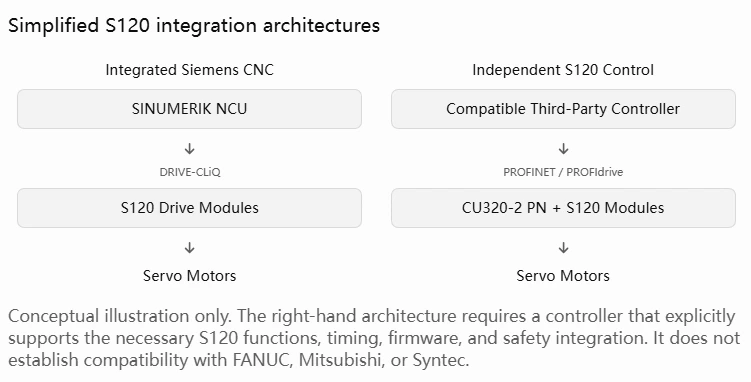
This distinction is important.
A Siemens drive may technically support an open industrial communication protocol without being directly compatible with a particular FANUC, Mitsubishi, or Syntec CNC.
A successful integration must confirm the required PROFIdrive application class and operating modes, cyclic data exchange, synchronization, command behavior, fault handling, and safety functions.
In addition, an existing SINUMERIK-connected S120 drive arrangement may require a different control unit, configuration, or other hardware changes before independent operation is possible.
Engineering conclusion: Retaining S120 drives is possible in some control architectures, but it should never be assumed from the availability of PROFINET alone.
2. Siemens vs. FANUC vs. Mitsubishi vs. Syntec: Drive Compatibility
FANUC, Mitsubishi, and Syntec offer capable CNC control systems. Their suitability for replacing Siemens depends more on the machine's requirements than on a universal ranking of brands.
| CNC controller | Typical servo communication | Direct reuse of Siemens S120 | Retrofit evaluation |
|---|---|---|---|
| Siemens SINUMERIK | DRIVE-CLiQ in relevant S120 configurations | Possible within supported Siemens architectures | Evaluate compatible control upgrades first |
| FANUC 0i / 30i families | FANUC-supported digital servo interfaces, including FSSB in applicable systems | Not established as standard direct compatibility | Evaluate matching FANUC drives and motors |
| Mitsubishi M80 / M800 families | Mitsubishi optical servo communication with supported MDS drives | Not established as standard direct compatibility | Confirm compatible Mitsubishi drive package |
| Syntec 220-5 series | EtherCAT or MECHATROLINK-III in supported configurations | No general direct compatibility | Verify approved third-party drives and firmware |
The table summarizes documented integration approaches rather than interchangeable performance ratings.
FANUC CNC Retrofit: When Is Complete Drive Replacement More Practical?
FANUC retrofit solutions typically involve replacing the controller together with compatible servo drives, motors, cables, and I/O components.
This is consistent with FANUC's official retrofit offering, which describes replacement of complete electrical control packages rather than promising universal retention of third-party drives.
A complete FANUC retrofit may be appropriate when:
- The Siemens drive electronics are no longer economical to maintain.
- The machine owner wants a coordinated controller, amplifier, and motor package.
- Local service engineers have experience with the selected FANUC system.
- The existing Siemens encoders and feedback devices cannot be supported economically.
However, replacing the electrical control system does not necessarily require replacement of the machine's guideways, ball screws, spindle assembly, or structural components.
Mitsubishi CNC Retrofit: What Must Be Checked?
Mitsubishi M800/M80 systems use supported MDS servo and spindle drive families with documented optical communication connections.
Mitsubishi's M800V/M80V product documentation illustrates the relationship between CNC hardware, MDS-E/EH drives, motors, encoders, and linear-scale interfaces.
For Siemens replacement, engineers should verify:
- The selected CNC and MDS drive combination.
- Motor and encoder compatibility.
- Spindle orientation and rigid-tapping functions.
- PLC program conversion and I/O mapping.
- Machine-specific compensation and tool-management requirements.
Existing Siemens motors should not be considered reusable until Mitsubishi or the selected drive supplier confirms the exact motor and feedback configuration.
Syntec CNC Retrofit: Does an Open Bus Make Integration Easier?
Syntec's 220-5 series supports EtherCAT and MECHATROLINK-III servo communication in its published configurations.
The manufacturer's specifications also identify model-dependent axis capacities and optional functions, including RTCP.
This makes Syntec worth evaluating where a retrofit design requires supported third-party drives.
However, sharing the same fieldbus does not ensure two devices can operate together.
For EtherCAT-based systems, engineers may need to verify CiA 402 compatibility where applicable, supported operating modes, distributed-clock synchronization, control cycle requirements, and manufacturer-specific device integration.
A Siemens S120 drive should not be assumed to support the necessary EtherCAT interface simply because it is an industrial Ethernet-based drive system.
The controller, drive, and feedback devices must be evaluated as a supported combination.
3. Which Siemens CNC Components Can Be Reused?
A retrofit does not always require replacing every electrical and mechanical component.
The most economical approach is often selective reuse, provided the retained components are in suitable condition and have supported interfaces.
| Existing component | Reuse potential | Required verification |
|---|---|---|
| Machine bed and guideways | Usually high | Geometry, wear, structural condition |
| Ball screws and couplings | Often | Backlash, axial play, mechanical condition |
| SINAMICS S120 drives | Conditional | Drive control unit, protocol, firmware, CNC support |
| Siemens servo motors | Conditional | Electrical ratings, encoder, commutation, brake |
| Spindle motor | Conditional | Power, torque, speed, drive compatibility |
| Linear scales | Conditional | Feedback protocol, signal levels, resolution |
| Tool changer mechanism | Often mechanically | Sensors, actuators, PLC sequences, interlocks |
| Hydraulic and pneumatic equipment | Often | Pressure, valves, condition, safety |
| Electrical cabinet | Conditional | Space, cooling, wiring, EMC, protection |
The table describes engineering feasibility, not a guarantee that a component can remain in service.
What Motor Parameters Matter Most?
Motor power alone cannot determine whether an existing Siemens servo motor will work with a replacement drive.
The engineer should collect the following information:
| Parameter | Unit | Why it matters |
|---|---|---|
| Rated motor power | kW | General drive sizing |
| Rated and maximum speed | rpm | Speed and overspeed limits |
| Continuous and peak torque | N·m | Required axis thrust and acceleration |
| Rated current | A | Amplifier selection |
| Motor voltage and electrical constants | V and model-specific units | Electrical compatibility |
| Rotor inertia | kg·m² | Servo dynamics and tuning |
| Encoder resolution and interface | Counts/rev or protocol designation | Position feedback |
| Brake voltage and current | V / A | Holding-brake control |
| Temperature sensor type | Device specification | Thermal protection |
For vertical axes, brake behavior and gravity-load protection require particular attention.
A motor that rotates successfully during an initial test has not necessarily passed the requirements for continuous machining operation.
Why Encoder Compatibility Can Prevent Motor Reuse
Servo motors use feedback devices for position, speed, and sometimes commutation information.
Depending on the system, these may include incremental encoders, absolute encoders, resolvers, or proprietary serial-feedback devices.
Even when mechanical dimensions and rated motor power match, incompatible encoder protocols may prevent the amplifier from operating the motor.
An encoder converter may be technically possible in some applications, but it introduces additional compatibility, diagnostic, and safety considerations.
For high-performance CNC axes, replacing the motor and feedback system with a manufacturer-supported combination may be more practical than developing an unsupported conversion.
4. How to Verify Motor, Encoder, and PLC Compatibility
Before purchasing the replacement controller, engineers should prepare a machine inspection report.
The report should identify the existing equipment, required functions, and acceptance criteria.
Example: Three-Axis Machining Center Retrofit Assessment
The following data represents a hypothetical vertical machining center, not a documented customer installation.
| Machine parameter | Illustrative value |
|---|---|
| Machine configuration | 3-axis vertical machining center |
| X/Y/Z travel | 800 / 500 / 500 mm |
| Maximum rapid traverse | 24 m/min |
| Rated spindle motor power | 11 kW |
| Maximum spindle speed | 8,000 rpm |
| Electrical supply | 380 V AC, 3-phase |
| Compressed-air supply | 0.6 MPa |
| Required positioning performance | To be specified from the original machine requirements |
| Existing positioning accuracy | To be measured before retrofit |
These values describe the inspection context. They are not sufficient to select servo amplifiers.
For example, an X-axis rapid traverse of 24 m/min does not directly determine motor power. Required motor torque also depends on moving mass, screw lead, acceleration, friction, transmission efficiency, and operating duty.
The assessment should therefore include both component nameplate data and machine measurements.
PLC and NC Program Migration
Replacing a Siemens controller may also require conversion of the original NC programs and PLC logic.
SINUMERIK, FANUC, Mitsubishi, and Syntec do not necessarily use identical programming behavior for all functions.
Potential differences include:
- Fixed machining cycles and canned cycles.
- Macro variables and parameterized programming.
- Tool offsets and coordinate transformations.
- M-code assignments and auxiliary functions.
- Spindle orientation and rigid tapping.
- Tool magazine management.
- Probing cycles and custom OEM functions.
For example, a Siemens machine may use custom cycles and PLC sequences developed by the original machine builder.
Those functions cannot automatically be transferred to a replacement CNC simply because both systems support common G-code commands.
The engineer should first inventory production programs and OEM-specific functions, then test representative machining operations after conversion.
Safety Requirements After a CNC Retrofit
A controller replacement can change the machine's electrical safety architecture.
Important functions include emergency stop, safe torque off, protective-door interlocks, unexpected restart prevention, and the safe control of vertical axes, spindles, and auxiliary mechanisms.
For machining centers and milling machines, ISO 16090-1:2022 provides relevant machine-tool safety requirements. The applicable requirements depend on the machine design, jurisdiction, and risk assessment.
Replacing a standard PLC program does not automatically preserve the safety integrity of the original installation.
Safety-related control functions must be reassessed and validated using an appropriate process.
How Should Retrofit Accuracy Be Verified?
Before removing the existing Siemens control, record the machine's baseline performance wherever feasible.
For positioning tests, ISO 230-2:2014 provides established methods for evaluating the accuracy and repeatability of numerically controlled axes. ISO 230-4:2022 covers circular contouring tests.
A practical acceptance record can include:
| Test | Equipment or method | Result to record |
|---|---|---|
| Linear-axis positioning | Laser interferometer or suitable calibrated measurement system | Positioning deviation and repeatability in μm |
| Circular interpolation | Ballbar or suitable circular-test system | Circular contouring errors in μm |
| Backlash assessment | Appropriate displacement measurement | Reversal deviation in mm or μm |
| Spindle speed | Calibrated tachometer or validated measurement | Measured speed in rpm |
| Tool changer operation | Controlled functional test | Sequence completion and interlock behavior |
| Safety functions | Documented safety-validation procedure | Pass/fail against defined acceptance criteria |
Measurements should be performed under recorded machine and environmental conditions.
A smaller CNC command increment does not prove higher machining accuracy. Actual accuracy depends on feedback, mechanics, thermal behavior, compensation, servo tuning, and machine geometry.
The final acceptance report should compare post-retrofit results with agreed tolerances and, where available, the original machine baseline.
5. Keep Existing Siemens Drives or Replace the Motion System?
There are three practical approaches to a Siemens CNC retrofit. Each has different costs, engineering requirements, and integration risks.
| Retrofit strategy | Components replaced | Main advantage | Main limitation |
|---|---|---|---|
| Siemens-compatible control upgrade | Selected controller and interface hardware | May preserve supported drives and existing system functions | Limited by hardware, firmware, and replacement availability |
| Third-party CNC with selective component reuse | CNC, necessary drives, I/O, and incompatible components | Preserves verified mechanical and electrical components | Requires detailed integration and validation |
| Complete electrical retrofit | CNC, drives, motors, feedback, PLC/I/O, required wiring | Establishes a coordinated replacement architecture | Higher initial equipment and installation cost |
When Is Retaining Siemens Drives Worthwhile?
Drive retention deserves consideration when the existing drives are functioning reliably, exact hardware documentation is available, and the proposed controller can support the required architecture.
For example, if the machine has serviceable S120 drives and Siemens-supported upgrade options remain available, preserving the original drive system may reduce wiring changes and commissioning work.
However, hardware retention is not necessarily economical when the drive generation is obsolete, replacement modules are difficult to obtain, or required integration work exceeds the value of the retained equipment.
When Is Complete Electrical Replacement More Practical?
A coordinated replacement system may be preferable when several major components are aging simultaneously.
This can include machines with recurring servo alarms, damaged feedback cables, unsupported control hardware, or incomplete original documentation.
A complete retrofit may also be appropriate when the machine owner wants to standardize multiple machines around a control platform supported by its maintenance team.
The decision should consider the expected operating life of the machine after modernization.
If the mechanical structure requires major repair, upgrading the CNC alone may not deliver a satisfactory result.
6. CNC Retrofit Cost and Engineering Assessment
The purchase price of a replacement CNC controller does not represent the total retrofit cost.
Engineers should include electrical hardware, PLC development, mechanical modifications, testing, training, and production downtime.
A basic cost model is:
Ctotal = Chardware + Cengineering + Cinstallation + Cvalidation + Cdowntime
The largest cost differences often arise from the amount of hardware that can be retained and the complexity of the required software migration.
For example, a machine with a functioning tool changer and documented I/O may require less PLC reconstruction than a machine with undocumented custom automation.
Likewise, replacing a CNC controller while retaining the motors is only economical if the compatible drives and integration work cost less than a supported replacement package.
Illustrative Retrofit Decision
Consider a three-axis machining center that still has acceptable mechanical performance but experiences repeated electronic faults.
The owner is considering three options:
| Evaluation factor | Siemens-compatible upgrade | Third-party selective retrofit | Complete electrical retrofit |
|---|---|---|---|
| Original drive retention | Potentially | Conditional | No |
| Original motor retention | Potentially | Conditional | No |
| PLC migration | Configuration-dependent | Usually substantial | Usually substantial |
| Electrical rewiring | Potentially limited | Moderate to extensive | Extensive |
| Long-term component standardization | Existing Siemens platform | Mixed platform | New coordinated platform |
| Principal engineering risk | Hardware/firmware support | Cross-platform integration | Installation and commissioning scope |
These are qualitative comparisons, not measured costs or universal outcomes.
A supplier quotation should specify every retained component and identify which party is responsible for compatibility testing.
How to Evaluate the Financial Benefit
One useful measure is the cost of avoidable downtime.
Annual Downtime Cost= Hlost/month×Clost/hour×12
Assume, for illustration, a machine experiences 12 hours of unscheduled downtime monthly, with an estimated lost contribution margin of $120 per hour.
The annual modeled loss is:
12 x 120 x 12 = $17, 280
This calculation can help establish the value of improving reliability, but it does not show that a particular CNC retrofit will eliminate that downtime.
A realistic investment assessment should also include maintenance savings, installation downtime, incremental operating expenses, financing or discounting, and the remaining useful life of the machine.
For retrofit acceptance, the project should have defined technical targets before installation, such as acceptable positioning error, repeatability, spindle functionality, and successful execution of representative production programs.
These targets should come from the machine's original performance requirements and the customer's machining needs, not from unsupported assumptions about the replacement controller.
7. Frequently Asked Questions
Q: Can a Siemens SINUMERIK 840D sl be replaced with FANUC while keeping SINAMICS S120 drives?
A: Not as a standard direct replacement. FANUC CNC systems typically use supported FANUC servo architectures, while SINAMICS S120 installations have Siemens-specific control arrangements. Although some S120 configurations support third-party controllers through PROFINET/PROFIdrive, this does not establish direct FANUC compatibility. Verify a supported interface or plan for replacement servo equipment.
Q: Do existing Siemens servo motors need to be replaced during a CNC retrofit?
A: Not always. Motor retention depends on amplifier compatibility, motor electrical characteristics, encoder communication, commutation requirements, brake control, and thermal protection. Confirm the exact motor part numbers with the proposed drive supplier. Matching rated power alone is insufficient.
Q: If a Syntec controller supports EtherCAT, can it communicate directly with an S120 drive?
A: No. EtherCAT support on the CNC does not establish that the existing S120 configuration exposes a compatible EtherCAT servo interface. Both devices must support appropriate communication profiles, operating modes, synchronization, and firmware configurations. A compatible interface must be documented and validated.
Q: Can a new FANUC, Mitsubishi, or Syntec controller correct positioning errors on an older machine?
A: A new CNC may support improved control and compensation functions, but it cannot automatically eliminate ball-screw wear, backlash, guideway errors, or structural distortion. Measure positioning and contouring performance before and after the retrofit using appropriate procedures, such as ISO 230-2 and ISO 230-4, and compare results against agreed acceptance limits.
Q: What should a CNC retrofit engineer provide to a supplier?
A: Prepare the following information:
- Machine manufacturer, model, year, and axis configuration.
- SINUMERIK CNC model, software version, and available backup files.
- Drive, motor, and encoder part numbers.
- Electrical drawings, PLC/I/O documentation, and safety-circuit information.
- Spindle specifications, tool changer configuration, and auxiliary equipment.
- Required machining functions, production programs, and performance targets.
These details allow the supplier to determine whether a controller-only upgrade, selective component replacement, or complete electrical retrofit is technically appropriate.
Final Recommendation: Select the Retrofit Architecture Before the CNC Brand
FANUC, Mitsubishi, and Syntec are potential alternatives to Siemens SINUMERIK, but none should be treated as a universal drop-in replacement.
For machines equipped with SINAMICS S120, begin by identifying the existing control unit, drive modules, feedback devices, and communication interfaces. A supported Siemens upgrade may be the simplest way to preserve functioning equipment.
If the machine requires a different CNC brand, compare the complete control and drive architecture rather than the controller price alone.
For machines with obsolete drives, unsupported encoders, or recurring electrical failures, a coordinated replacement package may provide a more maintainable solution.
The most suitable retrofit is the one that meets the machine's required accuracy, production functions, safety requirements, and lifecycle cost with a documented and supportable integration design.
For machining centers and other CNC equipment, MINNUO can support equipment configuration discussions and technical requirement evaluation through MN CNC. For an existing Siemens machine, provide the control, drive, and motor nameplate information before requesting a replacement proposal. The final compatibility decision must be confirmed against the selected component manufacturers' documentation.
 Email
 sales1: +86 15312799623