



Siemens CNC Retrofit vs Cross Brand Alternatives for Downtime Risk and Five Year TCO
Should You Keep Siemens or Switch CNC Brand?Neither route has the lowest cost or lowest risk in every factory. For an installed 840D sl fleet, staying with Siemens normally reduces CNC-language, operator and PLC transition risk, but it can retain supplier concentration and regional service cost. A cross-brand retrofit can win when it supports plant-wide standardization, stronger local service or a required open architecture. Treat component reuse as unproven until the bidder signs an interface and lifecycle matrix. Compare discounted five-year cash flow, recoverable and unrecoverable downtime, acceptance results and service obligations; do not select on controller price alone.
What Changes CNC Retrofit Risk and Cost
Why Do Controller Only Quotes Distort Retrofit Cost
FANUC's supplier guidance describes a typical retrofit as replacement of the CNC, servo and spindle motors, amplifiers, cables, I/O and operator interface. Use that as a conservative budgeting boundary, not as a rule that every cross-brand project must replace every component. A same-ecosystem proposal may reuse more installed hardware, but the bidder must prove each reused order number, firmware level, interface, safety function and lifecycle status in writing.
How Much 840D sl Logic Migrates to SINUMERIK ONE
Siemens supports migration of an 840D sl PLC 300 project to the SINUMERIK ONE PLC 1500 in TIA Portal. Its July 2025 manual states that the starting module's hardware configuration and network settings are not transferred automatically, and peripherals are not automatically interconnected. Compare assisted re-engineering with the cross-brand integrator's documented conversion method. Do not assume either route is automatic or that a cross-brand route always requires every drive and motor to be replaced.
How Should CNC Retrofit Downtime Be Valued
The outage ends only after safety validation, servo tuning, restored tool and work data, benchmark-part approval, backup recovery and operator handover. Do not price every hour as permanently lost contribution margin when output can be recovered through inventory, overtime or later capacity. Use: downtime economic loss = unrecoverable output x unit contribution margin + overtime recovery + expedited logistics + scrap/restart loss. State the recoverable share and the bottleneck assumption.
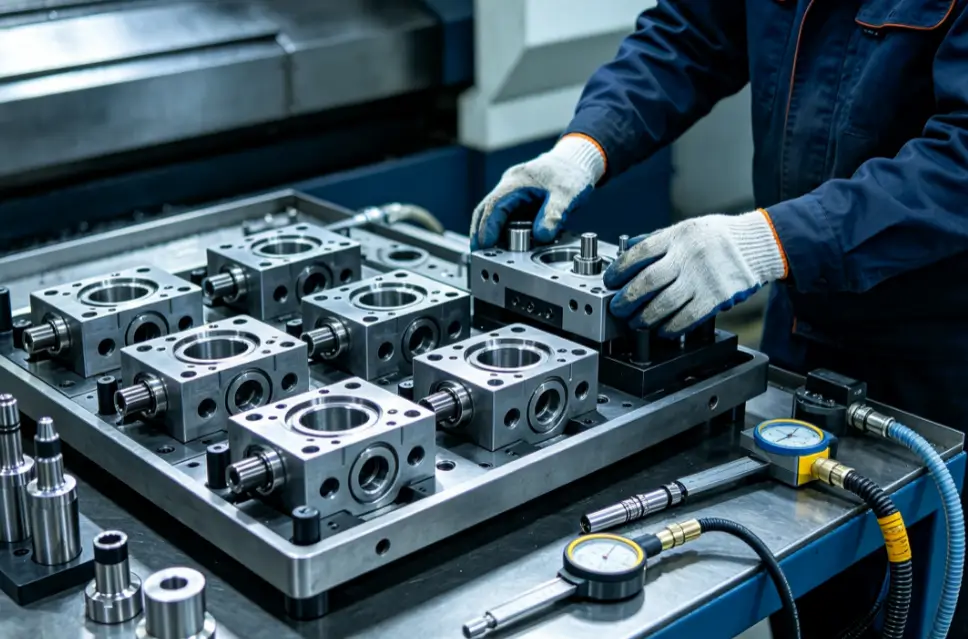
Siemens vs FANUC Mitsubishi HEIDENHAIN and Beckhoff
How Do Siemens and Cross Brand Retrofit Scopes Differ
| Decision factor | Stay in Siemens ecosystem | Switch CNC brand |
| NC programs and cycles | Siemens states CNC language, cycles and ShopMill/ShopTurn continuity with SINUMERIK ONE; OEM extensions still require testing | Basic ISO code may transfer; macros, cycles, M codes, probing and RTCP require mapping and regression testing |
| PLC and HMI | PLC-program migration is assisted; hardware, networks, messages, telegrams and safety still require adaptation | Budget a functional rewrite unless the integrator documents a conversion tool, reusable source and test coverage |
| Drives and feedback | SINAMICS/SIMOTICS reuse may be possible after order-number, firmware and safety review | Use a full-replacement budget until retained drives, motors, encoders and interfaces are contractually proven |
| Training | Lower when the plant already uses SINUMERIK Operate and Siemens maintenance tools | Higher initially; may be justified by regional skills, standardization or easier hiring |
| Supplier exposure | Continues Siemens dependency but preserves fleet commonality | Diversifies or changes dependency; may fragment the installed base |
| Best case | 840D sl fleet, complex OEM cycles, Siemens-trained staff, short outage priority | Weak Siemens support, strong alternative integrator, special-process or open-architecture need |
What Do Published CNC Capacity Numbers Actually Mean
| Platform | Published maximum / condition | Architecture | Screening use |
| SINUMERIK ONE | Direct 840D sl successor; axes/channels depend on NCU and licensed options | Integrated S7-1500F; TIA Portal | 840D sl migration and complex OEM cycles |
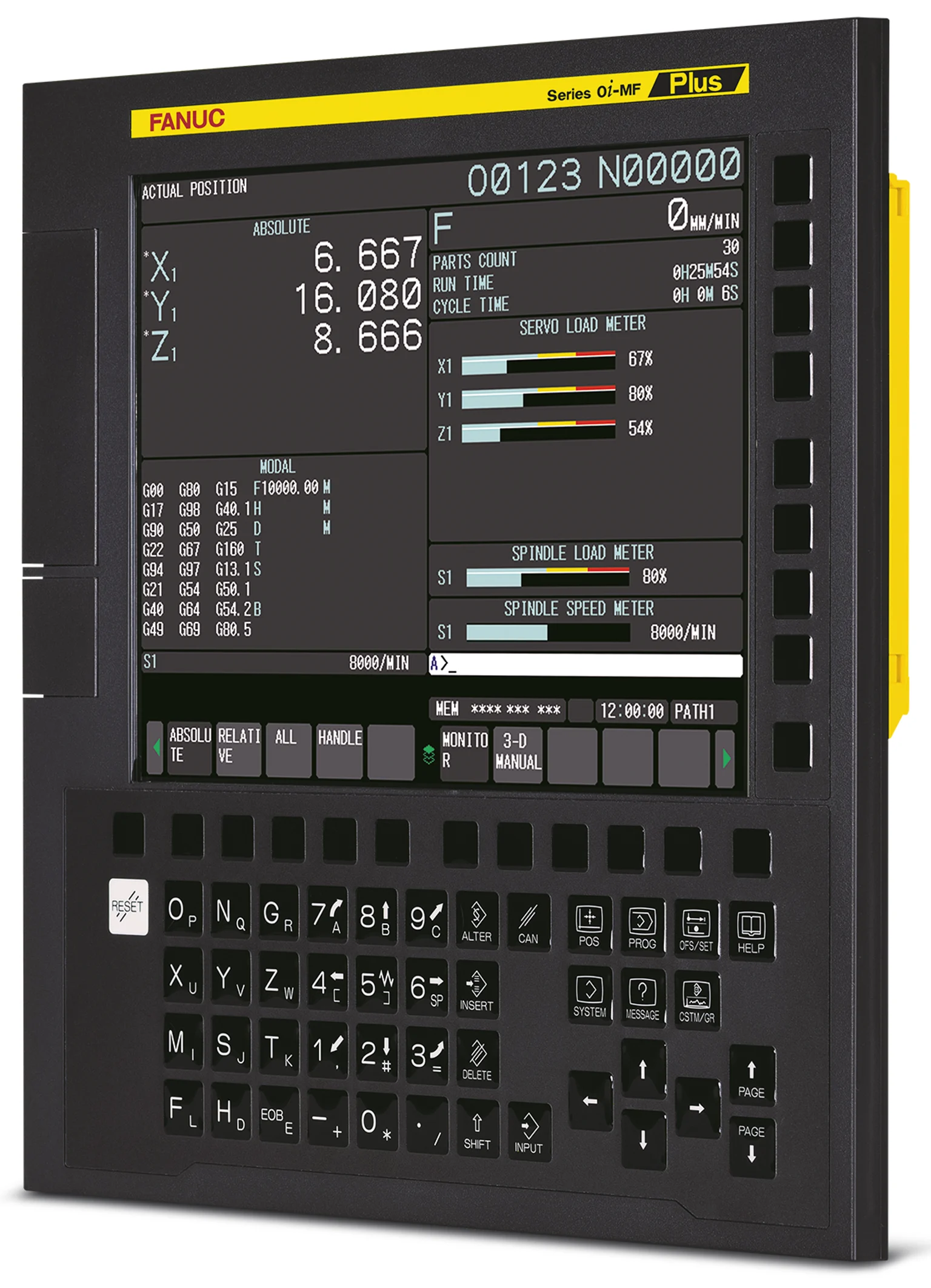
| FANUC 0i-MF Plus | 11/9 controlled and 9/7 feed axes by configuration; 2 paths; max 4 axes/path | PMC plus FANUC drive ecosystem | Standard milling; verify regional integrator depth |
| Mitsubishi M80V | Up to 9 total NC axes in listed variants; 4 simultaneous contour axes; confirm exact type | Mitsubishi CNC/PLC/drive ecosystem | Machining-center or lathe use by model |
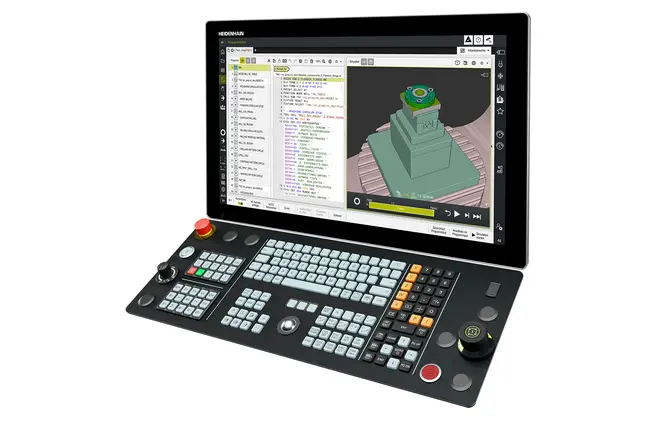
| HEIDENHAIN TNC7 | 24 control loops, including 4 for spindles; 0.5 ms block processing | OEM machine PLC integration | Milling, turning and grinding; OEM-dependent |
| Beckhoff TwinCAT CNC | System limits up to 128 axes, 32 channels and 32 interpolation axes/channel | PC, PLC and CNC on TwinCAT/EtherCAT | Special machines and integrated cells |
Comparability warning. Controlled axes, control loops and software-system limits are not equivalent metrics. Published maxima are option-, license- and machine-builder-dependent and do not prove accuracy, surface finish or cycle time. The figures above come from the respective official product documentation.
Specify the assembled machine: X/Y/Z/A/B/C travel, rapid rate in m/min, spindle rpm and kW, table load in kg, required utilities in MPa where applicable, positioning error in micrometres, thermal test conditions and benchmark cycle time in minutes.
How Do You Calculate Five Year CNC Retrofit TCO
Discounted five-year TCO = initial investment + sum of annual service, spares, energy, expected failure and recovery costs discounted by (1 + r)^t - discounted residual value. Use the same currency, tax treatment, discount rate and production volume for both bids.
| Cost element | Stay Siemens | Switch brand | Basis |
| Hardware and licenses | USD 310,000 | USD 250,000 | Illustrative quotation boundary |
| Engineering and commissioning | USD 140,000 | USD 250,000 | Assisted migration versus full rewrite |
| Training and documentation | USD 25,000 | USD 60,000 | Operators, maintenance and programming |
| Five-year service and spares | USD 150,000 | USD 120,000 | Use regional contract quotes |
| Planned outage exposure | 120 h x USD 2,000 = USD 240,000 | 220 h x USD 2,000 = USD 440,000 | Assumes all hours are unrecoverable |
| Modeled nominal subtotal | USD 865,000 | USD 1,120,000 | Not a complete TCO or market quote |
| Items not modeled | Failures, energy, finance, tax and residual value | Failures, energy, finance, tax and residual value | Add bid-specific cash flows before approval |
Interpretation. In this worked example, cross-brand hardware is USD 60,000 cheaper, but the stated engineering, training, service and fully unrecoverable outage assumptions make its nominal subtotal USD 255,000 higher. The arithmetic is correct; the inputs are illustrative and are not market prices or a customer result. A complete decision requires the omitted cash flows and a sensitivity range.
Downtime break-even point = extra same-ecosystem cost / verified unrecoverable hours avoided. If staying Siemens costs USD 100,000 more before downtime and avoids 80 unrecoverable hours, its break-even value is USD 1,250/h. If only 40 of those hours are unrecoverable, the break-even value doubles to USD 2,500/h. Add probability-weighted failures and recovery costs before approval.
Which CNC Retrofit Route Fits Each Factory
| Factory situation | Likely route | Why |
| High-volume bottleneck | Use the audited break-even formula; do not assume a brand winner | Verified unrecoverable outage can outweigh hardware price |
| Low-utilization toolroom machine | Apply measured recovery and due-date cost, even if small | Low utilization does not make downtime free |
| Plant standardizing on FANUC or Mitsubishi | Switch may win across fleet, not on one machine | Count shared spares, skills and software |
| Custom line needing open PC control | Beckhoff or similar may justify full rewrite | Architecture value must exceed migration cost |
| OEM cycles or PLC source unavailable | Same ecosystem may reduce but not remove risk | Obtain OEM support or compare machine replacement |
What Belongs in a CNC Retrofit RFP and Acceptance Plan
What Scope Should Every CNC Retrofit Bidder Quote
| RFP package | Minimum comparable scope |
| Control | CNC, HMI, PLC, safety, I/O, networks, licenses, source and recovery image |
| Motion | Drives, motors, feedback, spindle, brakes, thermal sensors, cables, tuning and compensation |
| Software | NC programs, OEM cycles, macros, tool data, probing, alarms, reports and interfaces |
| Services | Design, panel build, factory test, installation, commissioning, metrology, training and standby support |
| Commercial | Taxes, travel, recurring licenses, five-year spares, response SLA, warranty and liquidated downtime |
How Should a Retrofitted CNC Machine Be Accepted
| Acceptance domain | Method | Required record |
| Linear and rotary positioning | ISO 230-2; calibrated direct measurement | Bidirectional accuracy and repeatability for every contracted X/Y/Z/A/B/C axis |
| Two-axis circular contouring | ISO 230-4; ballbar or permitted calibrated instrument | G(b), D, G and F at agreed plane, radius, feed and warm-up state |
| Five-axis kinematics | ISO 10791-6 or agreed equivalent | Linear/rotary interpolation and TCP/RTCP result for the actual machine configuration |
| Spindle | Calibrated tachometer and power log | Rated rpm and kW, temperature, vibration and loaded stability |
| Finished workpiece | Contract benchmark plus ISO 10791-7 where applicable | Dimensions mm, roughness micrometres, cycle min and full cutting conditions |
| Reliability and recovery | Purchaser-defined 72-hour run and bare-hardware restore drill | Zero unresolved safety/motion alarms; recovery time and image verified |
Evidence rule. ISO 230-2 applies to linear and rotary axes; ISO 230-4 addresses circular contouring, while ISO 10791-6 and ISO 10791-7 add relevant five-axis kinematic and finished-test-piece coverage. The 72-hour run is a purchaser criterion, not an ISO requirement. Agree tolerances, environment, warm-up, software compensation state and uncertainty before the purchase order.
What Can Supplier Retrofit Evidence Actually Prove
Same-ecosystem evidence. In Siemens' NWI customer case, Fives refurbished Cincinnati gantry machines originally built from 1985 to 1998 with SINUMERIK ONE. NWI says capital investment and lead time were about one-third of new equipment; a Siemens representative describes 14 to 16 weeks as typical for a retrofit. NWI also attributes lower training requirements and standardized maintenance to fleet consistency.This is a single supplier-hosted customer case, not an independent cross-brand benchmark; do not transfer its ratios to another machine without a mechanical audit and firm quotations.
Cross-brand scope evidence. FANUC states that its modern retrofit scope typically includes the CNC, servo and spindle motors, amplifiers, cables, I/O and operator interface. It also advertises electricity-cost reduction of up to 50% with regenerative drives and low-loss devices. Both are supplier statements. The 50% maximum is excluded from this TCO model because no equal-baseline Siemens measurement or machine-level kWh/part record is available.
Twelve-month normalization. For a plant scheduled 4,000 h/year, 100 additional migration hours equal 2.5% of scheduled capacity. If all 100 hours are unrecoverable and worth USD 2,000/h, exposure is USD 200,000; if only 40% is unrecoverable, the contribution-margin portion is USD 80,000 before recovery costs. A verified 7% cycle-time reduction changes 4,000 h to 3,720 h for the same output, releasing 280 h; theoretical capacity rises 1/0.93 - 1 = 7.53%. These are arithmetic scenarios, not promised outcomes.
CNC Retrofit FAQ
Q: Is staying with Siemens always the lowest-risk retrofit?
A: No. It usually reduces program, operator and PLC transition risk for an 840D sl fleet, but obsolete peripherals, protected OEM code, safety redesign or weak local Siemens support can still dominate. Compare named components and accountable integrators, not brand labels.
Q: Can a cheaper cross-brand controller still produce a lower five-year TCO?
A: Yes. It can win when local engineering is stronger, spare parts and service are cheaper, fleet standardization removes duplicate skills, or the open architecture creates measurable value. It loses when full drive replacement, software rewrite, training and outage erase the purchase-price saving.
Q: How should downtime risk be priced before the retrofit?
A: Separate recoverable from unrecoverable output. Price unrecoverable output at contribution margin, then add overtime recovery, expedited logistics, scrap, restart loss and probability-weighted overrun. Run low, base and high cases and state contract responsibility.
Q: Should existing SINAMICS drives be reused in a Siemens migration?
A: Only after checking order numbers, firmware, DRIVE-CLiQ topology, encoders, safety functions, motor condition and lifecycle. Reuse can cut cost and outage, but unsupported combinations can increase commissioning and future failure risk.
Q: What is the minimum evidence required to choose between the two routes?
A: Require a signed asset audit, identical RFP scope, program and PLC migration matrix, safety concept, outage plan, regional service SLA, five-year spares list and benchmark result. Include ISO 230-2/230-4 and, for five-axis machining centers, applicable ISO 10791-6/10791-7 tests.
 Email
 sales1: +86 15312799623