



Slant Bed CNC Lathe: Working Principle & Complete Guide
In the field of precision mechanical processing, the slant bed CNC lathe has become a cornerstone of the industry with high efficiency, superior accuracy and versatile performance. Unlike traditional flat bed lathes, its unique inclined bed design delivers exceptional structural rigidity, excellent chip removal capacity and optimized ergonomic operation. It is the preferred equipment for mass production and complex component machining, widely applied in automotive, aerospace and medical device manufacturing. Whether you are a business owner, machinist or procurement specialist, this guide elaborates on its working principle, core components, operating procedures, advantages and troubleshooting tips to help you maximize its performance potential.
Slant bed CNC lathes have become mainstream equipment in modern manufacturing, enabling high-speed and high-precision turning with minimal errors. The bed is generally inclined at 30°–60° (standard 45°), solving three major limitations of flat bed lathes: poor chip removal, insufficient rigidity and inconvenient operation. With the growing demand for precision parts—especially in the electric vehicle and semiconductor industries—Google search queries such as slant bed CNC lathe price and slant bed CNC lathe for metal turning have surged sharply in 2026. This guide provides practical reference suggestions for common industry questions.
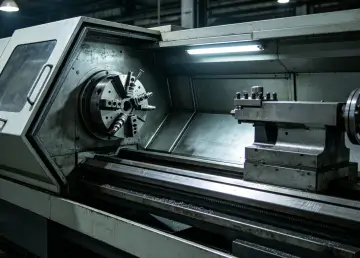
What Is a Slant Bed CNC Lathe? Definition & Core Features
A slant bed CNC lathe is a numerical control turning machine with an inclined bed forming a triangular cross-section, which enhances structural rigidity and optimizes chip evacuation. This design directly upgrades equipment performance, machining accuracy and efficiency, setting it apart from flat bed lathes.
Core Features
- Inclined Bed Structure: Tilt angle ranges from 30° to 60° (standard 45°) for optimal chip removal and rigidity; the triangular cross-section effectively resists bending and torsion.
- High Structural Rigidity: Made of high-strength cast iron (usually Meehanite cast iron) or alloy steel, minimizing deformation during heavy cutting and ensuring consistent machining accuracy.
- Superior Chip Removal: The inclined surface allows chips and coolant to slide down naturally, avoiding chip accumulation that may damage tools or cause secondary machining errors.
- Ergonomic & Compact Layout: Comfortable workpiece operating height reduces operator fatigue; smaller footprint suits small workshop deployment.
- Strong Compatibility: Supports multi-axis machining, power turrets and automated accessories, enabling one-clamp completion for complex parts.
These advantages make it ideal for processing precision components such as shafts and gears, widely used in aerospace (engine spindles) and medical industries (orthopedic implants with tolerance up to ±0.003 mm).
Working Principle of Slant Bed CNC Lathe: Operation Mechanism
Adopting CNC technology, the slant bed CNC lathe realizes automated turning via G-code and M-code. Its core working logic is to rotate the workpiece while using cutting tools to remove excess material. The inclined bed design improves operational stability and chip removal performance. The specific workflow is as follows:
- CNC Programming — The Brain of the Machine
The programming process includes three steps: creating part models via CAD software such as SolidWorks and AutoCAD; generating tool paths and machining parameters through CAM software like Mastercam; converting data into G-code to control machine movement. The G-code is loaded into CNC systems including FANUC, Siemens and Haas. It also supports conversational programming to simplify small-batch production setup.
- Workpiece Clamping & Positioning
Workpieces such as bar stock and blanks are clamped by a three-jaw hydraulic chuck. Long workpieces get extra support from the tailstock. A dial indicator is used for alignment to ensure concentricity with the spindle, preventing vibration and tool damage. The inclined bed facilitates easy operation and keeps the clamping area free of chip buildup.
- Spindle Rotation & Tool Movement
The spindle motor drives the workpiece to rotate at 50–4500 RPM (higher speed for soft materials like aluminum, lower speed for hard materials such as steel). Servo motors drive cutting tools along X/Z axes; high-end models support Y/C axis movement to remove material with precise incremental feeds. Coolant sprays automatically for cooling, lubrication and flushing chips.
- Machining Completion & Unloading
After program execution, the spindle stops. Finished parts are unloaded and inspected with calipers or coordinate measuring instruments. For mass production, automatic part collectors reduce manual work and realize unattended machining.
Core Components of Slant Bed CNC Lathe
All core components work collaboratively to guarantee machining accuracy and operational efficiency:
- Slant Bed Base
Made of high-strength cast iron or alloy steel with a tilt angle of 30°–60°. Annealing treatment releases internal stress; high-end models adopt one-piece casting to minimize deformation.
- CNC System
Serves as the machine’s brain to interpret G-code with a user-friendly interface. Advanced functions include tool life monitoring and remote access; conversational programming simplifies small-batch production setup.
- Spindle System
Driven by servo motors or inverters with precision bearings for stable rotation. Key parameters: spindle taper (BT30/BT40), spindle bore diameter (1.5–6 inches and above), speed range (50–4500 RPM).
- Turret / Tool Post
Equipped with 8–24 tool stations. Static turrets for turning; power turrets support milling and drilling. Tool change time is only 1–3 seconds to reduce downtime.
- Axis Drive System
Composed of servo motors, ball screws and linear guide rails, ensuring precise movement of X/Z/Y/C axes. A closed-loop feedback system further improves machining accuracy.
- Cooling System
Consists of cooling tank, pump and nozzles to deliver coolant for cooling, lubrication and chip removal. The filtering system extends coolant service life.
- Chuck & Tailstock
Three-jaw or four-jaw chucks and collets are used for workpiece clamping; the tailstock supports long workpieces, and some models support programmable automatic operation.
- Optional Accessories
Bar feeders, part collectors, tool setters and chip conveyors greatly improve efficiency in mass production.
Slant Bed vs Flat Bed CNC Lathe: Core Differences
Select the right machine according to application scenarios:
| Feature | Slant Bed CNC Lathe | Flat Bed CNC Lathe |
| Bed Design | Inclined 30°–60°, triangular cross-section | Horizontal, flat cross-section |
| Rigidity | High, suitable for heavy cutting | Relatively low, prone to deformation |
| Chip Removal | Excellent | Poor, requires manual cleaning |
| Accuracy | High (±0.001–0.003 mm) | Medium (±0.005–0.01 mm) |
| Cost | Higher | Lower |
| Application | High-precision & mass production | Small-batch & simple part machining |
Slant bed lathes excel in accuracy and efficiency, while flat bed lathes are more cost-effective for budget-limited and simple machining demands.
Slant Bed CNC Lathe Operation Steps: Step-by-Step Guide
Follow the standard procedures below (refer to the official manual for model-specific operations):
Step 1: Power On & Pre-Operation Inspection
- Turn on power and CNC system, ensure the emergency stop button is released.
- Check coolant level and pipelines, test normal operation of the cooling pump.
- Inspect spindle, chuck, tools and turret for abnormal conditions.
- Load and verify G-code, simulate tool paths to avoid collision risks.
Step 2: Workpiece Clamping
- Select a matched workpiece, clamp it on the chuck and adjust for concentric alignment.
- Support long workpieces with the tailstock and confirm no tool collision risks.
Step 3: Tool Setting
- Set tool length compensation (H-code) and workpiece coordinate system (G54–G59).
- Manually test tool position to ensure accuracy.
Step 4: Program Simulation & Dry Run
- Run program simulation and dry test to check machine motion performance.
Step 5: Formal Machining
- Confirm correct settings of spindle speed, feed rate and cutting depth.
- Start the spindle and coolant, run the program and monitor the whole machining process.
- Clean chips timely to prevent tool damage.
Step 6: Post-Machining Handling
- Stop spindle and coolant, unload workpieces and conduct quality inspection.
- Clean the machine, store tools and workpieces properly, then cut off the power supply.
Common Troubleshooting Tips
Poor Surface Finish
Causes: Tool wear, improper parameter settings, mechanical vibration, cooling system failure, workpiece misalignment.
Solutions: Replace worn tools, adjust speed and feed rate, fasten loose components, inspect coolant system, realign the workpiece.
Tool Breakage
Causes: Excessive cutting depth, improper speed, severe tool wear, workpiece misalignment.
Solutions: Reduce cutting depth, optimize spindle speed, replace tools, realign and firmly clamp the workpiece.
Dimensional Deviation of Parts
Causes: Incorrect compensation parameters, program errors, spindle runout, thermal expansion.
Solutions: Recalibrate compensation parameters, correct program mistakes, inspect spindle condition, preheat the machine before operation.
Maintenance Guidelines
Daily Maintenance
Clean chips and coolant residue, check coolant level, inspect tools and chuck, confirm safety guards are intact.
Weekly Maintenance
Lubricate guide rails and ball screws, clean cooling system filters, check spindle runout and pipeline leakage.
Monthly & Annual Maintenance
Inspect tool post and calibrate compensation parameters, check motor performance. Annual maintenance includes coolant replacement and professional overall equipment inspection.
Conclusion
The slant bed CNC lathe is a versatile essential device in the precision manufacturing industry. Mastering its working principle, core components and standard operation enables efficient production of high-quality parts. Abiding by safety rules and maintenance standards can greatly extend equipment service life. Whether you are a beginner or an experienced machinist, this complete guide helps you fully release the commercial value of slant bed CNC lathes.
 Email
Email sales1: +86 15312799623