



Small Precision Parts Machining Center Selection Guide: Key Points for Small CNC Milling Machines
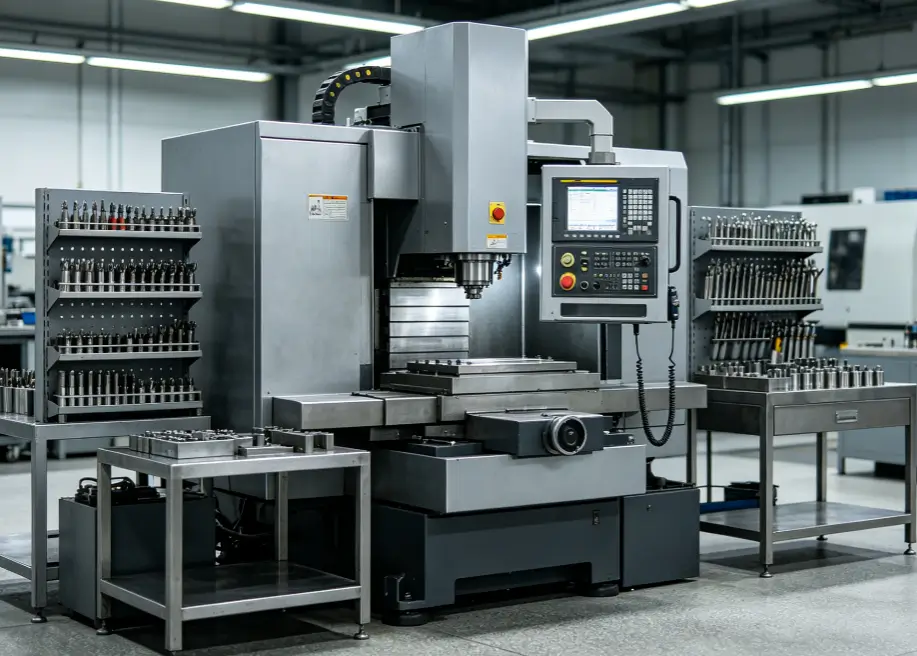
For precision processing factories, laboratories and vocational training schools, small CNC milling machines are the top choice for tiny precision component production, thanks to compact layout, high accuracy and flexible operation. This guide systematically sorts out core selection criteria including machine features, high-speed spindle indicators, tool magazine matching and automatic loading & unloading schemes, to help buyers make scientific equipment investment decisions and avoid unnecessary costs.
Core Advantages of Small CNC Milling Machines for Precision Parts
Small CNC milling machines are not simply miniaturized large machining centers; they are tailor-made for micro precision processing with unique strengths, perfectly fitting the demands of manufacturers, labs and teaching institutions.
Ultra-compact footprint to save workshop space
Mainstream models occupy less than 5 square meters, only 1/3–1/5 of the floor area of standard machining centers. They can be placed in small workshops, lab corners and training classrooms, ideal for sites with limited space.
High precision & stable long-term machining performance
Adopt integrated cast iron/aluminum frames, high-precision linear guides and ball screws to suppress vibration. Most models achieve repeat positioning accuracy of ±0.01mm, meeting tight tolerance requirements (±0.005mm) for 3C electronics, semiconductors and medical tiny parts.
Easy operation & low long-term maintenance cost
Equipped with user-friendly FANUC, Siemens or domestic Huazhong CNC systems for fast programming and learning. Fewer wearing parts extend maintenance cycles; daily maintenance expense is merely 10%–20% of large machine tools.
Applicable Scenarios by User Group
- Precision processing factories: Small-batch & multi-variety micro parts mass production
- Laboratories: New product sample trial production and cutting process verification
- Educational institutions: CNC machining practical training for students
High-Speed Spindle Selection Standard (Core Component)
The spindle determines cutting efficiency, workpiece surface finish and tool lifespan. High-speed spindles are mandatory for tiny precision parts; 4 key selection standards are listed below:
2.1 Matched spindle speed range by workpiece material
- Hardened steel / titanium alloy micro parts: 20,000–100,000 RPM high-speed spindle, reduces tool wear and improves surface roughness
- Aluminum & copper conventional light cutting: 5,000–20,000 RPM medium-low spindle, balances cutting torque and stability
Suggest selecting wide-range spindles to adapt to mixed material processing without equipment replacement.
2.2 Precision & vibration resistance requirements
- Radial runout ≤0.002mm, end face runout ≤0.001mm
- Equipped with ceramic bearings: low thermal expansion, strong vibration resistance under long high-speed operation
- Must support oil cooling or water cooling to control spindle temperature rise and precision drift
2.3 Reasonable power matching
Standard power range for micro parts: 1.5–5.5kW, sufficient for small-diameter tool cutting without energy waste.
For thick-wall high-hardness components, upgrade to higher-power spindles for heavy cutting capacity.
Tool Magazine Configuration Matching Rules
Tool magazines realize automatic tool change, shorten non-cutting time and eliminate manual positioning errors. Key selection indicators include capacity, tool change speed and structural type.
3.1 Tool magazine capacity matching logic
Calculate based on total tools per workpiece plus 10%–20% spare allowance:
- Labs / training schools (sample & simple processing): 8–16 tool pockets
- Standard small-batch precision factories (8–12 tools per piece): 16–24 tool pockets
- Complex multi-process precision components (over 20 tools): 30–40 tool pockets
3.2 Tool change efficiency standard
- Tool-to-tool time ≤5s
- Chip-to-chip time ≤8s
- Disc tool magazine: compact, fast switching for medium-small capacity
- Chain tool magazine: larger storage capacity, slightly slower for complex multi-process work
Reliability & Compatibility Requirements
Support end mills, ball cutters, tiny drills and other precision tools; stable clamping mechanism prevents tool loosening during high-speed cutting. Prioritize low-failure mature magazine designs to cut maintenance frequency.
Automatic Loading & Unloading Solutions for Mass Production
Automatic feeding reduces labor cost and human error, improving batch dimensional consistency. Three mainstream schemes for small CNC milling machines:
4.1 Delta Robotic Arm Feeding (Medium & Large Batch Production)
- 4-axis parallel robot, repeat positioning accuracy ±0.05mm, cycle up to 120 times/min
- Equipped with vacuum suction cups or flexible soft clamps for 0.2–5mm micro semiconductor & 3C parts
- Can link multiple milling machines into automated lines, cut labor cost by 75% and boost output by 60%
4.2 Flexible Vibratory Feeder + Vision Positioning (Multi-Variety Small Batch)
- Voice coil vibratory tray with 11 motion modes for disordered tiny part sorting, finished product yield up to 99.2%
- Dual industrial camera positioning accuracy ±0.05mm, recognizes over 2,000 special-shaped parts
- Mold switching time shortened from 2h to 5min, fit factories with frequent product changeovers
4.3 Simple Tray / Conveyor Feeding (Budget & Low-Volume Users)
Low-cost semi-automatic scheme with easy installation, suitable for labs, training schools and small workshops with limited procurement budget.
Selection Reference
High-volume precision factories: Delta robot or vision flexible feeding
Laboratories & training institutions: Simple tray automatic feeding
Comprehensive Machine Selection Tips
Follow the principle: Demand-oriented, precision-matched, balance efficiency and cost; avoid over-spec blind configuration.
Clarify core processing parameters first
Confirm workpiece material, maximum dimension, tolerance standard and daily output to lock spindle speed, magazine capacity and automation level.
Prioritize core precision parts & after-sales guarantee
Focus on high-precision spindle and stable tool magazine; select suppliers offering 48-hour on-site maintenance and fast spare parts supply.
Rational brand selection by budget
Cost-effective domestic brands reach the same precision level as imported equipment with faster local after-sales response for budget-sensitive buyers; mid-range configurations fit teaching and research labs.
Check software & tool compatibility
Ensure the machine is compatible with mainstream CAD/CAM software and existing cutting tools to avoid extra secondary investment.
Conclusion
Selecting a suitable small CNC milling machine is the foundation of improving precision processing competitiveness. By evaluating machine space advantages, high-speed spindle performance, reasonable tool magazine capacity and matching automatic feeding schemes according to actual production demands, factories, labs and training institutions can lower equipment investment risks and maximize long-term production benefits.
If you need customized selection schemes and detailed parameter consultation for micro precision machining equipment, feel free to contact us for professional one-on-one technical solutions.
 Email
Email sales1: +86 15312799623