



What NC Lathe to Choose for Multi-variety and Small-batch Processing? Efficiency and Tool Change Scheme
In the current transition of manufacturing to flexible production, multi-variety and small-batch processing has become the mainstream production model. This model addresses both the flexible demand for single-piece customization and the efficiency requirements of mass production, presenting dual challenges to the selection of CNC lathes, tool change speed, and machining stability. Many enterprises face dilemmas such as 'choosing the expensive or the right one' and 'how to balance tool change efficiency with machining accuracy' during the selection process. This article addresses the core pain points of multi-variety and small-batch processing, detailing CNC lathe selection techniques and providing efficient tool change solutions. These strategies help enterprises reduce production costs, improve efficiency, and meet diverse machining needs.
1. The Core Pain Points of Multi-variety Small-batch Processing Determine the Selection Direction
The core challenge in multi-variety small-batch processing lies in balancing frequent workpiece/process switching with efficient, stable production. Three key pain points emerge: First, the wide variety of workpieces with significant dimensional variations demands high versatility and flexibility from lathes. Second, frequent tool changes during small-batch operations consume excessive time, severely reducing overall efficiency. Third, manufacturers must ensure machining accuracy for different workpiece types while controlling per-piece costs to avoid equipment redundancy and waste.
Therefore, equipment selection should avoid blindly pursuing high-end configurations or focusing solely on low prices. The key lies in choosing CNC lathes that meet three core criteria: flexible adaptability, rapid tool change, and precise stability. These machines should support multi-product switching, minimize tool wear, and balance precision with efficiency. A scientifically designed tool change plan should be implemented to address operational pain points from both equipment and process perspectives.
2. Multi-variety and small-batch processing: Three core principles for CNC lathe selection (with recommended models)
The selection principle is 'demand-driven matching', which considers the workpiece's size, precision, and process complexity to avoid' functional redundancy 'and' configuration insufficiency'. These three core principles, along with recommended models, directly address the diverse small-batch processing needs of most SMEs.
Principle 1: Prioritize "flexible configuration" for multi-variety switching
The core requirement of multi-product processing is "one machine handling multiple workpieces," making flexible lathe configurations essential. Three key aspects require attention: First, the spindle's through-hole diameter must be sufficiently large to accommodate blanks of varying sizes, minimizing chuck changes. Second, the tool turret should have moderate capacity to avoid frequent tool removal while supporting diverse tool types (e.g., end mills, boring tools, thread cutters). Third, the CNC system must support modular programming, enabling quick program template switching during workpiece changes to reduce programming time.
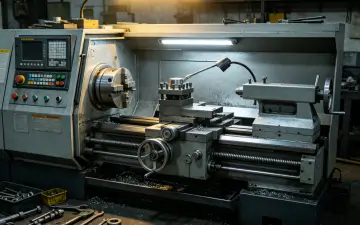
Recommended Models: Inclined-bed CNC Lathe (2-axis/3-axis). The inclined bed design features built-in chip evacuation to prevent chip accumulation and ensure machining accuracy, while offering enhanced rigidity for processing various workpieces including shafts and discs. The 2-axis model is ideal for simple rotary components (e.g., bolts, bushings), whereas the 3-axis/C-axis model adds milling and drilling capabilities, making it suitable for complex multi-step parts (e.g., grooved shafts, irregular shapes). With exceptional cost-effectiveness, it is the preferred choice for small and medium-sized enterprises (SMEs) requiring small-batch, multi-variety machining. For higher precision requirements, models equipped with high-precision CNC systems and position sensors can be selected to ensure consistent processing across different workpiece types.
Principle 2: Balancing "Knife Replacement Efficiency" to Minimize Downtime Losses
In small-batch multi-product machining, tool change time typically accounts for 30%-50% of total processing time, making the lathe's tool change speed and convenience critical. When selecting equipment, prioritize tool turret types and change mechanisms: servo tool turrets are recommended as they deliver over 30% faster tool changes than conventional hydraulic systems, with single-change cycles taking just 1-2 seconds. For optimal capacity, choose 8-12 tool stations – this configuration meets multi-product machining needs without increasing equipment costs or tool change time due to oversized turrets.
Recommended Model: Servo Turret Inclined Bed CNC Lathe. The servo turret, powered by motor, ensures rapid tool change response and precise positioning, ideal for high-frequency tool changes. Its modular tool holder enables quick tool switching without recalibration, significantly reducing downtime. For combined turning and milling operations, the model with a power tool holder allows "single-clamping multi-process machining," further minimizing tool changes and clamping cycles.
Principle 3: Control the "comprehensive cost" and reject the redundancy of function
For small-batch multi-variety machining, the unit profit margin is relatively low, making high-end multi-axis machines (e.g., 5-axis turning centers) unnecessary to avoid cost inefficiencies from redundant functions. The selection principle is "sufficient for the job": a standard 2-axis CNC lathe suffices for simple rotary parts; 3-axis/C-axis models are suitable for complex operations like milling grooves or drilling; vertical CNC lathes are preferable for large workpieces (e.g., over 500mm diameter) due to their high rigidity and suitability for heavy-duty machining, while horizontal CNC lathes are preferred for medium-sized parts for more efficient chip removal.
Additional advice: Prioritize brands with strong reputations and comprehensive after-sales support, such as Yunnan Machine Tool, Shenyang Machine Tool, and the CK6140 series. These models offer excellent cost-performance ratios, low failure rates, and readily available spare parts, with minimal maintenance costs—making them ideal for long-term use by small and medium-sized enterprises. Additionally, consider the machine tool's Mean Time Between Failures (MTBF) and opt for market-proven mature models to ensure production stability.
3. Multi-variety small-batch processing with efficient tool change solutions, achieving over 50% efficiency improvement
Selecting the right CNC lathe is just the foundation. A scientific tool change plan can further reduce downtime and tool wear. Considering the equipment's characteristics and machining process, the following four solutions can be directly implemented, suitable for most small-batch processing scenarios with multiple product varieties. The key lies in minimizing' ineffective tool change time' to enhance machine tool utilization.
Solution 1: Tool pre-adjustment + offline tool setting to save time on machine tool alignment
During multi-tool switching, traditional on-machine tool setting often takes 10-15 minutes, severely impacting efficiency. Solution: By equipping with an offline tool pre-adjustment system, the machine tool can pre-measure tool length and radius, generate tool compensation values, and store them in the CNC system. During tool switching, the pre-stored compensation parameters are directly invoked, eliminating the need for re-tooling. This reduces single tool change time to under 30 seconds.
Key features: The tool employs standardized interfaces (e.g., Coromant Capto® modular tool holder system) to ensure repeat positioning accuracy within ±2 microns. No secondary adjustments are required after tool change, enabling direct machining initiation while minimizing tool installation errors and enhancing machining precision. For tools with complex adjustments (e.g., internal bore boring rods), the EasyFix sleeve can be used to quickly achieve correct center height positioning, eliminating repeated debugging.
Option 2: Classified tool management + fixed tool positions to reduce tool search time
Multimachine processing requires multiple tools. Random tool placement results in inefficient tool selection and installation during each changeover. The solution involves tool classification management: tools are numbered and categorized by machining processes (turning, milling, drilling) and workpiece types, with tool positions fixed on the tool turret. Common tools (e.g., end mills, face mills) are assigned to positions 1-4, while specialized tools (e.g., thread cutters, boring tools) are allocated to positions 5-8. This system enables operators to quickly locate the correct tool during workpiece changes without repeated adjustments.
Enhancement Tip: Implement a "sister tool" strategy by equipping common tools with spare tools. When tool wear occurs, simply replace the spare tool without stopping the machine for sharpening or parameter adjustments, thereby reducing downtime. For turning centers with power-driven tool holders, dual-interface tool holders can be used to increase tool positions, enabling processing of more diverse parts without frequent tool changes.
Option 3: Optimize programming procedures to reduce tool changes
Poor programming practices may lead to excessive tool changes, resulting in increased downtime and operational losses. The solution involves adopting a hybrid approach of modular and parametric programming. This method breaks down machining processes into standardized "program modules" (e.g., end face cutting, external cylindrical turning, thread processing), allowing different parts' programs to be generated through modular combinations. Additionally, programming should adhere to the principle of "using the same tool for similar operations" to prevent frequent tool changes during identical processes.
For instance, when machining shaft components, the process begins with a lathe to complete all external turning operations, followed by threading using a thread cutter, and finally cutting with a cutting tool to avoid frequent tool changes. Additionally, off-line programming and simulation verification can be employed to complete program writing and tool path simulation in a virtual environment. This approach allows for early detection of interference issues, reduces on-machine debugging time, and lowers the scrap rate.
Option 4: Routine equipment maintenance to ensure tool change stability
Tool change efficiency depends not only on equipment and operational protocols, but also on maintenance practices. Insufficient lubrication in the tool turret and positional accuracy deviations can cause tool change delays and increased errors, ultimately prolonging downtime. Key maintenance tasks include: daily inspection of the tool turret lubrication system to ensure adequate oiling; weekly calibration of the turret's positioning accuracy to prevent misalignment during tool changes; and monthly cleaning of the tool turret base to remove chips and debris, thereby preventing tool jamming.
Meanwhile, conduct regular checks on the stability of the spindle and chuck to ensure secure workpiece clamping, preventing secondary machining due to clamping errors and reducing unnecessary tool changes and rework. For quick-change tool systems, periodically inspect the sealing integrity and clamping force of the clamping unit to guarantee tool change accuracy and stability.
4. Common Pitfalls in Model Selection and Tool Replacement: Avoiding These Traps
Misconception 1: Blindly pursuing multi-axis models — Most small-batch processing of diverse products do not require 5-axis equipment, as 3-axis/C-axis models can already meet complex process demands. Multi-axis models not only increase costs but also complicate operations and maintenance, leading to resource waste.
Misconception 2: Overemphasizing tool change speed while neglecting positioning accuracy. Rapid tool changes without precise positioning can cause significant machining errors, ultimately increasing rework time. When selecting equipment, both tool change speed and positioning accuracy must be considered, with servo tool turrets being the preferred choice.
Misconception 3: Neglecting tool management—focusing solely on equipment while overlooking tool classification and pre-adjustment, which results in excessive time spent searching for and aligning tools during tool changes, thereby failing to leverage the equipment's high-efficiency advantages.
Misconception 4: Neglect of After-sales Service – Some enterprises focus solely on equipment pricing and opt for niche brands, resulting in delayed maintenance when equipment malfunctions occur, leading to production halts and increased costs. It is recommended to select brands with well-established localized service networks to ensure spare parts supply and rapid emergency response.
Summary: Multi-variety small-batch processing requires dual approaches of model selection and tool change for high efficiency
For multi-variety small-batch machining, CNC lathes are the optimal choice, with the core principles being "flexible adaptation, efficient tool change, and cost control." Priority should be given to slanted-bed servo tool turret CNC lathes (2-axis/3-axis) that balance versatility and tool change efficiency. When paired with an off-line tool calibration, categorized tool management, and optimized programming tool change solution, downtime can be significantly reduced, resulting in over 50% improvement in machining efficiency.
For small and medium-sized enterprises (SMEs), pursuing high-end configurations is unnecessary. By selecting equipment based on actual needs and implementing scientific management, they can reduce costs and enhance competitiveness in small-batch processing of diverse products. If uncertain about specific machine models matching their processing requirements (e.g., workpiece dimensions or precision standards), SMEs should consult equipment manufacturers for customized selection based on actual parts. Simultaneously, optimizing tool change processes enables efficient implementation of flexible production.
 Email
Email sales1: +86 15312799623