



3 Thermal Deformation Control + 2 Error Compensation Methods to Keep Your Horizontal Machining Center Precision Stable
I. Introduction: Why Does the Precision of Horizontal Machining Centers "Deteriorate"?
The precision of horizontal machining centers directly determines the quality of machined parts and production efficiency. Precision degradation caused by thermal deformation during long-term use is a common challenge faced by many manufacturing enterprises. Whether it is mass production of automotive transmission housings or custom processing of aerospace precision parts, a precision deviation of even 0.01mm can lead to product scrapping, order delays, and ultimately increased production costs. Starting from the core causes of thermal deformation, this article will systematically share 3 practical thermal deformation control methods and 2 error compensation techniques, combined with daily maintenance key points to avoid pitfalls, helping enterprises quickly stabilize the precision of horizontal machining centers, reduce product scrap rates and production costs.
Many practitioners wonder why horizontal machining centers that met precision standards when newly purchased frequently experience dimensional deviations after 1-2 years of use. In fact, the core reason is the dual impact of thermal deformation and error accumulation. High-speed rotation friction of the spindle generates a lot of heat, cutting heat generated during processing is transmitted to the machine tool body, and fluctuations in workshop ambient temperature all cause micro-deformations of machine tool components—these deformations are indistinguishable to the naked eye but directly lead to machining dimensional deviations; if not intervened in a timely manner, these deviations will continue to accumulate, eventually resulting in precision loss and making the equipment "less and less accurate".
Whether you are a novice just getting started with horizontal machining centers or a senior practitioner struggling with precision degradation, the following content can help you find corresponding solutions. From low-cost cooling system optimization and environmental control to easy-to-master geometric error compensation for novices, and advanced automatic thermal error compensation, each step has detailed practical guidelines and parameter references. Continue reading to master the core secrets of maintaining long-term stable precision of horizontal machining centers and keep the equipment in "peak condition" at all times.
II. First, Understand: 3 Major Sources of Thermal Deformation in Horizontal Machining Centers
To effectively control thermal deformation, it is first necessary to clarify the sources of heat. Only by identifying the "heat sources" can targeted measures be taken. Combined with front-line production experience, the thermal deformation of horizontal machining centers mainly comes from the following 3 aspects:
1. Spindle Heating: The Most Major "Heat Source"
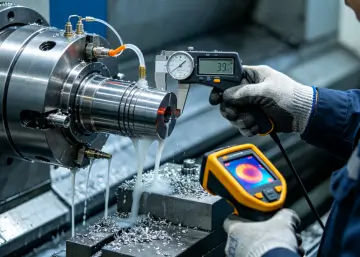
The spindle is the core component of a horizontal machining center and also the main source of heat generation. When the spindle rotates at high speed, friction inside the bearings generates a lot of heat, and the spindle motor also releases heat during operation. This heat raises the temperature of the spindle, which in turn causes spindle elongation and increased radial runout, directly affecting machining precision. Especially in mass production with continuous processing for more than 8 hours, the precision deviation caused by spindle heating becomes more obvious.
2. Cutting Heat Conduction: "Secondary Heat Source" Generated During Processing
When cutting materials such as steel, aluminum alloy, and titanium alloy, intense friction between the tool and the workpiece generates a lot of cutting heat. Part of this cutting heat is carried away by the chips, and the other part is transmitted to the machine tool worktable, guide rails and other components through the tool and workpiece, causing these components to heat up and deform. The cutting heat generated by different materials varies greatly; for example, the cutting heat density when processing titanium alloy is much higher than that when processing aluminum alloy, and the thermal impact on the machine tool is also more significant.
3. Ambient Temperature Influence: Easily Overlooked "Invisible Heat Source"
Fluctuations in workshop ambient temperature can also cause thermal deformation of horizontal machining centers, which is easily overlooked. For example, a daily temperature difference of more than 5℃ in the workshop, air conditioning vents blowing directly at the machine tool, and the horizontal machining center being too close to heat sources such as furnaces and heat treatment equipment can all lead to uneven temperatures of various machine tool components. When the temperatures of different parts of the machine tool are inconsistent, thermal stress is generated, which in turn causes micro-deformations and affects machining precision.
Tip: How to quickly determine if the precision degradation of the horizontal machining center is caused by thermal deformation? Here's a simple detection method for you: Measure the radial runout of the spindle with a dial gauge, and record the data in the cold machine state (before processing after startup) and the hot machine state (after continuous processing for 2 hours) respectively. If the difference between the two sets of data exceeds 0.005mm, it can be basically determined that the precision degradation is related to thermal deformation.
III. Practical Chapter: 3 Thermal Deformation Control Methods for Horizontal Machining Centers (Low Cost + High Feasibility)
Targeting the above 3 major heat sources, we have sorted out 3 practical and cost-controllable thermal deformation control methods that can be easily implemented by small and medium-sized enterprises.
1. Spindle Constant Temperature Cooling System Optimization: Prioritize Low-Cost Implementation
The spindle cooling system is the core of controlling spindle temperature. Doing a good job in this optimization can solve more than 70% of spindle heating problems. The specific operation points are as follows:
Daily Inspection Points: Before starting the machine every day, first check whether the liquid level of the cooling water tank is between the standard scale lines (usually more than 2/3 of the tank volume); at the same time, detect the coolant concentration. The concentration of ordinary water-based coolant is recommended to be maintained at 5%-8% (measurable by a concentration meter). Too high concentration will affect the cooling effect, and too low concentration will reduce the rust resistance. In addition, it is also necessary to check whether the pipelines of the cooling system are leaking or blocked to ensure smooth circulation of the coolant.
Practical Adjustment Steps: Adjust the pressure and flow rate of the cooling system according to the processed material and spindle speed. For example, when processing difficult-to-machine materials such as titanium alloy and high-strength steel, the spindle load is large and generates a lot of heat, so the pressure of the cooling system can be adjusted to 0.3-0.5MPa and the flow rate to 15-20L/min; when processing easy-to-machine materials such as aluminum alloy, the pressure can be adjusted to 0.2-0.3MPa and the flow rate to 10-15L/min.
Pitfall Warning: Avoid mixing coolants of different brands and types, as mixing may cause coolant deterioration and reduced cooling efficiency; at the same time, the coolant should be replaced regularly. It is recommended to replace it every 3-6 months under normal working conditions, and every month under harsh working conditions (such as continuous processing of difficult-to-machine materials).
2. Workshop Ambient Temperature Control: Basic Guarantee Is Essential
A good workshop environment is the foundation for the stable precision of the horizontal machining center. Through simple layout adjustment and temperature control, the impact of ambient temperature on the equipment can be effectively reduced.
Reasonable Layout: The horizontal machining center should be away from heat sources such as furnaces, heat treatment equipment, and welding equipment with a distance of not less than 3 meters to avoid direct radiation heating of the machine tool by the heat sources. At the same time, the distance between multiple horizontal machining centers is recommended to be not less than 1.5 meters to ensure air circulation in the workshop and reduce local overheating.
Temperature Stability: For enterprises with conditions, it is recommended to control the workshop temperature at a constant 20±2℃, which is the optimal working temperature environment for horizontal machining centers. It should be noted that avoid air conditioning vents blowing directly at key components such as machine tool guide rails and spindles, which can be solved by adjusting the direction of the air outlets or installing wind deflectors.
Low-Cost Solution: If there is no constant temperature workshop, small and medium-sized enterprises can adopt simple solutions to optimize the environment. For example, wrap the spindle and motor parts with heat insulation covers to reduce heat diffusion; hang temperature monitors in the workshop to real-time monitor temperature changes, and adjust in time when the temperature fluctuation exceeds 5℃ (such as turning on fans for ventilation, turning off direct light sources, etc.).
3. Processing Technology Optimization: Reduce Cutting Heat from the Source
Optimizing processing technology to reduce the generation of cutting heat is a "source control" solution for thermal deformation control. Specifically, it can be started from the following two aspects:
Cutting Parameter Adjustment: Reasonably adjust the cutting speed, feed rate and depth of cut according to the material characteristics to avoid excessive cutting heat caused by unreasonable parameters. For example, when processing 45# steel, the cutting speed of carbide tools is recommended to be controlled at 120-150m/min, the feed rate at 0.15-0.2mm/r, and the depth of cut at 2-3mm; when processing aluminum alloy, the cutting speed can be increased to 200-300m/min, and the feed rate at 0.2-0.3mm/r. By increasing the feed rate, the contact time between the tool and the workpiece is reduced, thereby reducing cutting heat generation.
Cooling and Lubrication Enhancement: Select cutting fluid suitable for the processed material to ensure that the cutting fluid can be fully sprayed to the cutting area and take away the cutting heat in time. For example, when processing aluminum alloy, it is recommended to use emulsion, which has better cooling and lubricating effects; when processing titanium alloy, special cutting fluid can be selected to improve heat dissipation efficiency. At the same time, check the position of the cutting fluid nozzle to ensure that the nozzle is aligned with the cutting point to avoid "inadequate cooling".
IV. Advanced Chapter: 2 Practical Error Compensation Techniques for Horizontal Machining Centers
After controlling thermal deformation through the above methods, if there is still a small amount of precision deviation, error compensation technology can be used to further improve precision. The following two error compensation techniques are suitable for novices and senior practitioners respectively, and you can choose according to your own situation.
1. Geometric Error Compensation: Easy to Master for Novices with High Cost-Effectiveness
Geometric error is a common type of error in horizontal machining centers, including positioning error, repeat positioning error, etc. It can be compensated through simple measurement and parameter adjustment, which can be quickly mastered by novices.
Core Tools: Dial gauge, micrometer (for simple measurement), laser interferometer (for high-precision measurement; it is recommended for small and medium-sized enterprises to rent, with a daily rental cost of about 500-1000 yuan, which is more cost-effective than purchasing).
Practical Steps: Step 1, Measure error data. Use a laser interferometer to measure the positioning error and repeat positioning error of the X, Y, Z axes of the machine tool respectively, and record the error values at different stroke positions; Step 2, Enter the machine tool system parameter interface (the operation of different brand systems is slightly different; for example, the Fanuc system can be entered through "Parameters → Compensation → Geometric Compensation"); Step 3, Corresponding input the measured error values into the system compensation parameters, save and restart the machine tool to complete the compensation.
Example: If the measurement finds that the positioning error of the X-axis at the 500mm stroke is +0.01mm, you can input -0.01mm into the compensation parameter corresponding to the 500mm X-axis to achieve error offset.
2. Thermal Error Compensation: Advanced Optimization Suitable for Medium and High-End Equipment
Thermal error compensation is a compensation method for dynamic errors caused by thermal deformation, which is divided into simple solutions and professional solutions, and can be selected according to equipment configuration.
Simple Solution: Suitable for ordinary horizontal machining centers. Through long-term monitoring, record the precision deviation law under different processing durations, and then set timed compensation in the machine tool system. For example, after monitoring, it is found that the Z-axis will have a thermal deformation error of +0.008mm after the machine tool has been continuously processed for 3 hours, and automatic compensation of -0.008mm can be set every 3 hours. This method does not require additional equipment, has low cost, and is suitable for working conditions with medium precision requirements.
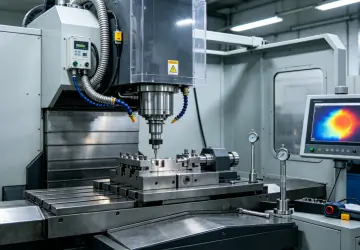
Professional Solution: Suitable for medium and high-end horizontal machining centers with intelligent monitoring functions. Install temperature sensors on key parts of the machine tool such as the spindle, guide rails, and worktable. The sensors real-time collect temperature data and transmit it to the system; the system automatically calculates the corresponding thermal deformation error according to the temperature change through a preset algorithm, and then completes the compensation automatically. This solution has high compensation precision and fast response speed, and is suitable for high-precision machining scenarios such as aerospace and precision molds.
V. Pitfall Avoidance Guide: 5 Daily Maintenance Details for Precision Maintenance
Thermal deformation control and error compensation are "symptomatic treatment", while standardized daily maintenance is "root cause treatment". Doing a good job in the following 5 daily maintenance details can effectively reduce the recurrence rate of precision degradation and extend the service life of the equipment.
1. Daily Maintenance: After starting the machine, check whether the spindle lubrication system is supplying oil normally and the cooling system is circulating smoothly; after processing, clean the chips and oil stains on the guide rails and worktable to avoid debris affecting the movement precision of the guide rails.
2. Weekly Maintenance: Calibrate the precision of testing tools such as dial gauges and micrometers to avoid error judgment errors caused by inaccurate testing tools; check the cutting fluid filtration system and clean the impurities in the filter.
3. Monthly Maintenance: Check whether the anchor bolts of the machine tool are loose, calibrate the levelness of the machine tool with a level to ensure that the machine tool is placed stably; check the tension of the spindle belt, and adjust it in time if the tension is insufficient.
4. Quarterly Maintenance: Completely replace the coolant and lubricating oil, and clean the inside of the cooling water tank and oil tank; check whether the wiring of electrical components is loose to ensure the normal operation of the control system.
5. Taboo Reminder: Avoid frequent start-up and shutdown of the horizontal machining center. Frequent start-up and shutdown will cause large fluctuations in spindle temperature and accelerate thermal deformation; avoid long-term idling of the equipment. Idling not only wastes energy but also increases spindle wear and heat generation.
VI. Real Case: Precision Recovery Practice of a Horizontal Machining Center in an Auto Parts Factory
To let you more intuitively understand the actual effect of the above methods, we share a real case of an auto parts factory.
Case Background: A horizontal machining center in this factory is mainly used for processing automotive transmission housings. Recently, it has experienced obvious precision deviation problems. The dimensional deviation of the processed housing hole diameter exceeds 0.02mm, the product scrap rate reaches 15%, and the monthly loss due to scrapping is about 30,000 yuan, which seriously affects the production progress.
Solution Process: The technical personnel first determined that the precision degradation was caused by thermal deformation through "measuring the radial runout of the spindle in cold/hot machine states". Then, a combined solution of "spindle cooling system optimization + geometric error compensation" was adopted: first, adjust the cooling system parameters, increase the coolant flow rate from 12L/min to 18L/min, and adjust the concentration to 7%; second, rent a laser interferometer to measure the error data of the X and Y axes, and complete the geometric error compensation through the system parameters.
Effect Data: After optimization and compensation, the dimensional deviation of the transmission housing hole diameter processed by this horizontal machining center is reduced to within 0.005mm, which fully meets the product precision requirements; the product scrap rate is reduced from 15% to less than 2%, saving about 25,000 yuan in production costs per month, and the optimization investment is recovered in less than 1 month.
VII. Summary: Maintaining Stable Precision of Horizontal Machining Centers Is Actually Not Difficult
To summarize, to maintain the precision of horizontal machining centers, the core is to do a good job in three things: "thermal deformation control + error compensation + daily maintenance". Reduce thermal deformation from the source through spindle cooling system optimization, workshop environment control, and processing technology optimization; offset the generated precision deviations through geometric error compensation and thermal error compensation; extend the precision stability cycle through standardized daily maintenance. As long as you practice according to the methods in this article, you can effectively solve the problem of precision degradation of horizontal machining centers and keep the equipment in an efficient and precise operating state at all times.
 Email
Email sales1: +86 15312799623