



FANUC vs. Guangzhou CNC: A Deep Comparison of the Performance of the Two CNC Systems and a Guide to Selection
Introduction
In the machining center manufacturing sector, the selection of numerical control (NC) systems directly impacts equipment performance, machining accuracy, and production efficiency. As the "brain" of a machining center, NC systems determine the functional limits and reliability of the machine tool. Currently, two leading NC system solutions—FANUC from Japan and Guangzhou CNC (GSK)—represent different technological levels in the market. The significant performance gap between these systems significantly affects end-users' machining experience and return on investment. This article will analyze the performance differences between these two systems from a technical perspective, explain their specific impacts on actual production processes, and provide a scientific basis for equipment procurement.
1 Comparison of Technical Architecture and Hardware Performance of CNC Systems
1.1 Technical Features of FANUC CNC System
FANUC's CNC systems feature a highly integrated modular architecture with industrial-grade hardware specifications. The system design extensively employs modular components, where tightly integrated control boards significantly enhance reliability while simplifying maintenance and replacement. A prime example is the FANUC Series 31i-B – a high-performance system equipped with high-speed data processing capabilities and advanced features including nanometer interpolation and AI Profile Control II.
At the hardware level, FANUC systems feature core technologies including HRV control, high-speed digital servo bus, and multi-channel processing capabilities. The control system utilizes 32-bit or 64-bit high-performance CPUs with large-scale programmable devices, while real-time control and hardware interpolation technologies ensure high-efficiency machining at micron-level precision. The system pre-reads multiple program lines (up to over 100 segments) in advance, equipped with speed prediction and trajectory prediction functions, which are critical for machining complex curved surfaces.
In terms of physical interfaces, the Fanuc system offers a wide range of connection options, including high-speed Ethernet ports, PCMCIA/CF card slots, and RS232 interfaces, facilitating data transfer and device networking. Its control unit and LCD feature an integrated design, which not only ensures a compact structure but also supports ultra-high-speed serial data communication.
1.2 Technical Architecture of GSK CNC System
The GSK218M CNC system, a flagship of China's mainstream CNC solutions, integrates a 32-bit high-performance CPU with programmable FPGA to deliver precision control at the micrometer level. Powered by the μC/OS real-time OS, it ensures real-time interpolation performance, while its multitasking architecture guarantees modular system operation.
The GSK system emphasizes practicality and cost control in hardware configuration, with a standard setup of four axes and three-axis linkage. The rotation axis can be parameterized, and an optional four-axis and four-axis linkage can be selected. The system's maximum positioning speed is 30 m/min, and the maximum feed speed is 15 m/min, which is somewhat inferior to the FANUC system.
In terms of interfaces, the GSK218M provides USB and serial port (RS232) communication, supporting online processing via USB flash drive (USB DNC), meeting basic data transmission requirements. The system features a 10.4-inch color display and employs FPGA display control technology, offering a relatively intuitive operation interface.
2 Comparative Analysis of Machining Accuracy and Dynamic Performance
2.1 Positioning Accuracy and Repeatability
FANUC systems achieve ultra-precision motion control through their nanoscale interpolation technology and high-resolution position detection capabilities. For instance, the Robodrill small machining center equipped with FANUC systems delivers bidirectional axis positioning accuracy of 0.006-0.02mm (per ISO230-2:2006) and reciprocating axis positioning accuracy below 0.004mm. This exceptional precision is primarily attributed to the system's ultra-high-resolution pulse encoders, which enable nanoscale interpolation and feedback.
GSK systems typically maintain positioning accuracy at the micron level, with a standard precision of approximately 0.015mm (semi-closed loop), which shows a significant gap compared to Fanuc systems. The system offers eight interpolation accuracy levels, requiring users to balance precision and efficiency. Higher interpolation accuracy levels result in faster speeds but lower precision, while lower levels provide slower speeds but higher precision.
2.2 Dynamic Response Characteristics and High-Speed Machining Performance
In high-speed and high-precision machining applications, the system's dynamic response characteristics are critical. FANUC systems feature high-acceleration positioning capabilities, with their compact machining centers achieving 1.3G three-axis acceleration. This enables extremely rapid machine tool response and significantly reduces movement adjustment time. When combined with AI Contour Control II (Artificial Intelligence Contour Control), the system can minimize shape errors through servo delay compensation, resulting in exceptionally smooth machined surfaces.
The GSK system features a basic dynamic performance, employing a control strategy that combines front and rear acceleration/deceleration. It offers linear and exponential acceleration/deceleration modes, allowing users to select the optimal combination based on the machine tool's rigidity. For machines with high rigidity, the linear front acceleration/deceleration mode can be chosen to reduce positioning time. Conversely, for machines with low rigidity, the exponential rear acceleration/deceleration mode ensures smooth positioning.
2.3 Thermal Deformation Compensation Technology
FANUC systems feature built-in AI thermal displacement compensation, which dynamically corrects thermal misalignment caused by spindle and X/Y/Z axes during machining. This ensures high-precision stability throughout extended operations. Particularly crucial in continuous production environments, the system effectively minimizes temperature-induced accuracy deviations.
Public data currently available does not indicate that the GSK system possesses comparable intelligent thermal compensation capabilities. This may result in cumulative precision deviations during prolonged continuous processing, requiring operators to implement process adjustments for compensation.
3 Five-axis Machining and Complex Surface Processing Capability
3.1 Multi-axis Linkage Control Performance
FANUC systems support true five-axis machining, enabling the production of complex-shaped workpieces with high speed, precision, and quality. Capable of controlling up to 26 axes (including 18 feed axes and 8 spindle axes), they excel in multi-path control. This capability makes FANUC an ideal choice for high-end five-axis machining centers, particularly in fields requiring complex curved surface parts such as aerospace and precision mold manufacturing.
The GSK218M system is standardly configured with a four-axis three-axis linkage, where the rotation axis can be parameterized. An optional four-axis four-axis linkage is available, though it falls short in true five-axis machining capability. While adequate for most conventional machining applications, it cannot meet the demands of high-end complex curved surface parts.
3.2 Complex Program Processing Capability
FANUC systems feature robust program processing and high-speed data handling capabilities. In 3D machining, setting the unit precision to 0.001mm requires processing capacity several times greater than standard programs. High-performance FANUC CNC systems (e.g., Series 31i-B) can efficiently execute such large-scale complex programs. The system also supports NURBS interpolation, which directly interpolates curves based on equations, effectively reducing errors and program size issues caused by discrete line segments.
The GSK system supports Hermite spline interpolation, which can be enabled for applications requiring higher precision. It pre-reads 100 program segments and processes 15 trajectory segments in advance, offering basic speed and trajectory prediction capabilities. However, compared to FANUC systems, its ability to handle complex surfaces still falls short.
4 Reliability and Stability Comparison
4.1 System Failure Rate and Maintenance Requirements
FANUC systems are renowned for their exceptional reliability, featuring robust self-protection circuits designed to operate across diverse environments (including voltage and temperature variations) with minimal workshop-specific requirements. Many clients run their machines continuously for 30 days a month, 24/7, yet these systems maintain consistent precision with an exceptionally low failure rate. This reliability makes FANUC systems particularly well-suited for manufacturing environments requiring uninterrupted production.
As a domestically developed CNC system, the GSK system still lags behind Fanuc in terms of reliability and stability. It features multi-level password protection to prevent unauthorized modifications of machining programs and CNC parameters, with four security tiers that enhance system stability. However, its long-term stability under continuous high-load production environments requires further improvement.
4.2 Servo System Performance
The Fanuc servo system utilizes high-speed digital communication and adaptive adjustment technology to automatically optimize servo parameters based on mechanical characteristics, thereby suppressing vibrations and improving tracking accuracy. Its HRV (High Response Vector) control technology enables high-response vector control, enhancing servo rigidity and precision.
The GSK system features basic servo drive functionality, offering two threading options: rigid threading and spindle-following threading. For rigid threading, the fourth-axis interface serves as the servo spindle interface, employing pulse string operation. This requires a spindle servo unit with a position loop. Theoretically, the maximum spindle speed for threading is determined by the servo unit, with experimental results reaching 1800 r/min.
5 User Experience and Programming Convenience
5.1 User Interface and Operation Logic
FANUC systems feature a unified user interface design, with all series sharing a similar overall structure and a standardized operation interface, facilitating quick operation for users. The system provides comprehensive guidance functions, including graphical programming and teaching functions, which reduce the complexity of programming for intricate workpieces.
The GSK system features a bilingual (Chinese-English) interface with support for metric-to-imperial conversion. Its functional menu layout is streamlined, resulting in a relatively gentle learning curve. The system provides enhanced operational convenience through features such as manual intervention return, handwheel interruption, and single-step interruption.
5.2 Programming Compatibility and Function Extension
Both systems support ISO standard G codes with similar programming logic, enabling easy portability of basic programs. However, in advanced features, the Fanuc system provides more extensive programming options, including User Macro B, parametric programming, and advanced fixed loops.
The GSK system features 79 G codes, including standard codes like G00, G01, and G02, along with programmable functions such as data input (G10, G11), scaling (G50, G51), rotation (G68, G69), and polar coordinates (G15, G16). It also includes specialized fixed loop instructions for slotting and hole enlarging, making it highly practical for drilling and milling machining centers.
6 Comparison of Actual Processing Effects
6.1 Surface Processing Quality
In high-speed and high-precision machining, FANUC systems utilize AI Contour Control II and nanoscale smooth interpolation technology to achieve superior surface quality. This is particularly critical for applications requiring high surface finish, such as mold manufacturing and precision components. The system's high-precision interpolation and intelligent error compensation effectively reduce common issues in conventional machining, including tool marks, overcutting, and residual material.
The GSK system can achieve basic surface finish, but it falls short of FANUC systems when processing parts requiring ultra-high surface finish. By selecting interpolation precision levels and utilizing Hermite spline interpolation, the system can improve surface quality to some extent.
6.2 Processing Efficiency and Labor Hour Comparison
In terms of machining efficiency, the Fanuc system's high-speed and high-precision capabilities significantly reduce processing time. Its high acceleration (up to 1.3G) and rapid feed rate (48m/min) minimize idle travel time, while the high-speed cutting function enhances material removal rates. Most importantly, the system's high-speed data processing ensures smooth operation of complex programs, preventing system delays that could cause downtime.
The GSK system's maximum feed rate is 30 meters per minute, which is somewhat inferior to the FANUC system. When processing complex surfaces or large programs, the system's processing capacity may limit the need to reduce the feed rate to avoid overcutting, thereby increasing machining time.
6.3 Machining Capability of Complex Parts
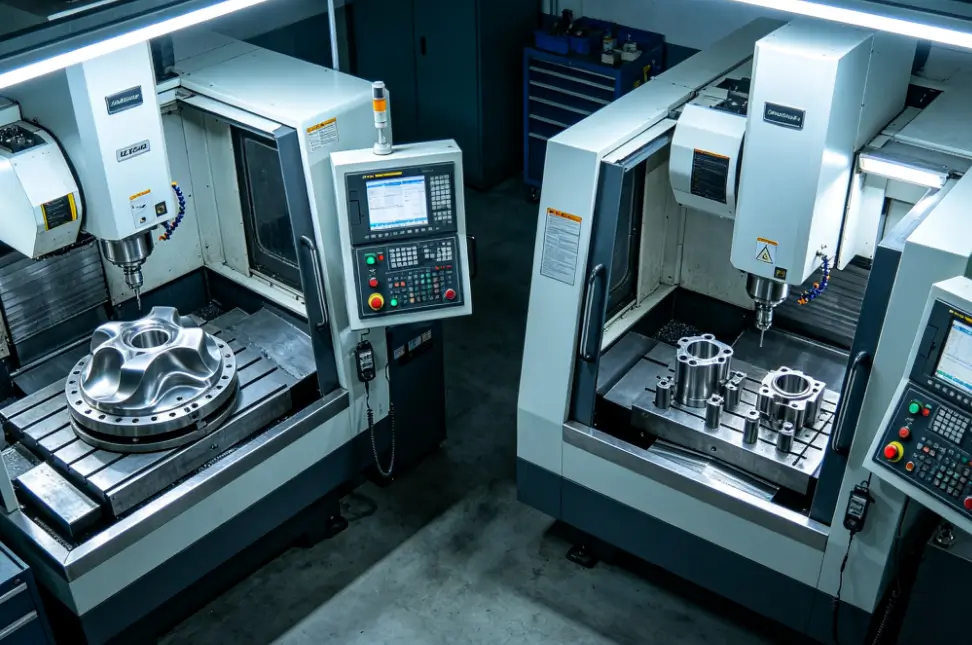
FANUC systems demonstrate outstanding capabilities in five-axis machining, complex surface processing, and micron-level precision machining, capable of handling highly intricate workpieces such as impellers, precision molds, and aerospace components. The system's multi-channel control function also supports compound machining, enabling the completion of multiple operations including turning, milling, and drilling on a single machine tool. This reduces workpiece clamping frequency while enhancing both precision and efficiency.
The GSK system is more suitable for the machining of conventional parts, such as planar profiles, two-dimensional curved surfaces, and hole systems, which are relatively simple geometric shapes. The system provides special fixed cycle instructions (e.g., grooving, reaming) that enhance its practicality in drilling and milling operations.
7 Application Scenarios and Selection Recommendations
7.1 Applications of FANUC Systems
FANUC CNC systems are particularly suited for the following applications:
- High-precision and high-complexity part machining: such as aerospace components, precision molds, medical devices, etc.
- Mass and high-efficiency production: such as automotive parts, electronic products, and other scenarios requiring continuous high-load production
- Five-axis linkage machining: such as impeller, turbine and other complex curved surface parts machining
- Integration of automated production lines: The excellent compatibility between FANUC systems and FANUC robots facilitates the construction of automated production units.
7.2 Applicable Scenarios of the GSK System
GSK CNC system is an economical and practical choice for the following scenarios:
- Production of small and medium-sized parts with low precision requirements
- Basic milling and drilling operations, such as machining for standard components and tooling fixtures
- Budgetary Configuration of Entry-level Machining Centers
- Training and Application Scenarios of Primary Numerical Control
Conclusion and Selection Suggestions
The performance gap between FANUC and GSK CNC systems directly reflects their positioning and pricing strategies. FANUC systems dominate the high-end manufacturing sector with their exceptional precision, high-speed processing capabilities, and reliability. In contrast, GSK systems, as a representative of domestic CNC systems, focus on meeting basic machining requirements and cost control, giving them a competitive edge in the mass-market segment.
For machining center manufacturers, selecting a CNC system requires a comprehensive evaluation of target customer needs, equipment positioning, and budget constraints. For high-end markets demanding extreme precision and efficiency, Fanuc systems are the undisputed choice. In contrast, GSK systems offer a more cost-effective solution for price-sensitive markets where basic machining requirements are sufficient.
No matter which system is chosen, it should be matched with the machine body and the system potential should be brought into full play by optimizing the process parameters, so as to create the maximum value for the end user.

 Email
Email sales1: +86 15312799623