



40% Efficiency Growth for Horizontal Machining Centers: ATC Tuning, Chip Conveyor Upgrade and Robot & Pallet Automation
Slow tool changes, frequent chip jams and labor-intensive manual loading & unloading are three major bottlenecks that drag down the productivity of horizontal machining centers. This article targets these pain points, elaborating on ATC parameter tuning and tool magazine management, chip removal system upgrades for different chip types, as well as pallet storage and robotic automation deployment. The featured solutions help workshops lift overall efficiency by 40% and cut downtime by 60%.
Many operators are troubled by these common issues: each tool change takes over 12 seconds, chip conveyors get clogged more than once a day, and manual loading & unloading accounts for over 30% of total working hours. These problems stem from unoptimized tool change parameters and layout, mismatched chip conveyors for actual chip conditions, and inefficient manual workflows. This guide delivers practical, ready-to-implement solutions, including FANUC system parameter adjustment, proper chip conveyor selection, and cycle logic design for robotic handling.
Beyond general theories, this document provides specific parameter templates to cut single tool change time below 6 seconds, a real case where an auto parts factory achieved 106% efficiency growth via automation, and practical reference materials such as chip conveyor comparison tables and automation layout diagrams. Follow the guidance to transform intermittent low-efficiency production into continuous high-efficiency operation, so as to expand production capacity and reduce labor and rework costs.
Three Core Efficiency Bottlenecks of Horizontal Machining Centers
1.1 Excess ATC Tool Change Time (Hidden Downtime > 25%)
Problems: Single tool change takes more than 12 seconds; tool jams or drops occur occasionally, requiring 15–30 minutes for troubleshooting each time; on-machine trial cutting and adjustment take 5 minutes per new tool.
Data Impact: A workshop’s horizontal machining center completes 80 tool changes daily. Excessive tool change time accumulates to 26.7 hours monthly, occupying 28% of total machining time. Two tool change failures per week lead to an extra 1.5 hours of monthly downtime.
Typical Scenario: When machining multi-process workpieces requiring more than 5 tools, tool change waiting time even exceeds actual cutting time, resulting in equipment utilization as low as 65%.
1.2 Chip Conveyor Blockage (Unexpected Production Interruption)
Common Faults: Long coiled steel chips wind around chain plates and cause blockage; chip conveying speed does not match cutting volume; chain plate breakage or motor overload requires 2–4 hours for repair.
Consequences: Clogged conveyors contaminate coolant, which needs replacement after machine shutdown (3 hours per time). Chips scratching finished surfaces push the rework rate up by 8%.
Data Support: A mold factory suffers 1.2 hours of daily downtime due to chip blockage, causing a monthly production loss of over 150 workpieces (20 minutes per piece).
1.3 Manual Loading & Unloading (Slow Production Cycle)
Bottlenecks: 5–8 minutes for each loading/unloading operation; 10 minutes for positioning the first workpiece per batch; 2 hours for fixture replacement during production changeovers.
Comparison Data:
- Manual mode: Total cycle per workpiece = 15 min (cutting) + 6 min (loading/unloading) + 4 min (waiting) = 25 min
- Automated mode: Total cycle reduces to 18 min, with efficiency improved by 28%
Scenario Pain Points: For multi-variety and small-batch production with 3 changeovers per day, manual work and fixture replacement take 6 hours, and effective machining time accounts for less than 70%.
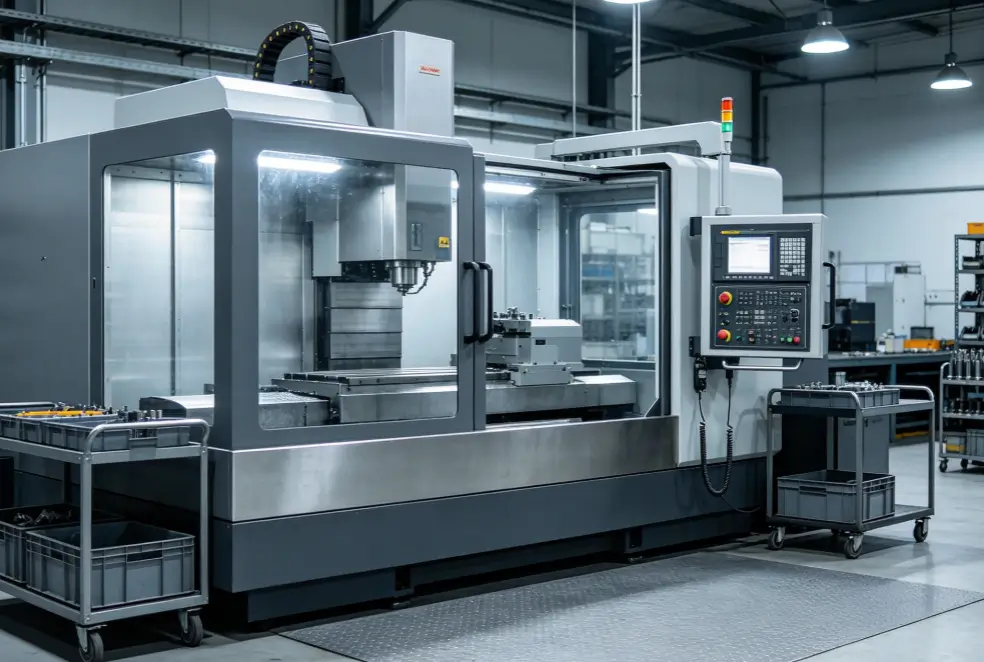
Solution 1: ATC Tool Changer Optimization (Single Tool Change ≤ 6 Seconds)
2.1 Parameter Tuning (Compatible with FANUC & Siemens Systems)
Optimization principle: Shorten tool magazine traverse time, spindle orientation time and tool clamping/releasing time.
FANUC 31i System Adjustment Steps
- Tool magazine rapid traverse: Adjust Parameter 10053 from 1500mm/min to 2500mm/min (ensure stable operation without abnormal noise).
- Spindle orientation: Adjust Parameter 1201 (orientation speed) from 50rpm to 100rpm; set Parameter 1203 (waiting time) from 0.5s to 0.2s.
- Tool clamping & releasing: Adjust Parameter 10060 (clamping time) from 1.2s to 0.8s; adjust Parameter 10061 (release time) from 1s to 0.6s.
Safety Rule: Conduct 50 consecutive tool change tests after adjustment. No tool jamming or dropping is allowed; tool holder runout ≤ 0.005mm and spindle load < 30%.
2.2 Tool Presetting & Tool Magazine Layout Optimization
Tool Presetting
- Measure tool length and radius with a presetting instrument (accuracy ±0.001mm) and input offset data in advance, eliminating on-machine trial cutting (saves 4 minutes per tool).
- Check cutting edges during presetting; replace tools when wear exceeds 0.1mm. Keep tool holders clean to avoid clamping errors.
Tool Magazine Layout
- Arrange tools following the machining sequence: roughing → semi-finishing → finishing → drilling → tapping, to reduce back-and-forth movement.
- Place frequently used tools (over 10 times per day) at the front positions (No.1–5) to shorten tool change paths.
2.3 ATC Daily & Periodic Maintenance
Daily Maintenance (5 minutes)
- Clear chips on tool magazine jaws and spindle taper holes with 0.4MPa compressed air.
- Check lubricant level of tool change arms; add lithium-based grease when insufficient.
Weekly Maintenance (30 minutes)
- Dismantle and clean tool change arm bearings, then apply high-temperature resistant grease (120℃ resistance, e.g. SKF LGMT 3).
- Test clamping force with a dynamometer (standard ≥ 15kN); adjust cylinder pressure if unqualified.
Emergency Handling
In case of tool jams, run M19 for spindle orientation and M08 for coolant first, then remove the tool manually. Do not force tool change to prevent mechanical damage.
2.4 Optimization Effect & Case
| Before Optimization | Measures | After Optimization | Improvement |
| 12s per tool change, 80 times daily | Parameter tuning + layout adjustment | 5.8s per tool change | 52% reduction on tool change time |
| 5min on-machine adjustment per tool | Offline tool presetting | No on-machine trial cutting | 5min saved per tool |
| 2 failures weekly, 1.5h downtime | Regular maintenance + clamping force inspection | 1 failure monthly, 0.5h downtime | 83% reduction on downtime |
Solution 2: Chip Removal System Upgrade (Zero Blockage for Different Chip Types)
3.1 Chip Conveyor Selection by Chip Category
| Conveyor Type | Applicable Chips | Machining Scenarios | Running Speed (m/min) | Advantages |
| Scraper Conveyor | Long coiled steel chips, small aluminum chips | Heavy roughing (e.g. 45# steel, cutting depth 3mm) | 1.5–2.5 | Anti-winding, handles large chip volume |
| Chain Plate Conveyor | Cast iron chips, blocky mold steel chips | Semi-finishing & finishing (e.g. P20 mold steel) | 2–3 | Stable operation, noise ≤70dB |
| Spiral Conveyor | Fine chips (stainless steel, titanium alloy) | Deep cavity machining, small hole drilling | 1–2 | Compact size for narrow spaces |
Selection Reminder: Do not use spiral conveyors for aluminum processing (aluminum chips stick easily). Choose Teflon-coated scraper conveyors instead.
3.2 Parameter & Linkage Optimization
- Speed matching: Set speed to 2.5–3m/min for roughing (chip volume > 500 cm³/h); set to 1.5–2m/min for finishing (chip volume < 100 cm³/h) to avoid splashing.
- Equipment linkage: Chip conveyor and coolant pump start synchronously with spindle (M03); stop the conveyor 30 seconds after spindle shutdown (M05) to flush residual chips.
- Coolant control: Emulsion concentration 8%–10%, rust inhibitor 5%–7% to prevent chip corrosion and pipeline blockage.
3.3 Blockage Alarm & Intelligent Maintenance
- Alarm devices: Install infrared sensors at the inlet (auto alarm & shutdown when chip height > 5cm); equip motor current monitor (power cut when current exceeds 120% of rated value to avoid burnout).
- Daily maintenance: Flush conveyor channels with 5MPa high-pressure water gun after work.
- Monthly maintenance: Inspect chain/scraper wear; replace parts when chain pitch deviation > 0.5mm, and apply anti-rust oil.
3.4 Practical Upgrade Case
Original Issue: Machining 45# steel with spiral conveyor (1m/min speed), 2 blockages per day, 1.2h daily downtime and 8% rework rate.
Upgrade Plan: Replace with Teflon-coated scraper conveyor (2.5m/min); add infrared alarm and delayed coolant shutdown function; formulate daily flushing rules.
Result: Zero daily blockage, 1.2h downtime saved per day, rework rate down to 1.5%, monthly output increased by 120 pieces.
Solution 3: Automated Integration – Pallet Storage + Robot (Unmanned Production)
4.1 Pallet Storage System (For Mass Production)
- Capacity & Specification Selection: Match station quantity with daily output (20-station for 200 pieces/day); select 630×630mm pallets for workpieces within 500×500mm.
- Layout Rules: Keep the distance between pallet storage and machine ≤1.5m to shorten transport time; reserve 1–2 inspection stations for first-piece checking.
- Operation Logic: Adopt FIFO (First In, First Out) via MES system. Pallet positioning pins (±0.002mm) and clamping structure ensure repeat positioning error ≤ 0.003mm (clamping force ≥10kN).
4.2 Robotic Loading & Unloading (For Multi-Variety Production)
- Robot Selection: Load capacity ≥ 1.5 × (workpiece + fixture weight); working radius covers raw material area, machine tool and finished area (e.g. FANUC M-10iD for conventional scenarios).
- Fixture Design: Use pneumatic grippers (clamping force 0.5–5kN) with anti-slip silicone pads, compatible with workpieces from φ50mm to φ200mm by changing fingers.
- Cycle Optimization:
- Single machine: Robot completes picking and placing while the machine is cutting, no idle waiting.
- Multi-machine collaboration: One robot serves two machines to lift equipment utilization up to 90%.
4.3 Signal Interconnection & Control Logic
- Communication: Connect robot, pallet storage and machine tool via Profinet/EtherCAT (signal response ≤ 0.1s) to transmit working status and emergency signals.
- Interlock protection: Robot stops feeding if machine door is open; machine cannot start until robot leaves, to avoid collision.
- Data monitoring: MES system tracks equipment status in real time; abnormal alarms are pushed to mobile terminals to shorten troubleshooting time.
4.4 Automation Application Case
Before: Manual operation, 25min per piece, 40 pieces daily, equipment utilization 65%.
Solution: One FANUC M-10iD robot + 10-station pallet storage for one horizontal machining center.
After: 18min per piece, 85 pieces daily, 16-hour unmanned operation, equipment utilization 92%, overall efficiency improved by 42%.
Comprehensive Optimization Case: Auto Parts Factory
5.1 Original Status
- Equipment: 3 FANUC-system horizontal machining centers (15kW spindle), for gearbox housing processing (45# steel, 6 tools required).
- Problems: 11s per tool change (120 times daily, 44h monthly tool change time); spiral chip conveyor causes 1.8h daily downtime; 30min per piece with manual loading, 35 pieces per machine daily, total monthly output 3150 pieces.
- Extra cost: Overtime work adds 20,000 RMB monthly labor cost; 8% scrap rate brings 15,000 RMB monthly rework loss.
5.2 Overall Optimization Plan
- ATC: Parameter tuning (5.5s per tool change) + sequence-based layout + offline tool presetting.
- Chip removal: Replace with scraper conveyor + infrared blockage alarm.
- Automation: Two 50kg-load robots serve three machines; each machine equipped with 8-station pallet storage.
- Management: Formulate special checklists for daily equipment inspection.
5.3 Optimization Result
- Output: 17min per piece, 72 pieces per machine daily, monthly output 6480 pieces (106% growth).
- Downtime & Labor: 50% tool change time reduced; chip-related downtime down to 0.2h/day; 3 workers cut.
- Cost: Monthly labor cost reduced by 30,000 RMB, rework loss down to 3,000 RMB; total monthly profit increased by 80,000 RMB.
- Utilization: Equipment utilization rises from 60% to 95%.
Common Misconceptions & Avoidance Tips
6.1 Only Optimize Tool Change Speed, Ignore Offline Presetting
- Problem: Tool change time shortened to 6s, but 5-minute on-machine adjustment per tool remains, leading to less than 10% overall efficiency growth.
- Solution: Combine speed tuning with offline presetting to eliminate on-machine adjustment.
6.2 Select Chip Conveyors by Speed Only, Ignore Chip Type
- Problem: Using high-speed spiral conveyor for long coiled steel chips causes frequent blockages.
- Solution: Prioritize chip type for model selection, then adjust running speed.
6.3 Blindly Adopt High-End Automation Without Cycle Matching
- Problem: Under-load robot carries overweight workpieces, resulting in longer handling time and lower efficiency.
- Solution: Robot load ≥ 1.5 times total weight of workpiece and fixture; pallet capacity ≥ 1.2 times daily output.
6.4 Neglect Daily Maintenance, Short Optimization Lifespan
- Problem: Optimized ATC returns to slow speed after one month due to wear.
- Solution: Establish regular maintenance and precision calibration rules to sustain optimization effects.
FAQ
Q1: What automation solution suits small workshops with 1–2 machines?
A: Choose one robot plus simple pallet racks (3–5 stations). It costs 60% less than full pallet systems, supports 8-hour unmanned work, lifts efficiency by 30%, with a payback period of around 10 months.
Q2: How to adjust ATC parameters for Siemens systems?
A: Adjust MD14510 (magazine speed) and MD14512 (spindle orientation time). Follow the same logic as FANUC: start with low speed, run 50 consecutive tests, then increase speed gradually.
Q3: Cost and payback period of chip conveyor upgrade?
A: Scraper conveyor: 20,000–30,000 RMB; chain plate conveyor: 15,000–25,000 RMB. 1 hour daily downtime saved brings extra 4,500 RMB monthly revenue, with payback period of 5–7 months.
Q4: Is automation cost-effective for multi-variety small-batch production?
A: Yes. Adopt quick-change fixtures and flexible robot grippers. Changeover time drops from 2h to 15min, daily auxiliary time cut from 8h to 1h, equipment utilization up to 85%, payback period around 12 months.
Conclusion
The core of horizontal machining center efficiency improvement is to eliminate major bottlenecks: cut hidden downtime via ATC optimization, stop unexpected shutdowns via chip removal upgrades, and break manual workflow limits via pallet and robot automation. The combined solutions can boost overall efficiency by over 40% and effectively reduce labor and rework costs.
The product design of MINNUO horizontal machining centers fully considers above pain points. Standard high-speed ATC (≤8s per tool change) and multi-type compatible chip removal interfaces reserve great space for later optimization, ensuring stable and smooth upgrading work.
We provide supporting materials including ATC parameter templates and chip conveyor selection tables. Exclusive customized optimization guides are available for MINNUO users, with parameters matched to machine features to reduce trial and error.
Start with data recording and ATC parameter adjustment to implement optimization step by step. Our professional technical team provides free efficiency diagnosis and customized automation schemes. Realize full offline tool presetting within 3 months and robot-pallet integration within 6 months, to lift overall equipment efficiency above 90%.
 Email
Email sales1: +86 15312799623