



How Thick Can a Waterjet Cut? Maximum Thickness by Material
How thick can a waterjet cut? The answer depends on the material, waterjet system, pump power, abrasive parameters, and required cutting quality.
Industrial abrasive waterjet systems can cut through materials over 300 mm (12 inches) thick under suitable conditions. However, many routine waterjet cutting applications involve materials approximately 75 mm (3 inches) thick or less, where cutting speed, accuracy, and operating costs are generally more manageable.
Waterjet cutting is particularly useful for thick metals, stone, glass, and composite materials because it removes material without creating a conventional thermal heat-affected zone.
However, the maximum thickness a waterjet can penetrate is not always the thickness it can cut economically or with the required edge quality.
This guide explains waterjet cutting thickness by material, the factors affecting maximum cutting depth, practical limitations, and how waterjet compares with laser and plasma cutting.
1. How Thick Can a Waterjet Cut?
The maximum cutting thickness of a waterjet varies depending on equipment capability and material characteristics.
According to OMAX Waterjet, industrial abrasive waterjet systems can cut through approximately 12 inches (305 mm) of many materials, with some specialized applications exceeding that thickness.
However, most routine abrasive waterjet cutting is performed on materials up to approximately 3 inches (76 mm) thick.
As material thickness increases, cutting speed generally decreases, while maintaining dimensional accuracy and edge quality becomes more challenging.
Pure Waterjet vs. Abrasive Waterjet Cutting
Before comparing cutting thickness, it is important to distinguish between the two main waterjet cutting methods.
Pure Waterjet Cutting
Pure waterjet cutting uses high-pressure water without abrasive particles. It is primarily suitable for softer materials, including:
- Foam
- Rubber
- Certain plastics
- Gasket materials
- Food products
The achievable thickness depends on material density, water pressure, nozzle configuration, and cutting speed.
Abrasive Waterjet Cutting
Abrasive waterjet cutting mixes high-pressure water with abrasive particles, commonly garnet, to remove harder materials.
Typical applications include:
- Carbon steel and stainless steel
- Aluminum and titanium
- Granite and marble
- Glass and ceramics
- Fiber-reinforced composites
For thick metals and hard materials, abrasive waterjet cutting is generally the relevant technology.
Typical Waterjet Cutting Thickness by Material
Different materials require different cutting conditions. The following table provides published examples of waterjet cutting capabilities rather than universal maximum thickness limits.
| Material | Published Cutting Capability Example | Main Considerations |
|---|---|---|
| Carbon steel | Around 300 mm on some high-capacity abrasive systems | Cutting speed, edge quality, and pump capacity |
| Stainless steel | Up to 100 mm in a published industrial cutting-service range | Cutting speed, abrasive consumption, and taper |
| Aluminum | Up to 100 mm in a published industrial cutting-service range | Alloy, thickness, required accuracy, and cutting speed |
| Titanium | Up to 75 mm in a published industrial cutting-service range | Material grade, cutting parameters, and productivity |
| Granite and marble | Up to 120 mm in a published industrial cutting-service range | Material structure, edge chipping, and cutting quality |
| Glass | Up to 80 mm in a published industrial cutting-service range | Brittleness, piercing method, and cracking risk |
| Composites | Up to 65 mm for certain FR4 composite applications | Layer construction and delamination risk |
| Plastics and foam | Highly variable; thick sections may be cut with suitable equipment | Density, material structure, and nozzle clearance |
Note: These figures illustrate capabilities reported by industrial waterjet manufacturers and cutting-service providers, including OMAX, WARDJET, and GEBU-tec. They are not universal limits or guaranteed production capacities. Larger cutting thicknesses may be possible with specialized machines and suitable operating conditions.
Waterjet Cutting Thickness for Metals
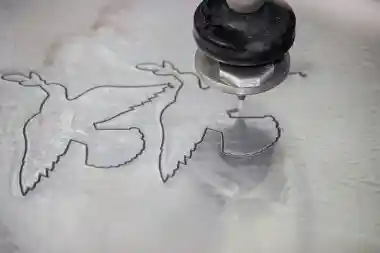
Steel and Stainless Steel
Abrasive waterjet systems can cut thick steel plates without the heat-affected zone associated with thermal cutting processes.
For thick steel, the main limitations are often cutting time, edge taper, abrasive consumption, and the required dimensional tolerance.
While high-capacity systems may cut steel approaching or exceeding 300 mm, such thicknesses require careful evaluation of cutting conditions and equipment capability.
Aluminum
Aluminum is commonly processed using abrasive waterjet cutting because the process does not rely on melting the material.
The achievable thickness depends on the alloy, pump power, and cutting-quality requirements.
Thicker aluminum sections are technically feasible, but manufacturers must consider the relationship between cutting speed and operating cost.
Titanium
Waterjet cutting is useful for titanium components because it avoids conventional thermal distortion and heat-affected zones.
The achievable thickness depends on the titanium grade, cutting system, and process settings.
Waterjet Cutting Thickness for Non-Metals
Stone and Granite
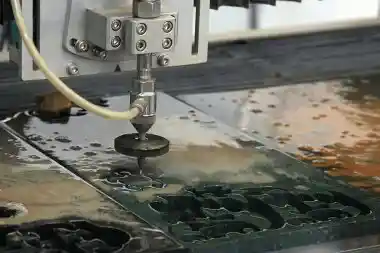
Abrasive waterjet cutting can process thick stone slabs, granite, and marble.
However, natural variations in material structure may affect edge quality and the risk of chipping.
Glass
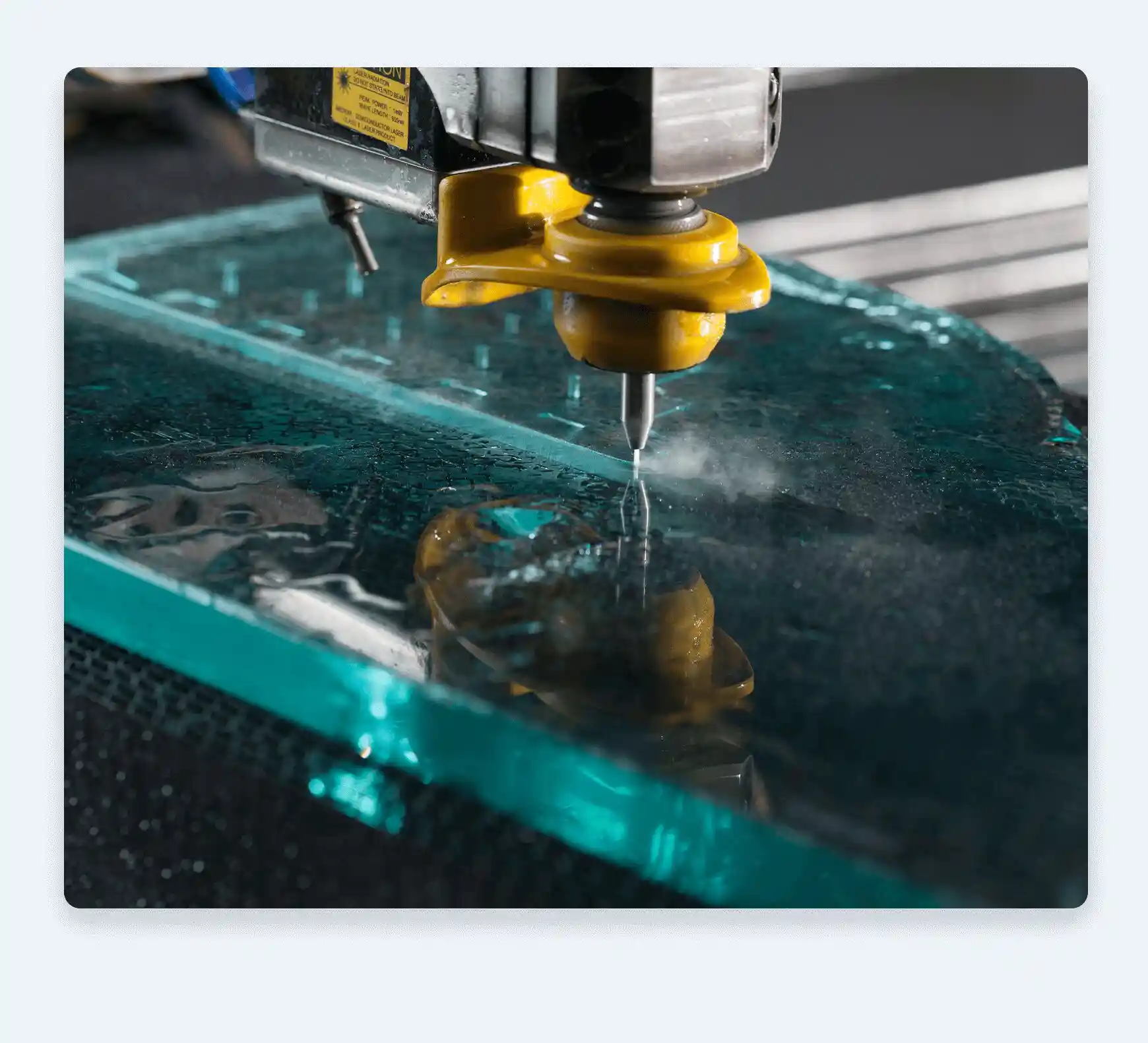
Waterjet cutting is suitable for many types of non-tempered glass, including certain laminated products.
Special piercing techniques may be required to reduce cracking or delamination.
Fully tempered glass is generally unsuitable for conventional abrasive waterjet cutting because it may shatter when penetrated.
Composites
Fiber-reinforced composites can be cut using abrasive waterjets, although cutting performance depends on the fiber type, resin system, and laminate structure.
For thick composite materials, proper piercing and cutting conditions are important to minimize delamination.
Plastics and Foam
Pure waterjets are often suitable for soft materials such as foam and rubber.
For these materials, cutting thickness depends heavily on density, flexibility, support conditions, and available cutting-head clearance.
Key takeaway: A waterjet's maximum cutting thickness cannot be determined by material type alone. Equipment specifications and cutting-quality requirements must also be considered.
2. What Factors Determine Maximum Waterjet Cutting Thickness?
The maximum thickness a waterjet can cut depends on several interacting technical factors.
Understanding these variables helps manufacturers determine whether a particular waterjet system can process their material efficiently.
1. Water Pressure and Pump Power
Water pressure is a major factor influencing the energy delivered by a waterjet cutting system.
Industrial waterjet equipment is available with different pressure ratings, from lower-pressure compact machines to high-performance systems operating at approximately 60,000–90,000 psi.
Higher pressure can increase jet velocity and improve cutting performance when the remaining system components are appropriately matched.
However, higher pressure alone does not guarantee greater practical cutting thickness.
Pump power, water flow rate, nozzle design, and abrasive delivery must also be considered.
For thick-material cutting, sufficient power at the cutting head is especially important.
2. Material Properties
Different materials respond differently to waterjet cutting.
Important properties include:
- Hardness and strength
- Density and internal structure
- Brittleness
- Material composition
- Layering or fiber reinforcement
For example, stainless steel, aluminum, and titanium require different cutting parameters, even at the same thickness.
Brittle materials such as glass may also need specialized piercing methods to prevent cracking.
Material hardness alone does not determine cutting speed or maximum thickness.
3. Abrasive Type and Flow Rate
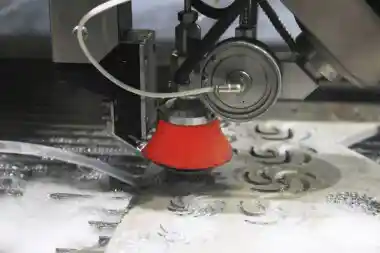
Abrasives play a critical role when cutting hard or thick materials.
Abrasive Selection
Garnet is widely used in industrial abrasive waterjet cutting because of its suitable hardness, particle characteristics, and cutting performance.
Abrasive Flow Rate
The amount of abrasive delivered to the cutting stream affects material removal efficiency.
Insufficient abrasive can reduce cutting performance, while excessive abrasive may waste material without producing proportional improvements.
Abrasive Particle Size
Particle size can influence cutting speed, kerf characteristics, and surface quality.
The appropriate abrasive specification depends on the material, nozzle configuration, and desired cutting result.
For thick materials, abrasive parameters should be optimized alongside pump pressure and cutting speed.
4. Cutting Speed and Edge Quality
Cutting speed strongly influences the thickness and quality achievable with a waterjet.
Slower Cutting Speeds
Reducing traverse speed gives the jet more time to remove material through the full thickness of the workpiece.
This can improve cutting penetration and reduce certain quality problems.
Faster Cutting Speeds
Higher cutting speeds improve productivity, but excessive speed can produce incomplete cuts, visible striations, and increased jet lag.
For thick materials, the correct cutting speed must balance:
- Complete material penetration
- Edge quality
- Dimensional accuracy
- Cutting time
- Abrasive and energy consumption
A waterjet may technically penetrate a thick workpiece while requiring an impractically slow cutting speed.
5. Nozzle Design and Condition
The cutting head influences jet stability and material removal efficiency.
Important components include the water orifice, abrasive mixing chamber, and focusing tube.
Orifice Size
The orifice diameter affects water flow and must be matched to the pump's pressure and power capabilities.
Component Materials
Waterjet orifices commonly use wear-resistant materials such as sapphire or diamond, while abrasive focusing tubes often use highly wear-resistant carbide-based materials.
Component Wear
A worn or damaged focusing tube can degrade jet quality, increase kerf variation, and reduce cutting consistency.
Regular inspection and replacement according to manufacturer recommendations help maintain cutting performance.
6. Equipment Configuration and Operating Conditions
Other factors may limit the achievable cutting thickness even when the pump has sufficient cutting power.
These include:
- Available Z-axis clearance
- Cutting-head standoff distance
- Pump and plumbing condition
- Water quality and filtration
- Workpiece support and fixturing
- Motion-control and taper-compensation capability
For example, a machine may have sufficient cutting energy to penetrate a thick steel plate but lack the Z-axis clearance needed to accommodate it.
Therefore, both cutting capability and physical machine capacity must be checked.
3. Practical Limitations of Cutting Thick Materials with a Waterjet
Waterjet cutting offers advantages for thick-material processing, but the ability to penetrate a material does not necessarily guarantee efficient production or high edge quality.
1. Reduced Cutting Speed
As material thickness increases, the cutting jet must remove material over a greater depth.
This typically requires slower traverse speeds, increasing machining time.
For very thick components, cutting time can become a major factor in the total production cost.
2. Edge Taper and Jet Lag
The waterjet loses energy and changes direction as it travels through the material.
This can produce:
- Cut-edge taper
- Increased kerf variation
- Visible striations
- Reduced dimensional accuracy near the bottom of the cut
The effects generally become more pronounced as material thickness increases.
Advanced cutting heads and motion-control systems can compensate for certain taper and jet-lag effects, but the achievable results remain dependent on the material and machine configuration.
3. Cutting Accuracy and Surface Finish
Abrasive waterjet cutting can produce good edge quality without conventional thermal damage.
However, thicker materials do not automatically achieve the same tolerances or surface finish as thinner materials.
The required accuracy may demand slower cutting speeds, specialized taper compensation, or secondary finishing.
For precision components, manufacturers should confirm the achievable tolerance through machine specifications or test cuts.
4. Abrasive and Operating Costs
Cutting thick materials usually requires more processing time and abrasive consumption.
Operating costs may include:
- Abrasive media
- Electricity
- Water treatment and filtration
- Nozzle and focusing-tube replacement
- Used abrasive and sludge disposal
- Machine maintenance
These expenses should be included when evaluating thick-material cutting economics.
5. Material-Specific Limitations
Waterjet cutting is a cold-cutting process and generally avoids the heat-affected zones created by laser or plasma cutting.
This is valuable for certain heat-sensitive metals, composites, and finished materials.
However, waterjets may still cause mechanical effects such as edge chipping, laminate delamination, or surface erosion.
The process also produces spent abrasive, contaminated water, noise, and potentially airborne mist, which require appropriate management.
Practical recommendation: When cutting thick materials, evaluate cutting speed, dimensional tolerance, edge quality, and operating cost rather than selecting a machine based only on its maximum advertised cutting thickness.
4. Waterjet vs. Laser and Plasma: Which Is Better for Thick Materials?
Waterjet, laser, and plasma cutting are widely used in industrial manufacturing, but their material compatibility and thickness capabilities differ.
The best cutting method depends on material type, thickness, required quality, and production efficiency.
Waterjet Cutting
Abrasive waterjets can process a wide range of metallic and non-metallic materials, including thick steel, aluminum, titanium, stone, glass, and composites.
They are especially useful when avoiding thermal damage is important.
High-capacity systems may cut material exceeding 300 mm under suitable conditions, although productivity and edge-quality requirements can limit practical applications.
Laser Cutting
Laser cutting is widely used for metal sheet and plate processing, especially when high production speed and precise contours are required.
Modern high-power laser systems can cut substantially thicker metals than traditional low-power equipment.
For example, certain TRUMPF TruLaser configurations specify cutting capacities up to approximately 60 mm for mild steel or stainless steel when equipped with the appropriate high-power and thick-sheet cutting package.
However, actual capacity varies by laser power, material, gas selection, and equipment configuration.
Plasma Cutting
Plasma cutting is used for electrically conductive metals and can provide high cutting speeds, particularly in steel fabrication.
Its maximum cutting thickness depends on the available current, plasma system, material, and whether the cut begins from the edge or requires piercing.
For example, Hypertherm's HPR800XD system specifies cutting capability up to 160 mm for certain stainless steel and aluminum edge-start applications.
This does not mean every plasma machine can cut to that thickness.
Cutting Method Comparison
| Comparison Factor | Abrasive Waterjet | Laser Cutting | Plasma Cutting |
|---|---|---|---|
| Typical materials | Metals, stone, glass, composites | Mainly suitable metals and selected other materials | Electrically conductive metals |
| Thick-material capability | Very high with suitable systems; 300 mm or more possible | High-power systems can process thick plate | High-current systems can process thick metal |
| Heat-affected zone | No conventional thermal HAZ | Present | Present |
| Cutting speed | Often slower on thick materials | Often fast within suitable thickness ranges | Often fast for metal cutting |
| Edge quality | Depends on thickness, speed, and taper control | Generally good within rated capability | Depends on system and cutting parameters |
| Main limitation | Cutting time, taper, abrasive consumption | Material, power, and thickness constraints | Conductive materials and cut-quality requirements |
No cutting process has a single universal maximum thickness across all materials.
For thick metals where thermal distortion must be avoided, abrasive waterjet cutting can be particularly attractive.
For applications where production speed is the priority, laser or plasma cutting may offer a better economic solution within their rated capabilities.
Conclusion: Choosing the Right Waterjet for Material Thickness
Abrasive waterjets can cut many materials over 300 mm thick, but most routine industrial applications involve substantially thinner materials.
Maximum cutting thickness depends on water pressure, pump power, material properties, abrasive parameters, nozzle condition, and cutting speed.
For steel, aluminum, titanium, stone, glass, and composites, manufacturers should evaluate not only whether the material can be penetrated but also whether the process can achieve the required cutting quality at an acceptable cost.
When selecting a waterjet cutting system, confirm:
- Material type and thickness
- Required edge quality and dimensional tolerance
- Pump pressure, power, and flow capacity
- Cutting-head and abrasive specifications
- Available Z-axis clearance
- Expected cutting time and operating costs
For assistance evaluating waterjet cutting equipment for thick-material applications, contact MINNUO to discuss your material specifications and cutting requirements.
The right waterjet system is not simply the one that cuts the thickest material, but the one that delivers the required cutting quality and productivity for your application.
Frequently Asked Questions (FAQ)
Q1. What is the maximum thickness a waterjet can cut?
A:Industrial abrasive waterjet systems can cut through approximately 300 mm (12 inches) of many materials, and some specialized systems can exceed this thickness. The practical limit depends on the machine, material, cutting speed, and required edge quality.
Q2. How thick can a waterjet cut steel?
A:High-capacity abrasive waterjet systems can cut steel sections approaching 300 mm or more under suitable conditions. However, cutting speed decreases and maintaining edge accuracy becomes more difficult as thickness increases. The actual capability must be confirmed for the specific equipment.
Q3. Can a waterjet cut materials thicker than 12 inches?
A:Yes. Some specialized abrasive waterjet systems have demonstrated cutting capabilities beyond 12 inches. However, these applications may involve long cutting times, reduced tolerance capability, and higher operating costs.
Q4. Does higher water pressure always increase maximum cutting thickness?
A:Not necessarily. Higher pressure can improve jet performance, but cutting capability also depends on pump power, water flow, nozzle configuration, abrasive delivery, and cutting speed. The complete system must be properly matched.
Q5. Is waterjet better than laser cutting for thick metal?
A:Waterjet cutting is often advantageous for very thick metal sections or applications requiring no conventional heat-affected zone. However, high-power laser systems may be faster and more economical for materials within their rated thickness range. The best choice depends on thickness, material, quality requirements, and production costs.
 Email
 sales1: +86 15312799623