



AI-Optimized CNC Machining: How to Boost Turning Center Efficiency in 2026
The global manufacturing sector is undergoing an intelligent transformation wave. AI-driven CNC machining has become a core driver for upgrading turning center production operations. Entering 2026, alongside the rollout of international energy efficiency standards such as IEC 618009, and deep integration of Industrial Internet of Things (IIoT) and digital twin technologies, artificial intelligence has evolved from a forward-looking concept into a practical tool that drastically lifts the efficiency, precision and sustainability of turning centers. This paper explores core AI application scenarios in CNC turning and delivers actionable implementation steps for manufacturers to raise overall productivity in 2026.
The Irreversible Trend: AI Transforms CNC Turning in 2026
2026 stands as a pivotal year for intelligent upgrading of CNC machining equipment. Industry projections indicate AI predictive maintenance systems will be installed on 38% of all newly delivered CNC machines, while the market penetration of AI-powered intelligent servo motors will hit 35%. For turning centers widely deployed in automotive, aerospace and medical device manufacturing, AI optimization addresses long-standing pain points of traditional machining workflows: low programming efficiency, unplanned production downtime, and heavy reliance on veteran skilled workers.
Relevant policies further accelerate this technological shift. China's Made in China 2025 initiative targets an 80% localization rate for core CNC systems by 2030, with substantial financial subsidies supporting R&D and industrialization of AI-integrated CNC technology. Meanwhile, the European Union's mandatory energy efficiency regulations push manufacturers to adopt AI optimization solutions that cut power consumption by over 20% compared with conventional equipment. Against this backdrop, AI retrofitting and upgrading of turning centers has shifted from an optional upgrade to a necessary move to sustain market competitiveness.
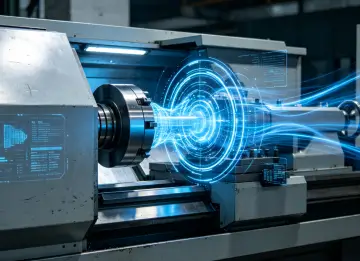
Core AI Application Scenarios for Higher Turning Center Efficiency
AI Automatic Programming: Cut Preparation Time by 50%
Traditional CNC turning programming relies on engineers manually writing G-code based on part drawings, a process that often takes 30 minutes or longer for complex workpieces. AI reshapes this workflow through natural language processing and machine learning algorithms.
For instance, Han's Intelligent Technology (Shandong) has developed an AI voice programming system. Operators only need to input simple voice instructions such as “Machine an aluminum flange with 30mm outer diameter and 50mm machining depth”, and the system automatically analyzes process parameters to generate error-free G-code within one minute, slashing programming time by half. Similarly, the HNC-10 series CNC system from Huazhong CNC embeds large language models to directly generate machining programs from 3D models, lifting programming efficiency by 40% to 60% for curved complex components.
Core benefits: Lower skill thresholds for frontline operators, freeing process engineers from repetitive coding work to focus on process iteration and optimization.
Predictive Maintenance: Reduce Unplanned Downtime by 75%
Tool wear and sudden mechanical failures cause unplanned downtime, a major factor dragging down turning center productivity. AI predictive maintenance resolves this issue by analyzing real-time operational data collected from machine-mounted sensors.
Siemens embeds AI algorithms into its Sinumerik CNC system to continuously monitor vibration, temperature and cutting force data, enabling early prediction of tool wear and potential mechanical faults. FANUC's FIELD platform leverages historical maintenance datasets for AI modeling, reaching a fault prediction accuracy of 92%. In real production cases, the digital twin AI monitoring platform developed by Han's Intelligent delivers early warnings for abnormal equipment states, cutting machine downtime by 75%.
Core benefits: Extend tool service life by 25%, lower maintenance expenses by 30%, and guarantee uninterrupted batch production.
Adaptive Machining Parameter Optimization: Lift Material Removal Rate by 30%
AI algorithms dynamically adjust feed rate, spindle speed, cutting depth and other machining parameters according to real-time cutting conditions, optimizing cutting performance for diverse workpiece materials and geometric structures.
A μAI intelligent machine tool developed by Shanghai Jiao Tong University adopts multi-agent reinforcement learning to generate and evaluate multiple machining paths simultaneously, selecting the optimal solution based on live cutting feedback. When processing titanium alloy parts, this technology raises the material removal rate by 30% and reduces workpiece surface roughness by 40%. DELMIA Machining software from Dassault Systèmes recommends optimized tool paths via AI analysis of 3D model features, cutting raw material waste by 15%.
Core benefits: Balance processing efficiency and dimensional precision, especially suitable for high-value hard-to-cut materials including titanium alloys and composite materials.
AI-Driven Human-Machine Collaboration to Boost Operational Flexibility
AI-enabled human-machine collaboration will become mainstream in CNC turning production in 2026, supported by natural language interaction and augmented reality (AR) technologies for more intuitive machine operation.
Han's Intelligent's remote maintenance diagnosis platform equips technicians with AR smart glasses paired with AI-generated 3D digital models and real-time equipment data, boosting troubleshooting efficiency by 90%. Operators can adjust parameters without halting production through voice commands like “Raise spindle speed by 100 rpm”.
Core benefits: Shorten batch changeover time by 40%, improve workshop operational flexibility, and better adapt to small-batch customized order production.
Step-by-Step Guide to Implement AI Optimization on Turning Centers in 2026
Step 1: Audit Existing Equipment and Clarify Production Demands
First evaluate current turning center models, supporting CNC systems (FANUC, Siemens, Huazhong CNC and other domestic brands included), and core production modes (mass standardized production or small-batch custom processing). For older legacy machines, prioritize retrofitting AI sensors and edge computing modules; for new equipment procurement, select models with native AI functions to avoid compatibility barriers.
Step 2: Launch Pilot Deployment on High-Yield Scenarios
Avoid full-scale rollout at the initial stage. Carry out pilot tests on high-impact links such as predictive maintenance for core turning equipment or AI automatic programming for complex parts. This minimizes trial investment while verifying actual optimization effects, allowing targeted adjustment of solutions based on on-site production data. As an example, medical component manufacturers can pilot AI programming for precision shaft workpieces to lower product reject rates.
Step 3: Realize Interconnection of All Data Systems
Build unobstructed data transmission links between AI tools, CNC controllers and Manufacturing Execution Systems (MES). Industry forecasts show cloud-based distributed CNC systems will capture 30% market share by 2030, so factories can adopt cloud-edge collaborative architectures to support real-time data analysis and remote workshop monitoring.
Step 4: Train Staff for AI Human-Machine Collaboration
AI does not replace experienced operators, but transforms their job positioning from code writers to process optimization specialists. Enterprises can organize systematic training to help staff master AI programming tools and interpret data analysis results, while reserving manual intervention channels for abnormal edge cases. Current vocational training curricula have incorporated AI tool chain application and process modeling modules to support internal workforce skill upgrading.
Key AI CNC Turning Industry Trends to Track in 2026
- Cloud-edge collaborative control: 5G combined with AI enables real-time data exchange between on-site turning centers and cloud platforms, supporting remote operation and coordinated cross-regional production scheduling.
- Autonomous intelligent machining: AI systems will independently generate G-code, automatically correct machining errors and adjust processes based on quality inspection data, upgrading equipment from automated operation to full autonomous decision-making.
- AI-powered green manufacturing: Digital twin technology paired with AI can identify 92% of energy waste points, optimizing cutting parameters and equipment operating modes to help factories comply with strict global environmental standards.
- Localized AI-CNC integrated solutions: Domestic CNC manufacturers will expand market share to 45% by 2024, delivering cost-effective AI intelligent upgrading schemes tailored for small and medium-sized processing factories.
Conclusion: Adopt AI to Secure Competitive Advantages in 2026
AI-optimized CNC turning is no longer experimental cutting-edge technology, but a proven solution to elevate turning center comprehensive productivity. By deploying AI automatic programming, predictive maintenance, adaptive parameter tuning and intelligent human-machine collaboration, manufacturers can cut downtime, boost machining precision and lower comprehensive production costs throughout 2026 and beyond.
Successful intelligent transformation relies on phased implementation, full data interconnection and targeted employee training. As global manufacturing accelerates intelligent upgrading, enterprises that integrate AI into CNC turning workflows will occupy a dominant competitive position in international market competition.

 Email
Email sales1: +86 15312799623