



Application and Key Technical Requirements of Gantry Machining Centers in the New Energy Field (Wind Power - Lithium Batteries)
With the rapid rise of the global new energy industry, the wind power and lithium battery sectors are experiencing a dual wave of large-scale expansion and technological upgrading. In this process, the precision and efficiency of wind power component processing, lithium battery mold processing, new energy gantry machining, and large structural part processing directly determine the performance and competitiveness of end products. As a core equipment in high-end equipment manufacturing, gantry machining centers, with their powerful processing capabilities, have become a key support for the new energy industry to overcome complex workpiece processing challenges and achieve efficient mass production.
Ⅰ. Core Application Scenarios of Gantry Machining Centers in the New Energy Field
Core workpieces in the new energy industry are mostly characterized by large size, high precision requirements, and special materials. Gantry machining centers, relying on their unique structural advantages, are widely used in the processing of key components in both wind power and lithium battery fields, accurately matching the core needs of the industry.
1. Wind Power Field: Consolidating the Foundation for Large Component Processing
The stability of wind power equipment directly depends on the processing precision of core components. Gantry machining centers are mainly responsible for processing large structural parts such as wind turbine blade molds, nacelle bases, and hubs. As the core carrier for blade forming, wind turbine blade molds must have extremely high profile accuracy and surface finish; otherwise, they will directly affect the aerodynamic performance of the blades and reduce power generation efficiency. As a key structure bearing core components such as generators and gearboxes, nacelle bases not only need to withstand huge loads but also ensure the coaxiality and positional accuracy of each connecting hole to ensure the long-term stable operation of the equipment. The processing of these large wind power components places strict requirements on the stroke, load capacity, and cutting stability of the equipment, making gantry machining centers the preferred choice in this field.
1.1 Wind Turbine Blade Mold Processing
- Application Requirements: Modern wind turbine blades generally exceed 80 meters in length, and their molds are of large size with complex three-dimensional curved surfaces. Extremely high contour accuracy and surface finish are required to ensure the aerodynamic performance of the blades.
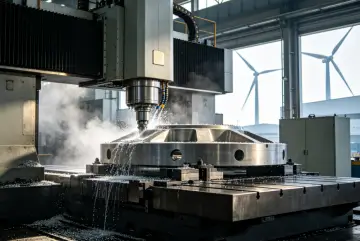
- Processing Solutions: Ultra-large new energy gantry machining centers are needed, featuring extremely long X/Y/Z axis strokes, which can complete the roughing, semi-finishing, and finishing of large molds with one-time clamping. The equipment must be equipped with a high-power electric spindle to handle the efficient milling of large-margin glass fiber-reinforced polymer (GFRP) while ensuring high dynamic accuracy and stability.
1.2 Processing of Large Structural Parts such as Nacelle Bases, Hubs, and Gearboxes
- Application Requirements: These components are mostly large cast iron or welded steel structures, weighing up to several tens of tons. Processing content includes a large number of planes, hole systems, threads, and special-shaped cavities. They not only require heavy-load cutting capabilities but also have high requirements for processing efficiency and consistency of hole position accuracy.
- Processing Solutions: Gantry machining centers with high rigidity and large-load worktables are the first choice. The equipment needs to be equipped with heavy-duty mechanical spindles or electric spindles to provide enormous torque and power, achieving efficient "turning instead of grinding" processing. At the same time, dual worktables or pallet changing systems can significantly reduce the auxiliary time for workpiece loading and unloading, realizing continuous production with efficiency as the top priority.
2. Lithium Battery Field: Empowering Precision Mold and Cabinet Processing
The rapid development of the lithium battery industry has put forward higher requirements for the processing precision and efficiency of components such as battery cabinets and electrode molds. Lithium battery mold processing and cabinet processing have become important application scenarios for gantry machining centers. As the protective and load-bearing structure of battery packs, lithium battery cabinets need to balance light weight and high strength, mostly adopting special materials such as aluminum alloys and titanium alloys. They also need to complete high-precision processing of complex cavities and multiple through holes to ensure the sealing and safety of battery packs. The precision of lithium battery electrode molds directly determines the thickness uniformity and dimensional accuracy of electrodes, which in turn affects the energy density and cycle life of batteries. Processing equipment is required to have micron-level positioning accuracy and stable cutting performance. With their precise control capabilities and efficient processing performance, gantry machining centers provide reliable support for the mass production of core lithium battery components.
2.1 Lithium Battery Mold Processing (e.g., Covers, Die-Cutting Molds, Pole Piece Calendering Molds)
- Application Requirements: Battery covers have complex structures, involving multiple cavities, deep cavities, precision slits, and high-precision guide pillar holes. Mold materials are often high-strength mold steel or even cemented carbide, requiring the machine tool to have excellent hard milling capabilities and extremely high surface processing quality.
- Processing Solutions: Precision gantry machining centers need to be equipped with high-performance electric spindles to achieve high-speed and high-precision mirror milling. The thermal stability and geometric accuracy of the machine tool are crucial to ensure the dimensional consistency and long service life of the mold.
2.2 Lithium Battery Cabinet (Battery Pack Housing) Processing
- Application Requirements: To improve battery life and ensure safety, new energy vehicle battery pack housings extensively use aluminum alloys or high-strength steel, and are expanding to new lightweight materials such as titanium alloys. The workpieces are large in size, thin-walled, and prone to deformation. Processing requires efficient removal of a large amount of metal while ensuring the flatness of each assembly surface, the positional accuracy of hole systems, and the accuracy of sealing grooves.
- Processing Solutions: For aluminum alloy cabinets, high-speed gantry machining centers equipped with large-flow cooling systems are needed to achieve efficient roughing and high-quality finishing. The demand for titanium alloy processing capabilities is increasingly prominent. Machine tools need to have sufficient rigidity, spindle power, and advanced tool cooling technology to address the challenges of difficult cutting and severe work hardening of titanium alloys.
Ⅱ. Special Technical Requirements for Gantry Machining Centers in the New Energy Field
The particularity of workpiece characteristics in the new energy industry determines that its technical requirements for gantry machining centers far exceed those of ordinary mechanical processing scenarios, requiring core adaptation in terms of stroke, load capacity, material processing capabilities, and efficiency.
- Large Stroke Design to Adapt to Large Workpiece Processing Workpieces such as wind turbine blade molds and nacelle bases are large in size. Some wind turbine blade molds can reach tens of meters in length. This requires gantry machining centers to have sufficient X-axis, Y-axis, and Z-axis strokes, while ensuring positioning accuracy and motion stability within the large stroke range. In addition, the equipment needs to be equipped with a large-size worktable, which must have uniform load-bearing capacity to avoid processing accuracy deviations caused by uneven weight distribution of workpieces.
- Heavy-Load Cutting Capacity to Handle High-Strength Workpieces Large wind power structural parts mostly use high-strength steel, cast iron, and other materials, weighing up to several tens of tons or even hundreds of tons. Some lithium battery cabinets use high-strength and lightweight materials such as titanium alloys. The processing of these workpieces requires gantry machining centers to have strong spindle power and cutting torque, enabling stable cutting under heavy-load conditions. At the same time, structures such as the machine bed and beam of the equipment must have sufficient rigidity to resist vibrations generated during cutting and avoid affecting processing accuracy.
- Special Material Processing Capabilities to Break Through Technical Bottlenecks Special materials such as titanium alloys in the lithium battery field and high-strength alloys in the wind power field have the characteristics of high hardness, strong toughness, and high cutting difficulty, putting forward special requirements for the tool system, spindle speed, and cooling system of gantry machining centers. The equipment needs to be compatible with high-hardness tools, have a variable-speed high-speed spindle, and be equipped with an efficient cooling system to timely remove a large amount of heat generated during cutting, reduce tool wear and workpiece thermal deformation, and ensure processing quality and efficiency.
- Efficiency-First to Meet Large-Scale Mass Production Needs The new energy industry is in a stage of large-scale expansion. The mass production demand of end products places extremely high requirements on processing efficiency. Gantry machining centers need to have high-speed feeding capabilities, optimize cutting path planning, and support multi-process integrated processing to reduce the number of workpiece clamping times and tool change time, realizing one-stop processing from blank to finished product. In addition, the equipment needs to have good stability and reliability, reduce failure rates, ensure continuous production, and meet the mass production needs of the industry.
Ⅲ. Successful Cases and Technical Solutions, Demonstrating Core Advantages
Based on a deep understanding of the processing needs of the new energy industry, we have tailor-made new energy gantry machining solutions. We have successfully provided efficient processing services for many wind power and lithium battery enterprises, accumulated rich industry application experience, and highlighted our technical strength and service advantages.
1. Wind Turbine Blade Mold Processing Solution
A wind power enterprise needed to process a 35-meter-long wind turbine blade mold, requiring a profile accuracy error ≤ 0.1mm and a surface roughness Ra ≤ 1.6μm. We adopted a customized large-stroke gantry machining center equipped with high-precision grating scales and a constant temperature control system to effectively offset the impact of environmental temperature changes on processing accuracy. For the complex mold profile, we optimized the CNC programming path and combined high-speed cutting technology to significantly improve processing efficiency. At the same time, a dedicated cooling system was matched to avoid profile deviations caused by overheating of tools. Finally, this solution not only met the customer's precision requirements but also shortened the processing cycle by 20%, winning high recognition from the customer.
2. Lithium Battery Titanium Alloy Cabinet Processing Solution
We provided titanium alloy battery cabinet processing services for a leading lithium battery enterprise. The workpiece needed to complete the processing of complex cavities and multiple sets of precision hole systems, requiring a hole position accuracy of ±0.02mm, while ensuring the light weight and high strength of the cabinet. We selected a gantry machining center with heavy-load cutting and high-precision positioning capabilities, matched with cemented carbide coated tools and special cutting parameters to effectively solve the problems of difficult cutting and easy deformation of titanium alloys. Through multi-station clamping design, multi-process processing was completed with one-time clamping, reducing clamping errors. At the same time, online inspection technology was introduced to real-time monitor processing accuracy and correct deviations in a timely manner. After the implementation of the solution, the qualified rate of cabinet processing increased from 92% to 99.5%, and production efficiency increased by 30%, helping the customer achieve large-scale mass production.
Ⅳ. Why Choose Our New Energy Gantry Machining Services?
In the context of increasingly fierce competition in the new energy industry, choosing a professional processing partner is crucial. We specialize in wind power component processing, lithium battery mold processing, and large structural part processing, with three core advantages:
- Precise adaptation to industry needs, customizing processing solutions according to the characteristics of new energy workpieces to solve the processing problems of large size, high precision, and special materials;
- Strong technical strength, owning customized gantry machining equipment and a professional technical team, capable of providing one-stop services from solution design, programming and processing to post-processing inspection;
- Rich industry experience, having served many leading enterprises, familiar with industry standards and processing pain points, able to quickly respond to customer needs and ensure processing quality and delivery efficiency.
We have always been driven by technological innovation and centered on customer needs, continuously optimizing new energy gantry machining solutions to help wind power and lithium battery enterprises break through processing bottlenecks, improve product competitiveness, and embark on a new journey of new energy industry development.
 Email
Email sales1: +86 15312799623