



Arm-Type vs. Umbrella-Type Automatic Tool Changers for CNC Mold Manufacturing
For CNC mold manufacturing, a double-arm automatic tool changer (ATC) is generally better suited to frequent tool changes, larger tool inventories, and continuous multi-operation machining. An umbrella-type ATC is often more economical for smaller mold inserts and simpler machining programs. The most important selection factors are tool-change time, usable magazine capacity, tool dimensions, and production requirements.
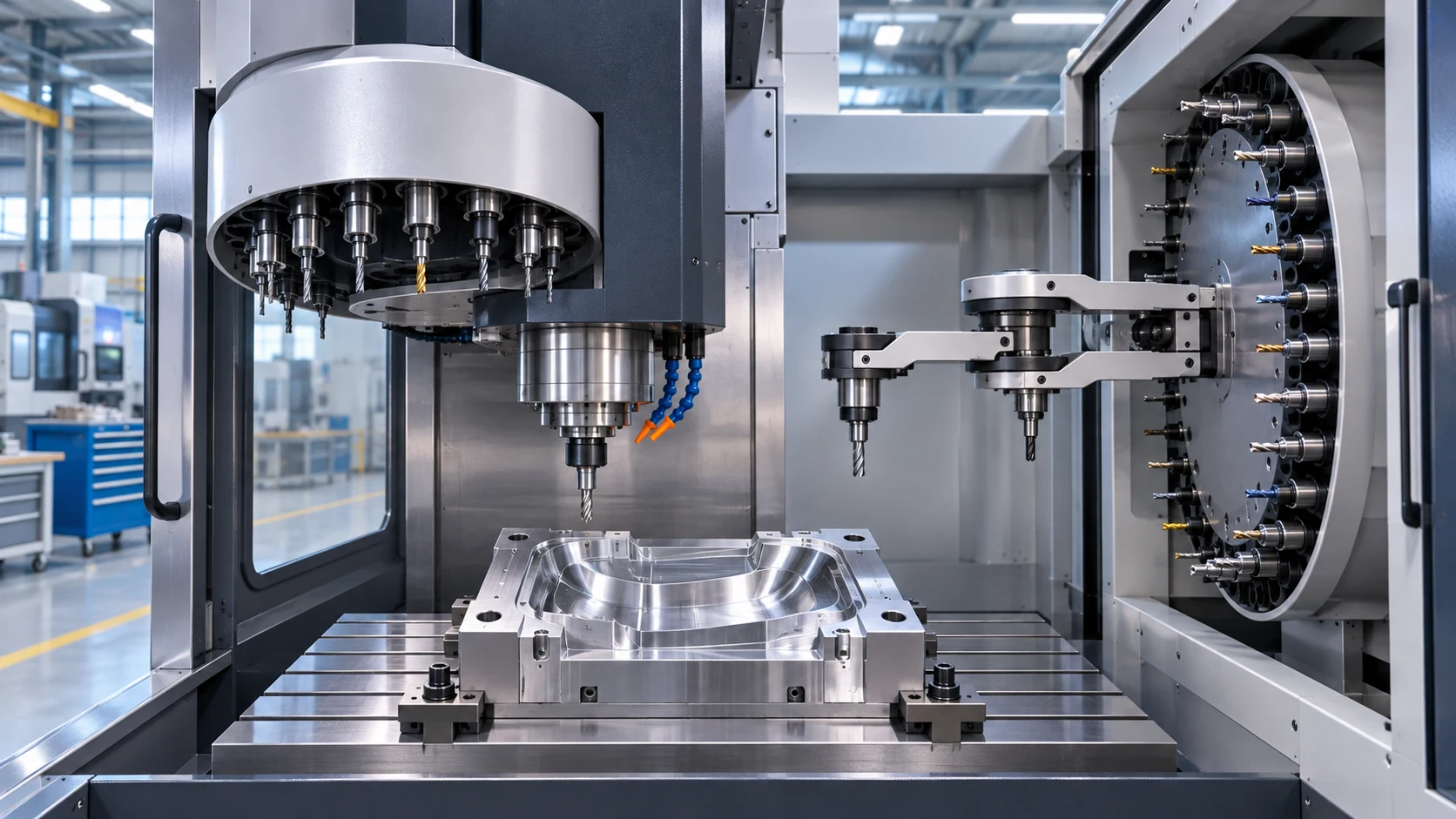
Why Does Automatic Tool Changer Selection Matter in CNC Mold Manufacturing?
CNC mold manufacturing involves multiple operations, including face milling, roughing, semi-finishing, cavity finishing, drilling, and tapping. Each operation may require a different cutting tool.
An automatic tool changer enables a CNC machining center to switch between these tools without manual intervention, reducing interruptions and supporting automated production.
However, different mold-making processes have different tool-changing requirements.
For example, finishing an injection mold cavity may involve several hours of continuous machining with relatively few tool changes. In contrast, machining a mold plate with numerous drilled and tapped holes can require frequent tool exchanges.
Three factors have the greatest impact on ATC selection:
- Non-cutting time: Frequent tool changes can reduce productive machine time, particularly in short-cycle operations.
- Tool magazine capacity: Insufficient capacity may require manual tool replacement and interrupt continuous machining.
- Operating reliability: Toolholder incompatibility, sensor faults, or mechanical problems can interrupt production, especially during unattended operation.
Selecting the right ATC helps balance machining efficiency, equipment investment, and long-term production requirements.
Arm-Type vs. Umbrella-Type ATC: Design and Performance
How Does an Umbrella-Type Automatic Tool Changer Work?
An umbrella-type ATC, commonly called a direct-pick tool changer, typically uses a circular magazine positioned near the spindle.
During a tool change, the spindle stops and moves to the designated exchange position. The magazine approaches the spindle, receives the current tool, and indexes to the next required tool. The spindle then retrieves the replacement tool and resumes machining.
This arrangement uses direct interaction between the spindle and magazine without a separate double-arm transfer mechanism.
Its relatively simple structure makes it suitable for compact vertical machining centers and applications with limited tool requirements.
However, spindle positioning, magazine movement, and indexing all contribute to the overall tool-change cycle.
How Does a Double-Arm Automatic Tool Changer Work?
A double-arm ATC uses a mechanical transfer arm to exchange tools between the spindle and magazine.
The arm grips the outgoing and incoming tools, removes them, rotates—typically through 180 degrees—and inserts each tool into its destination.
Some systems can prepare the next tool while machining continues, reducing the waiting time during the exchange.
Double-arm systems are commonly used on machining centers designed for frequent tool changes and larger tool inventories.
They also contain additional mechanical components, including grippers, cams, bearings, and positioning sensors, which require routine maintenance.
The main difference is the transfer method: an umbrella-type ATC typically relies on direct spindle-to-magazine exchange, while a double-arm ATC uses a dedicated mechanical arm.
A carousel describes the magazine arrangement rather than the transfer method; double-arm systems can also use carousel magazines.
Automatic Tool Changer Comparison: Speed, Capacity, and Tool Limits
The following published Haas Automation specifications illustrate the differences between three CNC machining center configurations.
| Specification | Haas VF-4 | Haas VF-4-V | Haas VF-2SS |
|---|---|---|---|
| ATC configuration | Direct-pick carousel | Side-mount double-arm | High-speed double-arm |
| Tool capacity | 20 | 30+1 | 30+1 |
| Tool-to-tool time | 4.20 s | 2.80 s | 1.80 s |
| Chip-to-chip time | 4.50 s | 3.60 s | 2.40 s |
| Maximum tool diameter, full magazine | 89 mm | 64 mm | 64 mm |
| Maximum large-tool diameter, adjacent pockets empty | Consult OEM | 127 mm | 127 mm |
| Maximum tool weight | 5.4 kg | 5.4 kg | 5.4 kg |
| Spindle speed | 8,100 rpm | 8,100 rpm | 12,000 rpm |
| Spindle power | 22.4 kW | 22.4 kW | 22.4 kW |
Source: Haas Automation official machine specifications. The VF-4-V is a China-market configuration included for technical comparison.
The VF-4 and VF-4-V have similar published spindle speeds and power ratings. Their average chip-to-chip times are 4.50 seconds and 3.60 seconds, respectively, representing a difference of 0.90 seconds per tool change.
The VF-2SS achieves an even shorter published time of 2.40 seconds.
These figures illustrate differences between complete machine configurations, not an isolated test of the two ATC mechanisms.
Tool-to-Tool vs. Chip-to-Chip Time: Which Matters More?
Manufacturers commonly use two measurements to describe ATC performance.
Tool-to-tool time measures the tool-exchange operation according to the manufacturer's defined procedure.
Chip-to-chip time covers a broader interval associated with changing tools and returning to cutting.
For production planning, chip-to-chip time is often more useful because it better represents the non-cutting portion of the machining cycle.
For example, the Haas VF-4 has a published tool-to-tool time of 4.20 seconds and a chip-to-chip time of 4.50 seconds.
The VF-4-V reports 2.80 seconds and 3.60 seconds, respectively.
For standardized testing, ISO 10791-9:2001 provides a framework for evaluating tool-change and pallet-change operating times on machining centers.
Buyers should compare values measured using consistent procedures.
How to Choose an ATC for CNC Mold Manufacturing
How Many Tool Magazine Positions Do Mold Makers Need?
Tool magazine capacity should match the complete machining program.
Mold manufacturing frequently uses face mills, roughing cutters, semi-finishing end mills, ball-nose finishing tools, drills, chamfering cutters, and measurement probes.
The following ranges provide practical starting points for equipment selection.
| Mold manufacturing application | Illustrative tool requirement | Main consideration |
|---|---|---|
| Small mold inserts | 8–15 tools | Compact magazine and equipment cost |
| Injection mold cavities | 16–30 tools | Multi-operation machining |
| Complex mold plates | 20–35 tools | Frequent drilling, milling, and tapping |
| Large stamping dies | 25–40+ tools | Tool dimensions and process flexibility |
A 20-position umbrella magazine may be sufficient for a program requiring 14 compatible tools.
A program involving 26 tools, however, may require a larger magazine or additional tool-loading operations.
Buyers should also distinguish nominal capacity from usable capacity.
For example, the Haas 30+1 configuration provides 30 magazine positions plus one tool in the spindle, rather than 31 magazine pockets.
Large-diameter cutting tools may require adjacent pockets to remain empty, reducing the number of tools that can be stored simultaneously.
For this reason, magazine capacity should be evaluated using the actual cutting-tool inventory rather than the advertised number of positions alone.
How Do Tool Diameter, Length, and Weight Affect ATC Selection?
Tool compatibility is especially important when machining molds with large cavities or deep features.
A small ball-nose finishing cutter has different handling requirements from a large face mill or long-reach roughing cutter.
Buyers should compare five essential parameters.
| Parameter | Importance |
|---|---|
| Maximum tool diameter | Prevents interference between adjacent tools |
| Maximum tool length | Ensures sufficient transfer clearance |
| Maximum tool weight | Protects the changer and retention mechanism |
| Permitted tool moment | Limits loads from long or heavy assemblies |
| Toolholder compatibility | Ensures safe spindle and gripper engagement |
For example, the Haas VF-4-V supports a published maximum tool diameter of 64 mm with the magazine fully occupied.
The large-tool allowance increases to 127 mm when the specified adjacent pockets are left empty.
The VF-4, VF-4-V, and VF-2SS each have a published maximum tool weight of 5.4 kg.
This illustrates an important consideration: a double-arm ATC does not necessarily support heavier tools than an umbrella-type system.
Tool weight, length, and clearance must be evaluated together.
Which ATC Is Better for Injection Molds, Mold Plates, and Stamping Dies?
Different mold-manufacturing applications place different demands on the tool changer.
| Application | ATC selection | Reason |
|---|---|---|
| Small prototype mold inserts | Umbrella-type often sufficient | Limited tools and modest change frequency |
| Long-duration cavity finishing | Either type | Cutting stability matters more than change speed |
| Multi-operation injection molds | Double-arm often advantageous | More tools and repeated exchanges |
| Mold plates with drilling and tapping | Faster ATC often beneficial | Frequent tool changes |
| Large stamping dies | Select by rated tool capacity | Heavy and oversized cutting tools |
| Unattended mold production | Evaluate complete ATC system | Capacity, monitoring, and recovery |
For complex injection molds requiring multiple tools and frequent machining operations, a double-arm ATC can provide greater production flexibility.
For small inserts or long-duration finishing programs, an umbrella-type system may deliver adequate performance with a lower initial investment.
The key is matching the changer to the machining program rather than selecting it solely according to mold complexity.
How to Verify ATC Performance Before Purchasing a CNC Machining Center
Published specifications help buyers compare equipment, but factory acceptance testing provides a clearer picture of the actual machine configuration.
For international procurement, the supplier should demonstrate the ATC using representative cutting tools before shipment.
Which ATC Parameters Should Be Tested During Factory Acceptance?
| Test item | Recommended verification |
|---|---|
| Tool-change time | Measure representative tool-to-tool and chip-to-chip cycles |
| Usable magazine capacity | Load the required tool inventory |
| Tool dimensions | Test long and oversized cutting tools |
| Tool weight | Verify complete toolholder assembly mass |
| Toolholder compatibility | Check spindle, gripper, and retention knob |
| Pneumatic operation | Verify pressure and flow where applicable |
| Change reliability | Record repeated cycles, alarms, and recovery behavior |
The acceptance report should identify the machine model, serial number, controller configuration, test procedure, and recorded results.
For example, the Haas VF-4-V specification lists a nominal air requirement of 113 L/min at 6.9 bar (0.69 MPa), with a minimum pressure of 5.5 bar (0.55 MPa).
These figures describe the air-supply requirement for that machine configuration. Other machines may require different supply conditions.
A useful acceptance package should include the official machine specification, tool-loading diagram, measured test results, and a signed inspection record.
A continuous factory video showing the tool-change sequence can provide additional evidence.
CNC Mold Manufacturing Case Study and ATC Productivity Analysis
Real Manufacturing Case: Omega Tool's CNC Mold Production
Omega Tool, a mold manufacturer based in Windsor, Ontario, has used Makino machining centers to improve large-mold manufacturing operations.
According to a published Makino case study, the company's investment in advanced machining centers produced several improvements:
- Approximately 30% higher productivity in the reported a81 comparison.
- Spindle utilization of approximately 85–90%.
- Machining time reduced by approximately one-third in a specific application.
- Fewer setups and secondary machining operations.
These improvements resulted from the combined capabilities of the machining systems, including fast tool changes, machine movement performance, pallet automation, and reduced setup requirements.
The case illustrates how integrated machine automation can improve mold production efficiency.
For buyers specifically evaluating ATC performance, the next step is to calculate how tool-change time affects their own production cycle.
How Much Production Time Can a Faster ATC Recover in One Year?
Consider a mold-component manufacturer operating two shifts with the following production requirements.
| Production parameter | Illustrative value |
|---|---|
| Components per day | 30 |
| Tool changes per component | 16 |
| Operating days per year | 260 |
| Baseline chip-to-chip time | 4.50 s |
| Alternative chip-to-chip time | 3.60 s |
| Time saved per change | 0.90 s |
| Machine-hour valuation | $80/hour |
The change-time values are taken from the published Haas configurations compared earlier. Production volume and hourly valuation are assumptions for this calculation.
Step 1: Calculate annual tool changes
30 × 16 × 260 = 124,800 changes/year
Step 2: Calculate annual machine time recovered
124,800 × 0.90 ÷ 3,600 = 31.2 hours/year
Step 3: Calculate the value of recovered capacity
31.2 × $80 = $2,496/year
When Does a Faster ATC Deliver a Meaningful ROI?
Suppose each component requires a 30-minute machining cycle containing 16 tool changes.
Reducing the complete tool-change time by 0.90 seconds would recover:
16 × 0.90 = 14.4 seconds per component
For a 1,800-second cycle, this represents a theoretical reduction of:
14.4 ÷ 1,800 × 100 = 0.80%
The adjusted cycle would be approximately 29 minutes and 45.6 seconds.
Although the percentage appears small, repeated savings can accumulate across high-volume production.
For a simplified investment example, assume the faster ATC configuration requires an additional $4,000.
If the full annual capacity value of $2,496 can be realized, the simple payback period would be:
$4,000 ÷ $2,496 = 1.60 years
The $4,000 premium is an illustrative assumption.
Actual ROI should include the additional equipment investment, maintenance costs, utilization, and any reduction in manual tool-loading interruptions.
For some mold manufacturers, the ability to store more tools and maintain uninterrupted production can be more valuable than a small improvement in tool-change speed.
Automatic Tool Changer FAQs for CNC Mold Manufacturing
Q:Is a Double-Arm ATC Always Faster Than an Umbrella-Type ATC?
A: Double-arm systems often provide shorter tool-change times, particularly in machines designed for frequent exchanges. However, actual performance depends on machine configuration, spindle movement, and magazine indexing. Complete chip-to-chip time is the more useful comparison for production planning.
Q:Is a 20-Tool Umbrella ATC Enough for Injection Mold Machining?
A: Yes, when the complete machining program fits within the usable magazine capacity. Buyers should include all cutting tools, probes, and any positions lost to oversized cutters. More complex programs may benefit from a larger magazine.
Q:Does a Double-Arm Tool Changer Improve Mold Machining Accuracy?
A: ATC design primarily affects tool handling and non-cutting time. Mold accuracy depends more directly on machine geometry, spindle condition, thermal stability, toolholder runout, cutting parameters, and measurement procedures.
Q:Why Can a 30-Tool Magazine Hold Fewer Than 30 Cutting Tools?
A: Oversized tools may require adjacent magazine pockets to remain empty. Tool length, weight, and magazine geometry can also impose restrictions. The effective capacity should be checked against the actual tool list.
Q:What Should Buyers Check Before Purchasing an ATC-Equipped CNC Machining Center?
A: Check usable magazine capacity, chip-to-chip time, maximum tool dimensions and weight, toolholder compatibility, maintenance requirements, and recovery functions. A factory acceptance test using representative tooling helps confirm suitability.
Conclusion: Which Automatic Tool Changer Should You Choose?
For CNC mold manufacturing, an umbrella-type ATC is often a practical choice for smaller tooling applications with fewer tool changes and limited magazine requirements.
A double-arm ATC is generally more attractive for complex, multi-operation machining where faster exchanges and larger tool inventories can improve production flexibility.
However, the best choice is not necessarily the fastest system.
Tool capacity, cutting-tool compatibility, machining cycle requirements, reliability, and total operating costs should determine the final selection.
For manufacturers comparing CNC machining centers for mold and precision component production, MINNUO CNC provides machine configurations and technical support based on workpiece dimensions, tooling requirements, and production objectives.
 Email
 sales1: +86 15312799623