



Automotive Mold CNC Milling Technology and Efficiency Improvement Practice
In the automotive manufacturing industry, the quality and processing efficiency of automotive molds directly determine the production cycle, cost control and product precision of auto parts. As the core processing technology of automotive molds, automotive mold processing and mold CNC milling are key to improving the competitiveness of mold manufacturers. Especially for automotive mold factories and stamping mold suppliers, mastering advanced CNC milling technology, optimizing large mold processing strategies, applying hard milling technology and efficient mold repair processing methods can significantly reduce production costs, shorten delivery cycles and enhance product quality stability. This article focuses on the core points of automotive mold CNC milling technology and practical methods for efficiency improvement, providing practical guidance for industry practitioners.
1. Core Challenges of Automotive Mold CNC Milling and Industry Demands
Automotive molds, especially large stamping molds such as auto body covers and bumpers, have the characteristics of large size, complex structure, high precision requirements and high material hardness. In the actual processing process, mold manufacturers often face many pain points: low processing efficiency of large molds leads to prolonged delivery cycles; traditional processing methods are difficult to meet the precision requirements of hardened mold materials; mold wear and damage during long-term use affect production continuity and increase replacement costs.
For automotive mold factories and stamping mold suppliers, solving these pain points is the key to occupying the market. With the continuous development of automotive lightweight and intelligence, the requirements for mold precision and processing efficiency are getting higher and higher. Mold CNC milling technology, with its high automation, high precision and strong flexibility, has become the mainstream technology in automotive mold processing. Among them, the rational application of large mold processing strategies and hard milling technology, as well as scientific mold repair processing, have become important means to improve processing efficiency and reduce costs.
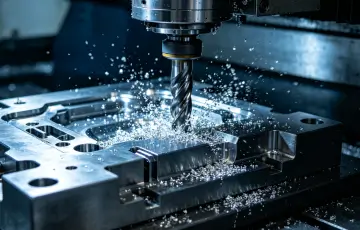
2. Large-Scale Mold CNC Milling Strategy: Balancing Precision and Efficiency
Large-scale automotive molds (such as auto body frame molds, bumper molds) have a projection area of more than 1.5 meters in many cases, with complex curved surfaces and dense functional structures, which puts forward high requirements for CNC milling strategies. The core of the strategy is to optimize the processing process, reduce tool wear and improve processing stability, so as to achieve the balance between precision and efficiency.
First of all, in the process planning stage, it is necessary to carry out finite element analysis (FEA) on the mold structure to optimize the clamping scheme. For large-scale mold blanks, an integrated casting or heavy-duty steel plate welding structure is adopted, and dense reinforcing ribs are set inside to enhance the rigidity of the mold and avoid elastic deformation during processing under thousands of tons of clamping force. At the same time, the multi-point balanced support and clamping system is designed to evenly distribute the clamping force to the entire template, reducing local deformation and ensuring processing precision.
Secondly, in terms of tool path optimization, 3+2 axis processing mode is adopted for large-scale molds with complex curved surfaces, which not only ensures that the cutting conditions of each point on the mold contour are basically the same, but also improves the movement speed and acceleration of the tool, avoiding the problem that 5-axis linkage processing is difficult to give full play to the performance due to the low speed of the rotating axis. In the rough machining stage, the Z-level back-and-forth cutting strategy is adopted to increase the cutting amount per pass and improve the material removal efficiency; in the semi-finishing and finishing stages, the tool path is optimized to reduce the number of tool changes and idle strokes. For example, when processing large-scale automotive bumper molds, the tool path is planned according to the mold structure, and the idle stroke time can be reduced by 20%-30%, and the overall processing cycle can be shortened by 15%.
In addition, the selection of cutting tools is also crucial. For large-scale mold processing, carbide tools with stiff shanks and V-brazed tool heads are selected, which have high hardness and wear resistance, and can adapt to the high-intensity cutting of large-scale molds. At the same time, the tool life is monitored in real time through the CNC system, and the tool is replaced in time to avoid processing defects caused by tool wear, which ensures the stability of automotive mold processing.
3. Hard Milling Technology: A Breakthrough in High-Precision Processing of Automotive Molds
Hard milling is a key technology in mold CNC milling, which refers to the milling process of mold materials with hardness above HRC55 directly by using hard alloy tools or CBN tools without heat treatment after quenching. Compared with the traditional "soft milling + quenching + grinding" process, hard milling technology has obvious advantages, which can greatly shorten the processing cycle, improve processing precision and reduce processing costs, and is especially suitable for the processing of high-hardness automotive molds such as stamping molds.
In the practical application of automotive mold processing, hard milling technology has solved the pain point that traditional processing methods are difficult to process high-hardness materials. For example, when processing automotive steering trunnion forging molds made of M4 high-speed steel with hardness of 65-68 HRC, the traditional EDM process needs to make electrodes, process cavities by EDM, remove the recast layer and polish, which takes a long time and high cost. By adopting high-speed hard milling technology, the mold cavity can be processed in less than 2.5 hours, and the semi-finishing and finishing can be completed in the hardened state, which not only eliminates the electrode manufacturing and EDM process, but also achieves the precision requirement of 0.025mm total tolerance, and the surface finish can avoid manual polishing, which greatly improves the processing efficiency and reduces the tool cost by using standard off-the-shelf cutting tools.
To ensure the effect of hard milling, it is necessary to pay attention to two key points: first, the selection of cutting parameters. It is necessary to adjust the cutting speed, feed rate and cutting depth according to the hardness of the mold material and the type of cutting tool. For example, when milling materials with HRC60-65, the cutting speed is controlled at 80-120m/min, the feed rate is 0.1-0.2mm/r, and the cutting depth is 0.1-0.3mm, so as to avoid tool damage caused by excessive cutting force; second, the cooling and lubrication system. During the hard milling process, a large amount of heat will be generated, which will affect the tool life and processing precision. Therefore, a high-pressure cooling system is adopted to spray the cutting area with cooling liquid accurately, reduce the cutting temperature, and take away the cutting chips in time to avoid the cutting chips scratching the mold surface.
For automotive mold factories and stamping mold suppliers, popularizing hard milling technology can not only improve the processing efficiency of high-precision molds, but also reduce the dependence on grinding processes, shorten the production cycle of molds, and enhance the market competitiveness of products. At present, hard milling technology has been widely used in the processing of automotive stamping molds, die-casting molds and other products, and has achieved remarkable economic benefits.
4. Mold Repair Processing: Extending Service Life and Reducing Cost Loss
Automotive molds will have wear, corrosion, cracks and other problems after long-term high-load production, which will affect the precision of auto parts and even lead to mold scrapping. For automotive mold factories and stamping mold suppliers, mold repair processing is an important way to extend the service life of molds, reduce replacement costs and improve resource utilization, which is an indispensable part of automotive mold processing.
The core of mold repair processing is to restore the original size precision and surface finish of the mold through scientific repair technology, ensure the consistency of product molding quality, and at the same time reduce the scrap rate of molds and realize green manufacturing and sustainable development. The common mold repair technologies include laser cladding repair, cold welding repair, CNC milling reprocessing and composite repair strategies.
In the actual repair process, the first step is to use a blue light scanner to obtain the 3D data of the mold damage area, and reconstruct the original CAD model through professional software to provide an accurate benchmark for subsequent processing. For local wear or corrosion of the mold surface, laser cladding technology is adopted to melt metal powder or wire with high-energy laser beam, forming a metallurgical bonding repair layer on the mold surface, which can realize micron-level precision repair and is especially suitable for the regeneration of complex structures such as grooves and edges of precision molds. For mold cracks or serious deformation, cold welding repair technology is adopted, which uses the principle of low-temperature solid-state diffusion for metal accumulation. The temperature of the mold matrix during the repair process does not exceed 150℃, which effectively protects the original heat treatment performance of the mold and avoids deformation or new cracks caused by high temperature.
CNC milling reprocessing is the key link in mold repair. Based on the 3D scanning data, the compensation processing path is programmed, and the 5-axis CNC machine tool is used to perform equal-precision cutting repair on the worn parts, which is suitable for the repair of complex curved surface molds. At the same time, the online measurement closed-loop control system is integrated, which uses contact probes or laser scanners to monitor the repair size deviation in real time and automatically correct the processing program, ensuring that the tolerance of the repaired mold is controlled within ±0.01mm. For large-scale die-casting molds, the composite repair strategy of thermal spraying + laser remelting is adopted, which deposits wear-resistant coating first, then eliminates pores through laser remelting and improves compactness, taking into account efficiency and performance.
Practice has proved that scientific mold repair processing can extend the service life of automotive molds by 30%-50%, reduce the cost of mold replacement by 40% or more, and at the same time ensure the continuity of production and reduce the loss caused by mold scrapping. For stamping mold suppliers, mastering efficient mold repair technology can also provide value-added services for customers and enhance customer stickiness.
5. Practical Measures for Efficiency Improvement of Automotive Mold CNC Milling
Combining the above three core directions, automotive mold factories and stamping mold suppliers can take the following practical measures to further improve the efficiency of mold CNC milling and reduce production costs:
- Integrate CAD/CAM technology: Realize the integration of product design, process planning, CNC programming and milling processing, directly transmit all CAD data to the CNC system, realize 3D tool compensation, and facilitate the adjustment of processing strategies, tool paths and other process contents at the machine tool, which can double the operation speed of the entire CNC processing process.
- Optimize the management of cutting tools: Establish a tool library management system, classify and manage different types of tools, monitor the tool life in real time, and adopt tool wear prediction technology to replace tools in advance, avoid processing interruptions caused by tool failure, and improve the utilization rate of tools.
- Introduce intelligent monitoring technology: Install sensors on the CNC machine tool to monitor cutting force, cutting temperature, tool vibration and other parameters in real time, find abnormal processing in time, adjust parameters, avoid processing defects, and reduce the rework rate.
- Strengthen the training of operators: Improve the professional quality of operators, make them proficient in the operation skills of CNC machine tools, master the optimization methods of processing parameters and tool paths, and reduce the operation errors caused by human factors.
Conclusion
With the continuous development of the automotive industry, the requirements forautomotive mold processing are getting higher and higher. Mold CNC milling technology, as the core technology of automotive mold processing, its application level directly determines the development space of mold manufacturers. For automotive mold factories and stamping mold suppliers, optimizing large-scale mold processing strategies, popularizing hard milling technology and improving mold repair processing capabilities are the key to improving processing efficiency, reducing costs and enhancing core competitiveness.
In the future, with the integration of intelligent technology and CNC milling technology, automotive mold CNC milling will develop towards higher precision, higher efficiency and more intelligence. Mold manufacturers need to keep up with the industry trend, continuously introduce advanced technology and equipment, optimize processing processes, and accumulate practical experience, so as to provide high-quality, efficient and low-cost mold products for the automotive industry, and achieve sustainable development in the fierce market competition.
If you are an automotive mold factory or a stamping mold supplier, and you want to further master the practical skills of automotive mold CNC milling, hard milling technology and mold repair processing, or need customized processing solutions, please contact us, and we will provide you with professional technical support and services to help you achieve efficiency improvement and cost reduction.

 Email
Email sales1: +86 15312799623