



CNC EDM Drilling Machine vs Conventional Drill Press for Mold Manufacturing
Answer: A conventional drill press is usually the better tool for machinable materials, larger general-purpose holes, and threaded-hole preparation. A CNC EDM drilling machine works only on electrically conductive materials, but it is better suited to hardened mold steel, carbide, Ø0.1–3 mm small deep holes, angled surfaces, and wire-EDM start holes. Most mold shops need the processes to complement each other. Validate the choice with representative parts and a 12-month total-cost model.
Why First-Time Mold-Shop Buyers Choose the Wrong Holemaking Process
Mistake 1: treating high hardness as proof that EDM is mandatory. Mechanical drilling does not become impossible at one universal HRC value. Tool material, machine rigidity, coolant delivery, drill diameter, depth-to-diameter ratio, tolerance, and batch size determine whether the process remains stable and economical.
Mistake 2: comparing only the smallest advertised diameter. A small mechanical drill can fail through runout, deflection, poor chip evacuation, or inadequate coolant. A small EDM electrode avoids cutting force, but the process still depends on electrode wear, dielectric cleanliness, flushing pressure, spark gap, and debris evacuation. A successful sample hole is not a production capability study.
Mistake 3: comparing purchase prices instead of complete cost. Mechanical drilling can hide costs in broken tools, pilot drilling, secondary setups, deburring, and scrap. EDM drilling adds tubular electrodes, guides, filters, deionization consumables, dielectric maintenance, and slower removal for large holes. Labor, consumables, rework, downtime, inspection, and capital cost belong in the same model.
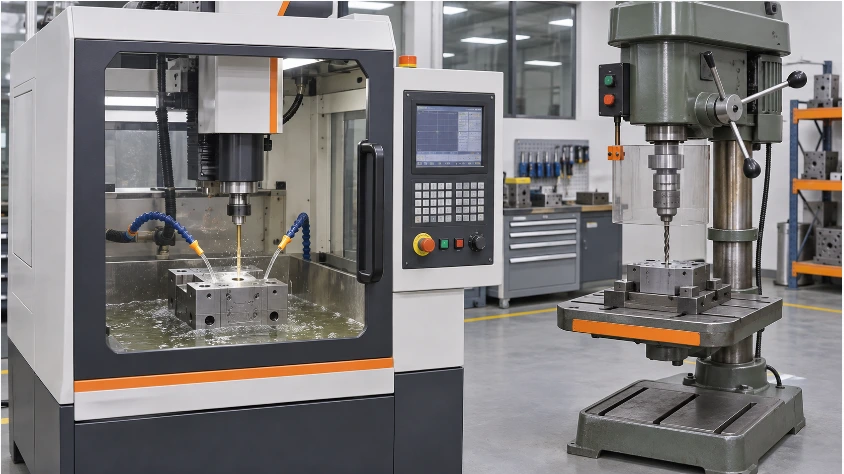
How CNC EDM Drilling Differs from a Conventional Drill Press
How a Drill Press Makes a Hole and Where Its Limits Come From
A drill press rotates a cutting tool in rpm. The cutting edges carry axial force and torque while producing chips. Spindle speed n relates to drill diameter Dc and cutting speed vc through n = 1000 × vc ÷ (π × Dc). Smaller drills require higher rpm at the same cutting speed, while deeper holes make coolant delivery and chip evacuation more difficult. Feed, specific cutting force, torque, and net power must be considered together.
How CNC EDM Hole Drilling Works and Why It Handles Hardened Steel
A CNC EDM hole drill advances a rotating copper or brass tube electrode toward an electrically conductive workpiece. Controlled electrical discharges remove material locally, while high-pressure dielectric fluid passes through the electrode and carries debris out of the gap. The electrode does not apply conventional cutting force, so workpiece hardness is not the primary limitation. Electrical conductivity, flushing stability, spark control, electrode wear, and debris evacuation are the decisive variables.
How Published Specifications Compare Across Three Representative Machines
| Representative use | Published model | Diameter or capacity | Speed and power listing | Fluid data | How a beginner should read it |
| Column drill press | KNUTH SSB 40 Xn | Ø40 mm steel capacity; 190 mm quill stroke | 75–2,020 rpm; 1.5 kW main motor | 6 L/min = 0.36 m³/h coolant flow | Useful for larger conventional holes; capacity is not an accuracy claim |
| Radial drill press | KNUTH R 40 VT PRO | Ø40 mm capacity; 250 mm stated drilling depth | 74–2,200 rpm; 2.2 kW main motor | Pump pressure not stated on product page | Provides reach for large workpieces; positioning depends heavily on setup |
| CNC small-hole EDM | GF DRILL 20 | Ø0.1–3 mm electrode range; 200 mm maximum depth | EDM spindle; rpm not published; 5 kVA maximum consumption | 70 bar = 7 MPa pump pressure; 16 L dielectric volume | Targets conductive small/deep holes; electrode size is not finished-hole size |
These are manufacturer specifications for representative machines, not proof that a buyer's part will reach the same accuracy or cycle time. A drill press capacity rating normally assumes defined material and operating conditions. In EDM, electrode outside diameter, finished-hole diameter, spark gap, runout, and electrode wear are separate values. Acceptance testing must use the same material lot, drawing, and inspection method.
Power-unit warning: the SSB 40 Xn value of 1.5 kW is the main motor's rated active power; the DRILL 20 value of 5 kVA is maximum apparent power for the machine. Dividing one by the other does not produce a valid energy ratio. Converting kVA to kW requires power factor. For operating-cost comparison, measure actual kWh over the same complete part cycle, including pumps, filtration, standby, and auxiliary equipment. Schneider Electric explanation of kW, kVA, and power factor
Material Hole Size Depth Burrs and Consumables Compared
| Decision factor | Conventional drill press | CNC EDM drilling machine | Practical mold-shop interpretation |
| Material | Machinability depends on material, hardness, tool, and parameters; nonconductive materials can be drilled with suitable tooling | Requires an electrically conductive workpiece; applicable to hardened tool steel, carbide, titanium, stainless steel, and copper | Rule out conventional EDM for nonconductors; evaluate EDM early for hardened conductive parts |
| Removal mechanism | Cutting edges produce axial force, torque, and chips | Pulsed electrical discharge removes material with essentially no conventional cutting force | Thin walls, angled entries, and small diameters benefit from low mechanical loading |
| Typical diameter direction | Usually more economical from several millimeters to tens of millimeters | Common small-hole electrode ranges are around 0.1–3 mm; specialist systems extend beyond this range | Do not use EDM to remove large volumes for ordinary large holes |
| Deep holes | Limited by drill stiffness, chip evacuation, coolant, runout, and wandering | Limited by flushing, debris removal, electrode wear, and taper | Require a part-specific test for Ø1 mm-class deep holes |
| Entry and exit quality | May show walking, exit burr, breakout damage, or tool marks | Typically avoids mechanical burrs but can produce recast layer, overcut, taper, and exit enlargement | Burr-free does not mean metallurgically or dimensionally complete |
| Position and repeatability | Manual machines depend on layout, fixtures, and operator technique | CNC axes provide programmed positions; axis performance should be verified separately | Hole diameter tolerance is not a substitute for axis-position testing |
| Consumables | Drills, coolant, fixtures, sharpening, and broken-tool risk | Tube electrodes, guides, filters, resin or dielectric, and wear allowance | Compare consumables and intervention time per 100 accepted holes |
| Typical mold tasks | Larger cooling holes, threaded-hole preparation, reaming stock, and repair holes | Wire-EDM start holes, small vent holes, hardened-part deep holes, and angled holes | Route each hole by function before choosing a machine |
Why a Plus-or-Minus 1 Micrometer Claim Does Not Represent Every EDM Drill
Makino's published product lineup assigns ±1.0 μm hole accuracy to selected micromachining and fine-hole platforms and ±50 μm to its general-precision EDM drilling category. Those values refer to different machine architectures, workpieces, applications, and undisclosed comparison conditions. The ±1.0 μm figure must not be presented as a default capability for all EDM hole drills.
An acceptance plan should separate at least four results: X/Y axis positioning accuracy, repeatability, finished-hole diameter and roundness, and entry-to-exit position or taper. ISO 230-2:2014, confirmed current in 2025, defines methods for evaluating the positioning accuracy and repeatability of numerically controlled axes. It does not replace inspection of the actual hole.
For deep holes, the measurement method must also be specified. Entry and exit can be measured directly. Mid-bore diameter, straightness, and recast layer generally require destructive sectioning, industrial CT, replication, or another agreed method. An entry photograph or one go/no-go result cannot prove the full bore geometry.
Which Process Fits Each Mold Hole
| Primary task | Preferred starting point | Why | What must be verified |
| Ø4–30 mm conventional holes or tap-drill holes in annealed/pre-hardened steel | Drill press or machining center | High removal rate and mature drilling, reaming, and tapping chain | Tool life, burr, fixture time, and actual material |
| Ø0.1–3 mm through-holes in hardened tool steel or carbide | CNC EDM hole drilling | No cutting edge carries the material load | Finished diameter, taper, recast layer, and electrode consumption |
| Wire-EDM start holes after heat treatment | CNC EDM hole drilling | Creates a threadable start passage in conductive hardened material | Breakthrough detection, exit location, and compatibility with automatic wire threading |
| Nonconductive ceramic, plastic, or composite | Mechanical or another non-EDM process | Conventional EDM needs an electrically conductive circuit | Delamination, chipping, and specialist tooling |
| Mixed work with uncertain utilization | Keep the drill press and outsource EDM initially | Uses real order history before committing capital | 12-month outsourcing cost, schedule risk, confidentiality, quality, and internal demand |
What Data to Require in a Machine Acceptance Test
Submit three to five representative parts with material grade, hardness, heat-treatment state, hole tolerance, depth, angle, quantity, and entry/exit access.
Require production configuration. Do not allow unquoted high-power generators, special electrodes, or optional equipment. Record burn or drilling time, setup, electrode/tool changes, intervention, and complete continuous-run time.
For mechanical drilling, record drill specification, cutting diameter, rpm, feed in mm/rev, coolant pressure/flow, broken tools, and burr. For EDM, record electrode material and OD, dielectric, actual flushing pressure such as 7 MPa, peak-current setting, breakthrough detection, and electrode consumption.
Measure entry, middle, and exit diameter where the inspection method permits; also record roundness, straightness, taper, hole position, surface condition, and recast layer. Put the instrument, sample count, and environmental conditions in the acceptance agreement.
Agree sample size from tolerance risk, order volume, measurement-system analysis, and Cpk/Ppk objectives. Thirty or one hundred holes are not universal acceptance standards.
Verify CNC axis positioning and repeatability under ISO 230-2 or an agreed equivalent. Review the applicability of ISO 28881:2022 to the machine's EDM safety documentation.
What Evidence Can Prove an EDM Hole Drill's Real Capability
What Official Demonstrations and Specifications Can Prove
Makino's official EDBV3 demonstration shows a diffuser feature in a 5 mm-thick Inconel 718 workpiece: a 1 mm-deep diffuser form followed by a 4 mm straight section. It is useful evidence of the process layout, submerged operation, flushing, and multi-axis capability. It is an aerospace example, not a mold-steel cycle-time guarantee.
GF's DRILL 20 brochure publishes an Ø0.1–3 mm electrode range, 200 mm maximum depth, 70 bar (7 MPa) pump pressure, 16 L dielectric capacity, and 5 kVA maximum consumption. Sodick's K1C example reports a 20 mm-thick WC workpiece with Ø0.6, 1.0, 2.0, and 3.0 mm copper tube electrodes and times of 5, 6, 7, and 6 minutes respectively. Different diameters, flushing states, and discharge technologies mean those four values cannot be rearranged into a general speed curve.
How Independent Research Explains Debris Evacuation in Small Deep Holes
A 2021 paper in the International Journal of Electrical Machining describes Ø0.2–3 mm brass or copper tube electrodes as typical for small-hole EDM. It explains that inadequate debris removal degrades the discharge state as aspect ratio increases. Experiments on a commercial machine compared conventional tube electrodes with straight-grooved electrodes, including a 125 mm-high stainless-steel workpiece. The research supports the statement that maximum Z travel alone does not prove deep-hole performance; its specific grooved-electrode result should not be generalized to every machine.
Which Evidence Level Should Drive a Purchase Decision
| Level | Acceptable evidence | What it can answer | What it cannot answer |
| A | On-site test on the same drawing, material lot, production configuration, and documented inspection report | Whether the buyer's hole is stable and the real complete cycle | Long-term maintenance cost without ongoing tracking |
| B | ISO 230-2 axis results, third-party calibration, and traceable instruments | Whether machine motion and measurement are reproducible | Specific EDM or cutting quality in the bore |
| C | Manufacturer specifications and official application examples | Rated limits and a plausible technical direction | The buyer's batch result, quality level, or total cost |
| D | Oral sales promises or video without conditions | A hypothesis to test | Ranking, acceptance, or a best-machine claim |
What Public Cases Prove and What They Do Not
Why an Estimated 12-Month Payback Is Not 12 Months of Measured Operation
HepcoMotion's published example concerns filtration for EDM drilling and heat-treatment water systems, not a mold shop and not a completed 12-month operating report. After magnetic filtration was installed, machine cleanout changed from about monthly to about every three months: an annualized frequency reduction from roughly 12 to 4 cleanouts, or 66.7%. Cartridge filters reportedly went more than six months without replacement. The supplier estimated about £600 in annual maintenance, labor, and consumable savings and an approximately 12-month payback. Because full investment and actual 12-month accounts were not disclosed, this guide does not infer a purchase price or label the forecast as measured return.
The case still demonstrates a relevant cost boundary: dielectric cleanliness, filtration, deionization, scrap, rework, and downtime belong in a 12-month EDM total-cost model. HepcoMotion filtration and maintenance case
Can a 12-Month Development Case Be Applied to Mold Manufacturing
Quaser reports that a Winbro semiconductor gas-distribution-plate program reached and exceeded the incumbent capability within a 12-month development period, reducing cycle time by 37% and producing a first-pass yield above 98%. Typical plates are described as 5–30 mm thick with 300–2,000 holes. This is a vendor-group case without raw cycle data, a disclosed hole distribution, statistical sample details, or third-party audit, and it is not a mold-manufacturing project. It shows the value of a structured 12-month development program, not a transferable mold-shop ROI or product ranking. Quaser and Winbro 12-month development case
What Role an EDM Start Hole Plays in a Mold and Die Workflow
Cheshire Wire Erosion describes trim, form, and reconditioning die components with a ±0.05 mm dimensional requirement and a surface target below Ra 2 μm. A Sodick K1CN CNC EDM drill first produced start holes in austenitic stainless-steel blocks. A Sodick VL600Q then completed the components through four wire-EDM cuts and reportedly achieved Ra 1.12 μm. The Ra 1.12 μm result belongs to the downstream wire-EDM operation, not to the K1CN start-hole wall. The case supports EDM drilling as an enabling step in a larger process, not as a replacement for every drilled feature. Cheshire Wire Erosion die-component project
How to Use Your Own 12-Month Orders to Decide Between Purchase and Outsourcing
Calculate annual incremental benefit as: avoided outsourcing cost + avoided schedule losses + additional contribution margin − electrodes or drills − dielectric/coolant and filtration − electricity − labor − inspection − maintenance − capital cost. Estimated payback in months = initial machine and supporting-equipment investment ÷ annual incremental benefit × 12. If demand or quality is uncertain, outsource first and build a hole-family database. Internal EDM becomes more valuable when post-heat-treatment rework, confidentiality, queue time, or line-stopping delays exceed the apparent per-hole price difference.
CNC EDM Drilling Machine FAQ for First-Time Buyers
Q: Can a CNC EDM drilling machine process plastic, ceramic, or other nonconductive materials?
A: Not by conventional EDM, because the process needs an electrically conductive workpiece and a stable discharge circuit. Conductivity is only the first filter: a conductive part does not automatically require EDM. Nonconductive materials normally move to mechanical drilling, laser processing, or another suitable method. Coated and composite structures require separate verification of the surface and substrate current path.
Q: Can EDM hole drilling replace a conventional drill press?
A: No. Route the work by hole function. Larger conventional holes, threaded-hole preparation, and holes intended for reaming or tapping usually start with mechanical drilling. Evaluate EDM for conductive hardened parts, small deep holes, wire-EDM start holes, and angled entries. Most mold shops benefit from complementary processes rather than a single winner.
Q: Why does a Ø1 mm electrode not necessarily produce a Ø1 mm finished hole?
A: Finished diameter reflects electrode OD, side spark gap, electrode runout, flushing state, and electrode wear. Require a continuous run in the target material and agree sample size from tolerance risk, order volume, measurement-system performance, and Cpk/Ppk objectives. Entry and exit can be measured directly; mid-bore geometry generally needs sectioning, industrial CT, or an agreed equivalent method.
Q: Which five specifications matter most when buying an EDM hole drill?
A: Check the finished-hole range in the target part, not only the electrode range; workpiece size, weight, and travel; flushing stability at the required depth; axis positioning plus real-hole position capability; and automation functions such as electrode feed, guide change, breakthrough detection, and unattended operation. One power, rpm, or maximum-speed value cannot predict the result.
Q: How should a mold shop compare cost per accepted hole?
A: Use the same workpiece, diameter, depth, quantity, and quality requirement. Record productive time, setup, tool or electrode changes, consumables, labor, energy, inspection, rework, and scrap. Cost per accepted hole equals the batch's complete relevant cost divided by accepted holes. Add depreciation, maintenance, floor space, and cost of capital for an equipment decision, and use 12 months of orders rather than one sample job.
 Email
 sales1: +86 15312799623