



8-Station vs 12-Station Turrets on a Slant-Bed CNC Lathe: Which Should You Choose?
An 8-station turret generally suits stable parts with a short tool list, long boring bars, and infrequent changeovers. A 12-station turret is usually the better fit when a part needs seven or more tools, live-tool operations, frequent product changes, or fewer secondary setups. Station count alone does not guarantee greater accuracy or faster indexing; the actual tool layout, interference envelope, clamping repeatability, and full program cycle decide the result.
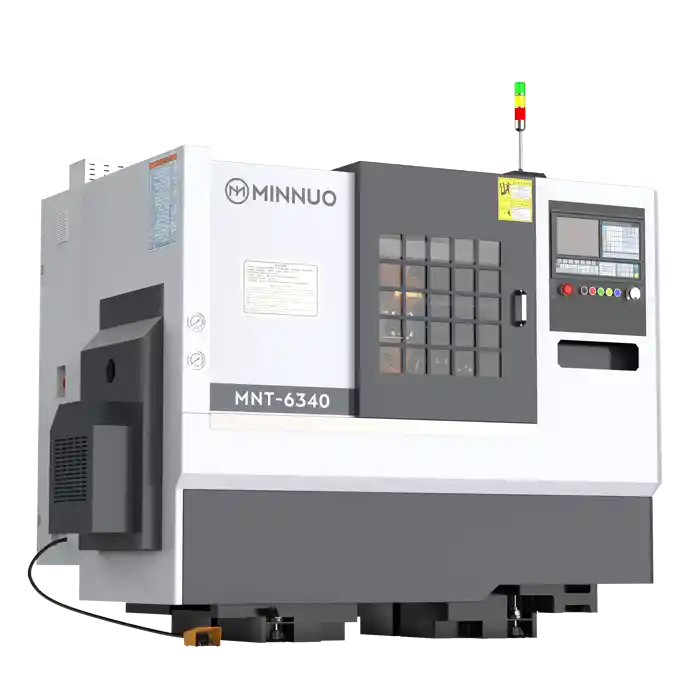
8 or 12 Stations? What Does the Wrong Turret Choice Cost?
Precision machine shops rarely lose output simply because a turret has four fewer stations. The loss usually begins when the buyer fails to evaluate the part family, holder width, longest tool, and changeover frequency in one verified tool-layout drawing. Three problems are especially common:
- The nominal station count fits, but the real tools do not. Wide grooving blocks, combination holders, live-tool units, and long boring bars may require an adjacent station to remain empty. Eight tools do not always occupy only eight usable positions.
- Reducing one setup creates inadequate clearance. A 12-station turret normally has a smaller angular pitch. If the turret diameter and work envelope do not increase accordingly, clearance around the chuck, tailstock, workpiece, and neighboring tools may shrink.
- The buyer compares only one catalog indexing time. Program-level time also depends on bidirectional shortest-path logic, the requested station sequence, whether axis motion can overlap, and when the control confirms turret clamping. One catalog value does not represent the complete part cycle.
The useful question is not whether a 12-station turret is more advanced. It is which turret holds the complete process tool set with adequate clearance while reducing non-cutting time and manual setup work.
8- vs 12-Station Turrets: Capacity, Clearance, Setup, and Accuracy
How Can 8 and 12 Stations Be Compared on the Same Platform?
A same-platform comparison is more meaningful than a cross-brand comparison. Mazak offers both 8- and 12-position drum turrets on the QTE 100, 200, and 300. Both use 25 x 25 mm tool shanks and non-lift rotary indexing. This shows that station count primarily changes tooling capacity; the number 8 or 12 alone does not establish whole-machine rigidity, accuracy, or indexing time.
| Decision factor | 8-station turret | 12-station turret | What the buyer should verify |
|---|---|---|---|
| Basic tooling capacity | Well suited to parts with fewer operations and a short recurring tool list | Accommodates more OD, ID, grooving, and threading tools | Use the actual tool list for representative parts, not the machine's marketing category |
| Angular pitch per station | 45 degrees | 30 degrees | Check neighboring-tool and chuck clearance carefully on the denser 12-station layout |
| Long boring-bar layout | Usually makes it easier to leave an adjacent station open | May require an empty neighboring station or a dedicated holder | Include the longest boring bar, widest holder, and largest part in the interference model |
| Changeover requirements | Different part families may require more manual tool replacement | More tools can remain preset, reducing changeover work | Compare changeovers per shift and tool re-touch time per changeover |
| Accuracy | Cannot be determined from station count | Cannot be determined from station count | Compare warm-machine indexing repeatability, test-cut results, and measurement uncertainty |
Source: Mazak QTE official product information. It confirms the 8/12-position choices, 25 x 25 mm tool shank, and non-lift indexing, but does not publish a controlled full-cycle comparison between the two turret options.
What Can Cross-Brand Turret Data Prove?
| Published configuration | Verified data | What it demonstrates | What it does not demonstrate |
|---|---|---|---|
| Mazak QT-PRIMOS 50/100/150 SG | 8-position drum turret; 0.2 s indexing; 20 x 20 or 25 x 25 mm OD tools; 20, 25, or 32 mm boring bars | A compact two-axis lathe can combine eight stations with fast indexing | It does not prove that every 8-station turret is faster than every 12-station turret |
| Haas ST-20Y-EU | 12-station BMT65 turret; 14.9 kW spindle rating; live tooling upgrade to 6,000 rpm | Twelve stations are commonly paired with Y-axis, C-axis, and live-tool capability | Maximum rpm alone does not establish continuous live-tool torque, power, or cutting capacity |
| EMAG HSC 1 | 12-station BMT-55 turret; live tools up to 5,000 min-1; cross drilling, keyway cutting, and thread milling | Integrated turning and milling normally require a larger resident tool set | The configuration cannot be directly generalized to a standard two-axis slant-bed lathe |
| Sauter 0.5.480.5xx | 8- and 12-station versions; about 0.38-0.52 s for a 30-degree step on the 12-station version and 0.45-0.62 s for a 45-degree step on the 8-station version, depending on permitted mass moment of inertia | More stations do not automatically mean a slower single indexing step | Single-step data cannot replace a test using the real station sequence and complete machine signals |
Sources: Mazak QT-PRIMOS, Haas ST-20Y-EU, EMAG HSC 1, and Sauter product information. These machines have different beds, servos, controls, and turret sizes; their data show configuration ranges, not a controlled 8-versus-12 result.
Which Parts Fit an 8-Station or 12-Station Turret?
Favor 8 stations
Representative parts usually need four to six tools; work is mainly OD/ID turning, facing, grooving, drilling, and threading; long boring bars require adjacent clearance; the part mix is stable and changeovers are infrequent.
Favor 12 stations
Representative parts need seven or more tools; one part includes several bore sizes, grooves, or threads; Y/C axes and live tools are required; or several part-family tools should remain preset to reduce changeover time.
Station count is not enough
Tools are unusually wide, long, or heavy; a subspindle is required; the machine uses a tailstock or large chuck; live tools need substantial continuous torque; or part tolerances approach the process-capability limit of the machine.
Screening rule only: "Four to six tools favors eight stations; seven or more tools favors twelve" is useful for early budgeting, not final selection. Combination holders, required empty stations, probes, part catchers, and spare tools all change the real station requirement.
How Should an 8- or 12-Station Turret Be Accepted?
No factory video, ballbar report, or raw turret-indexing record was supplied for this article. It therefore does not claim an independent machine test. The buyer should require evidence that identifies the machine serial number, date, environmental conditions, measurement equipment, and raw readings, then repeat the following checks during acceptance.
1. How Should Tool Layout and Interference Be Verified?
- Build a 3D interference model using the final chuck, soft jaws, tailstock, holders, longest boring bar, and largest workpiece.
- Check cutting positions, indexing positions, approach paths, and chip flow. Rotation of an empty turret is not an adequate demonstration.
- For live tooling, record the number of driven stations, maximum speed, continuous power and torque, permitted load, and adjacent-station restrictions.
2. How Should Maximum-Travel Indexing Time Be Tested?
- For an 8-station turret, test the maximum angular move with T1 to T5 to T1. For a 12-station turret, use T1 to T7 to T1.
- Also run at least ten randomized station sequences covering adjacent, long-travel, and reverse-direction moves.
- Measure from issue of the tool-change command to confirmation of turret-in-position and clamped status. Record whether the control uses bidirectional shortest-path selection.
- Measure both from a cold start and after continuous operation. Do not treat a catalog single-step value as the program-level tool-change time.
3. How Should Repeatability and Thermal Stability Be Tested?
- Use a reference holder or test bar and measure radial and axial return at fixed points. Keep the X/Z-axis measurement condition unchanged during turret indexing.
- Repeat each critical station at least ten times and report the maximum value, range, instrument resolution, and ambient temperature.
- Record turret indexing separately from X/Z-axis positioning. Linear- and rotary-axis positioning accuracy may be evaluated with reference to ISO 13041-4:2004 and its referenced ISO 230 method.
- Do not apply a universal 5 µm limit to every lathe. Derive the contractual value from critical part tolerances, process-capability targets, the machine specification, and measurement uncertainty.
4. Which Turret Parameters Belong in the Purchase Contract?
| Item | Contract requirement | Why it matters |
|---|---|---|
| Turret interface | Turret type, holder interface, OD tool size, and boring-bar diameter | Determines whether existing tooling can be reused and establishes holder cost |
| Load | Maximum tool mass, total turret load, permitted mass moment of inertia, and unbalance moment | Overload affects indexing, clamping, and service life |
| Live tooling | Driven stations, maximum rpm, continuous/short-term kW and N·m, and duty cycle | Maximum rpm alone cannot predict drilling or milling performance |
| Indexing performance | Specified station sequence, timing boundary, cold/warm condition, and maximum accepted time | Ensures that supplier and buyer use the same test definition |
| Repeatability | Measurement point, direction, cycle count, temperature, instrument, and acceptance limit | Replaces the vague claim of "high precision" with a repeatable test |
12-Station Live-Turret Case: Turning and Cross Drilling a Differential Case
EMAG has published a differential-case production system consisting of linked machines and four operations, with an overall line cycle of approximately 95 seconds. The VL turning centers use a driven 12-position turret to drill cross holes. The case supports a limited but useful conclusion: when a component requires both turning and cross drilling, additional stations and live tooling can enable process integration.
The 95-second figure is the published cycle time for the complete production system, not an independent cycle time for one 12-station lathe. It must not be converted directly into guaranteed annual output for another plant. Real output also depends on shifts, OEE, changeovers, tool life, inspection, and material handling. Source: EMAG differential-case production system.
Conversely, consider a stable precision shaft that needs only five tools for OD turning, facing, grooving, drilling, and threading, while a long boring bar needs neighboring clearance. An 8-station turret may provide a simpler layout, more clearance, and a lower holder investment. Moving to 12 stations would not necessarily reduce cutting time.
Evidence boundary: The public EMAG material does not provide 12 months of OEE, energy, or yield data for this production line. This article therefore does not invent an efficiency or energy-saving percentage. A proprietary customer case should disclose the baseline period, calculation method, machine identification, and 12-month operating record.
8- vs 12-Station CNC Lathe Turret FAQ
Q: Does a high-precision part automatically require 12 stations?
A: No. If representative parts normally require four to six tools and at least one usable spare station remains after the actual holders are installed, an 8-station turret can be sufficient. Accuracy should be verified through indexing repeatability, thermal stability, and test cuts; it is not determined by station count.
Q: Does a higher station count mean a more precise turret?
A: No. Turret indexing repeatability, the clamping mechanism, holder interface, tool overhang, machine temperature, and X/Z-axis condition determine the tool-tip position. The main value of 12 stations is additional tooling capacity and less setup work.
Q: Is a 12-station turret mandatory for turn-mill work?
A: Not necessarily, but live-tool holders are often wider, and a part may also need OD, grooving, drilling, and milling tools. A 12-station turret usually makes the layout easier. Buyers must still check the number of driven stations, continuous power and torque, and adjacent-station restrictions.
Q: Is testing only adjacent stations sufficient?
A: Do not test only adjacent stations. Test at least T1 to T5 on an 8-station turret and T1 to T7 on a 12-station turret, then run randomized tool-number sequences. Use production-representative holders and record total command-to-clamp-confirmation time in both cold and thermally stable conditions.
Q: Can every machine be required to stay within 5 µm?
A: There is no universal value for every lathe. Set the contractual limit from the critical part tolerance, process-capability target, machine specification, and measurement uncertainty. The agreement must also define temperature, load, measurement point and direction, cycle count, and statistical method.
 Email
Email sales1: +86 15312799623