



CNC Lathe for Sale: Find High-Quality Industrial Turning Machines
If you are searching for a reliable CNC lathe for sale to upgrade your workshop, expand production capacity, or replace outdated manual turning equipment, this comprehensive guide is designed for you. Industrial CNC lathes are the backbone of modern precision metal manufacturing, widely used in automotive, aerospace, machinery parts, hardware processing, and custom precision component production worldwide. Choosing a high-quality industrial turning machine directly determines your production efficiency, product tolerance accuracy, and long-term operational profitability.
With countless types of CNC lathes available on the global market—including 2-axis entry-level models, multi-axis live tooling lathes, heavy-duty industrial turning centers, and compact benchtop machines—many buyers struggle to select the most cost-effective and suitable equipment. This article covers everything you need to know before purchasing a CNC lathe, including machine classification, core specifications, key selection factors, new vs used machine comparisons, price ranges, and professional purchasing tips, helping you find premium industrial turning machines that match your production needs.
What Is an Industrial CNC Lathe & Why It Matters for Modern Manufacturing
A CNC lathe (Computer Numerical Control lathe) is an automated precision machining machine that uses pre-programmed CNC systems to control spindle operation, tool movement, and workpiece processing. Unlike traditional manual lathes that rely entirely on operator experience, industrial CNC lathes deliver consistent machining accuracy, stable batch production quality, and ultra-high processing efficiency, making them indispensable core equipment for industrial turning processes.
Industrial turning machines specialize in processing rotary parts, including shafts, flanges, sleeves, bolts, and custom cylindrical components. They can complete a full range of processes such as outer circle turning, inner hole boring, thread cutting, grooving, and taper turning in one clamping operation. For manufacturing enterprises, investing in a high-quality CNC lathe for sale effectively reduces labor costs, lowers product defect rates, and shortens production cycles, greatly enhancing market competitiveness.
Modern industrial CNC lathes are constantly upgraded in terms of automation and intelligence. Equipped with automatic tool changers, bar feeders, chip conveyors, and intelligent control systems, they support unattended batch production, perfectly adapting to small-batch customized processing and large-scale standardized industrial production scenarios.
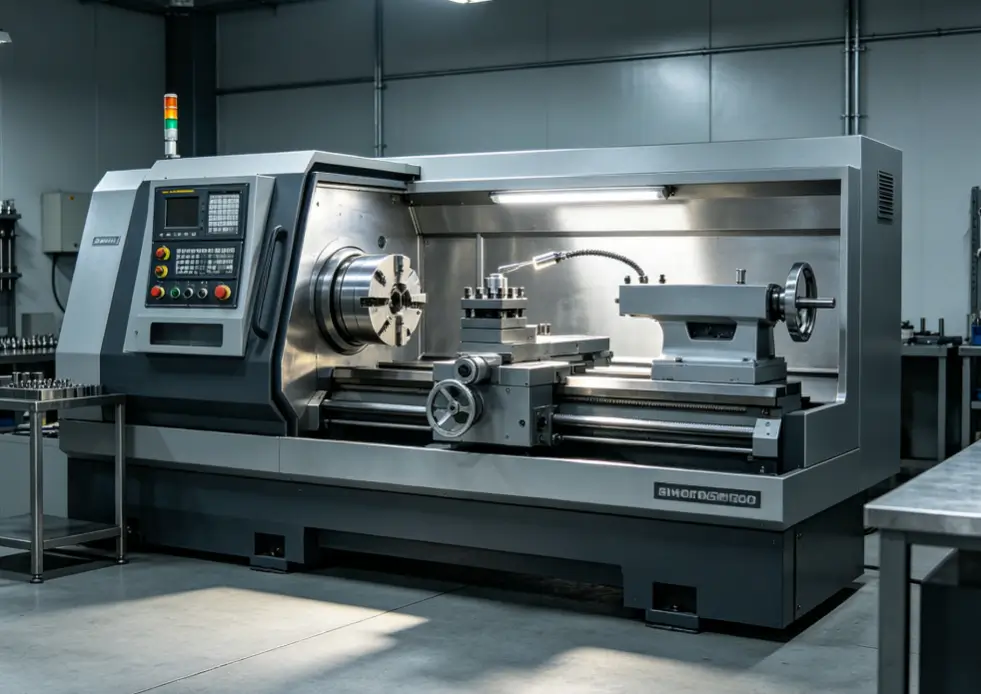
Common Types of Industrial CNC Lathes for Sale (Choose Based on Production Needs)
When browsing CNC lathe for sale listings, you will encounter various machine types with different structures, functions, and application scenarios. Understanding the classification of industrial turning machines is the first step to accurate selection. Below are the most mainstream industrial CNC lathe types on the market.
1. Horizontal CNC Lathe
Horizontal CNC lathes are the most widely used industrial turning machines, featuring a horizontal spindle layout and simple, stable structure. They are suitable for processing conventional small and medium-sized rotary parts, with excellent versatility and cost performance. Standard horizontal lathes are mainly divided into 2-axis CNC lathes and upgraded multi-axis models.
2-axis horizontal CNC lathes are the entry-level industrial models, completing basic X and Z axis movements to meet all conventional turning processes. They are ideal for small and medium-sized processing workshops, hardware factories, and machinery supporting enterprises, and are the most cost-effective choice for mass production of standard parts. Multi-axis horizontal lathes add auxiliary axes such as Y-axis and C-axis, supporting more complex forming processing.
2. Vertical CNC Lathe
Different from horizontal models, vertical CNC lathes adopt a vertical spindle design, mainly used for processing large, heavy, and thin-walled rotary parts that are difficult to fix on horizontal lathes, such as large flanges, wheel hubs, and mechanical bases. Vertical industrial turning machines have strong load-bearing capacity and stable clamping, effectively avoiding workpiece deformation during processing, and are widely used in heavy industry and large component manufacturing fields.
3. CNC Lathe with Live Tooling (Mill-Turn Lathe)
The CNC lathe with live tooling is a high-end multi-functional industrial turning machine, equipped with a power turret and live tooling accessories. On the basis of conventional turning functions, it adds milling, drilling, tapping, and side processing capabilities, realizing one-time clamping and complete processing of complex parts. This mill-turn integrated lathe eliminates the need for secondary clamping and repeated positioning, greatly improving processing accuracy and efficiency, and is very popular in the precision parts and aerospace component processing industries.
4. Heavy-Duty Industrial CNC Lathe
Heavy-duty CNC lathes are designed for large-size, high-hardness, and heavy-load processing scenarios. They adopt thickened bed structures, high-power spindles, and reinforced transmission systems, which can stably process high-hardness materials such as stainless steel, alloy steel, and die steel, as well as oversized workpieces. This type of industrial turning machine is mainly used in heavy machinery, engineering equipment, and petroleum machinery manufacturing fields, with ultra-high stability and durability.
5. Compact Benchtop & Small Industrial CNC Lathe
For small workshops, startup enterprises, and personalized customized processing scenarios, small and benchtop CNC lathes are the best choice. These machines occupy a small area, have low energy consumption, and are affordable, while maintaining industrial-level precision. They are suitable for small-batch precision parts processing, prototype production, and hobby industrial processing, filling the gap between household miniature lathes and large industrial equipment.
Core Specifications to Check When Buying a CNC Lathe for Sale
Many buyers only pay attention to the price when looking for a CNC lathe for sale, ignoring core parameter matching, which easily leads to equipment idleness or insufficient processing capacity in the later stage. To select a high-quality industrial turning machine that fits your production, you must focus on the following key specifications.
1. Swing Over Bed & Maximum Machining Length
Swing over bed refers to the maximum diameter of the workpiece that the lathe can process, and the maximum machining length determines the longest size of the workpiece. These two parameters directly define the processing range of the industrial lathe. Buyers need to confirm the maximum size of their conventional processing parts and reserve a certain margin to avoid equipment size limitations affecting production. Generally, the larger the swing over bed, the higher the equipment price, with approximately a 10% price increase for every 100mm increase in swing capacity.
2. Spindle Speed & Spindle Power
The spindle is the core power component of the CNC lathe. Spindle speed determines the processing fineness of small precision parts, while spindle power affects the cutting capacity of high-hardness and thick workpieces. High-speed spindles (up to 6000rpm or higher) are suitable for aluminum, copper, and other soft material precision processing; high-power spindles are more suitable for roughing and heavy cutting of steel and stainless steel materials. Industrial mass production scenarios prioritize high-power and high-stability spindle configurations.
3. CNC Control System
The control system is the brain of the industrial turning machine, directly affecting operation fluency, programming difficulty, and equipment stability. International mainstream systems include Fanuc, Siemens, and Haas, which have stable performance, complete functions, and global after-sales technical support, suitable for high-end industrial production. Domestic mainstream systems are cost-effective, easy to operate, and perfect for conventional industrial processing. Buyers can choose according to operator proficiency and production precision requirements, ensuring compatibility with mainstream CAD/CAM software to reduce programming barriers.
4. Precision Parameters
Industrial processing has strict requirements on tolerance accuracy. Key precision indicators of CNC lathes include positioning accuracy, repeat positioning accuracy, and spindle runout error. High-quality industrial turning machines can maintain repeat positioning accuracy within 0.002mm, fully meeting the precision requirements of automotive parts, medical components, and aerospace parts. For ordinary hardware processing, conventional precision models can meet production needs and control costs effectively.
5. Automation Configuration
Automation configurations determine production efficiency and labor costs. Standard industrial CNC lathes can be equipped with automatic tool changers, pneumatic/hydraulic chucks, bar feeders, part catchers, chip conveyors, and coolant circulation systems. For batch production, fully automated configurations can realize unattended operation, greatly improving production efficiency; for small-batch customized processing, basic semi-automatic configurations are more cost-effective.
New vs Used CNC Lathe for Sale: Pros & Cons for Industrial Buyers
When searching for industrial CNC lathe for sale, buyers often face a choice between new machines and refurbished/used machines. Both options have unique advantages and applicable scenarios, and the choice should be based on budget, production stability requirements, and service life planning.
Brand New Industrial CNC Lathe
Brand new CNC lathes feature zero wear, stable factory calibration precision, complete original accessories, and official warranty and after-sales service support. New machines have low failure rates in the later stage, long service life (up to 10–15 years of stable operation), and can adapt to long-term continuous industrial batch production. The only disadvantage is the higher upfront purchase cost. A new top-brand 2-axis industrial CNC lathe typically starts at $80,000, making it suitable for formal factories, long-term production layout, and high-precision processing enterprises.
Refurbished & Used CNC Lathe
The biggest advantage of used and refurbished industrial turning machines is their low price, which can save 30%–50% of the procurement cost compared with new machines. They are very suitable for startup workshops, temporary production orders, and low-budget equipment upgrades. However, used equipment has obvious drawbacks: partial component wear, possible precision attenuation, uncertain service life, and limited after-sales support. It is necessary to strictly inspect spindle accuracy, guide rail wear, and system operation status before purchasing refurbished lathes to avoid subsequent frequent failures affecting production.
2026 CNC Lathe Price Range for Industrial Turning Machines
The price of CNC lathes for sale varies greatly due to differences in model, configuration, precision, and automation. Below is the latest 2026 industrial CNC lathe price reference to help buyers quickly budget and avoid overpaying.
- Small Benchtop CNC Lathe: $10,000 – $25,000, suitable for small workshops, prototype processing, and light industrial production
- Standard 2-Axis Industrial CNC Lathe: $30,000 – $80,000, the mainstream model for medium and small processing factories, with high cost performance
- Live Tooling Mill-Turn CNC Lathe: $85,000 – $180,000, multi-functional high-precision model for complex parts processing
- Heavy-Duty Industrial CNC Lathe: $150,000 – $300,000+, suitable for heavy industry and large-size parts mass production
It is worth noting that the total cost of equipment procurement includes not only the machine body price but also auxiliary costs such as tooling fixtures, cutting tools, coolant systems, and installation and commissioning. The first-year tooling budget for industrial CNC lathes is usually $15,000 to $25,000, which buyers need to include in the total procurement cost assessment.
Key Factors to Verify Before Purchasing Industrial CNC Lathes
To ensure you purchase high-quality industrial turning machines and avoid low-quality equipment and procurement traps, you need to verify the following key points before confirming the order, especially for cross-border procurement and bulk purchases.
1. Factory Qualification & Certification
Formal industrial CNC lathe manufacturers must have complete production qualifications. Buyers can request CE certificates (for European market exports), ISO 9001 quality system certification, and official factory inspection reports to ensure that the equipment meets international industrial standards and has reliable quality.
2. Precision & Performance Test Report
High-quality suppliers will provide detailed factory test reports, including dimensional accuracy test data, axis backlash detection, spindle runout test, and continuous operation stability test data. Avoid purchasing equipment with untested precision, which may lead to unqualified processed parts.
3. After-Sales Service & Warranty Terms
Industrial CNC lathes are long-term production equipment, and after-sales support is crucial. Confirm the official warranty period, global after-sales service coverage, spare parts supply cycle, and free installation, commissioning, and operator training services. Reliable suppliers provide long-term technical support and quick spare parts supply to reduce equipment downtime losses.
4. Customization & Expansion Space
According to personalized production needs, confirm whether the equipment supports customized configurations, such as customized chuck specifications, increased automation accessories, and system language upgrades. In addition, reserve equipment expansion space to facilitate subsequent production capacity upgrades and functional expansion.
Why Choose Factory-Direct High-Quality CNC Lathes for Industrial Production
When searching for a CNC lathe for sale, choosing factory-direct industrial turning machines has obvious advantages over middleman channels. First, factory direct sales eliminate intermediate price differences, allowing buyers to obtain high-quality industrial equipment at more competitive prices. Second, formal factories strictly control production processes and precision calibration, with stable equipment quality and fewer defective products.
In addition, factory suppliers can provide one-stop services including equipment customization, installation and commissioning, technical training, after-sales maintenance, and spare parts supply. For industrial enterprises, this complete service system can effectively reduce equipment operation risks and later maintenance costs. All our industrial CNC lathes are strictly manufactured in accordance with international standards, with stable precision, durable performance, and full after-sales guarantee, suitable for all types of industrial turning production scenarios.
Final Buying Tips for Industrial CNC Lathe Purchasers
1. Match equipment parameters with processing needs first: Do not blindly pursue high configuration. Choose the most suitable spindle power, processing range, and precision standards according to your workpiece size, material hardness, and batch output to avoid resource waste.
2. Prioritize long-term total cost performance: On the premise of ensuring quality and stability, comprehensively evaluate equipment price, service life, maintenance cost, and energy consumption, not just the initial purchase price.
3. Focus on equipment stability and after-sales support: Industrial production requires continuous operation, and equipment stability and timely after-sales service are the core guarantees of production efficiency.
4. Reserve production upgrade space: Appropriately reserve processing range and functional expansion space according to future business development plans to avoid frequent equipment replacement.
Conclusion
A high-quality CNC lathe for sale is a core asset for industrial turning processing enterprises. Whether you are a small workshop looking for cost-effective entry-level equipment or a large factory needing heavy-duty, high-precision, multi-functional industrial turning machines, clarifying your production needs, mastering parameter selection skills, and choosing formal factory direct sales channels are the keys to successful procurement.
With stable performance, precise processing, and high automation, our industrial CNC lathes cover all mainstream models in the market, meeting the diversified production needs of global industrial users. If you are looking for reliable high-quality industrial turning machines, you can contact us for free parameter matching, latest quotations, and professional procurement solutions to help you improve production efficiency and create greater industrial value.
 Email
Email sales1: +86 15312799623