



CNC Milling Machine Buying Guide: Specs, Types & Cost
Investing in a CNC milling machine is a pivotal decision for manufacturers, whether you're a small shop expanding production or a large enterprise upgrading your machining lineup. The right CNC milling machine can boost efficiency, improve part precision, reduce operational costs, and unlock new production capabilities. However, with a wide range of models, specifications, and price points on the market, navigating the buying process can be overwhelming. This comprehensive guide breaks down everything you need to know about CNC milling machine specs, types, and costs, helping you make an informed purchase that aligns with your production needs, budget, and long-term business goals.
Why Choosing the Right CNC Milling Machine Matters
A CNC milling machine is more than just a tool—it's an investment in your production capacity. The wrong choice can lead to wasted resources, inefficient operations, and missed opportunities. For example, a small shop investing in a high-end 5-axis CNC milling machine for simple 2D parts will overspend and underutilize the equipment, while a manufacturer producing complex aerospace components with a basic 3-axis machine will struggle with precision and productivity. By understanding the key specs, types, and cost factors, you can avoid these pitfalls and select a machine that delivers maximum return on investment (ROI).
Additionally, the global CNC milling machine market is evolving rapidly, with advancements in automation, smart technology, and precision engineering reshaping the industry. Today's machines offer features like AI-driven adaptive machining, digital twin integration, and automated tool changers that were once considered luxury add-ons. This guide will help you navigate these advancements and determine which features are essential for your operations.
Key CNC Milling Machine Specs to Consider (Critical for Performance)
When evaluating CNC milling machines, specs are the foundation of your decision. They determine what the machine can do, how well it performs, and whether it can handle your specific workload. Below are the most critical specifications to prioritize, along with what they mean for your production.
Axis Configuration
The number of axes a CNC milling machine has directly impacts its ability to machine complex parts. Axes refer to the directions in which the spindle or workpiece can move, and each additional axis adds flexibility and precision. The most common axis configurations are:
- 3-Axis CNC Milling Machines: The most basic and widely used configuration, with X (horizontal), Y (vertical), and Z (depth) axes. Ideal for simple 2D and 3D parts, such as flat surfaces, slots, and holes. They are cost-effective, easy to operate, and suitable for low to medium complexity parts like automotive brackets, consumer electronics components, and simple molds.
- 4-Axis CNC Milling Machines: Adds a rotational A-axis (around the X-axis) or B-axis (around the Y-axis) to the 3-axis setup. This allows the workpiece to rotate, enabling machining of parts with features on multiple sides without repositioning. Common applications include gears, cams, and parts with angular features.
- 5-Axis CNC Milling Machines: The most advanced configuration, adding two rotational axes (typically A and C, or B and C) to the 3 linear axes. This allows the spindle to access any surface of the workpiece from any angle, eliminating the need for multiple setups and reducing errors. Perfect for complex parts like aerospace turbine blades, medical implants, and intricate molds. While more expensive, they significantly improve efficiency for high-precision, complex components.
When choosing an axis configuration, consider your part complexity. If you primarily machine simple parts, a 3-axis machine is sufficient. For multi-sided or complex geometries, a 4 or 5-axis machine is worth the investment.
Spindle Specifications
The spindle is the “heart” of a CNC milling machine, responsible for rotating the cutting tool. Its specifications directly affect cutting speed, power, and precision. Key spindle specs to evaluate include:
- Spindle Speed: Measured in revolutions per minute (RPM). Higher RPM is ideal for machining soft materials (e.g., aluminum, plastic), while lower RPM with higher torque is better for hard materials (e.g., steel, titanium). Typical spindle speeds range from 8,000 RPM for basic models to 20,000+ RPM for high-speed machines. For example, a machine with a 12,000 RPM spindle is suitable for most general-purpose machining, while a 15,000+ RPM spindle is better for high-speed cutting of aluminum parts.
- Spindle Power: Measured in horsepower (HP) or kilowatts (kW). Higher power allows the machine to handle heavier cuts, harder materials, and larger workpieces. Basic 3-axis machines typically have 5–10 HP, while industrial-grade machines can have 20+ HP. For example, a 7.5 kW (10 HP) spindle is sufficient for small to medium parts, while a 15 kW (20 HP) spindle is needed for heavy-duty machining of steel components.
- Spindle Taper: The taper connects the spindle to the tool holder, and its size determines the tool compatibility and rigidity. Common tapers include BT30, BT40, and BT50. BT40 is the most versatile, suitable for most general-purpose machining, while BT50 is used for heavy-duty applications. Ensure the spindle taper matches your existing tooling or your planned tooling investments.
Worktable Size and Capacity
The worktable is where the workpiece is mounted, so its size and capacity must match your typical part dimensions and weight. Key specs include:
- Worktable Dimensions: Measured by length (X-axis travel) and width (Y-axis travel). For example, a worktable with 1,000 mm × 500 mm dimensions can handle larger workpieces than a 600 mm × 400 mm table. Ensure the table size is large enough to accommodate your largest workpiece plus any fixtures.
- Maximum Workload: The maximum weight the worktable can support. Exceeding this limit can damage the machine and reduce precision. Basic machines can handle 500–1,000 lbs, while industrial machines can support 5,000+ lbs. For example, if you frequently machine heavy steel parts, a worktable with a 2,000+ lb capacity is essential.
- T-Slots: T-slots on the worktable are used to secure fixtures and workpieces. The number, size, and spacing of T-slots vary by machine—more T-slots offer greater flexibility for mounting different fixtures.
Precision and Accuracy
Precision is critical for manufacturing high-quality parts, especially in industries like aerospace, medical, and automotive. Key precision specs include:
- Positioning Accuracy: The maximum error when the machine moves the spindle to a target position. Measured in millimeters (mm) or inches (in). Typical positioning accuracy for basic machines is ±0.005 mm, while high-precision machines offer ±0.001 mm or better.
- Repeatability: The ability of the machine to return to the same position repeatedly. This is more important than positioning accuracy for consistent production. Repeatability specs typically range from ±0.002 mm to ±0.0005 mm.
- Backlash: The play between moving parts (e.g., screws and nuts). Minimal backlash ensures smooth movement and precise control. High-quality machines have backlash compensation features to reduce this play.
If you're machining parts with tight tolerances (e.g., medical implants, aerospace components), prioritize precision specs. For general-purpose machining, standard precision is sufficient.
Tool Changer System
An automatic tool changer (ATC) reduces setup time and improves efficiency by allowing the machine to switch tools automatically during machining. Key ATC specs include:
- Tool Capacity: The number of tools the ATC can hold. Basic machines have 10–20 tools, while industrial machines can hold 40+ tools. More tools mean fewer tool changes, which is ideal for complex parts that require multiple operations.
- Tool Change Time: The time it takes to switch from one tool to another. Faster tool change times (e.g., 1–2 seconds) improve productivity, especially for high-volume production. Common ATC types include carousel-style (slower, lower capacity) and swing-arm-style (faster, higher capacity).
If you're running high-volume or complex production, an ATC is a must. For small-batch or simple parts, a manual tool changer may be sufficient to save costs.
Control System
The control system is the “brain” of the CNC milling machine, responsible for interpreting G-code, controlling movement, and managing operations. Key factors to consider include:
- User Interface: A user-friendly interface makes programming and operation easier, reducing training time. Look for intuitive touchscreens, clear menus, and built-in help features.
- Compatibility: Ensure the control system is compatible with your CAM (Computer-Aided Manufacturing) software, as this will streamline programming. Popular control systems include Fanuc, Siemens, and Haas, which are widely supported by CAM software.
- Advanced Features: Modern control systems offer features like adaptive machining, tool life monitoring, and remote monitoring, which can improve efficiency and reduce downtime. These features are especially useful for industrial-grade machines.
For beginners, a simple, user-friendly control system is ideal. For experienced operators, advanced features can unlock greater productivity.
Common Types of CNC Milling Machines (Choose Based on Your Needs)
CNC milling machines come in several types, each designed for specific applications, part sizes, and production volumes. Understanding the differences between these types will help you select the right machine for your shop.
Vertical CNC Milling Machine (VMC)
Vertical CNC milling machines are the most common type, featuring a vertically oriented spindle that moves along the Z-axis, with the workpiece mounted on a horizontal worktable. They are versatile, compact, and suitable for a wide range of applications.
- Key Features: Compact footprint, open worktable for easy workpiece loading/unloading, lower cost compared to horizontal machines, and easy access for maintenance. Most VMCs are 3-axis or 4-axis, with 5-axis models available for complex parts.
- Ideal Applications: Small to medium-sized parts, flat or prismatic parts, molds, dies, and general-purpose machining. Common industries include automotive, consumer electronics, and small manufacturing shops.
- Pros: Versatile, cost-effective, easy to operate, and suitable for most general-purpose machining needs. They require less floor space, making them ideal for small shops.
- Cons: Limited access to multiple sides of the workpiece (requires multiple setups for complex parts), and less suitable for heavy-duty machining of large parts.
Horizontal CNC Milling Machine (HMC)
Horizontal CNC milling machines have a horizontally oriented spindle, with the workpiece mounted on a rotary table (A or B axis). This design allows for multi-sided machining and is ideal for high-volume, heavy-duty production.
- Key Features: Horizontal spindle, rotary worktable, larger tool capacity, and better chip evacuation (gravity helps move chips away from the workpiece). Most HMCs are 4-axis or 5-axis, with pallet changers for automated loading/unloading.
- Ideal Applications: Large, heavy parts, multi-sided parts, high-volume production, and heavy-duty machining. Common industries include aerospace, automotive (powertrain components), and heavy machinery.
- Pros: High productivity, better chip evacuation, ability to machine multiple sides in one setup, and suitable for heavy-duty cutting. Pallet changers enable unattended machining, reducing labor costs.
- Cons: Larger footprint, higher cost, and more complex operation and maintenance. They require more floor space and skilled operators.
Gantry CNC Milling Machine
Gantry CNC milling machines feature a gantry (a bridge-like structure) that spans the worktable, with the spindle mounted on the gantry. They are designed for large, heavy workpieces and high-precision machining.
- Key Features: Large worktable, high load capacity, and precise movement over large areas. Gantry machines can be vertical or horizontal, and are often 5-axis for complex large parts.
- Ideal Applications: Large parts, such as aerospace structures, mold bases, and heavy machinery components. Common industries include aerospace, automotive (large tooling), and heavy equipment manufacturing.
- Pros: Ability to handle very large and heavy workpieces, high precision over large areas, and versatile for complex large-scale machining.
- Cons: Very large footprint, high cost, and requires a dedicated space. They are not suitable for small shops or small parts.
Benchtop CNC Milling Machine
Benchtop CNC milling machines are small, compact machines designed for small parts, prototyping, and hobbyists. They are lightweight and can be placed on a workbench.
- Key Features: Small size, low cost, and easy to use. Most benchtop machines are 3-axis and have lower power and precision compared to industrial machines.
- Ideal Applications: Prototyping, small parts, hobby projects, and educational purposes. Suitable for small shops, startups, and schools.
- Pros: Affordable, compact, and easy to set up. Perfect for beginners or shops with limited space and small-scale production needs.
- Cons: Limited capacity, lower precision, and not suitable for heavy-duty or high-volume production. They cannot handle large or heavy workpieces.
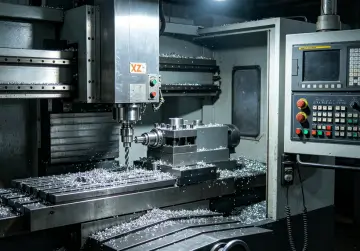
5-Axis CNC Milling Machine
As mentioned earlier, 5-axis CNC milling machines are the most advanced type, offering five axes of motion for complex part machining. They can be vertical, horizontal, or gantry-style.
- Key Features: 3 linear axes + 2 rotational axes, full 360° access to the workpiece, and high precision. They often include advanced features like adaptive machining and digital twin integration.
- Ideal Applications: Complex parts, such as aerospace turbine blades, medical implants, and intricate molds. Common industries include aerospace, medical, and high-precision manufacturing.
- Pros: Eliminates multiple setups, reduces errors, improves precision, and enables machining of complex geometries that are impossible with 3 or 4-axis machines.
- Cons: High cost, complex programming, and requires skilled operators. They are overkill for simple parts or small-scale production.
CNC Milling Machine Cost: What to Expect (2026 Guide)
CNC milling machine costs vary widely based on type, specs, brand, and features. Understanding the cost range and what factors drive prices will help you budget effectively and avoid overspending. Below is a breakdown of typical costs for different types of CNC milling machines, along with the key factors that influence price.
Cost Range by Machine Type
Prices are based on 2026 market data and include standard features (e.g., ATC for industrial machines, basic control system). Prices may vary by brand, location, and customizations.
- Benchtop CNC Milling Machine: $5,000–$20,000. These are entry-level machines for small parts, prototyping, and hobbyists. They have lower power, smaller worktables, and basic precision. Suitable for startups, hobbyists, and educational institutions.
- 3-Axis Vertical CNC Milling Machine (VMC): $20,000–$80,000. Mid-range machines for general-purpose machining. They include basic ATC (10–20 tools), 5–10 HP spindle, and standard precision. Suitable for small to medium shops machining simple to medium-complexity parts.
- 4-Axis Vertical CNC Milling Machine (VMC): $40,000–$120,000. Advanced VMCs with a rotational axis, larger ATC (20–40 tools), and higher power (10–15 HP). Suitable for shops machining multi-sided parts and medium-complexity components.
- 5-Axis Vertical CNC Milling Machine (VMC): $80,000–$250,000. High-precision machines with 5-axis motion, advanced control systems, and large ATC (40+ tools). Suitable for high-precision, complex parts like medical implants and aerospace components.
- Horizontal CNC Milling Machine (HMC): $100,000–$500,000+. Industrial-grade machines with large worktables, high power (15–30 HP), pallet changers, and advanced features. Suitable for high-volume, heavy-duty production of large parts.
- Gantry CNC Milling Machine: $200,000–$1,000,000+. Large, heavy-duty machines for very large workpieces. Prices vary based on size, precision, and features. Suitable for aerospace, heavy machinery, and large-scale mold manufacturing.
Key Factors That Influence Cost
Beyond the machine type, several factors can significantly impact the price. Understanding these factors will help you prioritize features and stay within budget:
- Brand: Reputable brands (e.g., Haas, Fanuc, Mazak, DMG MORI) charge a premium for quality, reliability, and after-sales support. Entry-level brands offer lower prices but may have lower quality and limited support.
- Precision and Accuracy: Higher precision machines (e.g., ±0.001 mm positioning accuracy) cost more than standard precision machines. Precision is critical for industries like medical and aerospace, but unnecessary for general-purpose machining.
- Automation Features: Add-ons like automatic pallet changers (APCs), robot loading/unloading, and tool life monitoring increase costs but improve efficiency.
- Customizations: Custom worktables, spindle upgrades, and specialized software can add 10–30% to the total cost. Only invest in customizations if they are essential for your specific applications.
- After-Sales Support: Machines with comprehensive after-sales support (e.g., on-site maintenance, training, spare parts) cost more but reduce long-term downtime and maintenance costs.
- Core Components: High-quality core components (e.g., imported spindles, precision guide rails, advanced control systems) increase costs but improve reliability and performance.
Total Cost of Ownership (TCO) vs. Upfront Cost
When budgeting for a CNC milling machine, it's important to consider the total cost of ownership (TCO), not just the upfront purchase price. TCO includes:
- Upfront Cost: The purchase price of the machine.
- Installation Costs: Delivery, setup, and calibration (typically 5–10% of the upfront cost).
- Maintenance Costs: Routine maintenance, spare parts, and repairs. Annual maintenance costs are typically 2–5% of the upfront cost.
- Operator Training: Training for your team to operate the machine (typically $1,000–$5,000 per operator).
- Tooling Costs: Cutting tools, tool holders, and fixtures. This is an ongoing cost, but initial tooling can cost $5,000–$20,000.
- Energy Costs: Industrial CNC machines consume significant energy, so factor in monthly electricity costs.
A cheaper machine may have a lower upfront cost but higher TCO due to frequent breakdowns, high maintenance costs, and lower efficiency. Investing in a high-quality machine from a reputable brand may have a higher upfront cost but lower TCO over time.
Tips for Buying a CNC Milling Machine (Avoid Common Mistakes)
To ensure you make the right purchase, follow these tips and avoid common pitfalls:
- Define Your Needs Clearly: Before shopping, outline your specific requirements: What parts will you machine? What is the maximum part size and weight? What is your production volume? What tolerances do you need? Answering these questions will help you narrow down your options and avoid overspending on features you don't need.
- Test the Machine Before Buying: Whenever possible, test the machine with your own parts or similar materials. This will give you a firsthand look at its performance, precision, and efficiency. Ask the supplier to demonstrate the machine's capabilities, including tool changes, programming, and error handling.
- Choose a Reputable Supplier: Select a supplier with a proven track record, good customer reviews, and comprehensive after-sales support. A reliable supplier will help you select the right machine, provide installation and training, and offer ongoing maintenance and support.
- Consider Used or Refurbished Machines: If you're on a tight budget, a used or refurbished CNC milling machine can be a cost-effective option. However, be sure to buy from a reputable supplier who thoroughly inspects and refurbishes the machine.
- Don't Sacrifice Quality for Price: While budget is important, sacrificing quality for a lower price can cost you more in the long run. A low-quality machine may have frequent breakdowns, poor precision, and short lifespan, leading to lost productivity and higher maintenance costs.
- Plan for Future Growth: Consider your future production needs when selecting a machine. If you plan to expand your product line or increase production volume, choose a machine that can grow with your business.
Final Thoughts: Choose Wisely for Long-Term Success
Buying a CNC milling machine is a significant investment, but with the right research and planning, it can transform your production capabilities and drive business growth. By focusing on the key specs, choosing the right type of machine, and understanding the cost factors, you can select a machine that meets your needs, fits your budget, and delivers maximum ROI.
Remember to prioritize your specific production requirements over flashy features, test the machine before buying, and choose a reputable supplier with strong after-sales support. With these steps, you'll be well on your way to selecting a CNC milling machine that helps your business thrive in today's competitive manufacturing landscape.
 Email
Email sales1: +86 15312799623