



Comprehensive List of Machine Tool Motors and Core Comparisons: A Must-Read Guide for Selection
In machine tool systems, the motor serves as the core power source, directly determining machining accuracy, efficiency, stability, and energy consumption. Different machine types (e.g., lathes, milling machines, machining centers, and grinders) have distinct requirements for motor performance, including power output, speed regulation, and response speed. The mainstream machine tool motors currently available on the market fall into four main categories: asynchronous motors, servo motors, stepper motors, and linear motors, each with unique advantages and limitations in structural design, operating principles, and application scenarios. This article provides a detailed analysis of the core characteristics of these motor types and offers practical guidance for machine tool selection and upgrades through comprehensive comparisons.
A Detailed Analysis of the Types of Core Motors for Machine Tools
The selection of machine tool motors must be closely aligned with 'processing requirements,' as different motors' power characteristics are suited to various processing scenarios. Below is a detailed introduction to four mainstream types of machine tool motors, covering their structure, working principles, core advantages, and limitations.
1. Asynchronous Motor: The "Power Foundation" of Traditional Machine Tools
Asynchronous motor, also called induction motor, is the most widely used traditional motor in the field of machine tools. It is mainly divided into three-phase asynchronous motor and single-phase asynchronous motor. Three-phase asynchronous motor is more suitable for the main drive system of medium and large machine tools because of its strong power.
Structurally, the asynchronous motor consists of core components such as the stator, rotor, and frame. When three-phase alternating current is applied to the stator, it generates a rotating magnetic field. The rotor induces current in this magnetic field, which in turn produces electromagnetic torque to drive the rotor's rotation. Its most notable feature is its simple and robust structure, with no commutator or brushes, resulting in extremely low maintenance costs.
Core advantages: ① Low cost with mature production technology, significantly lower procurement costs than servo and linear motors; ② High reliability, capable of withstanding harsh environments such as machine tool vibrations and dust, ensuring long service life; ③ Wide power range, with mass-produced models available from hundreds of watts to hundreds of kilowatts, compatible with various specifications of machine tool main drives.
The core deficiencies are: ① Poor speed regulation performance. When traditional asynchronous motors are used with variable frequency drive, the low-speed torque is insufficient to meet the uniform speed requirements for high-precision machining; ② High starting current, which can easily cause grid surges; ③ Low efficiency, especially under light-load conditions, where energy loss is significant.
Application scenarios: General-purpose machine tools such as lathes, milling machines, and drilling machines with low processing accuracy requirements, primarily used for the main drive system (e.g., driving spindle rotation and worktable feed).
2. Servo Motor: The "Core Soul" of High-Precision Machine Tools
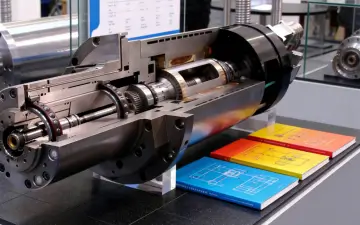
A servo motor is a precision-driven motor that responds accurately to control signals, categorized into DC and AC types. Currently, AC servo motors have become the preferred choice for high-precision machine tools due to their brushless design and wide speed range. The core feature is "closed-loop control," which uses an encoder to provide real-time feedback on the motor's speed and position, enabling precise motion control through continuous output adjustments.
Structurally, the AC servo motor consists of a stator, rotor, encoder, and driver. The stator generates a rotating magnetic field, while the rotor rotates through permanent magnets or electromagnetic induction. The encoder collects real-time rotor position data and transmits it to the driver. Based on the deviation between command signals and feedback signals, the driver adjusts the current to achieve precise speed control and positioning.
Core Advantages: ① Exceptional speed regulation precision with a wide range (0-3000rpm or higher), delivering stable torque at low speeds without "crawling" phenomena; ② Rapid response and outstanding dynamic performance, enabling swift adaptation to command signal changes—ideal for high-speed, high-frequency start-stop operations (e.g., rapid tool changes and high-speed feed in machining centers); ③ High control accuracy with positioning errors at the micrometer level, meeting precision machining requirements; ④ High efficiency, maintaining optimal energy utilization across various load conditions.
Key limitations: ① High cost: The servo motor and its components (drivers, encoders) cost 3-5 times more than asynchronous motors; ② High maintenance requirements: Precision parts like encoders are vulnerable to vibration and oil contamination, requiring regular inspection and calibration; ③ Stringent power quality and environmental conditions: Not suitable for dusty or highly humid environments.
Application scenarios: CNC machine tools with high precision and response speed requirements, such as machining centers, CNC lathes, precision grinders, and gantry milling machines. Primarily used in feed systems and spindle drives (for high-end machine tools).
3. Stepper Motor: The "Precision Choice" for Economical CNC
Stepper motor is a kind of motor that converts the electric pulse signal into angular displacement or linear displacement. The rotation angle is proportional to the number of pulse signal, and the speed is proportional to the pulse frequency. It can realize open-loop control without encoder, and has simple structure and convenient control.
Structurally, a stepper motor consists of a stator winding and a rotor (either permanent magnet or reluctance type). By sequentially energizing the stator winding, a rotating magnetic field is generated to drive the rotor in stepwise rotation. Based on structural differences, stepper motors can be classified into reactive stepper motors, permanent magnet stepper motors, and hybrid stepper motors. Among these, hybrid stepper motors combine the high precision of reactive motors with the high torque of permanent magnet motors, making them the most widely used type.
Core Advantages: ① Simple control without complex feedback systems, achieving precise positioning through pulse signals with low-cost control systems; ② High positioning accuracy with step angles of 0.9°-1.8°, further refined for mid-to-low-end CNC machining needs; ③ Fast response time and zero cumulative error (open-loop control), ideal for intermittent and short-stroke feed motions.
Key limitations: ① Low-speed operation is prone to "step loss" and "resonance" phenomena, compromising machining stability; ② Torque decreases with increasing rotational speed, resulting in poor high-speed performance and unsuitability for high-speed machining scenarios; ③ Low efficiency with noticeable heat generation during prolonged operation; ④ Open-loop control without feedback, causing positioning deviations when load exceeds rated torque that cannot be corrected.
Application scenarios: This system is designed for economical CNC lathes, compact engraving machines, 3D printers, and CNC indexing heads—equipment requiring moderate precision, low load, and moderate speed. It is primarily used in feed systems.
4. Linear Motor: The Future Direction of High-speed Precision Machine Tools
Linear motors revolutionize the conventional rotary-motor "rotation-to-linear" conversion mechanism by directly converting electrical energy into linear motion, eliminating the need for transmission components like lead screws or gears. As direct-drive motors, they can be categorized into linear induction motors and linear permanent magnet synchronous motors. The latter, with its superior thrust and efficiency, is particularly well-suited for machine tool applications.
Structurally, linear motor consists of stator (primary) and mover (secondary). The stator is fixed on the machine bed, and the mover is connected to the worktable. When three-phase AC is applied to the stator, a traveling wave magnetic field is generated, driving the mover to move linearly. The linear encoder is used to realize high-precision closed-loop control.
Core Advantages: ① Exceptional motion precision eliminates backlash and friction errors in lead screw transmission, achieving nanometer-level positioning accuracy; ② Superior speed with maximum feed rates exceeding 100m/min, significantly outperforming traditional rotary motor + lead screw systems; ③ High acceleration and ultra-fast response, ideal for high-speed, high-frequency precision machining (e.g., mold manufacturing, aerospace component processing); ④ Compact design reduces transmission components, lowers maintenance costs, and enhances machine tool space utilization.
Key limitations: ① High cost: As the most expensive among four motor types, it requires costly linear encoders and drivers; ② High heat generation: Electromagnetic induction between stator and rotor during operation produces significant heat, necessitating efficient cooling systems; ③ Strict installation precision and machine tool rigidity requirements, otherwise affecting motion stability; ④ Susceptible to electromagnetic interference, requiring proper shielding measures.
Application scenarios: High-end precision machining centers, high-speed grinding machines, laser processing equipment, and semiconductor manufacturing systems—all of which demand exceptional speed and precision.
Comparison Table of Core Parameters of Motor for Machine Tools of Class 2 and 4
| Motor type | speed regulation accuracy | response speed | rating torque | procurement costs | maintenance cost | Applicable speed | Typical application |
| asynchronous motor | General (frequency conversion speed regulation ±1%) | relatively slow | Medium to large | Low (1-2 points) | low | Medium-low | Ordinary lathe, milling machine, drilling machine |
| servomotor | Highly accurate (±0.01%) | fast | centre | Medium to High (3-5 points) | centre | Medium to High | Processing center, precision grinding machine, CNC lathe |
| stepper motor | Medium (±0.1% after subdivision) | Faster | Small to Medium | Medium (2-3 points) | low | low | Economy CNC, small engraving machine |
| linear electric motor | Extremely high (nanoscale) | in seven-league boots | Medium to large | High (5-8 points) | Medium to High | Gao | high precision machining center, high speed laser machine tool |
Note: The procurement cost score is benchmarked against asynchronous motors (1 point). Higher scores indicate higher costs, for reference only.
Core Principles and Recommendations for Machine Tool Motor Selection
The essence of selection lies in "matching processing requirements", requiring comprehensive evaluation of four key factors: machining accuracy, speed, load capacity, and cost budget, to avoid both "over-selection" and "under-selection". The following are targeted recommendations:
Select motor type based on machining precision: For general rough machining (e.g., casting rough turning, steel plate drilling), asynchronous motors suffice; for precision machining (e.g., mold cavity machining, part finishing), servo motors are preferred; for ultra-precision machining (e.g., aerospace components, semiconductor parts), linear motors are required.
Selection based on speed and response requirements: For high-speed machining (e.g., high-speed milling, high-speed grinding), servo motors or linear motors should be selected; for applications requiring high low-speed stability (e.g., end face grinding), stepper motors should be avoided due to their susceptibility to resonance, and servo motors are preferred.
Model selection based on load capacity: For heavy-duty machine tools (e.g., large gantry milling machines, heavy-duty lathes), the main drive system can utilize high-power asynchronous motors or linear motors. For light-load, short-stroke equipment (e.g., small engraving machines), stepper motors are recommended to reduce costs.
Selection based on cost budget: For economical production lines and small-scale processing plants, asynchronous motors with variable frequency drive (VFD) or stepper motors are preferred. For mid-to-high-end CNC equipment and enterprises pursuing processing efficiency and precision, servo motors can be adopted. In high-end equipment manufacturing and scientific research fields, linear motors are recommended.
Summary
The core motor system of machine tools comprises asynchronous motors, servo motors, stepper motors, and linear motors, each designed for specific applications: "general-purpose and economical," "precision and high-efficiency," "economical and accurate," and "ultra-high-speed and ultra-precision." When selecting motors, avoid the misconception that "the more advanced, the better" and instead evaluate them based on processing requirements, equipment specifications, and budget constraints. With advancements in CNC technology, servo motors have become cost-effective and are now the preferred choice for mid-to-high-end machine tools. As a core component of high-end equipment, linear motors are expected to see expanded applications as technology matures.
If you need motor selection plans for specific machine tools (e.g., vertical machining centers, CNC grinders) or want to compare motors from different brands, stay tuned for updates.
 Email
Email sales1: +86 15312799623