



Horizontal Machining Center Changeover Speed Up: Digital Twin Virtual Debugging + Quick-Change Functional Units
In multi-variety, small-batch production scenarios, the up to 2-hour changeover time for horizontal machining centers is a core pain point that reduces equipment capacity and causes order delivery delays. This article focuses on two core solutions: digital twin virtual debugging and quick-change functional units, detailing specific operation steps and selection and adaptation methods to help you reduce changeover time from 2 hours to within 25 minutes, simultaneously achieving a 40% increase in capacity.
Are you wondering: why do fixture changes, program trial cuts, and interference troubleshooting always take up so much time during changeovers? The root cause of slow changeovers isn't "low operational efficiency," but rather the risks of on-site debugging (trial cutting defects, interference and collisions) and the non-standardization of processes (reliance on experienced workers). Digital twins can resolve 80% of program and interference issues in a virtual environment beforehand, while quick-change functional units reduce on-site fixture and tool operations to just over ten minutes, achieving faster changeovers without relying on "overtime."
More importantly, the article not only includes a 3-step virtual debugging template compatible with FANUC/Siemens systems and a quick-change unit selection comparison table, but also a real-world case study of an auto parts factory that increased its monthly revenue by 180,000 yuan using this solution. A downloadable "Standardized Changeover Operation Manual" is also attached at the end. Continue reading, and you can directly apply these tools to transform changeover "downtime" into actual production capacity.
I. First, identify the 3 core pain points of slow changeover for multiple product types (with capacity loss data)
1. Cumbersome changeover operations: Fixture/tool/program adjustments account for over 80%
Problem manifestation: Fixture replacement requires disassembly and reassembly (30-40 minutes), tool pre-adjustment and tool compensation input (25-30 minutes), program debugging and interference checks (35-45 minutes);
Impact data: 3 changeovers per day → cumulative downtime of 6 hours, effective processing time less than 70%, monthly capacity loss exceeding 300 pieces (based on 20 minutes of processing per piece);
Typical scenario: An auto parts factory processes 10 types of gearbox parts (average 4 changeovers per day), with a total changeover time of 8 hours and equipment utilization of only 62%.
2. High Risks of On-Site Debugging: Trial Cut Scrap + Interference and Collisions
Common Problems: Unverified new programs lead to overcutting/undercutting (increasing scrap rate by 5%-8%), and fixture/tool interference (requiring 2-3 hours for repair);
Cost Losses: A single changeover trial cut scraps 2 workpieces (each worth 500 RMB) + downtime for repairs, resulting in direct losses exceeding 1500 RMB;
Industry Pain Point: 70% of SMEs rely on "on-site trial cutting and debugging," with unexpected failures accounting for up to 30% during changeovers.
3. Lack of standardized changeover procedures: Reliance on skilled workers leads to significant efficiency fluctuations.
Problems: Changeover procedures lack standardization (e.g., inconsistent clamping torque), parameter adjustments rely on experience (due to tool compensation input errors), resulting in a 40% efficiency difference between skilled and novice workers.
Production capacity fluctuations: Novices require 2.5 hours for changeover, while skilled workers require 1.8 hours, with daily production capacity fluctuating by ±15%.
Hidden costs: Companies need to pay additional subsidies to skilled workers (an extra 3000 RMB per month), and staff turnover further reduces changeover efficiency.
II. Core Solution 1: Digital Twin Virtual Debugging – Preemptively Solving 80% of Changeover Issues
1. Core Logic of Virtual Debugging
Essence: Building a 1:1 digital model of the physical machine tool, completing program verification, fixture assembly, and interference checks in a virtual environment, avoiding on-site trial cutting and malfunctions;
Core Advantages: Virtual debugging time is 1/5 of on-site time, and parallel operation is possible (simultaneous debugging of the next part while the machine tool is processing).
2. 3-Step Implementation of Virtual Debugging (Compatible with FANUC/Siemens Systems)
Step 1: Building a Digital Twin Model
Tools: Siemens NX, Dassault Systèmes CATIA, or domestic CAXA digital twin software;
Operation: Import machine tool parameters (spindle speed, travel range, tool magazine layout), fixture 3D model, and workpiece drawings;
Calibrate model accuracy (error with physical machine tool ≤ 0.005mm), and bind CNC system logic (such as FANUC 0i-MF instruction set).
Step 2: Virtual Changeover Debugging
Debugging Content:
* Program Verification: Import the new part machining program, simulate the cutting trajectory, and automatically detect overcut/undercut (accuracy ±0.003mm);
* Interference Check: Simulate fixture installation and tool change processes to eliminate the risk of collisions between the fixture and the machine tool column, and between the tool and the workpiece;
* Parameter Optimization: Adjust cutting parameters (feed rate, cutting speed) to ensure a smooth changeover process in the virtual environment (no jamming, no errors).
Step 3: Data Synchronization to Physical Machine Tool
Operation: Synchronize the virtual debugged program, tool compensation parameters, and fixture positioning data to the physical machine tool via Profinet/EtherCAT protocol;
On-site, only "data confirmation + quick verification" (5 minutes) is required, without reprogramming or trial cutting.
3.Virtual Debugging Effect Comparison
| Debugging Phase | On-site debugging (traditional method) | Digital Twin Virtual Commissioning | Time saved |
| Program Verification + Interference Check | 40 minutes | 8 minutes | 32 minutes |
| Parameter Adjustment + Test Cutting | 30 minutes | 0 minutes (Virtual Optimized) | 30 minutes |
| Total | 70 minutes | 8 minutes | 62 minutes |
III. Core Solution 2: Quick-Change Functional Unit – On-site Operation Reduced to 17 Minutes
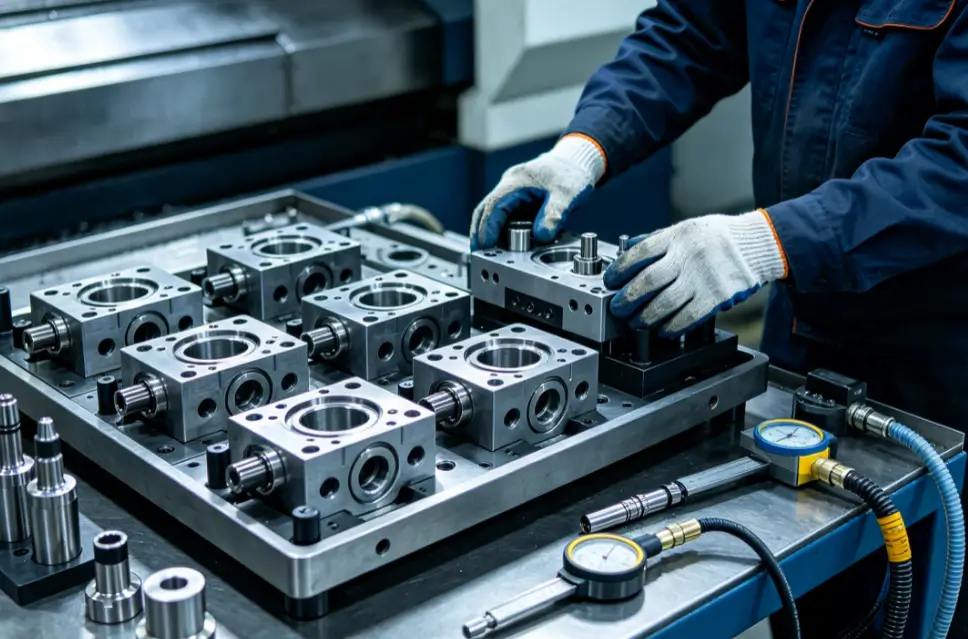
1. Quick Fixture Change: Zero-Point Positioning System + Modular Fixture
Selection Criteria:
Zero-Point Positioning System: Repeat positioning accuracy ≤ 0.002mm, clamping force ≥ 10kN (suitable for small and medium-sized parts);
Modular Fixture: Universal base designed according to part series (e.g., φ50-φ200mm parts share a common base), replacement takes only 1-2 minutes;
Operation Steps:
Pre-assembly: Complete the positioning and fastening of the new part fixture outside the machine tool, and install the zero-point positioning pin;
On-site Replacement: Hoist the fixture to the worktable using a crane/manual hoist, the zero-point positioning system automatically locks (30 seconds), no need for re-alignment.
2. Quick Tool Change: Pre-adjustment + Tool Magazine Partition Management
Pre-tool Pre-adjustment: Measure the tool length/radius in advance using a tool pre-adjustment device (accuracy ±0.001mm), input tool compensation parameters, and save to a USB flash drive;
Load the pre-adjusted tools into the spare tool magazine (24 tool positions, pre-loading time 10 minutes) according to the machining requirements of the new part;
Tool Magazine Partition Management: The machine tool magazine is divided into "Common Area" and "Change Area". During changeover, only the tools in the "Change Area" need to be replaced (5 minutes), without adjusting the entire magazine;
The program is bound to the tool number, and the tool compensation parameters are called synchronously (no additional input time).
3. Quick Program Change: Establishing a Standardized Program Library
Operation: Store programs categorized by part series (e.g., gearbox housing series, gear series), including complete instructions such as machining flow, tool compensation call, and fixture positioning;
During changeover, the program can be "called back with one click" on the machine tool panel (30 seconds), with parameters after virtual debugging, without on-site modification.
4. Total time for quick changeover of functional units:
Jig change: 1-2 minutes;
Tool change: 5 minutes;
Program call + data verification: 5 minutes;
Total: 11-12 minutes (with 8 minutes for virtual debugging, total changeover time within 25 minutes).
IV. Case Study: An Auto Parts Factory Achieves 79% Speed Up Changeover and 42% Increase in Production Capacity
1. Original Problem
Equipment: 3 horizontal machining centers (FANUC 0i-MF system), processing 12 types of auto parts (average 4 changeovers per day);
Pain Points: Changeover relies on skilled workers, each changeover takes 2 hours (35 minutes for fixtures + 30 minutes for tools + 45 minutes for programming + 10 minutes for trial cutting), averaging 8 hours of downtime per day, with a monthly production capacity of 2800 pieces;
Losses: Lost orders due to slow changeovers, resulting in a monthly revenue loss of 120,000 yuan.
2. Optimized Solution
Digital Twin Virtual Debugging: A model is built using Siemens NX to pre-verify programs and interference, requiring only 5 minutes of on-site verification;
Quick Change Unit Deployment: A zero-point positioning system (0.0015mm repeatability) and modular fixtures are installed, along with a tool pre-setting station and program library;
Standardized Process: A "Changeover Operation Manual" is developed, allowing beginners to follow the steps without relying on experience.
3. Optimization Results
Changeover Time: Reduced from 2 hours/time to 22 minutes/time, a 79% speedup;
Production Capacity Increase: Average daily downtime decreased from 8 hours to 1.5 hours, with monthly production capacity increasing to 4,000 units (+42%);
Cost Reduction: Reduced reliance on skilled workers (1 skilled worker can manage 3 machines), saving 5,000 yuan in labor costs per month;
Order Revenue: Two new long-term orders, increasing monthly revenue by 180,000 yuan. Total investment (virtual debugging software + quick-change unit) was 150,000 yuan, with a payback period of 1.2 months.
V. Common Misconceptions and Avoidance Guidelines for Speeding Up Changeovers
1. Misconception 1: Focusing solely on quick-change units while neglecting virtual debugging
Problem: Installing only quick-change fixtures/tools, but without program verification, still requires on-site trial cutting and debugging (consuming 30 minutes), preventing the total changeover time from being reduced to within 30 minutes;
Avoidance: Virtual debugging + quick-change units must be used together. Virtual debugging solves the "preliminary verification," while quick-change units solve the "on-site operation." Both are indispensable.
2. Misconception 2: Selecting quick-change units "only considering speed, not accuracy"
Problem: Selecting a low-cost zero-point positioning system (0.01mm repeatability) leads to excessive part accuracy after changeover (increasing scrap rate by 6%);
Avoidance: Prioritize accuracy (≤0.003mm) for quick-change units, then pursue speed, avoiding "speeding up without improving quality."
3. Misconception 3: Inconsistent Virtual Model and Physical Machine Tool Parameters
Problem: The digital model has not updated the actual machine tool parameters (such as spindle speed and travel range), resulting in successful virtual debugging but interference still occurring on-site.
Avoidance: Calibrate the digital model monthly, synchronizing it with the latest machine tool parameters (such as tool wear compensation and fixture positioning deviation) to ensure consistency between the virtual and physical models.
4. Misconception 4: Lack of Standardized Procedures, Changeover Efficiency Depends on Personnel
Problem: Without an operation manual, novice operators still require 2 hours for changeovers, and efficiency drops significantly after experienced workers leave.
Avoidance: Compile virtual debugging steps, quick changeover operations, parameter calls, etc., into a "Standardized Changeover Manual," and provide training to all employees to ensure stable efficiency.
FAQ: Common Issues Regarding Speeding Up Changeovers for Multiple Product Varieties
Q: Are digital twin virtual debugging costs high for SMEs with limited budgets?
A: Not high! Entry-level software (such as the domestic CAXA, annual fee 10,000-20,000 RMB) can be selected, or a third party can be commissioned to build the initial model (one-time cost 30,000-50,000 RMB); quick-change units can be implemented in stages (first install the zero-point positioning system, then add the tool pre-adjustment station), with a single-stage investment of less than 50,000 RMB and a payback period of ≤1.5 months.
Q: Will the machining accuracy be affected after the changeover time is shortened?
A: No! The digital twin has already verified the program and interference. The repeatability accuracy of the quick-change unit (zero-point positioning + pre-adjustment tool) is ≤0.003mm, which is more stable than traditional changeovers (manual alignment accuracy 0.01mm), and the scrap rate is actually reduced by 3%-5%.
Q: Is this optimization worthwhile if there are 1-2 changeovers per day?
A: Yes! Even with only one changeover per day, the traditional changeover time of 2 hours is reduced to 25 minutes after optimization, saving an average of 1.6 hours per day. This translates to an additional 240 pieces processed per month (based on 20 minutes per piece). At a profit of 50 yuan per piece, this results in an additional 12,000 yuan in monthly revenue, with a payback period of ≤2 months.
Q: Can older machine tools (over 5 years old) be adapted to digital twins and quick-change units?
A: Yes! Older machine tools only require the addition of a communication module (supporting the Profinet protocol, costing less than 5000 yuan) to synchronize virtual data; quick-change units (zero-point positioning, pre-adjusted tools) require no modification to the machine tool structure and are directly compatible.
Conclusion
The key to cutting multi-product changeover time is virtual pre-debugging plus fast on-site switching. Combining digital twin simulation and quick-change modules slashes setup time from 2 hours to under 25 minutes and boosts capacity by 40%.
MINNUO horizontal machining centers feature built-in digital twin communication interfaces, zero-point positioning-compatible worktables and partitioned tool magazines, making this optimization 30% easier to deploy than standard machines. We supply free debugging templates, selection charts and custom operation manuals exclusive to our equipment to cut implementation costs.
Our technical team provides free changeover diagnosis. We can fully roll out this solution within one month, helping your whole workshop achieve ≤30-minute changeovers and over 85% equipment utilization in three months. Partner with MINNUO to turn setup downtime into extra production output and revenue.
 Email
Email sales1: +86 15312799623