



How to Choose the Right Gantry Machining Center for Large Mold Machining? – A Complete Selection Guide
In the manufacturing industry, large mold machining demands high precision, efficiency, and stability. As the core equipment for processing large-scale, complex mold parts, the gantry machining center directly determines the mold’s quality, production cycle, and overall production cost. However, with numerous models, configurations, and technical parameters available in the market, selecting the most suitable gantry machining center for your specific large mold machining needs can be challenging. This comprehensive guide will break down the key factors, technical points, and practical steps to help you make an informed decision.
1. Clarify Your Large Mold Machining Requirements
Before starting the selection process, it’s critical to define your specific machining needs. This lays the foundation for narrowing down options and avoiding over-investment or inadequate performance.
1.1 Mold Size and Weight
- Workpiece Dimensions: Measure the maximum length, width, height, and weight of the large molds you plan to process. For example, if your molds are 5m (length) × 3m (width) × 1.5m (height) and weigh 10 tons, you’ll need a gantry machining center with a worktable size of at least 6m × 4m and a load-bearing capacity exceeding 10 tons. Ensure the machine’s X/Y/Z axis travel (stroke) fully covers the mold’s processing range—avoid choosing a machine with excessive travel (which increases cost) or insufficient travel (which limits application).
- Worktable Type: For heavy molds, prioritize a rigid, stable worktable (e.g., cast iron or granite base) with T-slots for secure clamping. Some models offer a rotary worktable for multi-angle machining, ideal for complex mold cavities.
1.2 Machining Precision Requirements
Large molds (e.g., automotive body molds, injection molding molds for large containers) require strict precision to ensure assembly accuracy and product quality. Key precision indicators to consider:
- Positioning Accuracy: Typically required to be ≤ ±0.005mm/m; for high-precision molds (e.g., medical device molds), aim for ≤ ±0.003mm/m.
- Repeatability Accuracy: Should be ≤ ±0.003mm to ensure consistent machining quality across multiple workpieces.
- Spindle Runout: ≤ 0.002mm to avoid surface defects on mold cavities and cores.
1.3 Machining Materials and Processes
- Mold Materials: Common materials include hardened steel (HRC 50-60), pre-hardened steel (HRC 30-40), aluminum alloy, and copper. For hard materials, choose a gantry machining center with a high-power, high-torque spindle (e.g., 22kW+ power, 1000N·m+ torque) and a rigid structure to handle heavy cutting. For aluminum alloy molds, prioritize high-speed machining (spindle speed ≥ 15,000rpm) to improve efficiency and surface finish.
- Processing Processes: If your workflow includes milling, drilling, tapping, and engraving, select a machine with multi-functional capabilities (e.g., automatic tool change, coolant systems, and chip removal devices). For deep-cavity mold machining, ensure the Z-axis stroke is sufficient and the spindle has good heat dissipation to prevent thermal deformation.
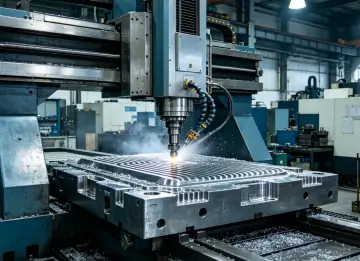
2. Key Technical Parameters to Evaluate Gantry Machining Centers
Technical parameters directly reflect the machine’s performance. Focus on the following core indicators when comparing models:
2.1 Spindle Performance
The spindle is the "heart" of the gantry machining center, influencing machining efficiency, precision, and tool life.
- Spindle Speed: Low-speed (3000-8000rpm) for heavy cutting of hardened steel; high-speed (12000-24000rpm) for high-efficiency machining of aluminum alloys. Variable-speed spindles offer versatility for mixed-material processing.
- Power and Torque: Higher power (≥ 18.5kW) and torque (≥ 800N·m) are essential for cutting thick, hard mold materials.
- Spindle Type: Belt-driven spindles are cost-effective and suitable for general-purpose machining; direct-drive (DD) or built-in motor spindles offer higher precision and speed, ideal for high-end mold production.
2.2 Axis Configuration and Travel
- Axis Travel: X-axis (crossbeam direction) ≥ mold length + 500mm; Y-axis (gantry movement direction) ≥ mold width + 300mm; Z-axis (spindle vertical movement) ≥ mold height + 200mm. Ensure sufficient travel to avoid collisions and cover all machining areas.
- Axis Drive System: Servo motors and ball screws are standard. For high-precision requirements, choose machines with linear motors (faster speed, higher accuracy, and lower maintenance) or high-precision ball screws (preloaded to reduce backlash).
- Rapid Traverse Speed: X/Y axis ≥ 30m/min, Z axis ≥ 20m/min to shorten non-cutting time and improve efficiency.
2.3 Rigidity and Stability
Large mold machining involves heavy cutting forces, so the machine’s rigidity is critical to avoid vibration and deformation.
- Machine Structure: Look for a gantry frame made of high-quality cast iron (e.g., HT300) or welded steel with stress relief treatment to enhance stability. Some high-end models use a bridge-type or gantry-column integrated structure for better rigidity.
- Guideway Type: Linear roller guides offer high speed and rigidity, suitable for heavy-load machining; sliding guides are more cost-effective but have lower speed.
- Load-Bearing Capacity: The worktable’s load capacity should exceed the mold’s weight by 20-30% to ensure stable operation during machining.
2.4 Automatic Tool Change (ATC) System
For complex mold machining that requires multiple tools, an efficient ATC system reduces tool change time and improves productivity.
- Tool Magazine Capacity: 24-48 tools are sufficient for most large mold applications; choose 60+ tools if processing highly complex molds with multiple processes.
- Tool Change Time: Aim for ≤ 8 seconds (tool-to-tool) to minimize downtime.
- Tool Weight and Size Capacity: Ensure the ATC can handle the maximum tool weight (e.g., 15-20kg) and length (e.g., 300-400mm) used in your mold machining.
2.5 Control System
The control system is the "brain" of the machine, affecting operation ease, programming efficiency, and precision.
- Mainstream Brands: Fanuc (e.g., 0i-MF Plus), Siemens (e.g., Sinumerik 840D sl), and Mitsubishi (e.g., M800V) are reliable choices for large mold machining. They offer powerful programming functions, high-speed processing, and stable performance.
- Key Features: Look for functions like 5-axis interpolation (for complex curved surfaces), tool length/radial compensation, and real-time error correction. User-friendly interfaces and compatibility with CAD/CAM software (e.g., Mastercam, UG) are also important for streamlining workflow.
3. Practical Selection Steps for Gantry Machining Centers
Step 1: Define Budget and ROI Expectations
Set a clear budget range (e.g.,100,000−500,000) and calculate the expected return on investment (ROI). Consider not only the initial purchase cost but also long-term expenses (e.g., maintenance, energy consumption, tool replacement). For high-volume, high-precision mold production, investing in a mid-to-high-end machine (e.g., with linear motors, high-speed spindle) may yield higher ROI by reducing cycle time and rework rates.
Step 2: Research and Shortlist Suppliers
- Reputable Manufacturers: Focus on well-known brands with experience in large mold machining, such as Haas, Mazak, Doosan, Hyundai Wia, and domestic leading brands like GF Machining Solutions, Chiron, and Dalian Machine Tool.
- Customer Reviews and Case Studies: Check customer feedback and case studies related to large mold machining. For example, if a manufacturer has successfully supplied machines to automotive mold factories, their products are more likely to meet your needs.
- Local Support and After-Sales Service: Ensure the supplier has a local service team to provide timely maintenance, spare parts replacement, and technical training. This is crucial for minimizing downtime in large-scale production.
Step 3: Request Quotes and Technical Specifications
Contact shortlisted suppliers to request detailed quotes and technical brochures. Provide them with your mold machining requirements (size, material, precision, processes) to get customized recommendations. Compare quotes based on the same technical standards to avoid "apples-to-oranges" comparisons.
Step 4: Visit Factories and Test Machining
If possible, visit the supplier’s factory to inspect the production process and quality control. Request a test machining with a sample mold (or similar workpiece) to verify the machine’s precision, speed, and stability. Check the surface finish of the test piece, measure dimensional accuracy with a coordinate measuring machine (CMM), and evaluate the machine’s operation noise and vibration.
Step 5: Negotiate Terms and Sign Contracts
Once you’ve selected the most suitable model, negotiate terms such as delivery time, installation, training, warranty period (preferably 1-2 years), and after-sales service. Ensure all agreements are clearly stated in the contract to avoid disputes.
4. Common Mistakes to Avoid in Selection
- Overlooking Mold Weight and Worktable Load: Choosing a machine with insufficient load-bearing capacity can lead to worktable deformation and reduced precision.
- Prioritizing Price Over Performance: A low-cost machine may have poor rigidity, low precision, or unreliable components, resulting in frequent breakdowns and higher long-term costs.
- Ignoring After-Sales Service: Poor after-sales support can cause prolonged downtime, affecting production schedules.
- Underestimating Spindle Power and Torque: Insufficient power/torque will reduce cutting efficiency and tool life, especially when machining hard materials.
- Neglecting Compatibility with CAD/CAM Software: Incompatible software can lead to programming errors and inefficient workflow.
Conclusion
Selecting the right gantry machining center for large mold machining requires a systematic approach—clarifying requirements, evaluating technical parameters, following practical steps, and avoiding common mistakes. By focusing on mold size, precision, material, and process needs, and comparing key indicators like spindle performance, rigidity, and control system, you can choose a machine that balances efficiency, precision, and cost-effectiveness.
Investing in a high-quality gantry machining center not only improves large mold machining capabilities but also enhances your competitiveness in the manufacturing industry. If you need further assistance with supplier recommendations, technical parameter analysis, or custom solutions, feel free to contact us for expert advice!
 Email
Email sales1: +86 15312799623