



How to Select an ATC for High-Mix, Low-Volume Machining: Capacity, Speed, and ROI
Whether an automatic tool changer is justified for fewer than five tool changes per day depends on what “tool change” means. Replacing a tool manually takes minutes, upgrading a standard ATC to a high-speed ATC saves seconds, and expanding the tool magazine mainly reduces setup-related loading, presetting, and offset verification. Buyers should evaluate usable capacity, chip-to-chip time, setup downtime, and unattended machining requirements.
Distinguish Manual Tool Changes, Standard ATCs, and Expanded Magazines
“Tool change” can describe three different investment decisions. Treating them as one calculation often produces the wrong purchasing conclusion.
| Decision | Comparison | Typical time saved | Primary metric |
|---|---|---|---|
| Add an ATC | Manual spindle change vs automatic change | Minutes per change | Daily changes, manual intervention and safety |
| Upgrade the ATC | Standard ATC vs high-speed ATC | Seconds per change | Changes per part, cycle time and chip-to-chip time |
| Expand the magazine | Manual magazine reloading vs more resident tools | Minutes per setup | Part-family tool count, daily changeovers and unattended hours |
If “fewer than five changes per day” means fewer than five programmed M06 cycles, upgrading only for a few seconds of additional ATC speed is unlikely to pay back.
If it means four or five production changeovers requiring tool loading, presetting and first-piece verification, a larger magazine can still be valuable. Four 20-minute changeovers create 80 minutes of daily machine stoppage.
When the current machine has no ATC, the comparison must use the full manual process: stop the spindle, remove the holder, clean the taper, install the next tool and confirm the tool number. That loss is measured in minutes, not seconds.
Which ATC Configuration Fits High-Mix, Low-Volume Production?
| Configuration | Suitable applications | Main advantage | Main limitation |
|---|---|---|---|
| Manual spindle changes | Prototypes, repair work, training and very low tool-change frequency | Low capital cost and simple mechanism | Requires an operator and prevents unattended cycles |
| Standard ATC with manual setup loading | Job shops where each part family fits within the available pockets | Automates program-level changes at moderate cost | Tools must still be reloaded during product changeovers |
| Expanded magazine with offline presetting | Mixed production, frequent rush orders and unattended machining | Keeps several part families and redundant tools resident | Higher purchase, footprint, maintenance and tool-inventory costs |
Why an Expanded Magazine Cannot Eliminate Setup Time by Itself
More pockets reduce how often tools must be removed and reloaded, but magazine capacity alone does not move all setup work offline. A complete system may also require:
- An offline tool presetter;
- Consistent tool and holder identification;
- Automatic offset transfer;
- Tool-life and redundant-tool management;
- NC program and tool-list verification.
This follows the SMED principle of separating operations that require a stopped machine from work that can be completed externally. The benefit comes from the combined process, not from pocket count alone.
How Many Tool Pockets Does a Machining Center Need?
How to Calculate Capacity by Part Family
Estimate the required nominal capacity with:
Cn=(Cc+Cs+Cb)×(1+r)
Where:
- Cn: required nominal magazine capacity;
- Cc: tools shared across the part family;
- Cs: dedicated tools required by the current production schedule;
- Cb: redundant tools for wear-prone or critical operations;
- r: capacity allowance, initially estimated at 10%–20%.
Suppose a mold-component family requires 14 common tools, 10 dedicated tools and three redundant tools. With a 15% allowance:
Cn=(14+10+3)×1.15=31.05
A 30-tool magazine would be marginal. A 40- or 50-tool configuration should be evaluated.
Why Nominal Capacity Is Not Usable Capacity
Usable capacity can be lower than the catalog number because:
- Large-diameter face mills may require empty adjacent pockets.
- Heavy tools may require slower ATC motion or designated positions.
- The magazine has both per-tool and total-load limits.
- Long tools can interfere with the arm, workpiece or fixture.
- Probes, angle heads and cleaning tools occupy pockets.
- Unattended production requires redundant tools for wear and breakage.
The purchase specification should state both nominal capacity and the usable capacity verified with the buyer’s actual tool mix.
Can ATC Speed Become a Machining Bottleneck?
Calculate the ATC Share of Cycle Time
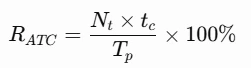
Where:
- Nt: automatic tool changes per part;
- tc: chip-to-chip time in seconds;
- Tp: total part cycle in seconds.
If a part requires 12 changes and chip-to-chip time falls from 2.4 to 1.4 seconds, the theoretical saving is:
12×(2.4−1.4)=12 seconds per part
For a 180-second cycle, the improvement is:
12/180×100%=6.7%
A high-speed ATC can therefore matter in short-cycle drilling and tapping operations with frequent changes.
If a 30-minute mold-milling cycle requires only two changes, the same one-second improvement saves two seconds, or approximately 0.11% of the cycle. Cutting strategy, chip evacuation, thermal stability and tool life are more important in that application.
Is an ATC Worth It for Fewer Than Five Changes per Day?
Assume a standard ATC has a 4.5-second chip-to-chip time and a high-speed unit requires 1.4 seconds. Five automatic changes per day save:
5×(4.5−1.4)=15.5 seconds per day
Upgrading only for those 15.5 seconds is unlikely to be economical.
The result changes when comparing manual spindle changes with an ATC. If a measured manual change takes three minutes and the ATC takes 4.5 seconds, five daily changes save:
5×(180−4.5)=877.5 seconds
That equals about 14.6 minutes per day or 60.9 hours over 250 production days.
The three-minute manual-change value is an example. Replace it with the median from at least 20 observed changes at the buyer’s facility.
How Do BT30 and BT40 ATC Specifications Compare?
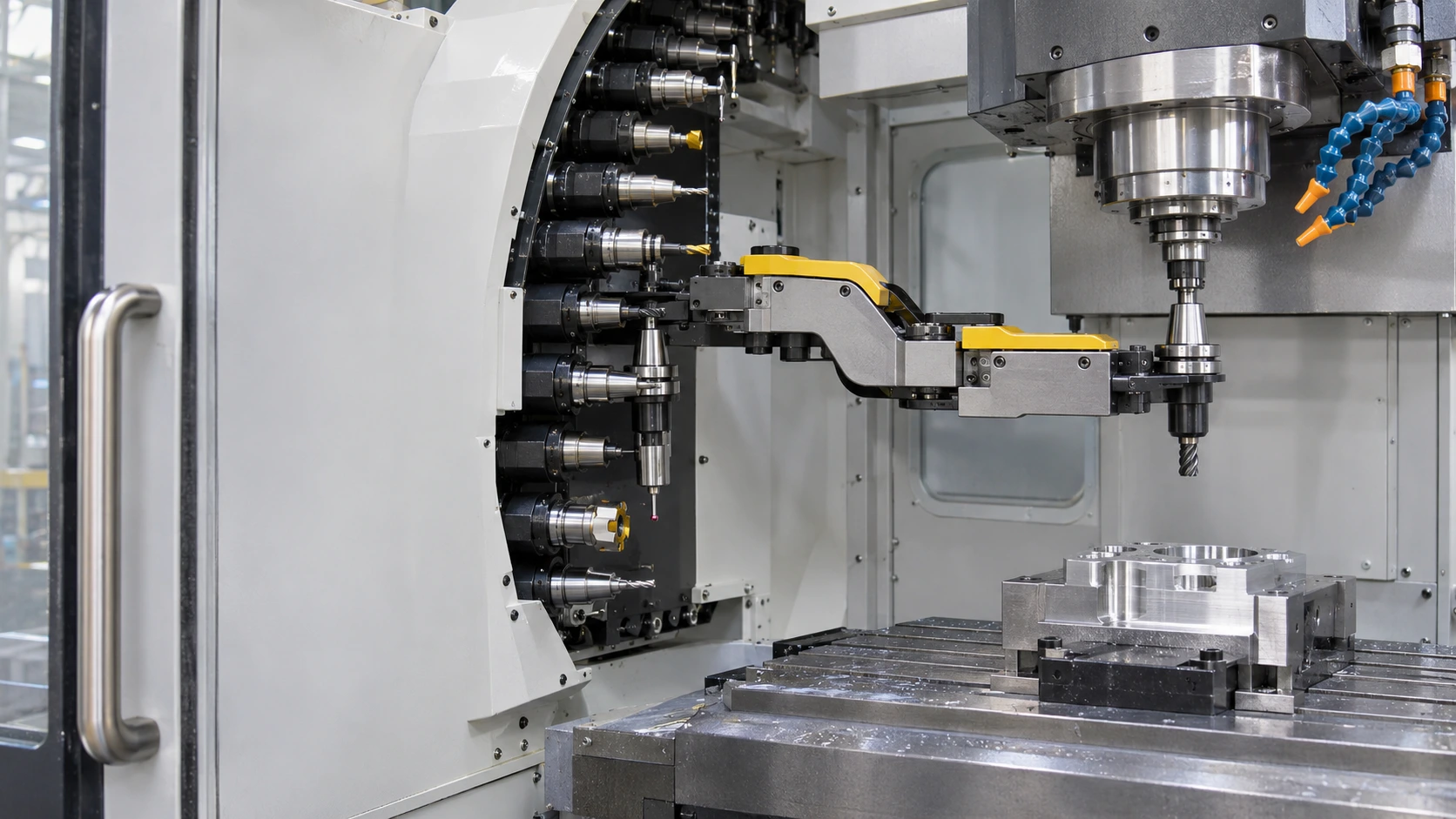
The following data illustrate the operating boundaries of selected BT30 and 40-taper machines. This is not a cross-brand ranking.
| Reference configuration | Taper and capacity | Spindle | Tool-to-tool / chip-to-chip | Tool limits | Air supply |
|---|---|---|---|---|---|
| Brother S700Xd2-100T | BT30; 100 tools | 12,000 rpm version: 7.0 kW continuous | Turret: 0.7 / 1.4 s | Turret diameter up to 110 mm; up to 4 kg per tool under specified conditions | Recommended 0.5 MPa; 40 L/min or 2.4 m³/h |
| Haas VF-2 | 40 taper; 20 tools | 8,100 rpm; 22.4 kW | 4.2 / 4.5 s | 89 mm diameter; 5.4 kg per tool | 113 L/min at 0.69 MPa; minimum 0.55 MPa |
| Haas VF-2SS | 40 taper; 30+1 tools | 12,000 rpm | 1.8 / 2.4 s | 64 mm at full capacity; 127 mm with adjacent pockets empty; 279 mm length; 5.4 kg | 113 L/min at 0.69 MPa; minimum 0.55 MPa |
Why 100 Tools Do Not All Change at 0.7 Seconds
The Brother 100-tool system consists of:
- A 28-tool high-speed turret;
- A 36-tool left storage unit;
- A 36-tool right storage unit.
The published 0.7-second tool-to-tool and 1.4-second chip-to-chip figures apply to changes within the turret. Transferring one tool from a storage unit to the turret takes approximately five seconds at the shortest position. Replacing all 28 turret tools takes approximately 140 seconds.
The Haas VF-2 and VF-2SS also differ in spindle speed, rapid traverse and tool-changer design. Their complete cycle-time difference cannot be attributed to the ATC alone.
BT50 machines, bridge mills and machines using angle heads require separate evaluation of tool mass, length, change distance and effective capacity. BT30 and BT40 data should not be extrapolated directly.
How Long Does an Expanded Tool Magazine Take to Pay Back?
Payback Formula

Where:
- T: simple payback in years;
- P: installed price premium over the standard magazine;
- tm: current loading, presetting and verification time in minutes;
- ta: downtime after adding the expanded magazine;
- N: production changeovers per day;
- D: annual production days;
- R: burdened machine cost per hour;
- Q: verified annual value from reduced errors, scrap and delivery losses;
- M: additional annual maintenance, spare-parts and financing cost.
High-Frequency Changeover Example
Assume:
- Installed magazine premium: CNY 80,000;
- Downtime reduction: 14 minutes per changeover;
- Changeovers: six per day;
- Production: 250 days per year;
- Burdened machine cost: CNY 350 per hour;
- Additional annual maintenance: CNY 8,000.

Low-Frequency Changeover Example
If the machine has only two daily changeovers and saves six minutes each time:

The CNY 80,000 premium is a calculation input, not a market-price claim. Use a written quotation that includes the magazine, installation, commissioning, freight, tax and initial spare parts.
When payback exceeds two years, evaluate net present value, residual value and demand variability instead of relying only on simple payback.
What Should Be Tested During ATC Acceptance?
| Test item | Recommended method | Required record |
|---|---|---|
| Tool-to-tool time | Run a standardized change cycle | Average, maximum and test-tool mass |
| Chip-to-chip time | Test from an agreed Z-axis position | Time, axis position and spindle condition |
| Change reliability | Run at least 100 consecutive changes | Successful cycles, alarms and recovery time |
| Usable capacity | Load the buyer’s largest and longest tools | Actual usable pockets |
| Heavy-tool capability | Load the proposed maximum tool mix | Per-tool mass, total load and reduced-speed conditions |
| Compressed air | Record pressure and flow during changes | MPa and L/min or m³/h |
| Tool-data error prevention | Simulate wrong numbers, expired tools and missing tools | Alarm, lockout and redundant-tool response |
| Positioning repeatability | Test to the agreed standard | mm or μm, temperature and test method |
Brother states that its tool-change figures are measured according to JIS B6336-9 and MAS011-1987. Standardized catalog results are useful for baseline comparison, but acceptance testing should use the buyer’s tool mass, Z-axis position and air-supply conditions.
For another BT30 reference, FANUC publishes the following values for the α-D21LiB5 ADV Plus: 21 tools, 1.3-second chip-to-chip time with a 2 kg tool, 4 kW continuous output at 10,000 rpm, 5.5 kW continuous output at 24,000 rpm, air consumption of 160 L/min at 0.35–0.55 MPa, and bidirectional positioning repeatability below 0.004 mm. These values apply only to the identified model. FANUC mechanical specifications
What Can a Real Case Study Prove About Large Tool Magazines?
Cast Technologies implemented a flexible manufacturing system comprising three horizontal machining centers, a 40-position pallet stocker, tool management, NC program management and production scheduling.
The published results include:
- A 25%–30% increase in spindle utilization;
- A 33% reduction in labor requirements;
- Four operators reassigned to higher-value work;
- More than 100 part types processed through the cell;
- Reduced setup, tool-changeover and work-in-process losses.
The case demonstrates how high tool capacity can support high-mix production when combined with pallet automation, scheduling and tool management.
It does not prove that a larger magazine alone produces a 25%–30% utilization increase. The source also does not disclose a standardized 12-month observation period. These results must therefore be presented as system-level outcomes, not as an isolated magazine test. Makino case study
A buyer can establish a controlled 12-month record:
- Month 1: Record baseline spindle utilization, loading time and tool-selection errors.
- Months 2–3: Complete tool identification, presetting and operator training.
- Months 4–6: Compare setup downtime and first-piece yield for the same part families.
- Months 7–12: Calculate unattended hours, maintenance cost, scrap and delivery performance.
Keep the part mix and calculation method consistent. Do not attribute gains from a new machine, increased demand or unrelated process improvements to the tool magazine.
ATC Selection FAQ
Q: Is an ATC a Waste of Money for Fewer Than Five Tool Changes per Day?
A: First determine whether this means fewer than five manual spindle changes or fewer than five programmed automatic changes. Replacing manual changes can save minutes and enable unattended operation. Upgrading an existing ATC only to save a few seconds is less likely to pay back.
Q: Do I Need a Larger Magazine for Fewer Than Five Production Changeovers per Day?
A: Frequency alone is insufficient. Observe at least 20 changeovers and record tool loading, presetting, offset entry and first-piece verification. Use the median downtime, installed magazine premium and burdened machine-hour cost in the payback formula.
Q: Is a 30-Tool Magazine Enough for High-Mix, Low-Volume Machining?
A: Add shared, dedicated and redundant tools, apply a 10%–20% planning allowance, and subtract pockets lost to oversized tools. If demand regularly approaches the effective limit, compare a 40- or 50-tool magazine.
Q: Should I Choose a 50-Tool or 100-Tool Magazine?
A: A 50-tool magazine often suits one primary part family or a small group of related parts. A 100-tool system is more appropriate for multiple resident families, redundant tools and unattended shifts. “Possible future use” alone is not sufficient justification.
Q: Does a Larger Magazine Reduce Tool-Change Speed or Reliability?
A: It depends on the architecture. A high-speed turret can remain fast, while transfers from peripheral storage, heavy-tool settings and more complex mechanisms may add time. Acceptance testing should cover the nearest and farthest pockets, maximum tool mass and storage-to-turret transfers.
 Email
 sales1: +86 15312799623