



Small Precision Parts Machining Center Selection Guide | High-Speed, High-Precision & Automation Tips
Small precision machining centers (small CNC milling machines) are core equipment for miniature, high-precision and complex component manufacturing, widely applied in precision hardware, medical devices, 3C electronics, scientific research and vocational training industries. Different from heavy-duty large machining centers, they deliver micron-level accuracy, high-speed cutting, compact footprint, low energy consumption and strong flexibility, perfectly matching multi-variety, small-batch refined processing demands.
However, the market features diverse models with huge configuration gaps. Many processing factories, labs and schools frequently face troubles including insufficient spindle speed, low tool change efficiency, unstable precision and poor automation compatibility. Based on the core demands of precision part production, this guide sorts out professional selection standards from four major dimensions: machine core features, high-speed spindle configuration, tool magazine setup and automatic loading/unloading schemes, helping buyers pick suitable equipment and avoid procurement pitfalls.
Core Characteristics of Small CNC Milling Machines: Unique Advantages for Precision Machining
Custom-built for tiny precision parts, small CNC milling machines possess three exclusive strengths that solve typical miniature processing pain points, serving as basic selection criteria.
1.1 High Precision & Long-Term Stability for Micron Machining
Premium small machining centers adopt one-piece cast iron beds, paired with precision ground ball screws and linear guides to suppress vibration during high-speed cutting. Their repeat positioning accuracy can reach ±0.01mm, and top-tier models support full micron-level precision control.
They are ideal for micro molds, medical fittings, electronic connectors and precision hardware, eliminating dimensional deviation, burrs and poor surface finish. Built-in intelligent anti-collision and constant temperature control systems guarantee stable precision for 24-hour non-stop production.
1.2 Compact, Energy-Saving & Flexible Layout
The floor space of a single unit is only around 1 square meter, requiring no large-scale workshop reconstruction. It can be flexibly deployed in factory expansion areas, university labs and research institutes.
Compared with large machining centers, they consume less electricity, feature simple structures and low failure rates, cutting operation and maintenance costs while reducing idle asset losses with excellent cost performance.
1.3 High Flexibility for Multi-Variety Small-Batch Production
Precision parts are usually tiny, complex, varied and produced in small lots. Small CNC milling machines support 3D curved surface machining, special-shaped forming, multi-hole drilling and micro grooving, compatible with steel, aluminum, copper, plastic, carbon fiber and other materials for fast process switching.
Suitable for mass factory production, lab sample prototyping and school practical training, they deliver far higher flexibility than traditional large machine tools.
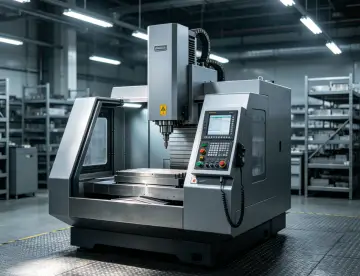
High-Speed Spindle Selection: Core Guarantee of Machining Precision
The spindle is the heart of small precision machining centers, directly deciding accuracy, surface finish and cutting efficiency, so it ranks first in selection priorities. Precision finishing and high-speed surface processing set strict requirements on spindle speed, rigidity and stability, with differentiated configurations for different scenarios.
2.1 Spindle Speed Matching Standards by Processing Type
Conventional precision machining (aluminum, plastic, standard hardware)
Spindle speed: 12,000–20,000rpm, power: 1.5–3KW
Fully meets routine slotting, drilling and milling, balancing efficiency and stability for mass production of standard precision parts.
Ultra-precision machining (micro molds, medical components, electronic precision parts)
Mandatory high-frequency high-speed spindle: 24,000–40,000rpm
Ultra-high speed reduces cutting lines, optimizes surface finish, prevents edge chipping and workpiece deformation, satisfying micron finishing standards.
2.2 Key Spindle Configuration Requirements
- Prioritize direct-drive high-speed spindles: No transmission gaps, less vibration, stable rotating speed, avoiding precision deviation caused by high-speed jitter (better than belt-driven spindles).
- Recommended taper: BT30 / BT40, compatible with most small thin-shank precision cutting tools.
- Must equip constant temperature cooling, automatic air blowing and tool detection functions to reduce thermal deformation and sustain consistent long-term precision.
- Scenario matching suggestion: Low-noise low-vibration spindles for labs; high-power wear-resistant spindles for factories with continuous mass production.
Tool Magazine Configuration Selection: Balance Efficiency & Process Compatibility
Tool magazines determine tool change speed and process adaptability, directly affecting processing cycle and automation level. The core selection rule is matching workpiece process complexity and production batch; over-spec large-capacity magazines are unnecessary to control costs.
3.1 Tool Magazine Solutions for Different Application Scenarios
Vocational training, lab prototyping & simple part processing
8–12 station hat-type tool magazine: Simple structure, low price and low failure rate, meeting basic drilling, milling and chamfering tool change demands for low-frequency sample processing.
Factory mass production & complex precision parts
20–32 station chain-type tool magazine: Fast tool change (0.5–3s standard cycle), supports continuous multi-process machining without manual tool replacement, greatly lifting batch production efficiency.
Optional 64-station large-capacity magazine for ultra-complex special-shaped parts to realize fully automatic processing.
3.2 Core Screening Criteria for Tool Magazines
Select magazines with high-speed precise tool change, anti-drop and anti-interference performance, supporting automatic tool diameter & weight detection to prevent collision damage to workpieces and spindles.
Ensure system compatibility with automatic tool setting, broken tool detection and tool life management, cutting manual intervention and scrap rates for micro precision components.
Automated Loading & Unloading Solution Selection: Match Different Production Capacities
With intelligent upgrading of precision processing industry, automatic loading/unloading systems become a key selection factor. They solve low manual efficiency, positioning deviation and high labor costs, applicable to factory unattended production and standardized lab training. Three mainstream solutions are sorted by production scale:
4.1 Entry-level Automation: Automatic Pallet Changer
Suitable for small-batch multi-variety processing, lab R&D sampling and university practical training.
Workpieces can be pre-installed on pallets for automatic switching during operation, eliminating full-time manual attendance and shortening standby time. Cost-effective and easy to refit, compatible with most entry-level small CNC milling machines.
4.2 Mid-tier Automation: AWC Automatic Workpiece Changer (Mainstream for Mass Production)
Customized for batch precision part manufacturing, the integrated AWC system realizes continuous automatic loading and unloading of multiple workpieces. Combined with intelligent control systems, it supports long-term unattended machining.
Compact structure requires no extra workshop space, matching the lightweight design of small machining centers, optimizing production cycles and stabilizing product consistency, the top choice for small & medium precision processing factories.
4.3 High-end Automation: Robotic Arm Linked Loading & Unloading (Smart Factory Scheme)
For large-scale standardized mass production. Small industrial robots cooperate with assembly lines to realize full automatic loading, processing, unloading and output. Compatible with CAD/CAM systems to adjust parameters adaptively, meeting high-precision and high-volume production demands of intelligent manufacturing enterprises.
Scenario-Based Targeted Selection Guide
5.1 Precision Processing Factories (Mass Production + Prototyping)
Recommended configuration: Small vertical machining center equipped with 20,000–40,000rpm direct-drive high-speed spindle, 20–32 station chain-type tool magazine and AWC automatic loading/unloading device. Balances precision, efficiency and automation, adapting to multi-type complex precision part mass production.
5.2 Scientific Research Laboratories (Sample R&D & Ultra-Precision Machining)
Recommended configuration: Micron-level high-precision machining unit with 24,000rpm+ low-noise high-speed spindle and 12-station stable hat-type tool magazine. Prioritize ultra-high precision, low failure rate and easy operation for precision sample development and special-shaped part trial production.
5.3 Educational Institutions (CNC Vocational Training)
Recommended configuration: Cost-effective small CNC milling machine with 12-station hat-type tool magazine and standard high-speed spindle. Simple structure, easy operation and low maintenance difficulty, fully meeting CNC teaching, practical demonstration and basic component processing training requirements.
Conclusion
The core selection logic for small precision part machining centers is: prioritize precision requirements, match actual application scenarios and upgrade automation reasonably.
Small CNC milling machines’ lightweight, high-precision and high-flexibility strengths fit mainstream miniature precision processing demands perfectly. Among core configurations:
- High-speed spindle determines the upper limit of machining precision;
- Tool magazine affects overall processing efficiency;
- Automatic loading/unloading system defines production capacity and intelligent level.
Factories, laboratories and schools should avoid blind over-spec configuration. Matching equipment parameters to processing materials, precision standards, production batches and site conditions can effectively control procurement and maintenance costs, boost equipment utilization, and achieve efficient, stable and cost-saving precision component manufacturing.
 Email
Email sales1: +86 15312799623