



Solving Large Workpiece Deformation Challenges: Thermal Compensation Technology and High-Precision Machining Practice for Heavy-Duty Lathes
In the field of heavy-duty mechanical machining, workpiece deformation remains a core pain point restricting production efficiency and machining accuracy. Particularly for large workpieces (such as machine tool beds, aerospace structural components, and heavy gear blanks), factors including large volume, complex structure, and differences in material rigidity make them prone to millimeter-level or even greater deformation during cutting processes. These deformations are caused by temperature changes, clamping stress, residual internal stress, and other influences, leading to increased product scrap rates, higher production costs, and even project delivery delays in severe cases. Data shows that machining errors caused by thermal deformation account for 40% to 70% of total errors in precision machining, and this proportion is more prominent in heavy-duty lathe machining. How to solve this problem through scientific technical means? As a core support for high-precision machining, thermal compensation technology provides a systematic solution for controlling large workpiece deformation.
I. Analysis of Core Causes of Large Workpiece Deformation
Large workpiece deformation is not caused by a single factor but by the superposition of multiple links and factors. Accurately identifying the causes is the premise for implementing effective control:
Thermal Deformation as the Dominant Error Source
Cutting heat generated during the cutting process, frictional heat from machine components (spindles, ball screws, ram, etc.), and ambient temperature fluctuations can cause thermal expansion and contraction of workpieces, tools, and the machine body. When the ram of a heavy-duty lathe operates at high speed, linear expansion caused by heat accumulation directly affects workpiece flatness. For large workpieces, due to slow heat dissipation, the temperature difference between the surface and the interior can exceed 10°C, easily resulting in uneven shrinkage of symmetric structures and local dimensional deviations.
Superimposed Effects of Clamping and Residual Stress
During the clamping of large workpieces, improper selection of clamping points, excessive clamping force, or uneven force distribution can lead to local stress concentration, causing elastic or plastic deformation. Meanwhile, looseness, uneven hardness inside the blank material, and residual internal stress not released after rough machining will gradually be released during subsequent processing or storage, breaking the stress balance and resulting in delayed deformation and cracking of the workpiece.
Constraints from Inherent Structural and Material Characteristics
Most large workpieces have the characteristics of large aspect ratio, uneven wall thickness, and complex shape, with insufficient inherent rigidity. They are prone to bending and torsional deformation under cutting forces during processing. Differences in thermal expansion coefficients and rigidity of different materials further increase the difficulty of deformation control.
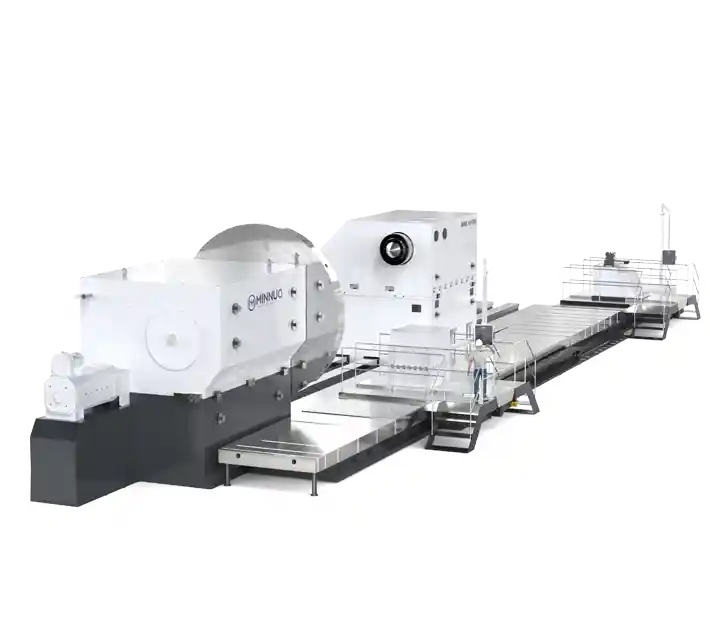
II. Thermal Compensation Technology for Heavy-Duty Lathes: From Passive Prevention to Active Precision Compensation
Traditional methods for solving workpiece deformation (such as adding cooling sleeves, idle preheating, and extending cooling time) have drawbacks such as low efficiency and limited compensation accuracy, making them difficult to meet the high-precision machining requirements of large workpieces. Modern thermal compensation technology achieves active offset of thermal deformation errors through real-time monitoring, dynamic calculation, and precise adjustment, and has become a core configuration for heavy-duty lathe machining.
Core Principles and Implementation Paths of Thermal Compensation Technology
Thermal compensation technology takes "real-time perception - data processing - precision compensation" as the core logic, and builds a closed-loop control system by integrating sensing devices, embedded compensators, and numerical control systems:
•Real-Time Perception of Thermal Deformation: Install micro-displacement sensors (such as Model 100DC-SE) and temperature sensors (thermocouples, resistance thermometers) on key parts of the machine tool, such as the ram and spindle. Equip with a thermal displacement reference measuring rod made of nickel-steel alloy with a low thermal expansion coefficient to accurately capture thermal expansion/contraction deformation and temperature change data, with a sampling frequency of no less than once per minute.
•Data Conversion and Signal Processing: The embedded compensator (adopting TMS320F28335 processor) converts the collected deformation data into compensation pulse signals (two-way orthogonal pulses with a period of 1ms~3ms) according to the motion ratio of the machine tool feed axis. After isolation by optocoupler devices and shaping by NOT gates, the signals are converted into four-way differential signals through a differential driver.
•Precision Compensation by Numerical Control System: Transmit signals to the numerical control system (such as Siemens 840D, Fanuc system) through the machine tool handwheel interface, call the micro-motion analysis function, and apply the thermal deformation as a zero offset to the feed axis to achieve dynamic real-time compensation and offset errors caused by thermal deformation.
Key Supporting Technologies and Process Optimization
A single thermal compensation technology cannot fully solve the deformation problem. It is necessary to combine supporting technologies and process optimization to form a full-process prevention and control system:
•Machine Tool Structure and Cooling System Upgrade: Adopt a thermally symmetric headstock and double-column structure design to offset tilt deformation caused by uneven temperature rise; optimize the built-in cooling channel of the spindle and the oil-cooled/air-cooled system of the ball screw, and regularly maintain to ensure unobstructed circulation of cooling fluid, controlling the temperature fluctuation of constant-temperature cooling fluid within ±1°C.
•Cutting Parameter and Tool Path Planning: Use a larger depth of cut and feed rate for rough machining, control the depth of cut at 0.20.5mm and feed rate at 0.10.2mm/r for finish machining, and match with sharp tools to reduce frictional heat; adopt the process of "rough machining - static cooling - finish machining", and extend the cooling time to 2~6 hours after rough machining to release residual heat and stress.
•Clamping Process Improvement: Expand the contact area through elastic pressure plates and full-arc jaws to disperse clamping force; adopt axial clamping method to apply clamping force to the workpiece end face to avoid bending deformation of thin-walled parts; reasonably arrange the clamping sequence, first apply auxiliary force to fit the support surface, then apply main clamping force to balance cutting force.
III. High-Precision Machining Practice Cases: Application Effects of Thermal Compensation Technology
The value of theories and technologies is ultimately reflected in practice. The following typical scenarios of heavy-duty lathe machining demonstrate the actual effects of thermal compensation technology on workpiece deformation control, providing references for industrial applications.
Case 1: Thermal Deformation Control of Heavy Aluminum Alloy Brackets
Problem: During the machining of an aviation aluminum alloy bracket (aspect ratio 60:1, wall thickness 8mm), due to cutting heat accumulation and residual stress release, the coaxiality deviation of the mounting holes exceeded the tolerance (error 0.05mm), and the qualification rate was only 65%.
Solution: Configure a ram thermal compensation system integrated with micro-displacement sensors and infrared thermal imaging monitoring; optimize the process flow, extend the cooling time to 6 hours after rough machining, adopt constant-temperature cutting fluid (±1°C) and annular isothermal cutting path for finish machining; implement reverse clamping symmetric machining before finish machining to further release internal stress.
Effect: The workpiece deformation was controlled within ±0.01mm, the coaxiality error of the mounting holes met the standard, the product qualification rate increased to 98%, and the production efficiency improved by 30% (reducing rework and cooling waiting time).
Case 2: Machining Deformation Prevention of Large Machine Tool Beds
Problem: When processing heavy machine tool beds (weight 5 tons, length 8 meters) using traditional methods, ram thermal deformation caused excessive flatness error, and delayed deformation occurred during storage, with a scrap rate of 12%.
Solution: Build a thermal compensation system in accordance with T/CMTBA 1002.2—2019, use a laser interferometer and multi-channel data acquisition device to monitor deformation; implement modal broadband aging treatment in the blank stage to remove internal residual stress; control the machining workshop at a constant temperature of ±2°C, away from heat sources and direct sunlight.
Effect: The flatness error was controlled within 0.02mm/m, no obvious delayed deformation occurred during storage, the scrap rate dropped to below 1%, and the manufacturing cost was significantly reduced.
IV. Industry Standard Guidance: Standardized Application of Thermal Compensation Technology
The promotion and application of thermal compensation technology for heavy-duty lathes is inseparable from the guidance and standardization of industry standards. T/CMTBA 1002.2—2019 "Heavy-Duty Machine Tools - Inspection - Part 2: Guidelines for Ram Thermal Deformation Inspection and Error Compensation" issued by the China Machine Tool & Tool Builders' Association specifies the methods, tools, and environmental requirements for ram thermal deformation inspection. It recommends the use of laser interferometers, multi-channel data acquisition devices and other equipment, and requires fixture design to minimize local thermal deformation, providing a basis for the standardized implementation of thermal compensation technology.
Carrying out the installation, commissioning, and inspection of thermal compensation systems in accordance with this standard can not only ensure compensation accuracy but also improve equipment compatibility and machining consistency, providing guarantee for batch high-precision machining of large workpieces.
Conclusion: Thermal Compensation Technology Empowers High-Precision Upgrade of Heavy-Duty Machining
Solving the problem of large workpiece deformation is crucial for the high-quality development of the heavy-duty mechanical machining industry. With the core advantages of dynamic perception and precision compensation, thermal compensation technology, combined with clamping optimization, process adjustment, and standardization, builds a full-process deformation control system, effectively solving the pain points of large errors, low efficiency, and high scrap rates in traditional machining.
In the future, with the upgrading of intelligent manufacturing technology, thermal compensation technology will be further integrated with the Internet of Things and real-time simulation technology, realizing the leap from "dynamic compensation" to "predictive compensation" and injecting stronger momentum into high-precision machining of heavy-duty lathes. Whether in the aerospace, heavy equipment, or construction machinery fields, relying on thermal compensation technology to achieve precise control of large workpiece deformation has become an inevitable choice to enhance core competitiveness.

 Email
Email sales1: +86 15312799623