



The Core Difference between Single Column and Double Column of Longman Machining Center
In large-scale component manufacturing, gantry machining centers have become essential equipment in industries such as aerospace, construction machinery, and mold production, thanks to their extended processing range and stable cutting performance. The single-column and double-column configurations, as the two primary structural types of gantry machining centers, exhibit significant differences in rigidity, precision, and application scenarios, which directly impact processing efficiency and product quality. This article will analyze the core distinctions between these configurations from a structural perspective, providing professional guidance for enterprise selection.
1. Structural Essence Difference: Core Differences in Force and Support Forms
The structure is the basis of determining the performance of the equipment. The core difference between single-column and double-column gantry machining centers lies in the support method and force distribution, which directly results in the inherent stability gap between the two.
The single-column gantry machining center features a cantilever-type structural design, where only one column supports the crossbeam and spindle assembly, concentrating the spindle and motor weight at the extended cantilever end. This configuration mimics the load-bearing capacity of a single human arm, where longer cantilever extension reduces spindle stability, leading to issues like cantilever sagging deformation and cutting vibrations. Additionally, its base typically employs a cross-slide platform design, with both X and Y axes integrated into the base. Any precision deviation in either axis can amplify and affect the other. When the worktable moves to both ends, heavy workpieces may deform the table surface due to insufficient support.
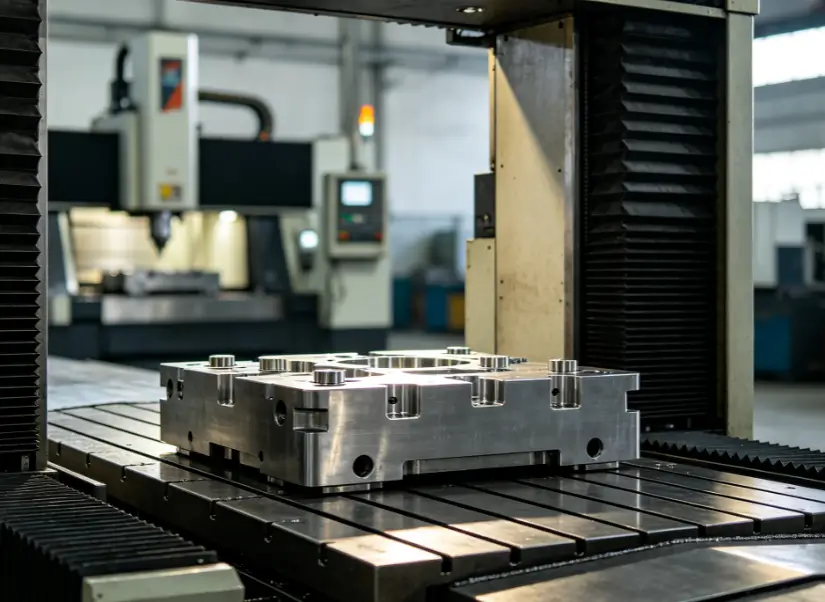
The dual-column gantry machining center features a symmetrical portal frame structure, comprising left and right columns, cross beams, and top beams to form a closed load-bearing system. Some models employ integral casting technology for the door frame, ensuring excellent thermal symmetry. This design mimics the coordinated weight-bearing mechanism of human arms, with cross beams and spindle weight evenly distributed across both columns. The spindle's proximity to the Z-axis screw rod (nearly zero distance) significantly reduces machining vibrations. The base directly supports the worktable, enabling single-axis movement for machining without any suspension during operation. The rigidity and stability of this design far surpass those of single-column models.
2. Core Performance Comparison: Analysis of Differences in Rigidity, Precision, and Efficiency
The structural differences directly impact device performance, with variations in key metrics like rigidity, machining precision, and efficiency determining their applicable scenarios.
2.1 Rigidness and Deformation Resistance
Rigidity is the core guarantee for heavy-duty cutting. Due to the cantilever structure limitation, single-column machines exhibit weaker resistance to bending and torsion. During heavy-load or high-speed cutting, vibrations are prone to occur, which not only affects the surface roughness of workpieces but may also accelerate tool wear. The limited contact area between the column and the bed results in force concentration on one side, leading to structural deformation after prolonged use.
The dual-column design employs a symmetrical structure to evenly distribute cutting forces to both columns and the bed, increasing contact area with the bed by over 30% compared to single-column configurations. The crossbeam typically features a box-type welded structure with internal stiffening plates, achieving a 40% improvement in bending stiffness. Critical components like the bed and columns are predominantly constructed from GG30 high-grade cast iron or honeycomb composite materials. Through aging and secondary tempering treatments to eliminate internal stresses, these components can effortlessly withstand heavy cutting impacts, with vibration amplitudes controlled within 0.005mm during heavy-load operations.
2.2 Processing Accuracy and Stability
Processing accuracy directly determines product qualification rates, with the precision control gap between the two being particularly evident in precision machining scenarios. The sagging deformation and vibration issues of single-column cantilevers cause significant fluctuations in machining accuracy. The positioning accuracy typically remains at the ±0.02mm level, which fails to meet micron-level precision requirements, and the accuracy degrades rapidly after prolonged continuous machining.
The dual-column system delivers superior precision through its symmetrical structure and stable force distribution. Mainstream models employ closed-loop control with optical grating scales, achieving repeat positioning accuracy of ±0.003mm/500mm across X/Y/Z axes, with full-stroke positioning accuracy ≤±0.015mm. Some high-precision variants feature an automatic temperature compensation system that real-time corrects thermal deformation errors, ensuring consistent precision during extended machining. Additionally, the dual-column system utilizes synchronized dual-drive control technology, maintaining lateral column movement errors ≤0.002mm to prevent processing deviations caused by crossbeam tilting.
2.3 Processing Efficiency and Adaptability
The single-column structure is relatively simple with high equipment lightweighting, achieving 30-36m/min X/Y axis rapid movement speed and short tool change time (typically ≤4 seconds). However, its insufficient rigidity limits high-intensity heavy-load cutting, making it suitable only for medium-light loads and small-to-medium-sized workpieces. Production efficiency is significantly constrained in heavy-load scenarios.
The dual-column machine features a robust structure with high-power spindle configurations (30-45KW, 1800N·m torque) and ball-bearing heavy-duty lead screw guides, enabling powerful cutting capabilities including high-strength steel and cast iron. Some models support multi-spindle collaborative machining or five-axis synchronization. With over 80 tool magazines, it achieves continuous multi-step processing—complete all operations in a single setup—reducing setup time by 60% compared to single-column models, significantly boosting production efficiency.
3. Applicable Scenario Segmentation: More Efficient Selection Based on Needs
Given their distinct performance characteristics, single-column and dual-column gantry machining centers serve different applications. Companies should make precise selections based on processing requirements, workpiece properties, and industry-specific needs.
3.1 Application Scenarios of Single Column Portal Machine
- Workpiece types: small and medium-sized, medium-light load workpieces, such as small mold frames, standard steel structural components, and small-to-medium machine tool accessories, typically weighing no more than 5 tons.
- Processing requirements: Moderate precision is required (positioning accuracy within ±0.02mm), primarily involving light-load operations such as milling, drilling, and tapping, without the need for high-intensity heavy cutting.
- Industry scope: Small mold manufacturing, general mechanical processing, hardware accessories production, etc., ideal for businesses with limited factory space and tight budgets.
3.2 Application Scenarios of Double Column Portal Machine
- Workpiece types: Large, heavy, and complex components such as wind turbine hubs, ship keels, aeroengine casings, and integrated die-cast parts for new energy vehicles. The worktable can support loads exceeding 30 tons, with an X-axis stroke extending up to 24 meters.
- Processing requirements: High precision, heavy-load cutting, high-speed cutting, and complex surface machining, with guaranteed precision stability for prolonged continuous operation. Some scenarios require five-axis synchronized machining.
- Industry sectors: aerospace, construction machinery, new energy (wind/nuclear), shipbuilding, and large-scale mold manufacturing, among other high-end manufacturing fields.
4. Selection and Supplement: Considerations of Cost and Operation and Maintenance
Beyond core performance and application scenarios, cost and operational complexity are equally critical in equipment selection. The single-column gantry machining center features a simple structure and lower manufacturing costs, with procurement prices typically ranging from 50% to 70% of dual-column models. Its compact footprint occupies only 60%-70% of space compared to dual-column systems for equivalent processing length, while requiring minimal maintenance and controllable operational costs.
The twin-column gantry machining center, featuring integral casting, high-precision transmission components, and complex control systems, entails higher procurement costs. Its substantial weight and expansive footprint impose stricter requirements on factory foundations. However, its exceptional rigidity and precision stability effectively reduce workpiece rejection rates and tool wear, ultimately lowering overall production costs over time. This makes it particularly suitable for large-scale production scenarios where stringent demands for machining quality and efficiency are paramount.
5. Summary: Core Principles of Model Selection
The distinction between single-column and dual-column gantry machining centers lies not in superiority, but in their suitability for different applications. The key to selecting the right model is to match your specific machining needs: For small-to-medium-sized, low-to-moderate-load workpieces where cost-effectiveness and compact layout are prioritized, a single-column machine is the optimal choice. Conversely, for large, heavy, and high-precision workpieces requiring heavy-load cutting and complex machining processes, a dual-column machine delivers more stable performance.
In practice, the equipment selection should be based on a comprehensive evaluation of factors including workpiece weight, machining stroke, precision requirements, budget, and factory conditions. When necessary, consult the equipment manufacturer for customized solutions to ensure optimal alignment between the equipment and production needs, thereby maximizing production efficiency.
 Email
Email sales1: +86 15312799623