



Vertical Machining Center vs CNC Lathe: Which One Suits Your Metal Workshop | 2026 CNC Buying Guide
Introduction
For metal fabrication workshops, custom job shops, mold manufacturers, auto parts suppliers and vocational training schools, selecting matching CNC equipment directly determines production efficiency and profit margins. Vertical Machining Centers (VMC) and CNC Lathes are the two most mainstream CNC machine tools, covering almost all conventional metal cutting processes.
However, many factory owners make costly investment mistakes due to unclear differences between the two devices:
1.Purchasing high-priced 3/5-axis VMCs for mass rotary shaft production leads to low efficiency and wasted high-precision equipment resources.
2.Relying solely on CNC lathes to process molds, aluminum shells and irregular structural parts requires repeated secondary milling, drilling and tapping, extending production cycles, raising labor costs and introducing machining errors.
The core difference between VMC and CNC lathe lies in machining motion logic: CNC lathes cut workpieces by rotating blanks, while VMCs perform precision cutting via rotating cutters with fixed workpieces. This guide compares their working principles, performance strengths, application scenarios, cost gaps and return on investment, enabling buyers to select equipment matching their workpiece features, order types, budgets and long-term development plans.
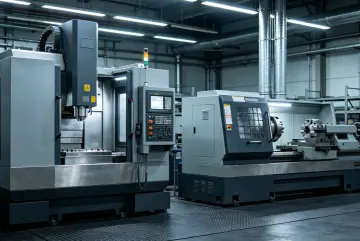
Core Working Principles of VMC and CNC Lathe
2.1 CNC Lathe (CNC Turning Center)
CNC lathes are designed for rotationally symmetrical parts with turning as the core process.
- Working mode: The workpiece is clamped on a horizontal spindle and rotates at high speed; fixed turning tools move linearly along X/Z axes to remove excess material.
- Standard 2-axis models support outer circle turning, boring, end finishing, threading, grooving and chamfering.
- High-end slant-bed turning centers with power turrets and optional Y/C axes can complete simple side drilling and keyway milling on rotary parts.
- Limitation: Limited milling stroke of live tools, unable to process large planes, deep cavities and complex 3D curved surfaces.
2.2 Vertical Machining Center (VMC)
VMC features a vertical spindle layout, fundamentally different from lathes.
- Working mode: Cutting tools are mounted on a high-speed rotating spindle; workpieces are fixed on the table, which moves along X/Y/Z axes for multi-directional cutting.
- Standard configuration includes automatic tool changers (ATC) and tool magazines for automatic tool switching to support continuous processing.
- Expandable with 4/5-axis rotary tables to realize one-clamp multi-sided full-angle machining.
- Integrated functions: Plane milling, cavity engraving, precision drilling, tapping, contour cutting and 3D mold finishing, eliminating repeated clamping positioning errors.
2.3 Fundamental Distinction
- CNC Lathe: Workpiece rotates, cutting tool fixed → for all rotary symmetrical parts
- VMC: Cutting tool rotates, workpiece fixed → for blocks, plates, molds and irregular 3D structural parts
Comprehensive Comparison Table
| Comparison Item | Slant Bed CNC Lathe | Vertical Machining Center (VMC) |
| Machining Logic | Rotating workpiece, stationary tool | Fixed workpiece, high-speed rotating cutter |
| Applicable Workpieces | Shafts, flanges, sleeves, thread fittings, bearing rings | Molds, fixtures, aluminum shells, brackets, plates, 3D parts |
| Standard Axes | 2-axis base, Y/C axis optional | 3-axis base, expandable to 4/5-axis |
| Core Processes | Turning, boring, threading, grooving | Milling, drilling, tapping, cavity machining, 3D carving |
| Mass Production Efficiency | Excellent for batch rotary parts | Excellent for multi-variety complex parts |
| Initial Procurement Cost | Low-medium, cost-effective for startups | Medium-high, 1.5–2.5 times ordinary lathes |
| Floor Space | Compact, space-saving | Large footprint, extra maintenance space required |
| Precision Advantages | Superior roundness & concentricity | Superior flatness, parallelism & 3D contour accuracy |
| Operation Learning Threshold | Low, simple programming & training | High, requires professional mold programming skills |
CNC Lathe: Advantages, Limitations & Applicable Scenarios
4.1 Core Advantages
- Ultra-high efficiency for mass rotary part production; shorter single-piece cycle for bolts, hydraulic sleeves, automotive shafts.
- Low entry cost: Economic flat-bed and slant-bed lathes fit small workshops and training schools with tight budgets.
- Compact structure saves workshop space and rental costs.
- Stable rotary precision guarantees high concentricity and roundness for sealing and assembly parts.
- Simple programming and operation; new operators can work independently quickly to cut training labor costs.
4.2 Main Limitations
- Single processing form; cannot independently process blocks, mold cavities and multi-angle irregular parts.
- Live tool travel is limited; even mill-turn lathes only support auxiliary small-scale milling, unable to replace dedicated milling machines.
- Composite cross-hole and keyway parts require repeated clamping and cross-equipment processing, increasing errors and delivery cycles.
4.3 Applicable Industries & Typical Parts
Automotive parts, hydraulic/pneumatic fittings, hardware fasteners, bearing processing, customized precision rotary hardware.
Typical workpieces: drive shafts, wheel hubs, cylinder sleeves, threaded joints, bearing inner/outer rings, various precision shaft components.
VMC: Advantages, Limitations & Applicable Scenarios
5.1 Core Advantages
- Powerful composite processing: Complete milling, drilling, tapping, boring and contour cutting in one clamp, avoiding repeated positioning errors and outsourcing costs.
- Standard core equipment for mold manufacturing, capable of high-precision injection, die-casting and stamping mold processing.
- Strong expandability: 4/5-axis rotary tables enable full-sided machining, matching new energy and aerospace industry upgrading demands.
- Flexible production capacity, suitable for small-batch prototype trial production and medium-batch mass processing, adapting to multi-variety personalized order shops.
- Outstanding flatness and 3D contour precision to ensure assembly accuracy of automation fixtures and non-standard structural parts.
5.2 Main Limitations
- High upfront investment and long-term operating costs: Equipment price, power consumption, cutter loss and maintenance expenses are medium-high.
- Large floor area requiring sufficient layout and maintenance space.
- Extremely low efficiency for simple rotary shafts, resulting in severe capacity waste.
- High technical threshold for operation and programming, requiring skilled operators and raising labor costs.
5.3 Applicable Industries & Typical Parts
Mold manufacturing, new energy vehicles, automation equipment, aerospace precision machining, non-standard customized parts.
Typical workpieces: mold cavities, aluminum battery shells, motor brackets, fixture plates, aerospace aluminum structural parts, irregular block components.
2026 Six-Dimensional Equipment Selection Rules
Judge whether to choose VMC or CNC lathe from six dimensions to avoid blind investment:
- Workpiece shape: Over 70% rotary symmetrical parts (shafts, flanges) → CNC lathe; mostly molds, brackets, plates → VMC.
- Process demand: Multi-plane milling, deep cavity and multi-hole composite processing → VMC; simple turning and threading → CNC lathe.
- Order batch: Large-batch single standard rotary parts → CNC lathe; small-batch multi-variety complex parts → VMC.
- Workshop space: Small limited-area workshops → compact CNC lathes; spacious factories → VMC layout.
- Procurement budget: Startups with limited funds → economic CNC lathes; factories pursuing diversified high-precision processing → 3-axis VMC.
- Long-term development: Future expansion into mold, new energy and non-standard parts → VMC; long-term fixed rotary hardware processing → CNC lathe.
Mill-Turn Lathe: Hybrid Solution for Mixed Turning & Milling Orders
Small and medium workshops with mixed turning and milling demands but insufficient budget for both VMC and lathe can select mill-turn composite lathes as a transitional scheme.
- Configuration: Equipped with Y/C-axis power turrets, integrating turning, side milling, cross-hole drilling and tapping, realizing one-step forming of composite shaft parts with key grooves and side holes.
- Important reminder: Mill-turn lathes are complementary rather than substitutes for VMC. Their milling stroke and cavity processing capacity are limited, unable to complete mold manufacturing and large-area plane finishing. Only suitable for high-precision composite rotary parts in automotive, hydraulic and machinery industries.
Cost & ROI Analysis
One-time investment
- Economic CNC lathes: Lowest entry cost, low risk and fast payback.
- Standard slant-bed turning centers: Stable performance for long-term mass production.
- 3-axis VMC: Higher procurement cost, but can undertake high-unit-price mold and customized orders with higher profit margins.
Daily operating cost
CNC lathes consume less power, have fewer wearing parts and simple maintenance, with lower long-term operating expenses. VMC requires regular tool magazine calibration, spindle maintenance and frequent cutter replacement; its annual operating cost is 1.8–2.5 times that of ordinary CNC lathes.
Investment return cycle
- Rotary mass production workshops: Recover CNC lathe investment within 1–2 years.
- Mold & complex part workshops: VMC has high upfront cost, but the average ROI cycle is 2–3 years supported by high-margin orders, with better long-term development potential.
FAQ
Q1: Can VMC replace CNC lathes for mass shaft processing?
A1: Technically feasible but highly uneconomical. VMC has complicated clamping and tool change procedures, far lower efficiency than lathes for rotary parts, squeezing workshop profits.
Q2: Can ordinary CNC lathes process mold parts?
A2: No. Standard 2-axis lathes lack effective milling capacity; even mill-turn lathes cannot complete deep cavities and complex molds, which require dedicated VMC.
Q3: Which machine has higher machining precision?
A3: Each has strengths. CNC lathes excel in roundness and concentricity of rotary parts; VMC performs better in flatness, perpendicularity and 3D contour precision of block parts.
Q4: What is the first CNC equipment for a new small workshop?
A4: Depends on core orders. Rotary hardware business → start with CNC lathe; mold & custom structural parts business → mini VMC first.
Conclusion
In the 2026 metal machining industry, VMC and CNC lathe have no absolute superiority, only suitability for different production scenarios.
- CNC lathes: Optimal for low-cost, high-efficiency mass production of rotary symmetrical parts, ideal for hardware, hydraulic and standard parts factories.
- VMC: Relies on flexible composite processing capacity to meet production demands of molds, new energy components and complex non-standard parts, serving as core equipment for workshop business upgrading.
Factory owners should avoid blind pursuit of high-end machines or low-cost entry models. Matching equipment performance with order characteristics, budget and development plans maximizes equipment utilization, cuts production costs and stabilizes long-term profit growth. For workshops with sufficient capital and diversified orders, the combined layout of CNC lathe + VMC can cover all conventional metal machining scenarios.
 Email
Email sales1: +86 15312799623