



5-Axis vs. Multi-Tasking CNC Machines: Benefits, Costs, and When to Upgrade
Quick Answer: Which CNC Machine Is Right for Your Shop?
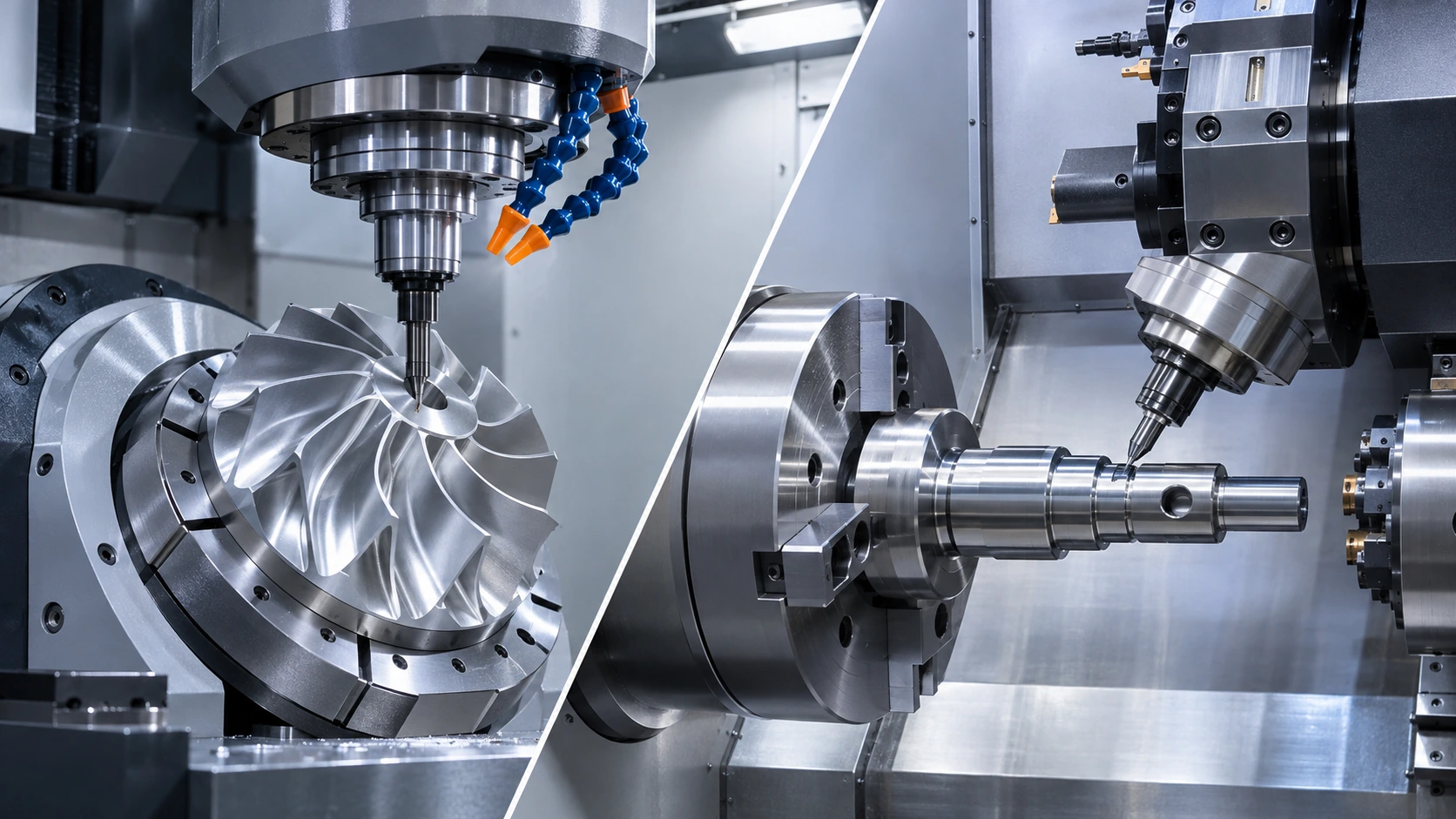
A 5-axis CNC machine is best suited to complex, multi-sided components requiring flexible tool orientation. A multi-tasking CNC machine is designed to combine different machining processes, such as turning, milling, drilling, and tapping, within one platform.
Both technologies can reduce setups, improve production flexibility, and simplify manufacturing workflows.
The main difference lies in their purpose: 5-axis machining expands tool accessibility, while multi-tasking machining integrates manufacturing operations.
For machine shop owners, choosing between them depends on workpiece geometry, machining requirements, production volume, and operating costs.
This guide compares their capabilities, applications, production benefits, and investment considerations to help manufacturers select the right CNC technology.
1. Why Are Machine Shops Investing in Advanced CNC Machines?
Manufacturing efficiency depends on more than cutting speed.
Workpiece loading, fixture changes, repeated setup procedures, and transfers between machines all contribute to production time.
Consider a precision housing that requires milling, drilling, tapping, and machining on several faces.
A conventional production process may involve multiple setups. Each setup requires workpiece alignment, fixture preparation, and machining verification.
A suitable 5-axis machining center can access several faces without repeatedly removing the component. A multi-tasking CNC machine can combine turning and milling operations that would otherwise require separate equipment.
These capabilities help manufacturers improve the efficiency of the entire production process.
1.1 Reducing Setup Time and Workpiece Handling
Every additional setup consumes production time.
Operators must secure the workpiece, establish machining datums, verify alignment, and prepare the next operation.
Reducing these steps can shorten lead times and free up manufacturing capacity.
Five-axis machines achieve this through additional tool orientations, while multi-tasking systems integrate selected machining operations.
1.2 Manufacturing More Complex Components
Modern mechanical components often contain angled holes, curved surfaces, deep cavities, and demanding geometric relationships.
Conventional CNC machines can manufacture many of these features, but complex geometries may require specialized fixtures or repeated positioning.
Advanced CNC configurations provide additional machining strategies.
This flexibility helps manufacturers handle more complex parts and expand their production capabilities.
1.3 Improving Production Flexibility and Delivery
Contract machine shops frequently manufacture different components for multiple industries.
Production requirements may change between orders, creating a need for flexible equipment and efficient changeovers.
Multi-axis machining reduces some fixture requirements, while process integration simplifies selected manufacturing workflows.
These improvements can help factories manage production schedules and respond more effectively to customer requirements.
2. 3-Axis vs. 4-Axis vs. 5-Axis vs. Multi-Tasking CNC Machines
Understanding the differences between machine configurations is essential before making an equipment investment.
| Machine Type | Main Capability | Typical Applications |
|---|---|---|
| 3-Axis Machining Center | Milling along three linear axes | Plates, brackets, mechanical housings |
| 4-Axis Machining Center | Three linear axes plus one rotary axis | Indexed machining, multi-sided parts |
| 5-Axis Machining Center | Three linear axes and two rotary axes | Complex contours, angled features, precision components |
| CNC Turning Center | Rotational machining | Shafts, sleeves, flanges |
| Multi-Tasking CNC Machine | Combined turning, milling, and other operations | Complex rotational and multi-operation components |
2.1 What Is a 3-Axis CNC Machining Center?
A 3-axis machining center controls movement along the X, Y, and Z axes.
It performs milling, drilling, tapping, pocketing, and contour machining.
These machines are widely used for general mechanical components because they offer practical machining flexibility and straightforward programming.
For simple prismatic components and repetitive operations, a 3-axis machining center often provides an economical manufacturing solution.
2.2 What Does a 4th Axis Add?
A 4-axis machining center adds a rotary axis, allowing the workpiece to rotate between machining positions or during supported cutting operations.
This makes it easier to access several faces without repeatedly changing fixtures.
Four-axis machining is useful for indexed features, cylindrical components, and multi-sided machining.
For workshops that regularly manufacture these parts, a fourth axis can provide a practical improvement in production flexibility.
2.3 What Makes a 5-Axis CNC Machine Different?
A five-axis CNC machine combines three linear axes with two rotary axes.
Depending on the configuration, the workpiece, spindle head, or both can rotate to provide additional tool orientations.
This enables flexible machining of complex surfaces, angled features, and multi-sided components.
Five-axis equipment is widely used for selected aerospace parts, medical components, precision molds, and complex industrial machinery components.
2.4 What Is a Multi-Tasking CNC Machine?
A multi-tasking CNC machine integrates different machining processes within one machine platform.
Typical functions include turning, milling, drilling, and tapping.
Advanced configurations may incorporate:
- Main and secondary spindles
- Live tooling
- C-axis control
- Y-axis movement
- B-axis tool orientation
- Automatic tool changing
These functions allow selected components to undergo several machining operations without being transferred between separate machines.
Multi-tasking refers to the integration of manufacturing processes rather than a fixed number of axes.
2.5 3+2 Machining vs. Simultaneous 5-Axis Machining
Five-axis equipment supports two important machining strategies.
3+2 positional machining uses rotary axes to position the workpiece or spindle at a selected angle. The machine then performs cutting using its three linear axes.
This approach is effective for angled holes, pockets, and multi-sided components.
Simultaneous 5-axis machining coordinates the linear and rotary axes during cutting, allowing continuous changes in tool orientation.
It is particularly useful for complex freeform surfaces, impellers, and precision contours.
For many machine shops, 3+2 machining provides sufficient flexibility. Simultaneous five-axis machining becomes more valuable when part geometry requires continuous tool orientation during cutting.
3. Key Benefits of 5-Axis CNC Machining
3.1 Fewer Setups for Multi-Sided Components
Consider a component requiring machining on five accessible faces.
A conventional 3-axis process may require several repositioning operations.
A 5-axis machining center can rotate the workpiece or spindle to access different faces while maintaining the primary workholding arrangement.
This reduces fixture changes, repeated alignment, and manual handling.
For complex components, fewer setups can simplify the manufacturing process and reduce non-cutting time.
3.2 Improved Dimensional Consistency
Every time a component is removed and repositioned, small alignment variations may occur.
Machining more features from the same setup reduces these repositioning-related error sources.
This is particularly useful when multiple holes or surfaces must maintain accurate geometric relationships.
Machine calibration, thermal stability, tooling, and workholding remain important factors in finished-part accuracy.
3.3 Greater Flexibility for Complex Geometries
Five-axis machining expands the range of tool approaches available to manufacturers.
Typical applications include:
- Aerospace structural components
- Precision molds and dies
- Turbine-related parts
- Selected medical implants
- Complex mechanical housings
Different machine configurations provide different advantages.
For example, trunnion-table machines rotate the workpiece, while swivel-head systems change the cutting spindle's orientation.
The preferred configuration depends on workpiece dimensions, geometry, and required tool accessibility.
3.4 Better Tool Access and Cutting Stability
Five-axis machining can provide more favorable cutting-tool orientations.
For certain components, this allows shorter tools to reach difficult features.
Reducing tool overhang improves rigidity and can help minimize vibration.
These advantages support stable cutting conditions and greater flexibility when machining complex surfaces.
4. How Multi-Tasking CNC Machines Improve Manufacturing Efficiency
Many precision components require both turning and milling.
A shaft, for example, may need external turning, internal boring, cross-hole drilling, threading, and keyway milling.
Traditionally, these operations might require a CNC lathe followed by one or more milling setups.
Multi-tasking equipment brings selected operations together.
4.1 Live-Tooling Lathes vs. Advanced Mill-Turn Centers
Turning-milling integration is available at different levels.
A CNC turning center with live tooling can perform turning alongside selected drilling, tapping, and milling operations.
Machines with Y-axis movement and C-axis control provide additional flexibility for machining off-center features.
Advanced mill-turn centers may include dedicated milling spindles, B-axis tool orientation, and secondary spindles.
These configurations support more complex machining requirements and reduce the need for separate production stages.
4.2 Reducing Transfers Between Machines
Moving components between machines adds handling, setup, and scheduling time.
Combining turning and milling within one machine simplifies the production route.
For example, a shaft may be turned and then machined with additional holes or slots without leaving the original machine.
This reduces unnecessary workpiece transfers and improves production continuity.
4.3 Improving Efficiency Through Process Integration
Multi-tasking machines offer several potential advantages:
- Fewer machine transfers
- Reduced setup requirements
- More consistent workpiece positioning
- Simplified production scheduling
- Greater flexibility for complex rotational components
These benefits are particularly relevant to high-mix production environments and components requiring multiple machining processes.
4.4 Understanding the Limitations
Greater process integration also introduces additional complexity.
Advanced multi-tasking machines may require specialized programming, tooling, maintenance, and operator training.
Because several operations depend on one machine, equipment availability becomes particularly important.
The most effective production configuration balances machining flexibility, operating costs, and available manufacturing capacity.
5. Where Are 5-Axis and Multi-Tasking CNC Machines Used?
Advanced CNC equipment is used across industries that require complex geometries, precision components, or multiple machining operations.
5.1 Aerospace Manufacturing
Aerospace components frequently involve complex surfaces, demanding materials, and tight dimensional requirements.
Five-axis machining is useful for selected structural components, precision housings, and turbine-related parts.
Multi-tasking systems support rotational components requiring both turning and milling.
These applications also involve strict process validation, inspection, and traceability requirements.
5.2 Medical Device Manufacturing
Medical manufacturing often involves small, complex components made from titanium alloys, stainless steel, and other specialized materials.
Five-axis machining supports selected implants, surgical instruments, and precision components.
Turning-milling equipment can manufacture certain screws, shafts, and rotational parts with additional features.
5.3 Automotive Manufacturing
Automotive production uses CNC equipment for shafts, transmission components, housings, and tooling.
Advanced CNC machines provide flexibility for complex components and changing production requirements.
For high-volume standardized parts, conventional machines integrated with automation may provide excellent productivity.
5.4 Mold and Die Manufacturing
Molds and dies frequently contain complex three-dimensional cavities and surfaces.
Five-axis machining improves tool accessibility and provides greater flexibility when machining angled features and intricate contours.
This can simplify certain manufacturing operations and reduce fixture requirements.
5.5 General Precision Engineering
Contract machine shops manufacture a wide variety of components for different customers.
Five-axis machines support multi-sided machining, while multi-tasking equipment integrates turning and milling.
These capabilities help workshops handle complex orders and reduce production changeovers.
6. Are 5-Axis and Multi-Tasking CNC Machines Cost-Effective?
The financial value of advanced CNC equipment depends on the complete manufacturing process.
Machine purchase price, setup time, cycle time, tooling, maintenance, and utilization all affect profitability.
6.1 Purchase Price vs. Total Cost of Ownership
A complete equipment budget should consider:
- Machine acquisition and installation
- CAD/CAM software
- Cutting tools and fixtures
- Operator training
- Energy and consumables
- Maintenance and spare parts
- Expected equipment utilization
The lowest purchase price does not necessarily result in the lowest cost per finished component.
6.2 Cost Comparison: Conventional vs. 5-Axis Machining
Consider a hypothetical production batch of 20 identical components.
| Cost Factor | Conventional Process | 5-Axis Process |
|---|---|---|
| Number of setups | 4 | 1 |
| Total batch setup time | 120 min | 35 min |
| In-cycle time per part | 65 min | 48 min |
| Shop hourly rate | $60 | $100 |
| Batch quantity | 20 | 20 |
Assume the hourly rates cover machine occupancy, allocated labor, and shop overhead during setup and production.
Conventional process
Total production time:
20 × 65 + 120 = 1,420 minutes
Modeled charge per component:
(1,420 ÷ 60 × $60) ÷ 20 = $71.00
5-axis process
Total production time:
20 × 48 + 35 = 995 minutes
Modeled charge per component:
(995 ÷ 60 × $100) ÷ 20 = $82.92
The five-axis process reduces total machine occupancy but has a higher modeled charge per component because of its hourly rate.
These illustrative figures represent the stated machine-time charges rather than complete manufacturing costs.
The comparison highlights an important purchasing principle: productivity improvements should be evaluated alongside operating costs.
6.3 How to Calculate CNC Machine Upgrade ROI
A practical investment evaluation compares additional equipment costs with expected financial benefits.
Annual Incremental Operating Benefit =
Annual production savings
- Additional contribution margin− Additional operating expenses
Simple Payback Period =
Incremental Investment ÷ Annual Incremental Operating Benefit
For example, an additional $200,000 investment generating $50,000 in net annual benefits has a simple payback period of four years.
A complete investment evaluation should also consider financing, equipment life, utilization, and production demand.
6.4 When Advanced CNC Machines May Be Less Economical
Advanced equipment may provide limited financial benefits when production consists mainly of simple components or when specialized machining functions are rarely used.
Low equipment utilization and high programming costs can also reduce investment returns.
For these applications, conventional CNC machines may remain the more economical option.
7. When Should a Machine Shop Upgrade Its CNC Equipment?
The best reason to upgrade is to solve a production limitation that existing equipment cannot address efficiently.
7.1 When Conventional CNC Machines Remain the Better Choice
Three-axis machining centers and standard CNC turning centers remain economical for simple components and repetitive production.
They offer practical machining capabilities without the additional complexity of multi-axis equipment.
For workshops producing mainly conventional parts, additional standard CNC capacity may provide better returns.
7.2 When 5-Axis CNC Machining Makes Sense
Five-axis equipment is particularly useful for:
- Multi-sided precision components
- Complex angled features
- Freeform surfaces
- Parts with difficult tool access
- Components requiring repeated repositioning
A suitable five-axis configuration can reduce setups and expand manufacturing flexibility.
7.3 When Multi-Tasking CNC Machines Are More Suitable
Multi-tasking equipment is valuable when components require substantial turning and milling.
Typical examples include complex shafts, flanges with off-center features, and precision rotational components.
A turning center with live tooling may be sufficient for simpler operations, while advanced mill-turn systems support more extensive process integration.
7.4 Evaluate Machine Utilization Before Investing
Machine utilization plays a major role in equipment profitability.
Before purchasing advanced equipment, manufacturers should estimate how much suitable work the new machine will handle.
A machine with sophisticated capabilities delivers greater financial value when those functions are used consistently.
7.5 Identify Production Bottlenecks
Different manufacturing problems require different solutions.
| Production Problem | Potential Solution |
|---|---|
| Repeated setups | 4-axis or 5-axis machining |
| Turning and milling transfers | Live-tooling or multi-tasking CNC |
| Insufficient capacity for simple parts | Additional conventional machines |
| Excessive manual loading | Automated loading systems |
| Dimensional inconsistencies | Improved fixturing, calibration, and inspection |
| Production scheduling delays | Better workflow and capacity management |
Selecting equipment according to actual production requirements helps manufacturers improve investment efficiency.
8. CNC Industry Development: Multi-Axis Machining, Automation, and Manufacturing Flexibility
The CNC machine tool industry continues to evolve toward greater machining flexibility, process integration, and automation.
As manufacturers face more complex component requirements and increasing pressure to improve productivity, machine tool technology is expanding beyond conventional standalone equipment.
8.1 From Conventional Machining to Multi-Axis Technology
Traditional CNC lathes and milling machines remain essential for general manufacturing.
However, complex components often require multiple setups, specialized fixtures, and several machining operations.
Five-axis machining improves tool accessibility, while multi-tasking CNC machines combine turning, milling, and other operations within one platform.
These technologies help manufacturers reduce unnecessary handling and accommodate more demanding machining requirements.
8.2 Automation and Integrated Manufacturing
CNC manufacturing is also developing toward more connected production systems.
Automated loading, robotic handling, machine monitoring, and digital process planning help manufacturers improve workflow efficiency and equipment utilization.
Machine tool suppliers are responding by expanding their offerings from individual machines to integrated machining and automation solutions.
8.3 MINNUO's Development in CNC Machine Tools
MINNUO's product development reflects these broader industry trends.
Building on its manufacturing experience in conventional lathes and milling machines, the company has expanded its CNC equipment portfolio to include precision machining centers, multi-axis machines, and integrated turning-milling systems.
Its MNT25Y and MNT50Y series represent Y-axis turning-milling solutions for components requiring turning and selected secondary machining operations, while the MTN Series includes more advanced multi-axis configurations for complex machining applications.
Alongside these machines, MINNUO offers CNC automation options and application-oriented equipment solutions, reflecting the industry's growing emphasis on manufacturing flexibility, process integration, and production efficiency.
These developments demonstrate how machine tool manufacturers can expand their capabilities to meet changing customer requirements.
Frequently Asked Questions
Q:What is the difference between 5-axis and multi-tasking CNC machines?
A:A 5-axis CNC machine provides greater tool orientation flexibility through three linear axes and two rotary axes.
A multi-tasking CNC machine combines different manufacturing processes, commonly turning and milling, within one platform.
Some advanced multi-tasking machines also support simultaneous five-axis machining.
Q:Is a 5-axis CNC machine better than a 3-axis machine?
A:Five-axis machines are better suited to certain complex and multi-sided components.
Three-axis machines remain economical for straightforward machining applications and repetitive production.
Q:Which industries use 5-axis CNC machines?
A:Common applications include aerospace, medical equipment, mold and die manufacturing, automotive engineering, and precision component production.
Q:Can small machine shops benefit from multi-tasking CNC machines?
A:Yes. Workshops producing components that require several machining operations can benefit from reduced transfers and greater production flexibility.
Equipment utilization and total investment remain important considerations.
Q:How do I calculate the ROI of a CNC machine upgrade?
Compare the additional equipment investment with expected annual savings and incremental contribution margin after deducting additional operating costs.
Machine utilization and realistic production demand are essential to the calculation.
Conclusion: Choosing the Right CNC Technology for Your Machine Shop
Five-axis and multi-tasking CNC machines offer different manufacturing advantages.
Five-axis machining improves tool accessibility and supports complex multi-sided components. Multi-tasking technology integrates turning, milling, and other operations to simplify production workflows.
For machine shop owners, the value of these technologies lies in how effectively they improve manufacturing efficiency, flexibility, and operating costs.
As CNC equipment continues to develop, manufacturers have more options for combining conventional machines, advanced machining systems, and automation.
MINNUO's expansion from conventional machine tools to multi-axis machining and integrated manufacturing solutions reflects this broader industry development.
The right CNC investment is not necessarily the most advanced machine, but the equipment that best supports your production requirements and long-term business goals.
Manufacturers exploring different configurations can visit MINNUO CNC to review available machine tools and machining solutions.

 Email
 sales1: +86 15312799623