



8 Types of CNC Machines for Medical Implant Manufacturing: Applications & Selection Guide
Medical implant manufacturing demands exceptional precision, consistency, and material control. From orthopedic bone screws to complex knee implants and vascular stents, each component requires a machining process suited to its geometry, material properties, and production requirements.
Different types of CNC machines offer distinct advantages. Swiss-type lathes excel at small, slender components, while 5-axis machining centers handle complex orthopedic geometries. Grinding machines produce precision surfaces, and laser cutting systems create intricate patterns in thin-walled medical stents.
Understanding these differences helps manufacturers select equipment that improves machining efficiency, maintains consistent product quality, and reduces production costs.
What Types of CNC Machines Are Used for Medical Implants?
Eight common CNC machine categories used in medical implant manufacturing are Swiss-type CNC lathes, mill-turn centers, 5-axis machining centers, micro-milling machines, CNC grinding machines, electrical discharge machining (EDM) systems, laser cutting machines, and 3-axis or 4-axis machining centers.
These equipment categories serve different manufacturing applications, from small rotational implants to complex orthopedic components.
| CNC Machine Type | Typical Medical Implant Applications | Key Advantage |
|---|---|---|
| Swiss-Type CNC Lathe | Bone screws, dental implants, fixation pins | Precision small-diameter machining |
| CNC Mill-Turn Center | Complex rotational implant components | Multiple operations in one setup |
| 5-Axis CNC Machining Center | Hip, knee, and spinal implants | Complex surface machining |
| CNC Micro-Milling Machine | Miniature implant features | Fine-scale machining |
| CNC Grinding Machine | Joint surfaces, precision cylindrical parts | Surface finish and dimensional control |
| CNC EDM Machine | Intricate features in conductive alloys | Low-force material removal |
| CNC Laser Cutting Machine | Vascular stents, thin-wall tubes | Intricate pattern cutting |
| 3-Axis/4-Axis Machining Center | Bone plates, orthopedic fixation components | Versatile and economical machining |
These are practical equipment categories rather than mutually exclusive machine-tool classifications.
1. Swiss-Type CNC Lathes for Bone Screws and Small Implants
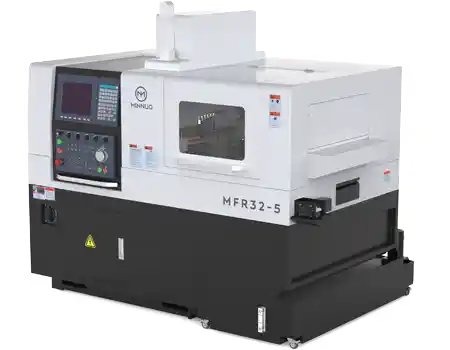
Swiss-type CNC lathes, also called sliding-headstock automatic lathes, are designed for precision machining of small-diameter and slender components.
Unlike conventional CNC lathes, Swiss-type machines can support the workpiece close to the cutting zone using a guide bushing. This reduces workpiece deflection and improves machining stability, particularly when producing long, narrow components.
Medical Implant Applications
Swiss-type CNC lathes are well suited for orthopedic bone screws, dental implant bodies, fixation pins, and small threaded components.
A typical bone screw requires several machining operations, including turning, threading, drilling, and milling of the drive recess. With live tooling and a sub-spindle, a Swiss-type lathe can complete many of these operations in one automated production cycle.
This reduces handling time and improves productivity.
Key Advantages
- Stable machining of slender, small-diameter parts.
- Integrated turning, drilling, and milling capabilities.
- Reduced workpiece deflection.
- Automated bar feeding for continuous production.
- High efficiency in repetitive manufacturing.
Best suited for: Manufacturers producing high volumes of small rotational implants, particularly orthopedic screws and precision fixation components.
2. CNC Mill-Turn Centers for Complex Implant Components
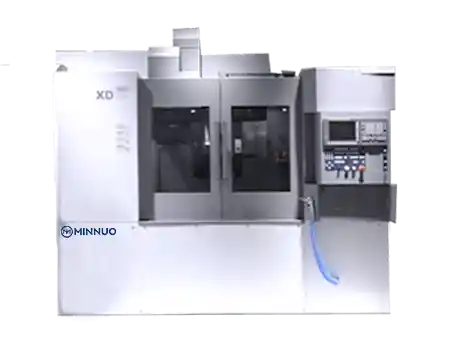
CNC mill-turn centers combine turning and milling operations within a single machine.
This capability is particularly valuable when manufacturing medical implant components containing both cylindrical and non-rotational features.
A conventional production process may require turning a component on a lathe, transferring it to a machining center, and completing additional drilling or milling operations. A mill-turn center can often perform these operations without repeated repositioning.
Medical Implant Applications
Mill-turn centers are suitable for complex dental implant components, orthopedic fixation parts, threaded components with milled features, and other precision rotational parts.
For example, a component may require external turning, internal drilling, angled holes, and a precisely milled recess. Combining these operations reduces setup time and simplifies production.
Key Advantages
- Turning and milling in one machine.
- Fewer setups and workpiece transfers.
- Improved consistency between machined features.
- Reduced handling and production time.
- Greater potential for automated manufacturing.
Best suited for: Manufacturers producing complex small parts where reducing setups improves efficiency and dimensional consistency.
3. 5-Axis CNC Machining Centers for Orthopedic Implants
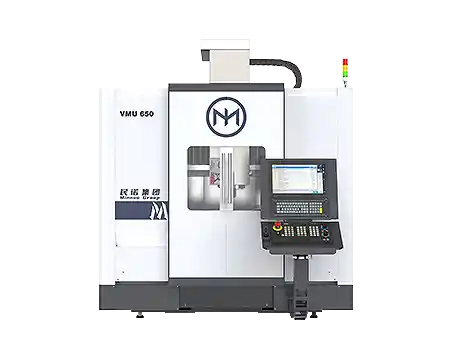
Five-axis CNC machining centers are widely used for complex components that require machining from multiple directions.
Unlike conventional three-axis machines, five-axis equipment adds two rotational degrees of freedom. This allows the cutting tool or workpiece to approach surfaces from different angles.
The technology is especially useful for curved surfaces, angled features, and geometries that would otherwise require multiple fixtures.
Medical Implant Applications
Five-axis CNC machining is commonly considered for hip replacement components, knee implants, spinal implants, and complex orthopedic fixation parts.
For example, femoral knee components contain multiple curved surfaces that require carefully controlled machining. Five-axis equipment provides flexible tool positioning and can reduce the number of setups.
Key Advantages
- Machining of complex three-dimensional surfaces.
- Improved access to difficult features.
- Fewer workpiece repositioning operations.
- Flexible tool orientation.
- Efficient machining of multi-surface components.
Best suited for: Complex orthopedic implants requiring multi-directional tool access and sophisticated surface machining.
4. CNC Micro-Milling Machines for Miniature Implant Features
CNC micro-milling machines are designed to manufacture extremely small features using miniature cutting tools.
These machines emphasize precise motion control, high-quality spindles, thermal stability, and accurate tool positioning.
As cutting tools become smaller, factors such as spindle runout, vibration, and thermal variation become increasingly important.
Medical Implant Applications
Micro-milling can be used for miniature implant features, small precision cavities, fine mechanical structures, and selected implantable-device components.
It is also valuable for manufacturing precision tooling used in medical implant production.
Key Advantages
- Machining of miniature geometric features.
- Compatibility with very small cutting tools.
- Precise control of tool movement.
- Production of intricate cavities and fine details.
- Suitable for specialized small-component manufacturing.
Best suited for: Manufacturers producing miniature features that require very small cutting tools and highly controlled machining conditions.
5. CNC Grinding Machines for Precision Implant Surfaces
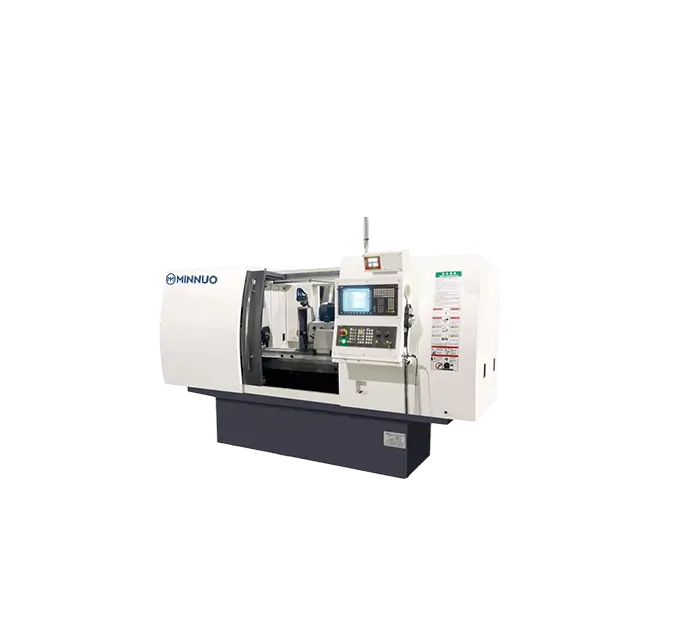
CNC grinding machines use abrasive wheels to remove material and produce precise dimensions, controlled geometry, and fine surface finishes.
Grinding is particularly important when conventional cutting processes cannot efficiently achieve the required surface characteristics or dimensional control.
Medical Implant Applications
CNC grinding may be used for orthopedic bearing surfaces, precision cylindrical components, and selected mating surfaces in implant assemblies.
For joint replacement components, grinding can help establish controlled geometry before additional finishing or polishing.
Key Advantages
- Precise material removal.
- Fine surface finishing capability.
- Controlled dimensional accuracy.
- Suitable for certain hard-to-machine materials.
- Repeatable automated grinding operations.
Best suited for: Components requiring demanding surface geometry, dimensional control, or precision finishing.
6. CNC EDM Machines for Intricate Metal Implant Features
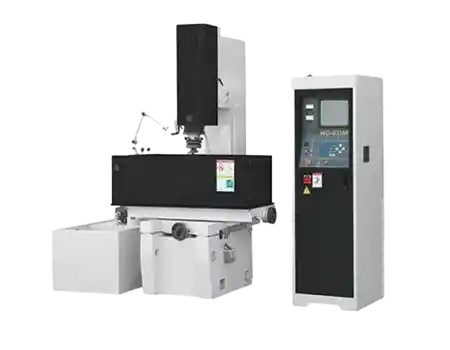
Electrical discharge machining (EDM) removes material using controlled electrical discharges between an electrode and an electrically conductive workpiece.
Unlike conventional milling or turning, EDM does not rely on mechanical cutting forces to remove material.
This makes it useful for producing intricate profiles, narrow features, and geometries that are difficult to machine with conventional cutting tools.
Main Types of CNC EDM Machines
Wire EDM: Uses a continuously moving wire electrode to cut precise profiles through conductive materials.
Sinker EDM: Uses a shaped electrode to produce cavities and complex features.
Small-Hole EDM: Produces narrow holes and specialized precision openings.
Medical Implant Applications
EDM may be used for intricate features in titanium alloys, cobalt-chromium alloys, and implant-grade stainless steels.
It is particularly useful when component geometry makes conventional cutting difficult.
Key Advantages
- Precision machining of electrically conductive materials.
- Minimal mechanical cutting forces.
- Production of intricate profiles and narrow features.
- Capability to machine hard conductive alloys.
- Flexible processing of complex geometries.
EDM can create a thermally affected surface layer, so finishing requirements are an important part of process planning.
Best suited for: Intricate features in conductive implant alloys that are difficult to manufacture using conventional machining.
7. CNC Laser Cutting Machines for Medical Stents
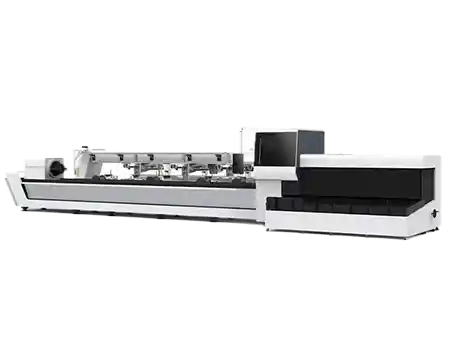
CNC laser cutting machines use focused laser energy to create precise patterns in metallic components.
They are particularly important in manufacturing vascular stents and other thin-walled tubular medical devices.
A vascular stent contains a network of narrow struts and openings that must be produced with controlled geometry.
Laser cutting enables manufacturers to create these intricate patterns using digitally programmed cutting paths.
Medical Implant Applications
Typical applications include metallic vascular stents, thin-walled implantable tubes, and selected fine-patterned medical components.
Key Advantages
- Fine-feature cutting capability.
- Complex pattern production.
- Flexible digital toolpaths.
- Efficient processing of thin-walled tubes.
- Compatibility with automated manufacturing systems.
Best suited for: Manufacturers producing metallic vascular stents and intricate thin-walled tubular components.
8. 3-Axis and 4-Axis CNC Machining Centers for Implant Components
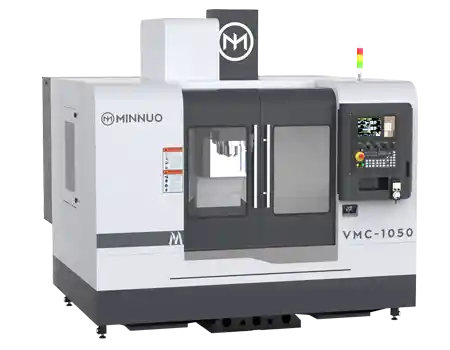
Three-axis and four-axis CNC machining centers remain practical choices for many medical implant components.
Although five-axis machines offer greater geometric flexibility, simpler machining centers can provide excellent productivity for components with accessible surfaces and less complex geometries.
Medical Implant Applications
These machines are suitable for selected orthopedic bone plates, fixation components, relatively simple spinal implant parts, and prismatic implant geometries.
A bone plate, for example, may require profile milling, drilling, countersinking, and surface machining.
A three-axis machining center can perform many of these operations efficiently.
3-Axis vs. 4-Axis CNC Machining
Three-axis machines move along the X, Y, and Z axes.
Four-axis machines add a rotational axis, allowing the workpiece to be indexed or rotated for machining from additional directions.
This can reduce manual repositioning and improve manufacturing flexibility.
Key Advantages
- Lower acquisition cost than many advanced multi-axis platforms.
- Straightforward programming and operation.
- Wide availability of tooling and maintenance support.
- Flexible machining of prismatic components.
- Good cost efficiency for simpler geometries.
Best suited for: Bone plates and other implant components that do not require complex simultaneous five-axis machining.
Which CNC Machines Are Suitable for Different Implant Materials?
Material selection directly influences machining strategy, cutting-tool performance, heat generation, and surface quality.
Titanium alloys, cobalt-chromium alloys, stainless steels, and implantable polymers require different approaches.
Titanium Alloys
Titanium alloys are widely used in orthopedic and dental implants because of their mechanical properties, corrosion resistance, and established use in suitable implant applications.
Ti-6Al-4V ELI, associated with ASTM F136, is a common example.
Titanium machining requires careful heat management because relatively low thermal conductivity can concentrate heat near the cutting zone.
Swiss-type CNC lathes are suitable for small rotational titanium components, while five-axis machining centers are useful for complex orthopedic geometries.
Cobalt-Chromium Alloys
Cobalt-chromium alloys are used in selected orthopedic implants requiring demanding mechanical and wear-related properties.
Examples include materials covered by ASTM F75 and ASTM F1537.
These alloys can be difficult to machine because of tool wear and work-hardening behavior.
Rigid CNC machining centers, appropriate cutting tools, and precision grinding processes are often important.
Implant-Grade Stainless Steel
Implant-grade stainless steels are used in selected surgical implant applications.
ASTM F138 and ASTM F139 cover certain wrought implant-grade stainless-steel products.
CNC turning, milling, and grinding can all be suitable, depending on component geometry and surface requirements.
PEEK
Polyetheretherketone (PEEK) is used in certain implant applications, including spinal devices.
ASTM F2026 is relevant to specified implantable PEEK materials.
PEEK machining requires attention to heat generation, dimensional stability, burr formation, and surface quality.
Precision CNC milling and turning are common machining options.
Material Selection Comparison
| Implant Material | Suitable CNC Processes | Main Machining Challenge |
|---|---|---|
| Titanium alloys | Turning, milling, 5-axis machining | Heat and tool wear |
| Cobalt-chromium alloys | Milling, turning, grinding | Work hardening and tool wear |
| Implant-grade stainless steel | Turning, milling, grinding | Burrs and surface integrity |
| Implantable PEEK | Milling, turning | Heat and dimensional stability |
How to Choose the Right CNC Machine for Medical Implants
Choosing the right CNC equipment requires evaluating the component, production process, and long-term manufacturing costs.
1. Match the Machine to Component Geometry
Start with the implant drawing.
Small rotational components often favor CNC turning, while complex curved surfaces may require five-axis machining.
Thin-walled stents are better suited to specialized laser cutting systems.
Selecting equipment based on component geometry helps avoid unnecessary machine complexity.
2. Evaluate Accuracy and Surface Requirements
Review critical dimensions, geometric tolerances, and surface specifications.
Machine positioning accuracy is important, but actual component quality also depends on tooling, workholding, thermal stability, and measurement methods.
Representative machining trials provide useful evidence of equipment performance.
3. Consider Production Volume
For high-volume production, automation, cycle time, and tool-life management strongly influence manufacturing efficiency.
For low-volume or frequently changing components, flexible programming and shorter setup times may be more valuable.
4. Compare Total Cost of Ownership
Machine purchase price is only one part of the investment.
Manufacturers should also consider tooling, installation, electricity, maintenance, inspection, scrap, and downtime.
A useful purchasing metric is:
Cost per Accepted Part= Total Relevant Production Cost÷Accepted Parts
This helps compare machines according to actual manufacturing economics rather than initial purchase price alone.
5. Verify Equipment Performance Before Purchase
Factory Acceptance Testing (FAT) and Site Acceptance Testing (SAT) help confirm equipment performance.
Key evaluation items include:
- Axis accuracy and repeatability.
- Spindle performance and thermal stability.
- Representative sample-part machining.
- Dimensional and surface inspection.
- Automation and safety functions.
- Maintenance documentation and technical support.
For demanding applications, buyers should establish measurable acceptance criteria before ordering the machine.
Quality Standards for Medical Implant Machining
Medical implant manufacturing requires controlled processes, material traceability, inspection records, and appropriate quality management practices.
ISO 13485:2016 establishes quality management system requirements for organizations involved in medical devices and related activities. It provides a framework for production controls, documentation, traceability, and process management.
Reference: ISO 13485:2016 — Official Standard
In the United States, the FDA's Quality Management System Regulation (QMSR) became effective on February 2, 2026, incorporating ISO 13485:2016 by reference within the revised regulatory framework.
Reference: FDA — Quality Management System Regulation
Manufacturers should integrate machine maintenance, process controls, measurement-system management, and component traceability into their established quality systems.
Frequently Asked Questions About CNC Machines for Medical Implants
Q:What is the best CNC machine for manufacturing titanium medical implants?
A:The best machine depends on component geometry and production requirements. Swiss-type CNC lathes are suitable for small titanium screws, while five-axis machining centers are often selected for complex orthopedic components.
Q:Why are Swiss-type CNC lathes used for orthopedic bone screws?
A:Swiss-type lathes support slender components close to the cutting area, helping reduce deflection. Their turning and live-tooling capabilities also enable efficient production of threads, holes, and other bone screw features.
Q:Is 5-axis CNC machining necessary for medical implants?
A:No. Five-axis machining is valuable for complex geometries, but many bone plates, screws, and simpler implant components can be produced efficiently using three-axis machining centers or CNC lathes.
Q:What tolerances can CNC machines achieve in medical implant manufacturing?
A:Achievable tolerances depend on the machine, material, component geometry, tooling, and manufacturing conditions. Manufacturers should establish tolerance requirements from engineering drawings and verify them through machining trials and inspection.
Q:What should buyers check before purchasing CNC machines for medical implants?
A:Buyers should evaluate machine accuracy, spindle performance, thermal stability, material compatibility, automation, maintenance support, and total cost of ownership. Representative machining trials and clearly defined acceptance criteria are particularly valuable.
Conclusion
Choosing the right CNC machine for medical implant manufacturing depends on component geometry, material properties, precision requirements, and production volume. From Swiss-type lathes for small bone screws to 5-axis machining centers for complex orthopedic components, each machine offers distinct manufacturing advantages.
For manufacturers exploring precision machining solutions, MINNUO CNC offers a range of CNC equipment for different industrial applications. Reviewing available machine configurations can be a useful starting point when planning or upgrading a precision manufacturing process.

 Email
 sales1: +86 15312799623