



China Japan Germany Slant Bed CNC Lathe Comparison
Chinese, Japanese and German slant bed CNC lathes should not be ranked by country alone. The SYIL L2, Okuma LB3000 EX III and INDEX B400 occupy different size and configuration classes. Freeze the workpiece and option package first, then compare like-for-like landed cost, ISO 13041-based FAT results and an enforceable local service SLA.
What Are the Main Risks When Importing a Slant Bed CNC Lathe
Quotes are not directly comparable.
Two 8-inch or 10-inch lathes may be quoted with different inclusions for a Y axis, live tooling, sub-spindle, chip conveyor, mist collector, voltage conditioning, tool measurement, CE documentation, installation, training and starter spares. Comparing only the FOB base machine shifts omitted capital items into post-delivery change orders.
One model is not a country benchmark.
The SYIL L2, Okuma LB3000 EX III and INDEX B400 are representative products with sufficiently public specifications, but they serve different market positions. Their published maximum workpiece lengths are 300 mm, 500/1,000 mm and 750 mm. Those differences cannot support a blanket conclusion about all Chinese, Japanese or German machines.
Service promises do not transfer automatically across borders.
Manufacturer warranty and parts statements are normally limited by market, model and stock status. SYIL regional pages contain both one-year and two-year warranty wording; Okuma America lists three years for core machines and five years for OSP controls; INDEX says in-stock parts can be dispatched within 24 hours, not delivered or installed within 24 hours. Put the applicable country, warranty start date, exclusions, stock location, freight, duty and engineer response time into the customer contract.
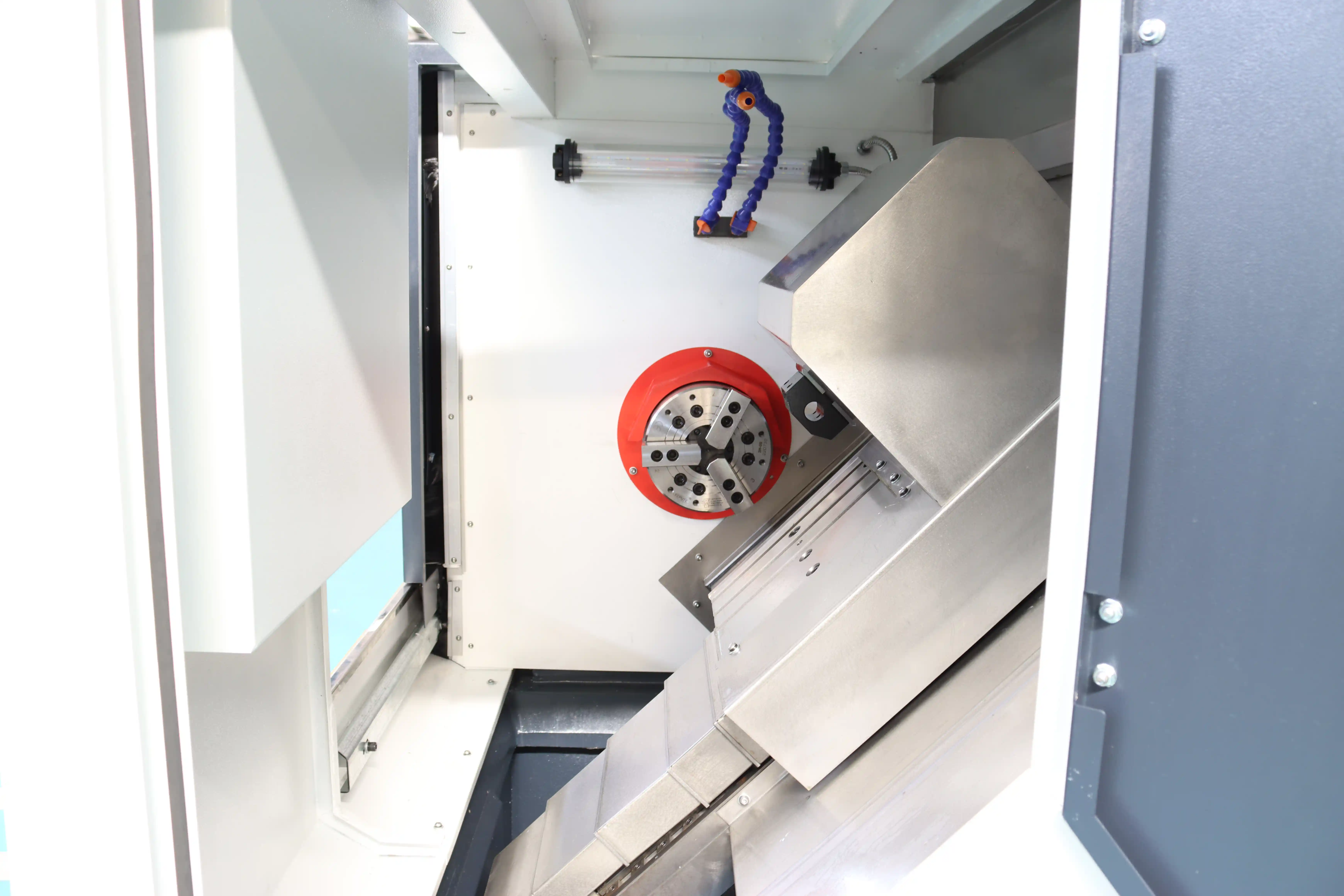
SYIL L2 vs Okuma LB3000 EX III vs INDEX B400 Specifications
Table 1 compares current public manufacturer specifications. A value marked not published is an RFQ requirement, not a zero-performance value.
| Metric | SYIL L2 | Okuma LB3000 EX III | INDEX B400 |
| Positioning | Compact 8-inch turning center | Medium slant-bed horizontal lathe | High-configuration universal turning center |
| Swing / machining diameter | 510 mm swing over bed; detailed table lists 380 mm maximum workpiece diameter | 410 mm maximum machining diameter | Confirm against chuck, turret and tooling; chuck up to 315 mm |
| Maximum workpiece length | 300 mm | 500 or 1,000 mm | 750 mm |
| Bar capacity | 52 mm | Not in public summary; confirm by RFQ | 82 mm |
| Spindle speed | 4,000 rpm | 45-5,000 rpm | 4,000 rpm |
| Spindle power | 11/15 kW; duty order not explained | 22/15 kW; 30 min/continuous | 16/24 kW; 100%/40% duty |
| X/Z rapid traverse | 30/30 m/min | 25/30 m/min | 40/40 m/min; Y 20 m/min |
| Turret / options | 8- or 12-station servo turret | Live tooling, Y axis and sub-spindle available | 12-station disk or 18-station star turret; live tooling |
| Control | Siemens SINUMERIK 828D | Okuma OSP-P500 | Siemens 840D sl |
| Machine weight | 3,050 kg | Not in public summary; confirm by RFQ | 7,800 kg |
Table 2 lists fields that catalog pages often omit even though they affect landed cost and production stability.
| RFQ field | SYIL L2 | Okuma LB3000 EX III | INDEX B400 | Dealer action |
| Coolant pressure MPa | Not published | Not published | 0.8/2.0 MPa (8/20 bar) | Standardize pressure class for chip breaking and deep holes |
| Coolant filtration μm | Not published | Not published | 200 μm basic unit | Confirm filtration for high-pressure through-tool coolant |
| Compressed-air demand m³/h | Not published | Not published | Not published | Request average, peak and required pressure |
| Connected load | Not published | Not published | 40 kW | Use local tariffs for the five-year energy model |
| Geometric / positioning accuracy μm | Not quantified on product page | Not quantified on product page | Not quantified on product page | Reference ISO 13041 and measure during FAT |
| Public price | RFQ | RFQ | RFQ | Use one option list, currency, Incoterm and validity period |
How to Select a Slant Bed CNC Lathe for the Workpiece and Service Risk
Selection should follow the workpiece, takt time, downtime exposure and local support capability. The matrix below is a screening path, not a country ranking. Every shortlisted machine still requires a common RFQ, target-part trial and FAT.
| Customer condition | Capability to verify | Screening direction | Evidence before sale |
| General turning, small batches, limited floor space | Footprint, bar capacity, basic turret, maintainable control | Screen same-size compact machines without assuming a country winner | Continuous target-part trial, local spares list, response SLA |
| Tight dimensional window, long unattended runs | Ambient effects, spindle thermal drift, axis repeatability | Any machine that passes the project thermal FAT | Cold-to-stable curve and external metrology report |
| Turn-mill work and one-setup completion | Y axis, live tooling, sub-spindle, postprocessor, collision simulation | Screen all suppliers against the complete option package | Full process cycle, yield and tooling cost per part |
| High downtime cost or cross-border delivery | Local engineers, critical boards, first-time fix rate | Choose the service system that accepts a written SLA | Stock location, response time and historical MTTR |
How Should Spindle Power in kW Be Compared
Read spindle power together with the duty rating, torque curve, base speed and workholding stiffness. Okuma's 22/15 kW means 30-minute/continuous duty; INDEX lists 16/24 kW at 100%/40% duty; SYIL lists 11/15 kW without explaining the order or duty basis. Request the full power-torque curve and cut the target material at the specified depth of cut ap, feed f and spindle speed n. Ranking machines by the two kW figures alone is technically invalid.
How Do the Three Representative Machines Differ in Technical Positioning
SYIL L2: the public specification shows a 1,775 x 1,600 x 1,690 mm footprint, 52 mm bar capacity and 30/30 m/min X/Z rapid traverse. It belongs on a compact turning-center shortlist. Public data does not prove lower price, long-term accuracy or superior local service; verify those items through RFQ, FAT and the local SLA.
Okuma LB3000 EX III: official material lists a rigid slant-bed box construction, OSP-P500, Thermo-Friendly Concept and options for a Y axis, sub-spindle and live tooling. It is a useful reference for thermal design and integrated options, while training, licenses, parts and service costs require a local quotation.
INDEX B400: official material lists a 45-degree mineral-cast monoblock, 82 mm bar capacity, Y +/-60 mm and multiple turret configurations. It is relevant to larger bar work and process integration, but cannot be ranked directly against the smaller L2 by power, weight or option count.
How to Compare the Landed Cost of a Slant Bed CNC Lathe
All three public pages are RFQ-based, so this article does not invent national price bands. Issue the same RFQ fields to every supplier:
Base machine: chuck size, bar capacity, spindle duty, turret interface, tailstock and chip conveyor.
Process package: C/Y axes, live tooling, sub-spindle, tool measurement, automatic door, bar feeder and robot interface.
Compliance package: target-market electrical drawings, language, CE/UKCA/UL or local requirements, risk assessment and technical file.
Commercial package: EXW/FOB/CIF/DDP, marine insurance, installation, training, acceptance, warranty start and exchange-rate validity.
Service package: critical-spares list, local stock, remote response, engineer arrival SLA, travel rates and software licenses.
Five-year TCO = landed machine price + compliance work + installation and training + five-year energy + maintenance and spares + unplanned downtime + financing and floor-space cost - realizable residual value.
Unplanned downtime loss = attributable downtime hours x realizable contribution margin per hour + emergency outsourcing + late-delivery penalties. Recovered hours can carry the full contribution margin only when orders, labor, material and downstream capacity are available.
How to Verify Accuracy and Long-Term Value
How to Build an ISO 13041 FAT for a Slant Bed CNC Lathe
ISO 13041-1:2020 covers geometric tests for horizontal-spindle numerically controlled turning machines and turning centers. It excludes vibration, abnormal noise, stick-slip and speed/feed checks. A purchase scope may also reference Part 4 for positioning accuracy, Part 6 for finished test pieces and Part 8 for thermal distortion. ISO 13041-8 explicitly assigns no numerical thermal tolerances, so the buyer and supplier must set project limits from part tolerance, process capability and the agreed environment.
The table below defines contract fields, not universal pass values. Axis results should use the parameters and standard test cycle defined by ISO 230-2/ISO 13041-4. Every μm limit must identify the axis, measurement travel, environment, warm-up condition, measurement uncertainty and retest rule.
| Test | Contract must state | Instrument and raw record | Acceptance principle |
| X/Z positioning | Agreed A, E and R parameters; travel for each axis; μm limits | Laser interferometer CSV, before/after compensation, ambient temperature | Calculate with the agreed standard cycle; never accept a single screenshot |
| Thermal distortion | Ambient, rotating-spindle and moving-axis tests; duration and project limit in μm | Displacement readings, temperature curve, sample interval and stability criterion | ISO defines methods; the parties set numerical limits |
| Standard test piece | Material, drawing, tool and cutting data; size, roundness and Ra limits | External roundness and roughness instruments with calibration status | Use one test piece and measurement procedure; retest only as contracted |
| Target-part capability | Critical dimensions, tolerance, sample size, Cpk/Ppk target and takt time | Continuous-run data, gauge R&R, scrap and rework records | One conforming part cannot establish statistical capability |
| Hydraulics and safety | Chuck pressure MPa, clamping interlock, power-loss and alarm tests | Calibrated pressure record, settings and alarm log | Use the chuck maker's curve and risk assessment |
How to Verify Warranty Parts and the Local Service SLA
SYIL regional pages show conflicting one-year and two-year warranty wording; Okuma America's published coverage is market- and product-specific; INDEX publishes 24-hour dispatch for in-stock parts. None proves response time, delivery time or mean time to repair in the buyer's country. Put the local hotline, engineer radius, critical-parts stock, remote-access rights, travel rates and remedies into the SLA. Track MTTR, first-time fix rate and on-time parts delivery every quarter.
No unprovided factory video or inspection screenshot is used as evidence. Verifiable text evidence includes manufacturer specifications, ISO test scope, required contract fields, instrument records and access dates. Any later FAT video should identify the machine serial number, date, ambient temperature, instrument calibration ID and source report.
How to Validate the Purchase with Public Cases and Twelve-Month Data
Evidence boundary example.
An INDEX 2025 customer publication says Coşkun Otomat used a cam-controlled INDEX MS25-6 multi-spindle machine in 1998 to cut one shock-absorber valve cycle from 40 s on another machine to 5 s. The arithmetic reduction is (40-5)/40 = 87.5%.[8] The source and arithmetic are verifiable, but the machine is not the B400 or one of the three universal slant-bed lathes compared here. The case also lacks twelve-month energy, yield and availability data. It demonstrates evidence limits; it does not prove that German machines or the B400 are generally 87.5% faster.
Twelve-month operating validation.
Establish a baseline on the demo or first customer machine and export the same data at months 1, 3, 6 and 12: availability, MTTR, first-pass yield, cycle time, kWh per part, tooling cost per part and parts lead time. Efficiency improvement = (baseline cycle - new cycle)/baseline cycle x 100%. Energy reduction per unit = (baseline kWh/part - new kWh/part)/baseline kWh/part x 100%. Without a continuous twelve-month log, describe the result as a trial, not long-term field performance.
Illustrative commercial model.
At 4,000 planned hours per year, 95% versus 90% availability creates a theoretical 4,000 x (0.95-0.90) = 200-hour gap. Only if every recovered hour has demand does 120 USD/h produce an upper-bound contribution margin of 24,000 USD/year. A real model should multiply by demand utilization and deduct incremental labor, tooling, energy and quality loss. This is not a measured promise for any brand.
Slant Bed CNC Lathe Selection FAQ
Q: Are Chinese slant bed CNC lathes necessarily less accurate than Japanese or German machines?
A: No. Country of origin does not establish accuracy. Compare machines under the same environment, warm-up state and measurement uncertainty. Record agreed axis parameters under ISO 13041-4/ISO 230-2, test thermal distortion under ISO 13041-8 with separately contracted numerical limits, and verify cutting performance on the same target part with external metrology.
Q: How should dealers normalize widely different CNC lathe quotations?
A: Freeze the workpiece and takt-time package first. Then normalize chuck, bar capacity, spindle duty, turret, C/Y axes, sub-spindle, chip conveyor, measurement, automation interface, compliance documentation, installation, training, Incoterms and warranty start. Rank the final offers by five-year TCO, not FOB base price.
Q: What is the minimum FAT scope for an imported slant bed CNC lathe?
A: At minimum, cover the contracted geometry, X/Z positioning parameters, ambient and spindle thermal distortion, a standard or target test piece, roundness and Ra, loaded tool changes, hydraulic clamping interlocks, power-loss recovery and alarm records. Record serial number, environment, warm-up, instrument model, calibration status, raw data and retest rules.
Q: How do Siemens FANUC and OSP controls affect dealer support?
A: They affect parts sourcing, engineer skills, parameter backups, postprocessors, network security and training. A common control may widen the third-party service pool; an integrated proprietary control may reduce interface uncertainty. Compare locally qualified engineers, critical-board stock, remote-diagnostic rights and software licensing rather than interface preference.
Q: When can a higher-specification machine or stronger service network pay back?
A: A higher quotation can recover its premium when realizable contribution margin is high, downtime is costly, the process is complex, the thermal window is narrow, or one setup removes work-in-process and re-clamping. Calculate with normalized quotations, real demand utilization, quality cost and the local SLA; country of origin is not a business case.
 Email
 sales1: +86 15312799623