



CNC Milling Efficiency Improvement Secrets: Cutting Parameter Optimization & Tool Path Strategies
In the competitive manufacturing landscape, maximizing CNC milling efficiency is the core key to reducing production costs, shortening delivery cycles, and gaining market competitiveness. For CNC programmers and production supervisors, mastering scientific cutting parameter optimization and advanced tool path optimization techniques is not just a "skill upgrade" but a necessary means to improve workshop productivity and profitability.
Many workshops face the pain point: obviously using the same CNC milling machine and raw materials, but the processing efficiency varies greatly—some teams complete batch processing in 8 hours, while others take 12 hours; some tools have a long service life and stable processing quality, while others frequently wear and cause rework. The root cause lies in the unreasonable setting of cutting parameters and the lack of optimized tool path planning. This article will focus on feed rate optimization, cutting depth and width matching, high-speed machining strategies, and CAM programming skills, providing actionable secrets to help you break through efficiency bottlenecks.
1. Cutting Parameter Optimization: The Foundation of Efficiency Improvement
Cutting parameters are the "core engine" of CNC milling processing. The rational matching of cutting speed, feed rate, cutting depth, and cutting width directly determines processing efficiency, tool life, and processing quality. Blindly increasing speed or feed rate will not only fail to improve efficiency but may also lead to tool damage and machine wear; overly conservative parameters will waste machine potential and increase production costs.
1.1 Feed Rate Optimization: Balance Efficiency and Stability
The feed rate (F value) is the key to controlling the processing cycle. Many CNC programmers have a misunderstanding: "the higher the feed rate, the higher the efficiency". In fact, the optimal feed rate needs to be matched with the tool material, workpiece material, and cutting depth to avoid vibration and tool chipping.
Practical optimization tips:
- For high-hardness materials (such as HRC25-35 steel), the feed rate should be appropriately reduced (100-300 mm/min) to lower tool load; for soft materials (such as aluminum alloy), the feed rate can be increased (300-800 mm/min) to boost material removal efficiency, paired with non-stick coated edge tools to prevent material adhesion.
- Enable adaptive cutting functions of mainstream CNC systems (FANUC, Siemens). The system dynamically adjusts the feed rate in real time according to actual cutting resistance, ensuring stable operation while unlocking maximum machine efficiency.
- Avoid frequent sudden acceleration and deceleration of feed motion. Smooth transition settings in CAM programming effectively reduce idle loss and abnormal tool wear caused by speed fluctuations.
1.2 Cutting Depth & Width Matching: Reduce Invalid Cutting
Cutting depth (ap) and cutting width (ae) directly determine the number of tool passes and total machining time. The core optimization principle is to maximize single-pass material removal without exceeding the rigidity limit of machine tools, fixtures, and cutting tools, completely eliminate redundant empty cutting strokes, and compress overall processing cycles.
1.3 Standard CNC Milling Cutting Parameter Reference Table (Common Industrial Materials)
Most workshop efficiency losses stem from relying on empirical blind parameter setting. Below is a verified mass-production cutting parameter comparison table for mainstream materials, suitable for carbide end mills (2/4 flutes), standard vertical machining centers, and conventional dry/wet cutting conditions. CNC programmers can directly reference and fine-tune according to actual fixture clamping rigidity, perfectly supporting whole-process cutting parameter optimization and batch efficient production.
| Workpiece Material | Tool Recommendation | Cutting Speed vc (m/min) | Spindle Speed n (RPM) | Feed Rate F (mm/min) | Cutting Depth ap (mm) | Cutting Width ae (mm) | Applicable Scenario |
| 6061 / 7075 Aluminum Alloy | Uncoated Solid Carbide End Mill, 2/3 Flutes | 1200 – 1800 | 8000 – 12000 | 600 – 1200 | 0.5 – 1.0 × Tool Diameter | 0.8 – 1.0 × Tool Diameter | High-speed roughing & finishing, no sticky tool, ultra-high efficiency batch processing |
| 45# Steel / Q235 Structural Steel | TiAlN Coated Carbide End Mill, 4 Flutes | 180 – 220 | 2500 – 3500 | 200 – 350 | 0.3 – 0.5 × Tool Diameter | 0.5 – 0.7 × Tool Diameter | Universal mold base roughing, conventional structural parts mass production, stable tool consumption |
| HRC30 – HRC35 Pre-hardened Mold Steel (P20) | Ultra-fine Grain Coated Carbide Tool | 120 – 150 | 1800 – 2500 | 120 – 200 | 0.2 – 0.4 × Tool Diameter | 0.4 – 0.6 × Tool Diameter | Mold cavity semi-finishing, low vibration, guaranteed surface roughness standard |
| HRC48 – HRC52 Hardened Steel (NAK80/S136) | High-temperature Resistant Nano Coated Hardened Tool | 60 – 80 | 800 – 1200 | 60 – 100 | 0.1 – 0.2 × Tool Diameter | 0.15 – 0.3 × Tool Diameter | Precision mold finishing, anti-tool chipping, extend tool life by 30% |
| TC4 Titanium Alloy | Special Titanium Alloy Milling Tool, Edge Reinforced | 40 – 60 | 600 – 1000 | 50 – 80 | 0.15 – 0.3 × Tool Diameter | 0.2 – 0.4 × Tool Diameter | Aerospace parts processing, heat resistance control, avoid cutting hardening deformation |
Table Usage Tips for On-site Workshops: Reduce spindle speed by 10% and feed rate by 15% for long cantilever machining; increase air-oil mist cooling for titanium alloy and hardened steel to avoid thermal wear; match parameters with tool path strategies to maximize comprehensive machining efficiency.
2. Tool Path Optimization: Reduce Idle Time and Improve Processing Continuity
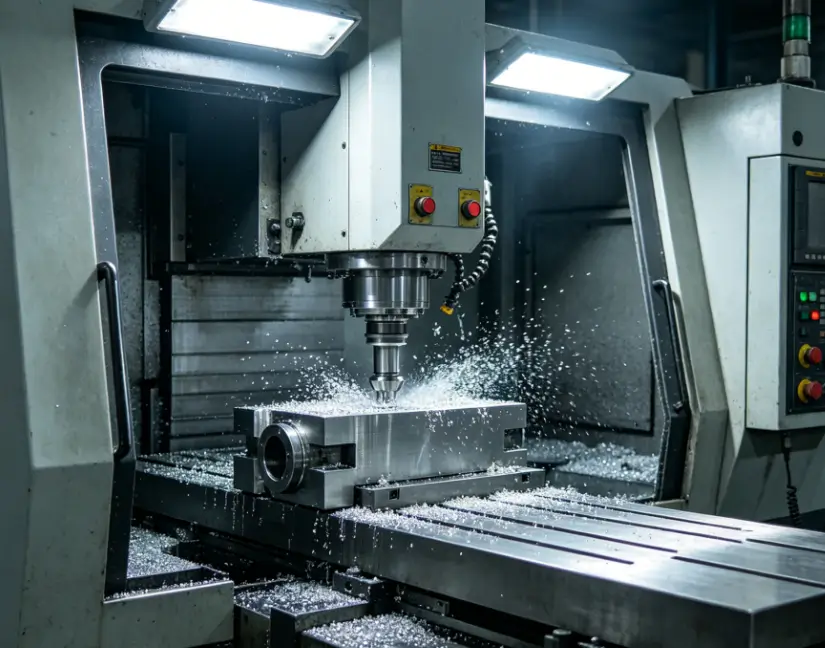
Tool path optimization is the "hidden weapon" to improve CNC milling efficiency. A reasonable tool path can reduce idle travel, avoid unnecessary tool lifting and stopping, and extend tool life while ensuring processing quality. According to statistics, up to 20% of manufacturing costs come from inefficiencies caused by non-optimal tool paths, so optimizing tool paths is core to stable machining efficiency improvement.
2.1 High-Speed Machining Strategy: Efficient and Stable Processing
High-speed machining (HSM) is not blind high-speed operation, but a systematic combination of low-load cutting, smooth tool paths, and high-temperature resistant tools. It disperses cutting heat in real time, reduces local tool pressure, and is especially suitable for hard molds, thin-walled parts, and complex surface batch processing.
Key implementation points:
- Adopt trochoidal milling instead of traditional full-side heavy cutting. Keep the tool cutting angle stable at all times, reduce instantaneous load fluctuation, and increase single-group tool output by 25%+.
- Cancel frequent Z-axis retraction actions. Use continuous spiral descending and layered closed-loop path planning to eliminate invalid idle stroke time between cutting intervals.
- Cooperate with high-speed small-aperture layered cutting. Match the above parameter table with low depth and high speed to avoid workpiece deformation and tool breakage risks.
2.2 CAM Programming Skills: Improve Programming Efficiency and Path Rationality
Excellent CAM programming directly determines the execution quality of on-site parameters and paths. Many inefficient problems are caused by rough programming rather than machine tool performance limitations. Standardized programming habits can quickly realize on-site efficiency improvement.
Essential CAM programming tips:
- Use intelligent residual milling recognition. Automatically identify uneven margins after roughing, focus on localized supplementary cutting, and avoid repeated full-area empty cutting.
- Integrate fixed parameter templates. Solidify the parameter data in the comparison table into UG/Mastercam material libraries, one-click call for similar parts, and eliminate manual debugging errors.
- Optimize multi-hole and multi-feature sorting. Adopt shortest-path topological sorting to reduce G00 rapid positioning idle time, and the efficiency improvement effect is more obvious in small-batch multi-variety production.
- Full simulation collision detection before formal cutting. Pre-check path dead angles and parameter mismatches in advance to avoid shutdown rework and delay of delivery schedules.
3. On-site Implementation Management Suggestions for Production Supervisors
Efficiency improvement cannot rely solely on the experience of individual programmers. Production supervisors need to form standardized workshop management mechanisms: unify cutting parameter standards for the same material and same tool, regularly count tool life data, eliminate backward low-efficiency processing schemes, and synchronously train teams on matching tool path optimization methods to achieve overall workshop capacity improvement.
4. Conclusion
The core of CNC milling efficiency improvement lies in precise cutting parameter optimization and scientific tool path optimization. With the supporting standard parameter comparison table, combined with high-speed machining strategies and standardized CAM programming, enterprises can effectively shorten processing time, reduce production costs, stabilize processing quality, and quickly improve core workshop production capacity without replacing new equipment.
 Email
Email sales1: +86 15312799623