



CNC Milling Machine Purchase Avoid Pit Guide: 10 Must-Ask Technical Questions for Suppliers | Complete Procurement Checklist
Introduction
For manufacturing enterprises purchasing CNC milling machines for the first time or carrying out factory equipment renewal, cooperating with unqualified suppliers will bring substantial hidden losses: substandard machine accuracy after delivery, insufficient rigidity leading to frequent tool breakage and poor workpiece surface quality, slow after-sales response causing production delays, and out-of-stock core spare parts resulting in long-term equipment shutdown.
Most procurement failures stem from ambiguous technical indicators, vague acceptance rules and unwritten after-sales terms before contract signing. Many buyers only focus on surface parameters such as spindle speed, travel range and system brand, ignoring four core links: formal acceptance standards, standardized rigidity testing, clear after-sales commitments and stable spare parts supply.
To eliminate information asymmetry and help manufacturers select suppliers efficiently, this article sorts out 10 targeted technical questions covering four risk prevention dimensions. All questions are tailored to real production pain points without empty jargon, and can be directly used for supplier communication, bidding evaluation and contract drafting.
4 Core Hidden Risks in CNC Milling Machine Procurement
The four major industry procurement pitfalls below are the core basis for designing the follow-up questioning system:
Unclear acceptance standards
Suppliers adopt loose internal acceptance criteria inconsistent with ISO and national machine tool accuracy standards; buyers cannot reject unqualified equipment after signing contracts.
Non-standard rigidity testing
Suppliers only conduct no-load static testing instead of dynamic cutting rigidity tests. Machines run smoothly without loads but vibrate violently during heavy cutting, leading to unqualified workpiece dimensions.
Vague after-sales commitments
Empty promises like "lifetime after-sales service" lack quantified response speed, on-site maintenance cycle and clear warranty scope, causing slow troubleshooting during peak production.
Unstable spare parts supply
Adoption of exclusive customized spare parts with long delivery cycles; suppliers may stop producing accessories within 3–5 years, leading to premature equipment scrapping.
10 Must-Ask Technical Questions for CNC Milling Machine Suppliers
Classified into four core risk prevention dimensions:
Dimension 1: Equipment Acceptance Standards (3 Questions – Avoid Post-Delivery Accuracy Disputes)
Acceptance is the most critical safeguard for procurement. All accuracy indicators must be written into contracts with clear ISO and national standard basis, rather than relying on oral promises.
Q1
What official standards will be adopted for factory inspection and on-site final acceptance of this CNC milling machine? Can complete original test data of all acceptance reports be provided?
Risk Reminder: Formal manufacturers comply with ISO 230 series machine tool accuracy standards and GB/T national metal cutting machine specifications. Small unqualified factories only use simple self-made testing tools without standardized acceptance reports. All geometric, positioning and repeated positioning accuracy data must be specified in the contract; oral acceptance promises shall be rejected.
Q2
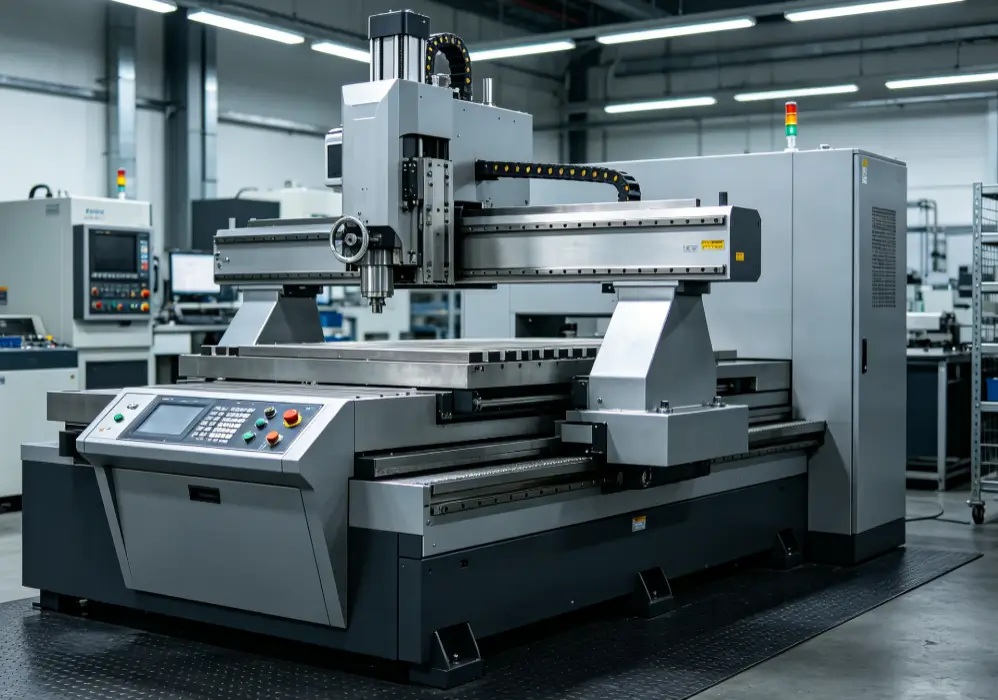
What are the clear tolerance limits for core acceptance indicators including spindle runout, axis perpendicularity and positioning accuracy? Will free re-calibration be offered if accuracy fails to meet standards before delivery?
Risk Reminder: For general vertical CNC milling machines, industry standards require spindle near-end runout ≤0.003mm and linear positioning accuracy ≤0.01mm/1000mm. Confirm the free rework cycle for unqualified accuracy, and clarify the buyer’s right to return goods if secondary re-inspection still fails.
Q3
Is standardized cutting sample acceptance included? What standard workpiece will be used for on-site cutting tests to verify actual machining precision?
Risk Reminder: No-load accuracy cannot represent real processing performance. Cutting sample inspection must be completed before final payment. Confirm surface roughness and dimensional tolerance standards matching your common processing materials such as aluminum alloy and steel.
Dimension 2: Machine Tool Rigidity Testing Methods (2 Questions – Solve Vibration & Tool Breakage in Heavy Cutting)
Rigidity determines machine service life and processing stability. Static rigidity tests are meaningless; dynamic cutting rigidity data serves as the core production reference.
Q4
Does this milling machine adopt static rigidity testing or dynamic cutting rigidity testing? What testing tools and full-process parameters will be used?
Risk Reminder: Most low-end suppliers only carry out static spindle load tests. Qualified manufacturers implement JB/T 8357.1 spindle static rigidity standards plus full-load dynamic vibration cutting tests to simulate real production conditions.
Q5
Under heavy cutting loads, what is the maximum allowable cutting depth and X/Y/Z axis vibration amplitude? Will the machine bed deform after long-term heavy cutting?
Risk Reminder: Request official heavy cutting test videos and original data reports. Mold and steel heavy processing manufacturers should focus on bed casting thickness and reinforcing rib layout to prevent accuracy attenuation after half a year of operation.
Dimension 3: After-Sales Service Commitment (3 Questions – Avoid Production Shutdown Losses)
Low-cost equipment without reliable after-sales support generates higher hidden costs. All after-sales indicators must be quantified and written into contracts without ambiguous wording.
Q6
What is the nationwide remote after-sales response time and on-site maintenance arrival time? What are the free warranty periods for the whole machine and core components respectively?
Risk Reminder: Clear time limits shall be stipulated: remote fault response within 2 hours, domestic on-site maintenance within 24–48 hours. Distinguish warranty terms for vulnerable parts (cutters, guide rail oil seals) and core components (spindle, servo motor, CNC system) to avoid after-sales prevarication.
Q7
Will free offline training on machine operation, programming and daily maintenance be provided for our operators? Is there a permanent online technical consultation channel?
Risk Reminder: Most procurement teams ignore operator training. Improper daily maintenance is the primary cause of premature machine failure. Confirm training frequency, duration and whether exclusive technical contact engineers will be assigned long-term.
Q8
How will equipment failures caused by long-term processing fatigue be resolved after the warranty expires? Are preferential long-term maintenance packages available for cooperative customers?
Risk Reminder: Clarify off-warranty labor fees and on-site service charges in advance to prevent arbitrary price hikes during breakdowns and lock long-term maintenance budgets.
Dimension 4: Spare Parts Supply Guarantee (2 Questions – Prevent Permanent Machine Shutdown)
Spare parts delivery cycles directly determine production line utilization. Avoid non-universal customized accessories unavailable on the open market.
Q9
Are core spare parts (spindle bearings, servo drivers, system motherboards, guide rail sliders) universal standard parts or exclusive customized parts? Can third-party compatible spare parts be used for replacement?
Risk Reminder: Prioritize equipment equipped with universal standard spare parts. If suppliers cease production or close down, universal accessories can be sourced globally to avoid machine scrapping. Reject fully customized closed-loop accessory schemes.
Q10
What is your company’s global spare parts delivery cycle and spot inventory status? How many years of continuous matching spare parts supply can you guarantee for this milling machine model?
Risk Reminder: Standard suppliers guarantee over 10 years of spare parts supply. Clarify delivery cycles: conventional vulnerable parts within 3 working days, core parts within 7 working days. Confirm overseas warehouse support for cross-border buyers to shorten logistics lead times.
3 Most Common Low-Level Procurement Pitfalls to Avoid
- Only compare unit prices and ignore acceptance clauses
Low-priced machines often cut costs on bed castings, guide rails and spindle rigidity. Ambiguous acceptance standards mean buyers cannot return defective equipment after receipt.
- Confuse no-load accuracy with actual cutting accuracy
High precision under empty running cannot guarantee stable processing results; cutting sample acceptance must be the final inspection standard.
- Rely on verbal after-sales promises without contractual constraints
All after-sales time limits, warranty scope and spare parts supply commitments must be attached as supplementary clauses to formal procurement contracts.
Conclusion
Successful CNC milling machine procurement does not depend on the lowest quotation, but full control over every technical detail and service clause. For first-time buyers and enterprises renewing equipment, these 10 standardized questions cover the entire workflow including factory testing, on-site acceptance, daily operation, post-warranty maintenance and spare parts replacement.
Before signing procurement contracts, send this unified questionnaire to all bidding suppliers, horizontally compare their response data, and screen qualified high-quality suppliers based on acceptance indicators and after-sales capacity. This completely eliminates procurement hidden risks and maximizes the ROI of factory automation equipment.
FAQ for CNC Milling Machine Procurement
Q1. What is the most critical indicator when purchasing a CNC milling machine?
Machine rigidity and formal cutting acceptance standards, rather than spindle speed or travel parameters. Rigidity determines long-term processing stability, while acceptance standards protect buyers’ legitimate rights and interests.
Q2. What is a reasonable warranty period for a CNC milling machine?
2-year full machine free warranty, and a recommended 3-year warranty for core components such as spindles and CNC systems, with unlimited lifelong remote technical support.
Q3. Is dynamic rigidity testing necessary for ordinary milling machines?
Yes. Static rigidity data cannot reflect vibration during actual metal cutting, so full-load dynamic cutting testing is a mandatory acceptance step.
 Email
Email sales1: +86 15312799623