



CNC Turning vs Lathe Machining: Precision, Applications, and Selection Guide
CNC turning and lathe machining are both methods of shaping materials, typically metals, through a rotating workpiece and cutting tool. CNC turning offers higher precision, automation, and flexibility compared to traditional lathe machining. While both processes are effective, CNC turning is preferred for complex and high-volume production runs.
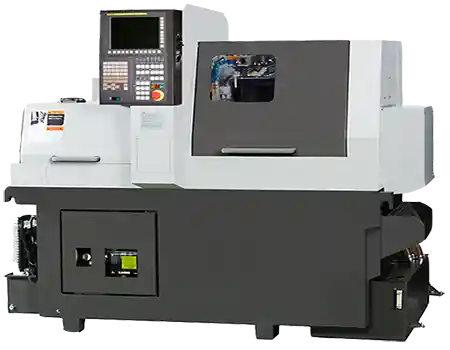
CNC Turning: Computer Numerical Control (CNC) turning is a manufacturing process that uses automated machines to rotate a workpiece against cutting tools to shape it. CNC turning machines are programmable and can execute highly precise operations, which makes them ideal for complex, repeatable parts.
Lathe Machining: Traditional lathe machining refers to manually operated or mechanically controlled turning processes, where a cutting tool is fed against a rotating workpiece to remove material. While it shares similarities with CNC turning, lathe machining generally requires more operator intervention and provides less automation.
Process Explanation
CNC Turning Process:
- Workpiece Setup: The workpiece is securely clamped onto the machine’s spindle or chuck.
- Programming: A CAD (Computer-Aided Design) model is converted into a G-code, which is used to control the CNC machine’s operations, including spindle speed, feed rate, and toolpath.
- Cutting: As the workpiece rotates, the cutting tool is brought into contact with the material to remove excess material in a precise manner, according to the programmed instructions.
- Finishing: CNC turning machines often include additional tools like boring bars, drills, and threads to achieve the final shape, including smooth finishes and intricate details.
Lathe Machining Process:
- Workpiece Setup: Similar to CNC turning, the workpiece is mounted on the lathe’s chuck or spindle.
- Manual or Mechanical Feed: Unlike CNC machines, lathe machining relies on manually or mechanically adjusting the cutting tool and workpiece to remove material.
- Cutting: The workpiece rotates, and a cutting tool is fed into the material to create the desired shape.
- Finishing: Lathe machining may require manual inspection and adjustments to ensure the desired precision.
Technical Specifications
| Feature | CNC Turning | Lathe Machining |
|---|---|---|
| Automation | Fully automated with G-code programming | Manual or semi-automated |
| Precision | High precision (±0.001 inches or better) | Lower precision (±0.005 inches or more) |
| Material | Can work with a variety of materials | Typically works with metals and plastics |
| Complexity | Suitable for complex, intricate shapes | Best for simple, less intricate designs |
| Setup Time | Faster due to pre-programming | Longer due to manual setup |
| Production Volume | Ideal for high-volume runs | Suitable for low to medium-volume runs |
| Cost | Higher initial cost, lower operating cost | Lower initial cost, higher labor cost |
Advantages and Disadvantages
CNC Turning Advantages:
- High Precision and Accuracy: CNC turning machines can create parts with high dimensional accuracy, which is essential for industries requiring fine tolerances such as aerospace and medical device manufacturing.
- Automation: Minimal human intervention reduces the risk of human error and increases repeatability in mass production.
- Complex Parts: CNC turning allows for intricate geometries, threads, and grooves that would be difficult or impossible to achieve with manual machining.
- Faster Setup and Production: Pre-programming speeds up the setup time and can quickly switch between production runs.
- Less Operator Skill Required: Once programmed, CNC machines can run autonomously, requiring less manual expertise compared to traditional lathes.
CNC Turning Disadvantages:
- High Initial Investment: The cost of CNC turning machines is significantly higher than manual lathes, which can be a barrier for small shops.
- Programming Time: While faster in the long run, the initial programming can take time, especially for complex parts.
- Maintenance Complexity: CNC machines have more electronic components that may require specialized maintenance.
Lathe Machining Advantages:
- Lower Initial Cost: Traditional lathes are less expensive, making them accessible for small businesses and shops with low budgets.
- Simplicity: The process is straightforward and can be done without the need for complex programming or CAD software.
- Flexibility for Simple Jobs: Ideal for creating simple, large quantities of cylindrical parts, such as rods or shafts.
Lathe Machining Disadvantages:
- Lower Precision: Manual adjustments lead to variations in part dimensions, especially for complex or intricate components.
- Labor-Intensive: More time and skill are required to operate the machine effectively.
- Increased Risk of Human Error: Manual intervention increases the risk of mistakes during setup and operation, especially in high-volume production.
- Limited Automation: Lacks the speed and efficiency of CNC machining, especially for mass production.
Industrial Applications
CNC Turning Applications:
- Aerospace: Precision parts such as turbine blades and fasteners.
- Medical Devices: Surgical instruments, implants, and custom prosthetics.
- Automotive: Engine components, transmission parts, and custom fittings.
- Defense: Manufacturing parts with exact specifications for military equipment.
Lathe Machining Applications:
- General Manufacturing: Simple cylindrical parts such as shafts, bushings, and sleeves.
- Small Shops: Used in low-volume production or prototyping where automation is not required.
- Toolmaking: Manufacturing of simple tools and fixtures that don’t require intricate geometries.
- Repair and Maintenance: Ideal for making replacements for worn-out parts in older machinery.
Comparison with Alternatives
CNC Turning vs CNC Milling:
- CNC milling uses a rotating cutting tool and is ideal for cutting materials from multiple sides, while CNC turning involves a rotating workpiece.
- CNC milling is better suited for 3D shapes, while CNC turning excels at cylindrical parts and simple geometries.
CNC Turning vs CNC Grinding:
- CNC grinding is used for high-precision finishing operations, particularly for hardened materials, while CNC turning is better for producing the bulk of the part.
- Grinding provides superior surface finishes, but turning is faster and more cost-effective for general shaping.
FAQ Section
1. What is the main difference between CNC turning and lathe machining?
CNC turning uses automated programming for precision and higher efficiency, while lathe machining relies on manual or mechanical controls, making it less precise and more labor-intensive.
2. Which method is best for high-volume production?
CNC turning is preferred for high-volume production due to its automation, precision, and ability to produce complex parts efficiently.
3. Can lathe machining be automated?
Yes, lathe machining can be semi-automated, but it still requires manual intervention for setting up and adjusting the cutting tools.
4. What materials can be processed with CNC turning and lathe machining?
Both methods can process a wide range of materials, including metals, plastics, and composites. CNC turning is often used for harder materials like titanium and high-strength alloys.
5. What industries benefit most from CNC turning?
CNC turning is widely used in industries such as aerospace, medical devices, automotive, and defense, where high precision and complex geometries are critical.
Conclusion
Both CNC turning and lathe machining are essential techniques in modern manufacturing, each suited to different applications. CNC turning offers superior precision, automation, and adaptability for complex and high-volume production, while traditional lathe machining remains valuable for simpler, low-volume projects where cost-effectiveness and simplicity are key. When choosing between the two, industrial engineers and procurement professionals must consider factors such as production volume, required precision, and the complexity of the parts being produced.
 Email
Email sales1: +86 15312799623